Relevance: GS Paper III – Environment | Climate Change | Oceanography | Disaster Management | Telangana Current Affairs
For Prelims:
INCOIS, Marine Heatwave, MAHAS, Arabian Sea, Sea Surface Temperature, Coral Bleaching, El Niño, Ocean Stratification, Blue Economy, Potential Fishing Zone, Tsunami Early Warning System, Ministry of Earth Sciences
For Mains:
Climate Change and Oceans, Marine Ecosystem Stress, Fisheries Sustainability, Coastal Vulnerability, Blue Economy, Ocean Governance, Early Warning Systems
Why in News?
The Indian National Centre for Ocean Information Services has reported marine heatwave conditions in the Arabian Sea, with sea surface temperatures exceeding normal limits and crossing the 90th percentile threshold. According to its MAHAS report, different regions are under Watch, Alert, and Warning categories, indicating varying levels of thermal stress. The warming is affecting areas such as the Andaman and Nicobar Islands, India’s eastern coast, and parts of the western coast extending towards Oman, raising concerns over marine ecosystems, fisheries, and coral health.
INCOIS
- The Indian National Centre for Ocean Information Services (INCOIS) is an autonomous scientific institution under the Ministry of Earth Sciences.
- It is located in Hyderabad, Telangana, an important prelims fact because despite dealing entirely with marine and ocean sciences, it is situated in a landlocked inland city.
- It serves as India’s central operational oceanographic institution and provides scientific ocean information and advisory services for fishermen, shipping and maritime navigation, coastal zone management, offshore industries, disaster management authorities, and defence-related maritime operations.
- INCOIS collects data through satellites, ocean buoys, research vessels, underwater sensors, bottom pressure recorders, and real-time forecasting models.
Its major functions include:
- Ocean State Forecasting – It predicts waves, tides, ocean currents, sea surface temperature, and storm surges, which are important for ports, coastal safety, and offshore operations.
- Tsunami Early Warning Centre – INCOIS operates India’s Tsunami Early Warning System for the Indian Ocean Region using seismic and ocean observation networks.
- Potential Fishing Zone (PFZ) Advisory – It identifies areas where fish are likely to aggregate using satellite indicators like chlorophyll concentration and thermal gradients. This helps improve catch efficiency and reduces fuel costs for fishermen.
- Marine Heatwave Advisory Services (MAHAS) – This specialised system monitors sea surface temperature anomalies and provides early warning for marine heatwaves. The present Arabian Sea warning has been issued through this system.
Marine Heatwave: Meaning and Scientific Basis
- A Marine Heatwave is a prolonged period of unusually high ocean temperature in a specific marine region.
- It is not a temporary rise in temperature for one or two days. It is a sustained thermal stress event that affects the functioning of the marine ecosystem. Scientifically, a Marine Heatwave is defined as:
when sea surface temperature remains above the 90th percentile of historical climatological values for at least five consecutive days.
Let us understand this clearly.
Suppose the normal sea temperature of a region during April is based on long-term historical records. If the current sea temperature remains unusually higher than what is observed in 90% of past years, and this condition continues for at least five days, it is classified as a Marine Heatwave.
This makes it different from normal summer warming. It represents persistent abnormal warming and not just seasonal heat. Marine heatwaves are now increasing in frequency, duration, and intensity because of climate change. Earlier they were rare events. Now they are becoming recurring oceanic climate disturbances.
Classification of Marine Heatwaves
Category | Meaning | Impact |
Watch | Initial stage where unusual warming begins and early signs of thermal stress appear | Treated as an advance warning |
Alert | Stronger and more persistent warming conditions | Marine ecosystems begin to experience visible stress; fish productivity and coral health may start getting affected |
Warning | Most serious category with severe and prolonged heat stress | Causes major ecological disruption such as coral bleaching, fish migration shifts, and reduction in ocean productivity |
Causes of Marine Heatwaves
Cause | Explanation |
Global Warming | The long-term rise in Earth’s average temperature due to greenhouse gas emissions is the biggest reason behind rising ocean temperatures. Oceans absorb more than 90% of excess atmospheric heat, making them major heat reservoirs. |
El Niño Events | El Niño alters global atmospheric circulation and weakens normal oceanic cooling systems, leading to widespread abnormal ocean warming. |
Weak Monsoon Winds | Normally, strong winds help vertical mixing of ocean layers and bring cooler water upward. When monsoon winds weaken, this mixing reduces and heat gets trapped near the surface. |
Ocean Stratification | When warm water remains at the top and cooler water stays below without proper mixing, heat accumulates at the surface. This is called stratification and it increases marine heatwave intensity. |
Changes in Ocean Currents | Warm ocean currents can transport higher temperatures into new regions, intensifying local marine heatwaves. This is particularly important in the Arabian Sea. |
Arabian Sea Warming and Indian Ocean Context
- The Arabian Sea is warming faster than many other tropical ocean regions and has emerged as a major hotspot of marine heatwaves in the northern Indian Ocean.
- It lies to the west of India and is bounded by India, Pakistan, Iran, Oman, Yemen, Somalia, and the Maldives. It connects to the Red Sea through the Gulf of Aden and to the Persian Gulf through the Gulf of Oman and the Strait of Hormuz.
- Compared to the Bay of Bengal, the Arabian Sea was traditionally considered less cyclone-prone due to relatively cooler waters and stronger vertical wind shear.
- However, in recent years, rising Sea Surface Temperature (SST) has increased the frequency and intensity of cyclones in the Arabian Sea.
Examples include Cyclones Tauktae, Nisarga, Biparjoy, and Tej, which showed unusually high intensity.
This warming directly affects:
- Southwest Monsoon behaviour
- Cyclone formation and rapid intensification
- Coral reefs and marine biodiversity
- Fisheries productivity, especially tuna and deep-sea species
- Coastal livelihoods and maritime economy
- The Arabian Sea also plays an important role in the Indian Monsoon system because warm SST enhances moisture supply for monsoon winds.
- Marine heatwaves in this region are now spreading along India’s western coast, towards Oman, the southern Indian Ocean, Mauritius, South Africa, and Western Australia, indicating a broader Indian Ocean warming pattern rather than an isolated regional event.
- This is important for prelims because increasing Arabian Sea warming is directly linked to climate change, monsoon variability, stronger cyclones, and marine ecosystem stress.
CARE MCQ
Q. With reference to Marine Heatwaves, consider the following statements:
- Marine heatwaves are periods of abnormally high sea surface temperature persisting for several days or weeks.
- Marine heatwaves improve coral reef health and increase fish productivity in affected regions.
- The Arabian Sea has witnessed a rise in marine heatwave events in recent years.
Which of the statements given above are correct?
(a) 1 and 3 only
(b) 2 and 3 only
(c) 1 and 2 only
(d) 1, 2 and 3
Answer: (a) 1 and 3 only
Explanation
Statement 1: Correct
Marine heatwaves occur when sea surface temperatures remain significantly above normal for an extended period. They are the oceanic equivalent of heatwaves on land.
Statement 2: Incorrect
Marine heatwaves damage coral reefs through bleaching, reduce fish availability, disturb marine food chains, and negatively affect fisheries.
Statement 3: Correct
The Arabian Sea has become more vulnerable to marine heatwaves because of rising sea surface temperatures, which also contribute to stronger cyclones and ecosystem stress.
Q.With reference to Marine Heatwaves (MHWs), consider the following statements:
- Marine heatwaves are primarily identified on the basis of prolonged abnormal rise in sea surface temperature.
- Marine heatwaves can increase the intensity of tropical cyclones by providing additional heat energy.
- The Bay of Bengal experiences marine heatwaves, while the Arabian Sea remains largely unaffected due to its deeper waters.
Which of the statements given above are correct?
(a) 1 and 2 only
(b) 2 and 3 only
(c) 1 and 3 only
(d) 1, 2 and 3
Answer: (a) 1 and 2 only
Statement 1: Correct
Marine heatwaves are defined as periods of unusually high sea surface temperatures that persist for several days or weeks in a specific marine region.
Statement 2: Correct
Warmer sea surfaces provide more latent heat energy, which can strengthen tropical cyclones and support rapid intensification.
Statement 3: Incorrect
The Arabian Sea has also emerged as a major hotspot of marine heatwaves in recent years. In fact, increasing sea surface temperatures in the Arabian Sea have contributed to stronger cyclones and ecological stress.
Q. With reference to Marine Heatwaves, consider the following statements:
- A Marine Heatwave occurs when sea surface temperature remains above the 90th percentile of historical values for at least five consecutive days.
- The Indian National Centre for Ocean Information Services (INCOIS) functions under the Ministry of Environment, Forest and Climate Change.
- Marine Heatwave Advisory Services (MAHAS) is operated by INCOIS from Hyderabad.
Which of the statements given above are correct?
(a) 1 and 3 only
(b) 2 and 3 only
(c) 1 and 2 only
(d) 1, 2 and 3
Answer: (a) 1 and 3 only
Statement 1: Correct
A Marine Heatwave is scientifically defined as a period when sea surface temperature remains above the 90th percentile of historical observations for at least five consecutive days. It represents an unusually prolonged warming event in the ocean.
Statement 2: Incorrect
INCOIS functions under the Ministry of Earth Sciences (MoES), not under the Ministry of Environment, Forest and Climate Change. It is India’s premier institution for ocean information and advisory services.
Statement 3: Correct
Marine Heatwave Advisory Services (MAHAS) is a specialised system operated by INCOIS for monitoring sea surface temperature anomalies and issuing early warnings for marine heatwaves. INCOIS is headquartered in Hyderabad, Telangana.
Therefore, the correct answer is (a) 1 and 3 only.
Q.Sea Surface Temperature (SST) refers to:
(a) Temperature of water at the ocean floor
(b) Temperature of the uppermost layer of the ocean
(c) Temperature of underground seawater reserves
(d) Temperature of ocean currents below 500 metres
Answer: (b) Temperature of the uppermost layer of the ocean
Explanation:
Sea Surface Temperature (SST) is the temperature of the top layer of ocean water, which directly interacts with the atmosphere and plays an important role in monsoon formation, cyclone intensity, and marine heatwaves.
TGPSC Mains Question
Q. Rising marine heatwaves are emerging as a major threat to India’s blue economy and coastal sustainability. Discuss.
(250 words)
FAQs
Q1. What is the minimum duration for a Marine Heatwave?
At least five consecutive days.
Q2. Which institution monitors Marine Heatwaves in India?
INCOIS through its Marine Heatwave Advisory Services (MAHAS).
Q3. Where is INCOIS located?
It is located in Hyderabad, Telangana.
Q4. Why is Arabian Sea warming important?
Because it affects fisheries, cyclones, coral reefs, and the Indian monsoon system.
Q5. Why is this important for Telangana exams?
Because INCOIS is one of India’s most important scientific institutions located in Hyderabad.
Relevance: GS Paper III – Environment | Climate Change | Disaster Management | Sustainable Development
For Prelims:
Climate Adaptation, Nationally Determined Contributions (NDCs), Paris Agreement, COP30, UNEP Adaptation Gap Report, Climate Resilient Villages (CRV), NICRA, SAPCC, NAPCC, Locally Led Adaptation (LLA), Climate Finance, Vulnerability Assessment
For Mains:
climate resilience, adaptation finance, disaster preparedness, local governance, sustainable development, climate justice, livelihood security, community participation, vulnerability reduction, resilient infrastructure
Why in News?
India is facing increasing climate-related disasters and economic losses due to floods, droughts, cyclones, heatwaves, and erratic monsoons.
The Economic Survey 2025–26 highlighted Tamil Nadu’s Climate Resilient Villages (CRV) Programme as a model for scaling climate adaptation from policy to grassroots implementation.
India has suffered nearly $170 billion in losses from 430 extreme weather events between 1995 and 2024, affecting nearly 1.3 billion people.This has brought adaptation planning to the centre of national development strategy.
What is Climate Adaptation?
- Climate adaptation refers to adjustments in natural or human systems in response to actual or expected climatic stimuli, so as to moderate harm or exploit beneficial opportunities.
- It is one of the two key strategies under climate action, the other being climate mitigation (reduction of greenhouse gas emissions).
- Adaptation is necessary because climate change impacts are already occurring and unavoidable due to past emissions.
- It includes anticipatory (planned) and reactive (after impact) measures.
- It can be autonomous (natural/system-driven) or planned (policy-driven).
Major sectors involved:
- Agriculture (crop diversification, drought-resistant varieties)
- Water resources (rainwater harvesting, efficient irrigation)
- Coastal areas (sea walls, mangrove restoration)
- Urban planning (heat-resilient infrastructure, drainage systems)
- Health (disease surveillance, heat action plans)
- It is strongly linked with the concept of resilience, i.e., the capacity to absorb shocks and recover.
- Global recognition under international frameworks:
- Paris Agreement includes a Global Goal on Adaptation
- United Nations Framework Convention on Climate Change emphasizes adaptation planning
India’s Climate Vulnerability Situation
- India is among the most climate-vulnerable countries globally and ranks 9th in global climate risk.
- As per Germanwatch (Climate Risk Index):
- 1995–2024 period:
- ~430 extreme weather events recorded
- ~$170 billion economic losses
- ~1.3 billion people affected cumulatively
Structural Reasons for High Vulnerability
- Large population base dependent on climate-sensitive sectors
- Monsoon-dependent agriculture → high rainfall variability risk
- Limited freshwater availability (≈4% of global resources)
- High poverty and regional inequality → low adaptive capacity
- Rapid urbanization without adequate climate-resilient infrastructure
Major Vulnerable Sectors
- Agriculture: Highly sensitive to rainfall variability, heat stress
- Water resources: Groundwater depletion + erratic monsoon
- Coastal zones: Cyclones, storm surges, sea-level rise
- Urban settlements: Flooding, urban heat island effect
- Public health: Heatwaves, vector-borne diseases
- Energy systems: Demand stress (cooling needs), hydro-power variability
Nationally Determined Contributions (NDCs) and Adaptation
- Nationally Determined Contributions (NDCs) are climate action plans submitted by countries under the Paris Agreement.
- NDCs are country-specific, periodically updated commitments aimed at achieving global climate goals.
Components of NDCs
- Mitigation targets (emission reduction, renewable energy expansion)
- Adaptation strategies (coping with climate impacts)
- Resilience building measures
- Climate finance requirements and priorities
Major Adaptation Focus Areas in India’s NDCs
- Coastal resilience: Protection against sea-level rise and cyclones
- Climate-resilient infrastructure: Disaster-proof roads, buildings, and utilities
- Disaster preparedness: Early warning systems, risk reduction strategies
- Agriculture resilience: Climate-smart farming, drought-resistant crops
- Ecosystem restoration: Forests, mangroves, wetlands
- Community-based adaptation: Local participation and indigenous practices
Tamil Nadu’s Climate Resilient Villages (CRV) Programme
- Tamil Nadu’s Climate Resilient Villages Programme is now considered one of India’s best adaptation models.
- It operates across 11 vulnerable districts and adopts a holistic village-level climate resilience strategy.
- Supported by WRI India, the programme focuses on:
- water conservation
- drought mitigation
- flood prevention
- renewable energy adoption
- livelihood diversification
- local ecosystem restoration
- disaster preparedness planning
- Instead of isolated schemes, it treats the village as a complete climate unit.
- This place-based approach improves long-term resilience and community ownership.
- That is why the Economic Survey highlighted it as a model for national replication.
Role of NICRA in Climate Adaptation
- NICRA stands for National Innovations in Climate Resilient Agriculture.
- It is implemented by the Indian Council of Agricultural Research (ICAR).
- Its objective is to make Indian agriculture climate-resilient through scientific planning and farmer participation.
NICRA covers 651 districts and focuses on:
- climate risk mapping
- drought management
- flood adaptation
- heat stress reduction
- resilient crop varieties
- livestock protection
- farmer capacity-building
Since agriculture remains the most climate-sensitive sector in India, NICRA is critical for food security and rural stability.
Adaptation Finance Gap
- Climate adaptation requires large and sustained financial investment.
- The UNEP Adaptation Gap Report 2025 estimates that developing countries face an annual financing gap of $284–339 billion up to 2035.
- India’s Economic Survey estimates adaptation spending at nearly 5.6% of GDP in FY22.
- However, the Union Budget 2026–27 remains heavily tilted toward mitigation rather than adaptation.
This creates a major imbalance.
Adaptation projects often struggle because:
- benefits are difficult to quantify
- returns are long-term
- private investment remains low
- adaptation lacks dedicated financial classification
A WRI study estimates that every rupee invested in adaptation can generate nearly ten times return by preventing avoidable losses.
State Action Plans on Climate Change (SAPCCs)
- SAPCCs are State Action Plans on Climate Change.
- They are state-level climate blueprints aligned with the National Action Plan on Climate Change (NAPCC).
- These plans are designed according to local ecological and socio-economic conditions.
Their objectives include:
- adaptation planning
- mitigation strategy
- mainstreaming climate concerns into development
- institutional coordination
- local capacity-building
- Currently, 34 States and UTs have prepared SAPCCs.
- However, many require revision because climate risks are intensifying rapidly.
- Delhi, for example, is revising its SAPCC due to worsening heatwaves and extreme rainfall events.
- Effective adaptation requires these plans to move from documents to actual governance tools.
Challenges in Grassroots Climate Adaptation
- Many adaptation plans remain policy documents without local implementation.
- There is often weak coordination between departments handling water, agriculture, disaster management, and urban planning.
- Climate vulnerability assessments are not updated regularly, reducing planning quality.
- Local governments often lack trained personnel and technical capacity.
- Adaptation finance is poorly tracked and often mixed with general development expenditure.
- Community participation remains weak in many states, despite adaptation being most effective when locally designed.
- Private sector participation is also limited because adaptation outcomes are less directly profitable than mitigation projects.
- This creates a major implementation gap.
Locally Led Adaptation (LLA)
- COP30 strongly emphasized Locally Led Adaptation.
- This means resilience planning should be co-developed with communities rather than imposed from the top.
It includes:
- village-level planning
- local knowledge integration
- women’s participation
- tribal ecological practices
- livelihood redesign
- skill development
- rehabilitation frameworks
Way Forward
India must create a clear national adaptation finance framework separate from mitigation budgeting. Regular climate vulnerability assessments should be institutionalized at district and block levels.
Climate cells at State and district levels must be strengthened with dedicated workforce and technical expertise. Schemes like MGNREGA, Jal Jeevan Mission, PMKSY, and Smart Cities should be integrated with adaptation goals.
Adaptation benefits such as avoided losses, health gains, and livelihood security should be quantified to attract private and international finance.
Conclusion
India’s climate challenge is no longer about future risk—it is a present governance crisis.
With rising losses, increasing vulnerability, and widening adaptation finance gaps, climate resilience must become central to development planning.
Tamil Nadu’s Climate Resilient Villages Programme shows that successful adaptation happens when policy reaches the grassroots.
The future of climate governance will depend not on how many policies are written, but on how deeply resilience is built into everyday life.
CARE MCQ
Q.With reference to the Adaptation Gap Report, consider the following statements:
- It is released annually by the United Nations Environment Programme.
- It assesses the gap between adaptation needs and the actual efforts taken to address climate change impacts.
- It deals with mitigation finance and carbon market mechanisms under Article 6 of the Paris Agreement.
Which of the statements given above are correct?
(a) 1 and 2 only
(b) 2 and 3 only
(c) 1 and 3 only
(d) 1, 2 and 3
Answer: (a) 1 and 2 only
Explanation:
- Statement 1 is correct: The Adaptation Gap Report is published annually by the United Nations Environment Programme.
- Statement 2 is correct: It examines the difference between adaptation requirements and the actual adaptation actions taken worldwide.
- Statement 3 is incorrect: Mitigation finance and carbon market mechanisms relate to emission reduction efforts, not to the Adaptation Gap Report.
Q.With reference to the Paris Agreement, consider the following statements:
- It was adopted during COP21 in 2015 under the United Nations Framework Convention on Climate Change.
- It aims to limit the global temperature increase to well below 2°C above pre-industrial levels while pursuing efforts to limit it to 1.5°C.
- It makes legally binding emission reduction targets mandatory for all developing countries.
Which of the statements given above are correct?
(a) 1 and 2 only
(b) 2 and 3 only
(c) 1 and 3 only
(d) 1, 2 and 3
Answer: (a) 1 and 2 only
Explanation:
- Statement 1 is correct: The Paris Agreement was adopted in 2015 during COP21 held in Paris under the United Nations Framework Convention on Climate Change.
- Statement 2 is correct: Its goal is to keep global temperature rise well below 2°C and preferably limit it to 1.5°C above pre-industrial levels.
- Statement 3 is incorrect: The Agreement does not impose legally binding emission reduction targets on all developing countries; countries submit voluntary Nationally Determined Contributions (NDCs).
Q.With reference to climate adaptation in India, consider the following statements:
- Nationally Determined Contributions (NDCs) include both mitigation and adaptation commitments.
- NICRA is implemented by the Ministry of Environment, Forest and Climate Change.
- Tamil Nadu’s Climate Resilient Villages Programme was highlighted in the Economic Survey 2025–26.
Which of the statements given above are correct?
(a) 1 and 3 only
(b) 2 and 3 only
(c) 1 and 2 only
(d) 1, 2 and 3
Answer: (a) 1 and 3 only
Explanation:
- Statement 1 is correct: Nationally Determined Contributions (NDCs) under the Paris Agreement include both mitigation and adaptation measures to address climate change.
- Statement 2 is incorrect: NICRA (National Innovations in Climate Resilient Agriculture) is implemented by the Indian Council of Agricultural Research, not by the Ministry of Environment, Forest and Climate Change.
- Statement 3 is correct: Tamil Nadu’s Climate Resilient Villages Programme was specifically highlighted in the Economic Survey 2025–26 as a model for climate adaptation at the grassroots level.
FAQs
Q1. What is climate adaptation?
Climate adaptation means adjusting systems and communities to reduce damage caused by climate change.
Q2. What is the difference between mitigation and adaptation?
Mitigation reduces emissions causing climate change, while adaptation reduces vulnerability to climate impacts.
Q3. What is NICRA?
NICRA stands for National Innovations in Climate Resilient Agriculture, implemented by ICAR for climate-smart farming.
Q4. What are SAPCCs?
SAPCCs are State Action Plans on Climate Change that guide state-level adaptation and mitigation efforts.
Q5. Why is Tamil Nadu’s CRV Programme important?
It provides a successful grassroots model of locally led climate adaptation that can be replicated nationally.
Relevance: GS Paper II – International Relations | India and Africa | Global South | South-South Cooperation
For Prelims:
India-Africa Forum Summit (IAFS), African Union (AU), Global South, Line of Credit (LoC), Indian Technical and Economic Cooperation (ITEC), Pan-African e-Network, EXIM Bank, Indian Diaspora, Development Partnership Administration (DPA), SAGAR, MAHASAGAR
For Mains:
strategic autonomy, South-South cooperation, maritime security, development partnership, capacity building, food security, energy security, diplomatic outreach, multipolarity, Global South leadership
Why in News?
- strategic autonomy, South-South cooperation, maritime security, development partnership, capacity building, food security, energy security, diplomatic outreach, multipolarity, Global South leadership
Historical Foundation of India-Africa Relations
- Contacts between India and Africa date back to ancient times through Indian Ocean maritime trade.
- Monsoon wind system enabled predictable navigation between western Indian ports and the East African (Swahili) coast.
- Trade exchange included:
- India → textiles, beads, spices
- Africa → gold, ivory, and other raw materials
- Indian merchant communities settled in East Africa (e.g., coastal regions of present-day Kenya, Tanzania).
- In the medieval period, trade expanded further through Arab intermediaries, integrating India–Africa links into a wider Indian Ocean commercial network.
- Resulted in cultural diffusion, including language influences, food habits, and commercial practices along the Swahili coast.
Anti-Colonial Solidarity and Post-Independence Cooperation
- Common struggle against colonialism strengthened political ties between India and African nations.
- Mahatma Gandhi’s experiences in South Africa deeply influenced India’s freedom movement and symbolized India–Africa connection.
- India actively supported African liberation movements and opposed apartheid at global forums.
- Bandung Conference marked the beginning of structured Afro-Asian solidarity.
- Both India and African countries became key members of the Non-Aligned Movement, emphasizing:
- Anti-colonialism
- Racial equality
- South–South cooperation
- This phase laid the foundation of modern India–Africa relations, based on political solidarity, mutual respect, and developmental partnership.
India-Africa Forum Summit (IAFS-IV)
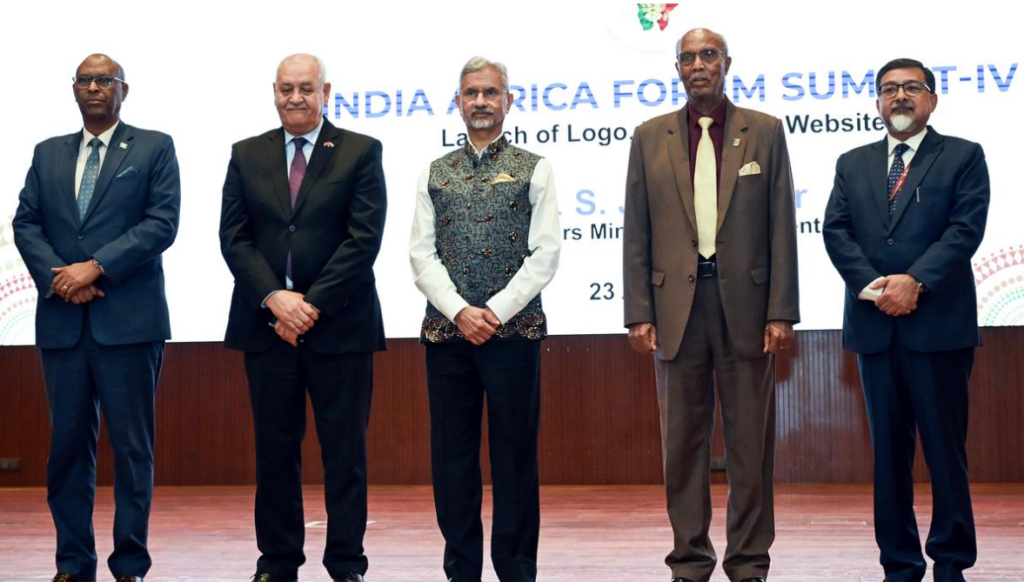
- The India-Africa Forum Summit is the highest institutional mechanism for engagement between India and African countries.
- It serves as the main platform for political dialogue, economic cooperation, and strategic partnership.
- The fourth summit in 2026 is highly significant because it is being held after more than a decade, making it an important opportunity to reset and deepen the relationship.
- The summit will focus on major areas such as trade, healthcare, digital cooperation, food security, maritime security, education, technology transfer, and green development
- India wants the summit to move the relationship from a donor-recipient model toward a partnership of equals based on shared development goals.
Strategic Importance of Africa for India
- Africa is resource-rich: crude oil, natural gas, gold, diamonds, cobalt, lithium → critical for India’s energy and industrial needs.
- Around 15–20% of India’s crude oil imports come from African countries (e.g., Nigeria, Angola).
- Africa is a growing export market for Indian goods: pharmaceuticals, automobiles, textiles, engineering products.
- India is among the top investors in Africa in sectors like telecom, mining, infrastructure, and agriculture.
- Potential for food security cooperation through land availability and agricultural partnerships.
- Africa lies along key Sea Lines of Communication (SLOCs) in the Indian Ocean, crucial for India’s trade and energy flows.
- Eastern African coast is strategically located near major chokepoints:
- Strait of Hormuz
- Bab-el-Mandeb
- Ensures maritime security cooperation (anti-piracy operations, naval presence).
- Africa is central to India’s vision of SAGAR (Security and Growth for All in the Region).
- Counterbalance to growing influence of external powers, especially China, in Africa.
Energy, Fertilizer and Resource Security
- Africa is a major source of hydrocarbons; countries like Nigeria and Angola supply a significant share (≈15–20%) of India’s crude oil imports.
- Availability of natural gas reserves (e.g., Mozambique, Tanzania) supports India’s diversification of energy sources, including LNG imports.
- Rich deposits of critical minerals such as cobalt (DRC), lithium, manganese, and rare earths are essential for renewable energy, batteries, and electronics industries in India.
- Africa holds large reserves of phosphates (Morocco) and potash, crucial for India’s fertilizer security and agricultural productivity.
- India has invested in fertilizer projects and long-term supply agreements in African countries to reduce import dependence.
- Africa’s untapped renewable energy potential (solar, wind) provides scope for collaboration in clean energy transition.
- Ensures diversification of supply chains, reducing overdependence on West Asia and other regions.
- Resource cooperation supports India’s goals of energy security, food security, and industrial growth
Diplomatic Expansion and Institutional Presence
- India has significantly expanded its diplomatic footprint across Africa in recent years.
- India now has 46 diplomatic missions covering all regions of the African continent.
- Since 2018, several new embassies and consulates have been opened to improve political engagement and faster execution of development projects.
- A stronger diplomatic presence helps in trade promotion, protection of Indian citizens, support for Indian businesses, development cooperation, and strategic coordination during crises.
- Diplomatic presence is not only symbolic—it is necessary for sustained and effective foreign policy implementation.
Challenges in India-Africa Relations
- Despite strong goodwill, India faces several challenges in deepening its relationship with Africa. China has a much larger economic presence through infrastructure financing, mining investments, and Belt and Road projects.
- India often faces delays in implementing projects under Lines of Credit due to administrative bottlenecks and financing issues. This affects credibility and speed.
- Trade volume between India and Africa is still lower than its actual potential. Private sector participation from India also remains limited in many strategic sectors.
- Political instability, military coups, terrorism, and civil conflicts in some African countries create additional uncertainty for long-term investments.
- Competition from China, the United States, the European Union, Turkey, and Gulf countries makes strategic engagement more complex.
India vs China in Africa
- China is Africa’s largest trading partner, while India is among the top trading partners but far behind China in volume.
- China follows a state-driven, infrastructure-led model (railways, ports, highways), whereas India follows a demand-driven, partnership-based approach focusing on local needs.
- China provides large-scale loans and finance (often tied to projects); India provides Lines of Credit (LoCs) on concessional and transparent terms.
- China aggressively secures energy and mineral resources through long-term contracts and ownership; India adopts a diversified and less aggressive resource strategy.
Way Forward
India must convert historical goodwill into stronger economic and strategic outcomes. Project execution under Lines of Credit must become faster and more transparent.
Trade agreements and investment partnerships should be expanded, especially in pharmaceuticals, digital public infrastructure, renewable energy, food security, and critical minerals.
Conclusion
India-Africa relations are no longer limited to diplomacy—they are central to India’s strategic autonomy, economic security, and leadership in the Global South.
In a world affected by sanctions, wars, supply disruptions, and geopolitical rivalry, Africa offers India both stability and long-term partnership.
CARE MCQ
Q.With reference to India–Africa relations, consider the following statements:
- The India–Africa Forum Summit is the official platform for cooperation between India and African countries.
- India is a member of the African Union.
- India provides Lines of Credit and capacity-building support to African nations under its development partnership programme.
Which of the statements given above are correct?
(a) 1 and 3 only
(b) 2 and 3 only
(c) 1 and 2 only
(d) 1, 2 and 3
Answer: (a) 1 and 3 only
Explanation:
- Statement 1 is correct: The India–Africa Forum Summit serves as the formal platform for political, economic, and strategic cooperation between India and African countries.
- Statement 2 is incorrect: India is not a member of the African Union; it is a continental organization of African states.
- Statement 3 is correct: India extends Lines of Credit, grants, and capacity-building support to African countries as part of its development partnership and South-South cooperation policy.
Q.With reference to India–Africa trade relations, consider the following statements:
- Africa is one of India’s major partners for crude oil and natural gas imports.
- India has signed a continent-wide Free Trade Agreement with the African Union.
- India is among the top five trading partners of Africa.
Which of the statements given above are correct?
(a) 1 and 3 only
(b) 2 and 3 only
(c) 1 and 2 only
(d) 1, 2 and 3
Answer: (a) 1 and 3 only
Explanation:
- Statement 1 is correct: Africa plays an important role in India’s energy security. Countries such as Nigeria, Angola, Algeria, and Libya have been major suppliers of crude oil and natural gas to India. India imports a significant share of its petroleum requirements from African nations, making the continent an important trade and strategic partner in the energy sector.
- Statement 2 is incorrect: India has not entered into a continent-wide Free Trade Agreement with the African Union. Trade relations are mainly conducted through bilateral agreements with individual African countries and through broader cooperation platforms like the India–Africa Forum Summit. The African Continental Free Trade Area (AfCFTA) is an African initiative and India is not a part of it.
- Statement 3 is correct: India is among the leading trading partners of Africa, along with countries such as China, the United States, and the European Union. India exports pharmaceuticals, machinery, automobiles, textiles, and manufactured goods to Africa, while importing crude oil, gold, phosphates, and other raw materials. This makes India one of Africa’s top five trade partners.
Q. With reference to India’s development cooperation with Africa, consider the following statements:
- The Pan-African e-Network Project was launched to provide tele-education and telemedicine services.
- The project was implemented by the Indian Space Research Organisation alone without involvement of any other institution.
- India offers scholarships and training programmes for African students and professionals under ITEC.
Which of the statements given above are correct?
(a) 1 and 3 only
(b) 2 and 3 only
(c) 1 and 2 only
(d) 1, 2 and 3
Answer: (a) 1 and 3 only
Explanation:
- Statement 1 is correct: The Pan-African e-Network Project was launched by India in 2009 to connect African countries with Indian universities and hospitals through satellite and fibre-optic technology. Its purpose was to provide tele-education, telemedicine, e-governance, and capacity-building support, strengthening India’s development partnership with Africa.
- Statement 2 is incorrect: The project was not implemented by Indian Space Research Organisation alone. It involved multiple institutions, including TCIL (Telecommunications Consultants India Limited), Indian universities, and super-specialty hospitals. ISRO provided satellite support, but the project was a collaborative initiative involving several agencies.
- Statement 3 is correct: Under the Indian Technical and Economic Cooperation (ITEC) programme, India provides scholarships, training courses, skill development, and professional capacity-building programmes for students, civil servants, defence personnel, and professionals from African countries. This reflects India’s emphasis on human resource development and South-South cooperation.
FAQs
Q1. What is IAFS?
IAFS stands for India-Africa Forum Summit, which is the highest political and institutional platform for cooperation between India and African countries.
Q2. Why is Africa important for India?
Africa is important for India because of energy security, fertilizer supply, strategic minerals, trade expansion, maritime security, and Global South diplomacy.
Q3. What is India’s biggest strength in Africa?
India’s biggest strength is historical trust created through anti-colonial solidarity, development partnership, and people-centric cooperation.
Q4. How does India differ from China in Africa?
India focuses more on human development and institutional capacity-building, while China focuses more on infrastructure financing and strategic capital investments.
Q5. Why is the Indian diaspora important in Africa?
The Indian diaspora acts as a living bridge by strengthening trade, cultural trust, long-term partnerships, and India’s soft power influence.