Table of Contents
Relevance: : GS Paper II – Polity | Federalism | Regional Parties | Political Parties | State Reorganisation.
For Prelims:
Bharat Rashtra Samithi (BRS), Telangana Rashtra Samithi (TRS), Article 3, Andhra Pradesh Reorganisation Act 2014, State Reorganisation, Tenth Schedule, Anti-Defection Law, Section 29A of RPA 1951, Election Symbols Order 1968
For Mains:
Regionalism, Federalism, Statehood Movements, Role of Regional Parties, Constitutional Position of Political Parties, Cooperative Federalism.
Why in News?
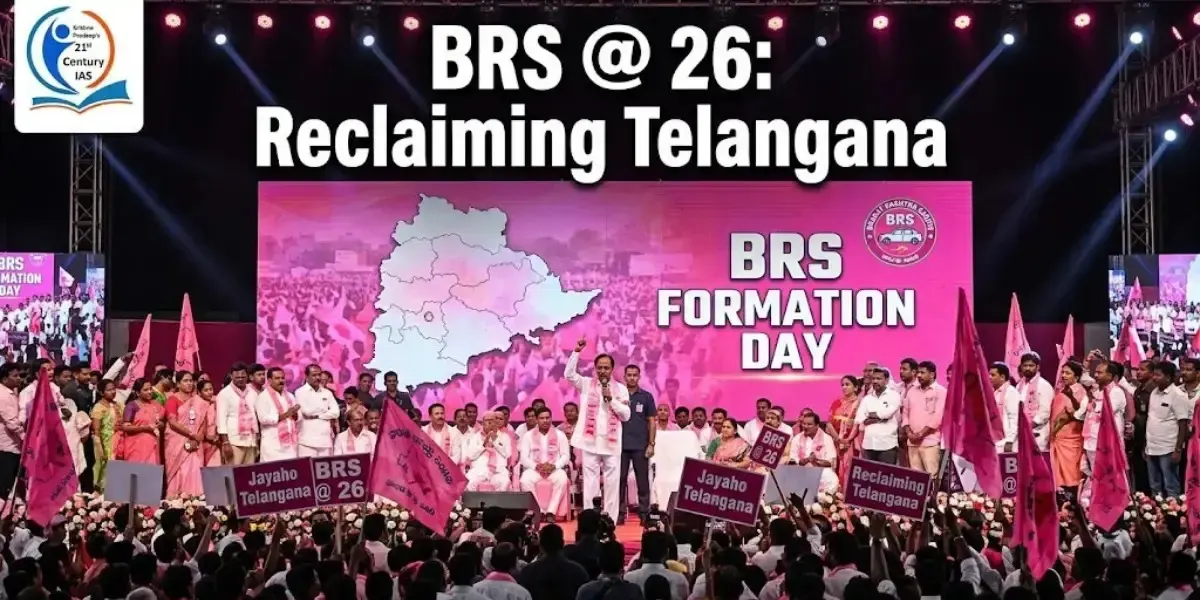
- Bharat Rashtra Samithi is observing its 26th Formation Day while attempting to rebuild its political base after losing power in Telangana following a decade of governance from 2014 to 2023.
- The party, originally founded as Telangana Rashtra Samithi (TRS), is now trying to shift from a leader-centric structure to a cadre-driven organisation and promote a new political narrative of “Reclaiming Telangana.”
- This development brings attention to two important constitutional themes: the formation of Telangana as a separate state and the constitutional position of political parties in Indian democracy.
Formation of Telangana: Historical and Constitutional Background
Formation of Telangana
- Telangana became the 29th State of India on 2 June 2014 after the bifurcation of the erstwhile Andhra Pradesh through the Andhra Pradesh Reorganisation Act, 2014.
- It was formed under Article 3 of the Constitution of India, which gives Parliament the power to create new states, alter boundaries, and change the names of existing states.
This issue becomes important in current affairs whenever regional parties like Bharat Rashtra Samithi (BRS) raise the narrative of “Telangana identity” and “reclaiming Telangana.”
Historical Background
- Before Independence, the Telangana region was part of the princely State of Hyderabad ruled by the Nizam.
- Unlike Coastal Andhra and Rayalaseema, Telangana was under princely administration and had a different political, administrative, and land system.
- After Independence, Hyderabad did not immediately join India. It was integrated into the Indian Union through Operation Polo (Police Action) in 1948.
- After this, Hyderabad became a Part B State, and Telangana remained within Hyderabad State.
Merger with Andhra (1956)
- In 1953, Andhra State was created for Telugu-speaking people after the death of Potti Sriramulu.However, Telangana remained separate.
- The States Reorganisation Commission (SRC), 1955, recommended that Telangana should remain a separate state for some time because:
- It was economically less developed
- People feared domination by Andhra elites
- Safeguards were needed in jobs and education
Despite this, Telangana was merged with Andhra State on 1 November 1956, forming Andhra Pradesh.
This merger was based on the Gentlemen’s Agreement (1956), which promised safeguards regarding:
- Government jobs
- Educational opportunities
- Use of financial resources
- Political representation
- Regional autonomy
Later, many people felt these promises were not properly implemented.
Reasons for Separate Telangana Demand
- Economic Neglect:People believed that Telangana’s revenue was being used more for the development of Coastal Andhra and Rayalaseema. Irrigation, industries, and infrastructure development were seen as unequal.
- Employment Issues: Local people felt that government jobs were going to people from other regions. Violation of Mulki Rules and local reservation protections created major dissatisfaction.
- Water Disputes: Telangana raised concerns over unfair sharing of Krishna and Godavari river waters. Irrigation projects were considered unequal.
- Cultural Identity: Telangana had a separate historical experience under the Hyderabad State and developed its own dialect, traditions, and social identity. People wanted recognition of this distinct identity.
- Political Domination: There was a perception that leadership and decision-making remained dominated by Coastal Andhra elites. This created a strong regional political demand.
Article 3 and Creation of New States
- The constitutional basis for creation of Telangana lies in Article 3 of the Constitution of India.
- Article 3 empowers Parliament to form new states by separation of territory from an existing state, unite states, alter boundaries, increase or diminish area, and change the name of a state.
- This reflects the flexible nature of Indian federalism, where Parliament has significant authority over internal territorial reorganisation.
- Unlike many federations, Indian states do not possess constitutional permanence regarding boundaries
Procedure for State Reorganisation under Article 3
- A Bill for creation of a new State can be introduced only in Parliament and only with the prior recommendation of the President.
- Before introduction, the President refers the Bill to the concerned State Legislature for expressing its views within a specified time.
- The opinion of the State Legislature is only advisory and not binding.
- Even if the State Legislature opposes the Bill, Parliament can still proceed.
- The Bill is passed by a simple majority and not by a special majority.
- After Presidential assent, it becomes law.
- This makes state reorganisation easier than constitutional amendment.
Andhra Pradesh Reorganisation Act, 2014
- The Parliament passed the Andhra Pradesh Reorganisation Act, 2014, which formally created Telangana.
- Major provisions included the creation of Telangana, Hyderabad serving as a joint capital for up to ten years, division of assets and liabilities, allocation of government employees, sharing of river waters, distribution of public institutions and division of public debt.
- Hyderabad eventually became the permanent capital of Telangana, while Andhra Pradesh initiated the development of Amaravati as its new capital.
- This Act remains one of the most important examples of Article 3 in practice.
Political Parties in the Constitutional Framework
- Political parties are essential to parliamentary democracy because they connect citizens with the government, contest elections, form governments and provide opposition.
- Interestingly, the Constitution originally did not contain detailed provisions regarding political parties.
- Their formal constitutional recognition came later through constitutional amendments and election laws.
- Political parties derive their basic legitimacy from Article 19(1)(c), which guarantees the right to form associations and unions.
- This provides the foundation for citizens to organise themselves politically.
Constitutional Recognition through the Tenth Schedule
- Political parties received formal constitutional recognition through the 52nd Constitutional Amendment Act, 1985, which introduced the Tenth Schedule, also known as the Anti-Defection Law.
- This law deals with defection of legislators, party discipline and disqualification for violating the party whip.
- It gave political parties constitutional significance by linking legislative membership with party loyalty.
- The Tenth Schedule is therefore the strongest constitutional recognition of political parties in India.
Registration and Recognition of Political Parties
- Political parties are registered under Section 29A of the Representation of the People Act, 1951.
- A party must apply to the Election Commission of India and declare commitment to the Constitution, democracy, secularism, socialism and national integrity.
- Registration gives legal identity but does not automatically make it a recognised party.
- Recognition is granted separately by the Election Commission under the Election Symbols (Reservation and Allotment) Order, 1968.
- Recognition can be as a State Party or a National Party depending on vote share and electoral performance.
- Recognised parties receive reserved symbols, consultation rights with ECI, free airtime on state media and star campaigner benefits.
CARE MCQ
Q. Consider the following statements regarding Article 3 of the Constitution of India:
- Parliament can create a new State by separating territory from an existing State.
- Consent of the concerned State Legislature is mandatory for creation of a new State.
- A Bill under Article 3 requires only a simple majority in Parliament.
Which of the statements given above are correct?
(a) 1 and 3 only
(b) 2 and 3 only
(c) 1 and 2 only
(d) 1, 2 and 3
Answer: (a)
Explanation
Statement 1 is correct : Article 3 empowers Parliament to create a new State.
Statement 2 is incorrect : the opinion of the State Legislature is only advisory and not binding.
Statement 3 is correct : the Bill is passed by a simple majority.
Therefore, the correct answer is (a).
Q.The Tenth Schedule of the Constitution of India is primarily related to:
(a) Distribution of legislative powers between Centre and States
(b) Recognition and administration of Scheduled Areas and Scheduled Tribes
(c) Disqualification of legislators on grounds of defection
(d) Powers and functions of the Election Commission of India
Ans: (c)
Explanation: The Tenth Schedule, added by the 52nd Constitutional Amendment Act, 1985, contains provisions related to the Anti-Defection Law, which deals with disqualification of Members of Parliament and State Legislatures on grounds of defection.
Q. Under the Tenth Schedule of the Constitution, a nominated member of Parliament is liable for disqualification on grounds of defection if he joins a political party:
(a) at any time before taking oath as a member
(b) within six months from the date on which he takes his seat in the House
(c) after six months from the date on which he takes his seat in the House
(d) only after being elected in the next general election
Ans: (c)
Explanation: Under the Tenth Schedule, a nominated member may join a political party within six months of taking his seat without attracting disqualification. If he joins any political party after six months, he becomes liable for disqualification on grounds of defection.
TGPSC CARE MAINS
Q. Regional political parties have strengthened Indian federalism but also created new governance challenges. Discuss with special reference to the Telangana movement.
(250 words)
FAQs
Q.Which Article deals with creation of new States?
Ans: Article 3 of the Constitution of India.
Q.When was Telangana formed?
Ans:Telangana was formed on 2 June 2014.
Q.Which law created Telangana?
Ans:The Andhra Pradesh Reorganisation Act, 2014.
Q.Which amendment gave constitutional recognition to political parties?
Ans:The 52nd Constitutional Amendment Act, 1985 through the Tenth Schedule.
Q.What was the original name of BRS?
Ans:It was originally called Telangana Rashtra Samithi (TRS).