Table of Contents
Relevance: :GS Paper III – Environment | Biodiversity | Species Conservation
For Prelims:
Great Indian Bustard (GIB), Jumpstart Method, Ardeotis nigriceps, Critically Endangered, CITES Appendix I, Schedule I, Wildlife Protection Act 1972, Grassland Ecosystem, Species Recovery Programme, Captive Breeding
For Mains:
species conservation, grassland ecology, flagship species, habitat fragmentation, conservation breeding, power line mortality, ecosystem restoration, biodiversity governance, endangered species recovery, in-situ and ex-situ conservation
Why in News?
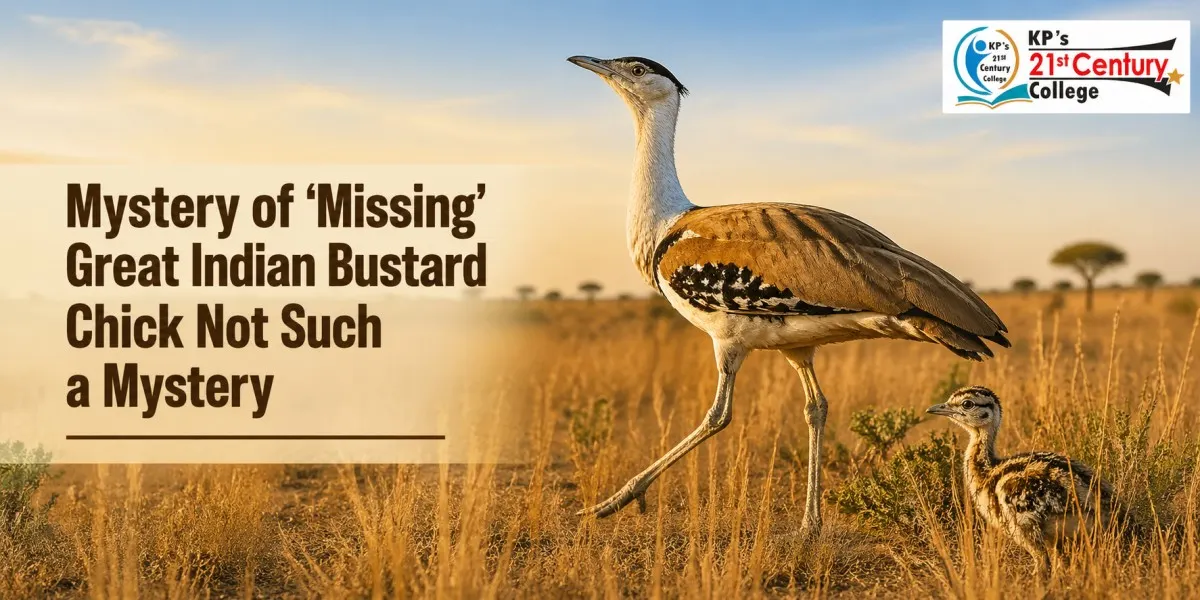
- A Great Indian Bustard (GIB) chick hatched in Kutch, Gujarat, using an innovative conservation technique called the “jumpstart method” has gone missing after learning to fly.
- Officials stated that the disappearance is not entirely mysterious because once the chick became capable of flight, it likely moved into the open grassland landscape and may have fallen prey to predators.
- This chick was significant because it marked the first successful use of the jumpstart method for GIB conservation in Gujarat.
- The event has again brought attention to the critically endangered status of the Great Indian Bustard and the urgent need for strong conservation efforts.
About the Great Indian Bustard Chick Case
- The chick was hatched on March 26, 2026, in the Naiya grassland of Kutch, Gujarat.
- It was born after conservationists transferred a fertile egg from Rajasthan’s captive breeding centre to Gujarat.
- This was necessary because Gujarat currently has only three surviving female GIBs in the wild, and their eggs are generally infertile due to the absence of breeding males.
- The chick was observed safely for several weeks and started flying around April 18.
- After learning to fly, it was not seen for 4–5 days, creating concern that it may have been preyed upon or moved beyond the monitoring zone.
- Because the chick was too small, it was not geotagged, making tracking difficult.
What is the Jumpstart Method
The jumpstart method is an innovative conservation technique used to increase the survival chances of endangered bird species.
How it works?
- A wild female GIB lays an infertile egg in Gujarat
- Conservationists carefully replace that infertile egg with a fertile egg brought from a captive breeding centre in Rajasthan
- The wild female then naturally incubates and raises the fertile chick as her own offspring
This combines the advantages of captive breeding and wild parental care.
- It improves survival rates because the chick grows in its natural habitat while still benefiting from scientific intervention.
- This method is especially useful where local breeding populations are too small for natural reproduction.
About Great Indian Bustard (GIB)
- The Great Indian Bustard is one of the heaviest flying birds in the world and is among India’s most critically endangered birds.
- It is considered the flagship species of Indian grasslands and an important indicator of ecosystem health.
Scientific Name: Ardeotis nigriceps
Habitat: Arid and semi-arid grasslands, open scrublands, and dry plains
Distribution: Mainly found in Rajasthan and Gujarat, with very small fragmented populations in Maharashtra, Karnataka, and Andhra Pradesh
State Bird: Rajasthan
Conservation Status of GIB
IUCN Red List:Critically Endangered Wildlife (Protection) Act, 1972: Schedule I – highest legal protection CITES: Appendix I – international trade prohibited except under exceptional circumstances CMS (Convention on Migratory Species): Protected under international conservation commitments |
Great Indian Bustard (GIB) – Causes of Critical Endangerment
Factor | Key Points |
Collision with Power Lines | Biggest threat; poor frontal vision leads to collision with overhead transmission lines → high mortality |
Habitat Loss | Grasslands misclassified as “wastelands” → diverted for agriculture, solar parks, industries |
Hunting & Poaching | Historical decline due to hunting; now reduced but impact still visible in low population |
Fragmented Population | Small, isolated populations → low genetic diversity and breeding success |
Low Reproductive Rate | Lays only one egg at a time → very slow population recovery |
Conservation Efforts for Great Indian Bustard
Initiative | Key Points |
Project Great Indian Bustard | Species-specific recovery programme focusing on habitat protection and population increase |
Captive Breeding Centres | Located at Ramdevra and Sam (Jaisalmer, Rajasthan); use artificial incubation |
Artificial Insemination | Scientific breeding method to improve success rate and maintain genetic diversity |
Power Line Mitigation | Underground cabling + bird diverters to reduce collision deaths |
Top of Form
Bottom of Form
Species Recovery Programme
The Great Indian Bustard is covered under the Species Recovery Programme under the Centrally Sponsored Scheme of Integrated Development of Wildlife Habitats (IDWH).
Objective
To provide focused scientific intervention for critically endangered species with small and declining populations.
Features
- 100% central assistance to States and UTs
- Scientific recovery plans prepared with institutions like Wildlife Institute of India (WII)
- In-situ conservation (natural habitat protection)
- Ex-situ conservation (captive breeding and reintroduction)
- Anti-poaching measures and habitat restoration
Challenges in Conservation of Great Indian Bustard
- Delayed Detection – Vast open grasslands make continuous tracking and early threat identification difficult
- Monitoring Constraints – Small chicks cannot be easily geotagged → limits scientific tracking
- Renewable Energy Conflict – Expansion of solar and wind projects increases power line networks in habitat
- Weak Grassland Policy – Grasslands often undervalued compared to forests in conservation planni
Way Forward
Power transmission lines in GIB habitats must be shifted underground wherever possible.
Grasslands should be legally recognized as ecologically important ecosystems and not treated as wastelands.Captive breeding must be strengthened with better genetic management. Jumpstart methods should be expanded in suitable habitats.
Satellite tracking and non-invasive monitoring systems should be improved.Community-based conservation must be made central to long-term success.Inter-state coordination between Rajasthan and Gujarat is necessary for species recovery.
Conclusion
The disappearance of the Great Indian Bustard chick highlights both the fragility and hope of conservation efforts.
While the missing chick may simply have entered the risks of natural life in the wild, its successful hatching through the jumpstart method marks an important breakthrough.
Saving the Great Indian Bustard is not only about protecting a single bird species but also about preserving India’s threatened grassland ecosystems.
CARE MCQ
Q. With reference to the Great Indian Bustard, consider the following statements:
- It is listed as Critically Endangered under the IUCN Red List.
- Collision with overhead power lines is one of its major threats.
- It is naturally found in dense tropical rainforests of North-East India.
Which of the statements given above is/are correct?
a) 1 and 2 only
b) 2 and 3 only
c) 1 and 3 only
d) 1, 2 and 3
Ans: (a)
Explanation
Statement 1 is correct : the Great Indian Bustard is classified as Critically Endangered by IUCN.
Statement 2 is correct : power line collision is the leading cause of mortality.
Statement 3 is incorrect : GIB is mainly found in arid and semi-arid grasslands, not tropical rainforests.
Q.Which of the following birds found in India is NOT listed as Critically Endangered under the IUCN Red List?
(a) Great Indian Bustard
(b) White-bellied Heron
(c) Indian Vulture
(d) Himalayan Quail
Ans: (c)
Explanation:
The Indian Vulture is classified as Endangered, not Critically Endangered, though it has suffered a drastic population decline mainly due to diclofenac poisoning. Therefore, option (c) is correct.
The Great Indian Bustard is listed as Critically Endangered due to habitat loss, hunting, and collision with power lines.
The White-bellied Heron is also classified as Critically Endangered, with a very small global population and severe habitat threats.
The Himalayan Quail is considered Critically Endangered and is possibly extinct, as it has not been reliably sighted for many decades.
Q.Consider the following statements:
Statement-I: Jerdon’s Courser, a bird endemic to the Eastern Ghats of India, was rediscovered in 1986 after being considered extinct for several decades.
Statement-II: The Great Indian Bustard, once widespread across the Indian subcontinent, is now classified as Vulnerable on the IUCN Red List.
Which one of the following is correct in respect of the above statements?
(a) Both Statement-I and Statement-II are correct and Statement-II is the correct explanation for Statement-I
(b) Both Statement-I and Statement-II are correct but Statement-II is not the correct explanation for Statement-I
(c) Statement-I is correct but Statement-II is incorrect
(d) Statement-I is incorrect but Statement-II is correct
Ans: (c)
Explanation:
Statement-I is correct:Jerdon’s Courser is a rare nocturnal bird endemic to the Eastern Ghats of Andhra Pradesh. It was believed to be extinct for many decades before being rediscovered in 1986, making it one of the most remarkable rediscoveries in Indian wildlife conservation. Therefore, this statement is correct.
Statement-II is incorrect: The Great Indian Bustard is not classified as Vulnerable. It is listed as Critically Endangered under the IUCN Red List due to severe habitat destruction, hunting, and threats from overhead power lines. Its population has declined sharply, making it one of India’s most threatened bird species. Hence, this statement is incorrect.
Q.Consider the following species:
- Asiatic Lion
- Great Indian Bustard
- Snow Leopard
- Olive Ridley Turtle
How many of the above-mentioned species are listed as Endangered under the IUCN Red List?
(a) Only one
(b) Only two
(c) Only three
(d) All four
Ans: (a)
Explanation:
- Asiatic Lion — Endangered
The Asiatic Lion is found mainly in Gir National Park, Gujarat, and is listed as Endangered due to restricted habitat and vulnerability to disease outbreaks. - Great Indian Bustard — Critically Endangered
It is not Endangered but placed in a higher threat category due to extremely low population levels. - Snow Leopard — Vulnerable
The Snow Leopard is listed as Vulnerable, not Endangered, after reassessment by IUCN. - Olive Ridley Turtle — Vulnerable
It is classified as Vulnerable because of threats like fishing nets, habitat destruction, and coastal development.
Thus, only one species (Asiatic Lion) is listed specifically as Endangered.
FAQs
Q1. Why is the Great Indian Bustard important?
Ans: is a flagship species of Indian grasslands and an indicator of ecosystem health.
Q2. What is the jumpstart method?
Ans: It is a conservation method where a fertile egg is placed in the nest of a wild female to improve breeding success.
Q3. What is the biggest threat to GIB?
Ans: Collision with overhead power transmission lines is the most serious threat.
Q4. Why are grasslands important for GIB?
Ans: They provide breeding grounds, food sources, and open landscapes necessary for survival.
Q5. How many GIBs are left globally?
Ans: The estimated global population is fewer than 200 individuals.