Table of Contents
Relevance: TGPSC: Telangana Economy, Renewable Energy, Solar Power, Water Resources, Sustainable Development
For Prelims:
- PM Surya Sarovar Yojana | Solar Parks Scheme | Floating Solar Projects | National Institute of Solar Energy | PM-KUSUM
For Mains:
- Clean energy transition | Floating solar potential | Renewable energy governance | DISCOM bottlenecks | State-level energy competitiveness
Why in News?
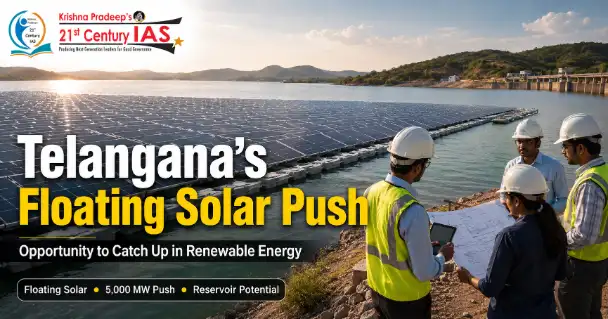
Telangana remains outside the list of beneficiary States under the Centre’s Solar Parks Scheme, even as India has approved the Pradhan Mantri Surya Sarovar Yojana for developing 5,000 MW of floating solar projects. Experts have urged Telangana to tap its floating solar potential in reservoirs such as Sriramsagar and Nagarjunasagar to avoid falling behind renewable energy leaders like Andhra Pradesh, Karnataka and Tamil Nadu.
What is the Issue?
- Telangana has around 5 GW of installed solar capacity as of October 2025, but it is not among the top solar States and is also absent from the list of States benefiting from the Solar Parks Scheme.
- The concern is that while India is expanding solar energy through large solar parks, rooftop solar, agricultural solarisation and floating solar, Telangana’s clean energy addition has slowed compared to other southern States.
India’s Solar Parks and Floating Solar Push
The Solar Parks Scheme has sanctioned 54 solar parks across 13 States, with a combined capacity of about 39.1 GW.
Key State Comparison
- Rajasthan and Gujarat lead India’s solar growth.
- Andhra Pradesh has secured five solar parks with a capacity of 4.2 GW.
- Telangana is missing from the list of Solar Parks Scheme beneficiaries.
The Centre’s new push comes through the Pradhan Mantri Surya Sarovar Yojana, approved on 31 July 2026, which aims to develop 5,000 MW of floating solar projects.
The scheme is based on an assessment by the National Institute of Solar Energy, which estimates India’s floating solar potential at 102.18 GWp.
Why Telangana is Lagging Behind
1. Regulatory Bottlenecks
Delays in clearances and approvals have slowed fresh renewable energy momentum.
2. DISCOM Resistance to Open Access
Resistance from distribution companies to open access has affected investor confidence and project viability.
3. Land Allocation Delays
Solar projects require timely land identification and allocation. Delays reduce Telangana’s competitiveness compared to neighbouring States.
4. Slow Clean Energy Capacity Addition
Telangana has reportedly recorded the lowest clean energy capacity addition among southern States over the past five years.
5. Missed Solar Park Opportunity
Unlike Andhra Pradesh, Telangana has not secured projects under the Solar Parks Scheme, reducing its visibility in large-scale solar development.
Why Floating Solar Matters for Telangana
Floating solar projects are especially relevant for Telangana because the State has large reservoirs and water bodies.
Potential Sites Mentioned
- Sriramsagar Reservoir
- Nagarjunasagar Reservoir
Advantages of Floating Solar
- Reduces pressure on land acquisition
- Uses existing reservoirs and water bodies
- Can reduce water evaporation
- Supports clean power generation
- Helps utilise underused water surfaces
- Can improve Telangana’s renewable energy ranking
For a State facing land and approval challenges, floating solar can become a practical route to expand clean energy capacity.
Role of Central Solar Schemes
India’s solar expansion is being supported by multiple Central schemes.
1. PM Surya Sarovar Yojana
Aims to add 5,000 MW floating solar capacity. It is expected to reduce about 10 million tonnes of CO₂ emissions annually and generate up to 17,000 jobs.
2. PM Surya Ghar
Promotes rooftop solar adoption. It has already covered more than 43 lakh households.
3. PM-KUSUM
Promotes solar energy in agriculture. It has benefited more than 21.77 lakh farmers through solar pumps and feeder-level solarisation.
Conclusion
Telangana has strong solar irradiation and renewable energy potential, but it is currently lagging behind leading solar States. The Centre’s 5,000 MW floating solar push offers Telangana a new opportunity to revive momentum without heavy land dependence. By tapping reservoirs such as Sriramsagar and Nagarjunasagar, resolving DISCOM and regulatory bottlenecks, and actively using Central schemes, Telangana can regain its place in India’s clean energy transition.
CARE MCQ
Q. Consider the following statements regarding Telangana and India’s floating solar push:
- Telangana is currently outside the list of beneficiary States under the Centre’s Solar Parks Scheme.
- PM Surya Sarovar Yojana aims to develop 5,000 MW of floating solar projects.
- Floating solar projects can reduce pressure on land availability.
- Telangana has no major reservoirs suitable for floating solar consideration.
Which of the statements given above are correct?
(a) 1, 2 and 3 only
(b) 1 and 4 only
(c) 2, 3 and 4 only
(d) 1, 2, 3 and 4
Answer: (a) 1, 2 and 3 only
Explanation
Statements 1, 2 and 3 are correct. Telangana is not among Solar Parks Scheme beneficiaries mentioned in the report, PM-SSY aims at 5,000 MW floating solar, and floating solar reduces land pressure.
Statement 4 is incorrect because Telangana has major reservoirs such as Sriramsagar and Nagarjunasagar, which can be explored for floating solar.
FAQs
1. Why is Telangana in news?
Because it is missing from the top solar States list and Solar Parks Scheme beneficiaries.
2. What is PM Surya Sarovar Yojana?
A Central scheme to develop 5,000 MW floating solar projects.
3. What is floating solar?
Solar panels installed on reservoirs, ponds or other water bodies.
4. Why is floating solar useful?
It reduces land requirement and uses existing water bodies.
5. Which reservoirs are important for Telangana?
Sriramsagar and Nagarjunasagar are mentioned as potential sites.
6. What is Telangana’s installed solar capacity?
Around 5 GW as of October 2025.