Why in News?
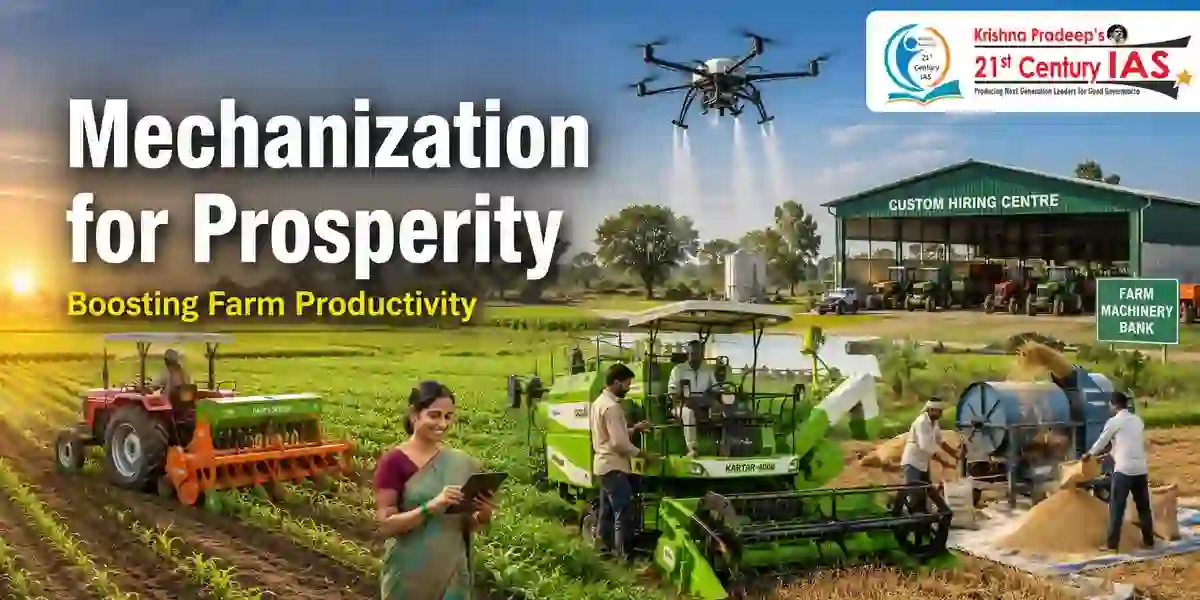
The Sub-Mission on Agricultural Mechanization has expanded access to farm machinery and modern agricultural technologies for small farmers, women, Scheduled Castes, Scheduled Tribes, Farmer-Producer Organizations, Self-Help Groups and rural entrepreneurs. Since its inception, ₹9,404.47 crore has supported the distribution of 21.61 lakh agricultural machines, while ₹52.5 crore has enabled 40,928 drone demonstrations across 40,918 hectares to promote precision agriculture.
What is Farm Mechanization?
- Farm mechanization means the use of machines, equipment and modern technologies in agriculture.
It covers different stages of farming such as:
- Land preparation
- Sowing
- Irrigation
- Plant protection
- Harvesting
- Post-harvest management
- Crop residue management
- Mechanization reduces dependence on manual labour and animal power. It helps farmers complete agricultural operations on time, reduce production costs and improve productivity.
- In India, farm mechanization is especially important because agriculture faces challenges such as labour shortage, small landholdings, rising input costs and climate-related risks.
What is Sub-Mission on Agricultural Mechanization?
- The Sub-Mission on Agricultural Mechanization was launched in 2014–15 as a Centrally Sponsored Scheme under the Rashtriya Krishi Vikas Yojana.
- The core principle of SMAM is “reach the unreached.”
- It aims to extend the benefits of farm mechanization to those farmers and groups who cannot easily afford costly machinery.
The major beneficiaries include:
- Small and marginal farmers
- Women farmers
- Scheduled Castes
- Scheduled Tribes
- Farmer-Producer Organizations
- Self-Help Groups
- Rural entrepreneurs
- Farmers in North-Eastern and underserved regions
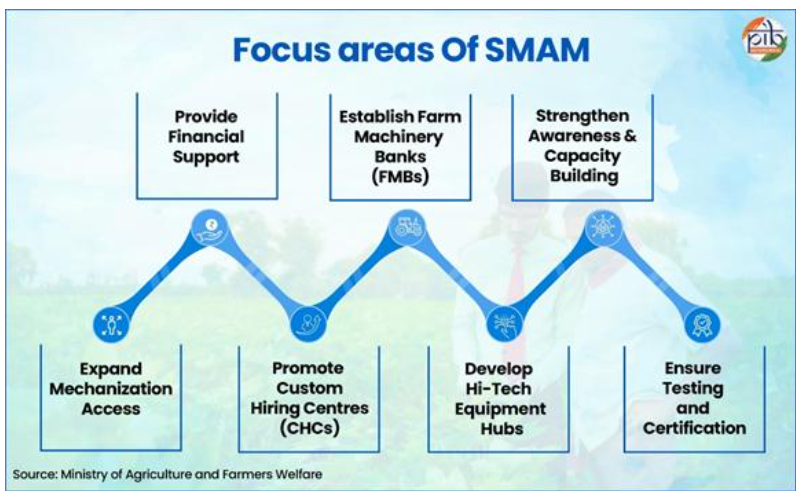
- SMAM addresses two major problems in Indian agriculture: small landholdings and high capital cost of machines. It does this by promoting rental-based access to farm equipment through Custom Hiring Centres and Farm Machinery Banks.
Rashtriya Krishi Vikas Yojana
The Rashtriya Krishi Vikas Yojana was launched in 2007 to encourage States to increase public investment in agriculture and allied sectors.
It gives States flexibility to design and implement projects based on local agricultural needs.
RKVY supports interventions such as:
- Crop production
- Agricultural infrastructure
- Farm mechanization
- Value addition
- Pre-harvest and post-harvest infrastructure
In 2017–18, RKVY was restructured as RKVY-RAFTAR, or Remunerative Approaches for Agriculture and Allied Sector Rejuvenation. This restructuring gave greater focus to agricultural infrastructure and value-chain development.
Strategic Pillars of SMAM
1. Training, Testing and Demonstration
SMAM promotes agricultural mechanization through training, testing, demonstration and awareness generation. Farmers are exposed to modern machines and technologies so that adoption becomes easier.
It also supports performance testing and certification of agricultural machinery to ensure quality and suitability.
2. Financial Assistance for Machinery Procurement
The scheme provides subsidy support through the Direct Benefit Transfer system.
- 40% subsidy is provided for general beneficiaries.
- 50% subsidy is provided for SC/ST farmers, small and marginal farmers and beneficiaries in North-Eastern States.
- Small and marginal farmers receive ₹2,000 per hectare for mechanized services, including drone services, through CHCs, SHGs and FPOs.
3. Custom Hiring Centres
SMAM promotes Custom Hiring Centres, where farmers can rent farm machinery instead of purchasing it.
This is useful for small farmers who cannot afford expensive machines individually.
CHCs receive financial assistance of 40% of project cost for projects up to ₹250 lakh.
4. Farm Machinery Banks
Farm Machinery Banks provide machinery to farmers on a hiring basis.
They receive 80% financial assistance for projects up to ₹30 lakh. SHGs, FPOs and local institutions can use this support to acquire agricultural machinery.
5. Hi-Tech and High-Productivity Equipment Hubs
SMAM supports hubs equipped with advanced, high-capacity and crop-specific machines.
These hubs improve access to costly and high-value agricultural equipment.
6. Special Focus on North-Eastern Region
The scheme provides enhanced support to the North-Eastern Region.
It includes:
- Up to 100% subsidy for small machinery
- 95% support for Farm Machinery Banks
- Region-specific interventions for low farm power availability
Financial Support and Achievements
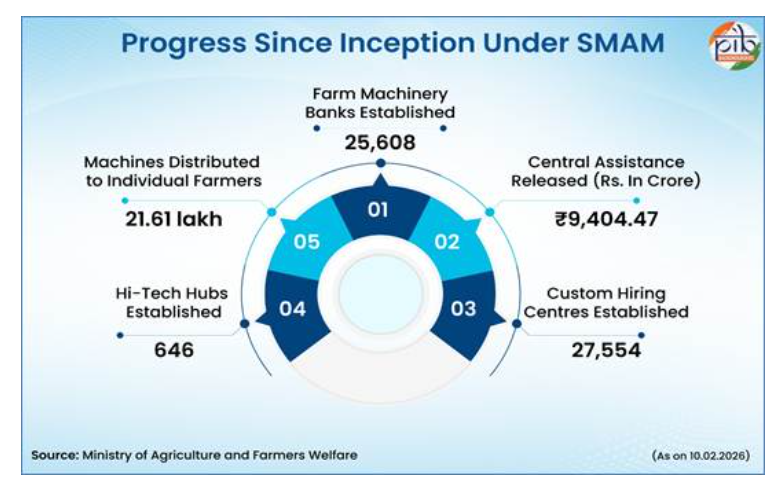
From 2014–15 to 2025–26, SMAM has made significant progress in expanding farm mechanization.
| Component | Achievement |
| Central assistance released | ₹9,404.47 crore |
| Agricultural machines distributed | 21.61 lakh |
| Custom Hiring Centres established | 27,554 |
| Hi-Tech Hubs established | 646 |
| Farm Machinery Banks established | 25,608 |
| Individual machinery ownership beneficiaries in 2020–21 | 2.07 lakh |
| Individual machinery ownership beneficiaries in 2024–25 | 2.32 lakh |
The scheme follows a differentiated funding pattern:
- 60:40 between Centre and States for most States
- 90:10 for North-Eastern and Himalayan States
- 100% Central funding for Union Territories
This structure helps expand mechanization across diverse regions.
Drone-Based Farming under SMAM
SMAM also promotes the use of drones in agriculture.
Drones can help in:
- Spraying fertilizers
- Applying nutrients
- Spraying agrochemicals
- Precision agriculture
- Reducing labour burden
- Improving input efficiency
Under SMAM, ₹52.50 crore was provided to the Indian Council of Agricultural Research to promote drone adoption through field demonstrations.
From 2023–24 to 2025–26, ICAR, State Agricultural Universities and Krishi Vigyan Kendras conducted 40,928 Kisan Drone demonstrations covering 40,918 hectares.
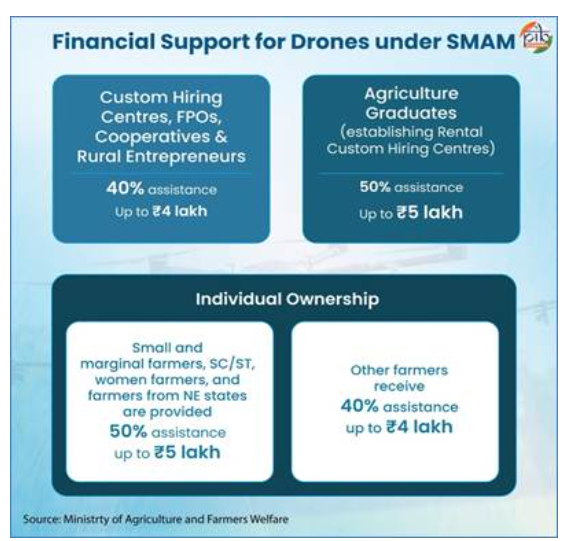
Financial Assistance for Drones
- ICAR institutes, KVKs and State Agricultural Universities receive 100% assistance up to ₹10 lakh per drone.
- FPOs receive grant support of up to 75%.
- Agencies providing drone services receive contingency support of ₹6,000 per hectare.
SMAM also earmarks 30% of total funds for women farmers, improving their access to agricultural machinery and mechanized services.
Significance of SMAM
Inclusive Mechanization
SMAM focuses on small farmers, women, SC/ST communities and underserved regions. This makes mechanization more inclusive.
Reduction in Drudgery
Farm machinery reduces manual labour, especially for women and small farmers involved in labour-intensive operations.
Higher Productivity
Timely sowing, irrigation, spraying and harvesting improve crop productivity and reduce losses.
Affordable Access
Custom Hiring Centres and Farm Machinery Banks make machines available on rent, reducing the need for individual ownership.
Support for Precision Agriculture
Drone demonstrations promote efficient use of fertilizers, nutrients and agrochemicals.
Post-Harvest Management
Mechanization supports processing, storage, value addition and crop residue management.
Regional Equity
Special focus on North-Eastern and underserved States helps reduce regional disparities in access to farm technology.
Challenges
- Small and fragmented landholdings reduce machine viability.
- High cost of advanced machines limits adoption.
- Many farmers lack awareness about available support.
- Custom Hiring Centres may face maintenance and operational challenges.
- Skilled operators are needed for drones and advanced machines.
- Access to repair services and spare parts remains weak in rural areas.
- Digital and technical capacity is limited among small farmers.
- Mechanization must be adapted to local crops, soil conditions and farm sizes.
Way Forward
- Promote small, affordable and region-specific farm machinery.
- Strengthen Custom Hiring Centres and Farm Machinery Banks.
- Train rural youth as machine operators, drone pilots and repair technicians.
- Improve awareness through demonstrations and IEC campaigns.
- Link mechanization with FPOs, SHGs and rural entrepreneurship.
- Expand drone-based precision agriculture with clear safety and SOP-based use.
- Promote women-friendly tools to reduce labour burden.
- Encourage climate-smart machines for crop residue management and water efficiency.
- Strengthen testing, certification and after-sales service networks.
Conclusion
The Sub-Mission on Agricultural Mechanization has become an important intervention for improving farm productivity, reducing drudgery and making modern technologies accessible to small and marginal farmers. Its focus on Custom Hiring Centres, Farm Machinery Banks, drones, women farmers and North-Eastern States reflects an inclusive approach. However, long-term success will depend on affordable access, effective training, localised machinery, repair networks and sustainable technology adoption. SMAM can play a key role in making Indian agriculture more productive, efficient and future-ready.