Why in News?
The Government highlighted the role of India’s rural credit system as a key pillar of rural development and agricultural growth. The rural credit ecosystem has expanded through institutions such as NABARD, Scheduled Commercial Banks, Regional Rural Banks, Cooperative Banks and Small Finance Banks, along with policy measures such as Priority Sector Lending, Ground Level Credit targets, Kisan Credit Card, Modified Interest Subvention Scheme, SHG-Bank Linkage Programme and digital platforms.
India’s Rural Credit Landscape
India’s Rural Credit Landscape
- India’s rural credit system provides short-, medium- and long-term finance for agriculture, allied activities, rural enterprises, household consumption, income generation, asset creation and livelihood security.
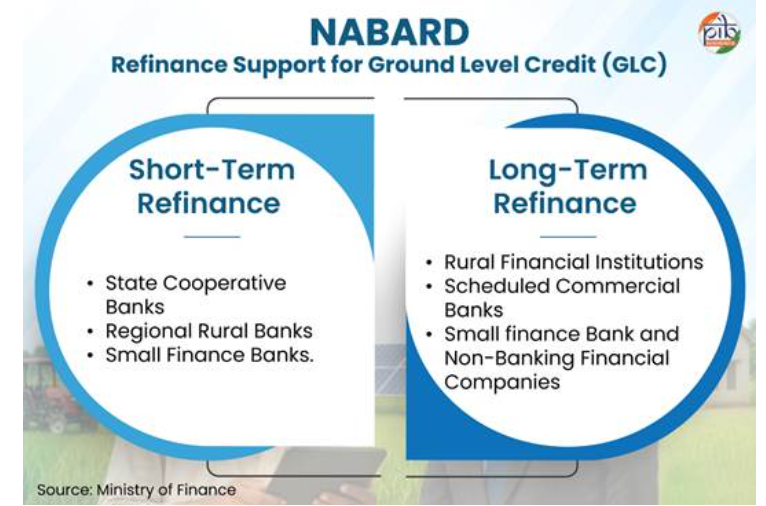
- The system has gradually shifted from informal moneylenders to institutional credit. NABARD, the apex rural development financial institution, supports the sector through refinance, infrastructure finance, institutional development and supervision of Cooperative Banks and Regional Rural Banks.
According to NABARD’s Rural Economic Conditions and Sentiments Survey, May 2026:
- 77.2% of rural households reported higher consumption.
- Around 51% depended only on formal credit.
- More than 27% used both formal and informal credit.
Thus, formal rural credit is expanding, though informal borrowing continues.
Evolution of Rural Credit System
India’s rural credit system has evolved through several institutional and policy milestones.
| Year | Development | Importance |
| 1955 | National Agricultural Credit Long-term Operations Fund created; State Bank of India established | Expanded rural banking and agricultural finance |
| 1969 | Nationalisation of 14 major commercial banks | Reoriented banking towards priority sectors and small farmers |
| 1982 | NABARD established | Integrated financing, development and supervision for rural credit |
| 1992 | SHG-Bank Linkage Programme introduced | Expanded formal credit access for rural poor households |
| 1998 | Kisan Credit Card launched | Improved timely and affordable credit for farmers |
| 2014 | Pradhan Mantri Jan Dhan Yojana launched | Expanded universal banking access under JAM Trinity |
| 2015 | MUDRA Scheme launched | Provided collateral-free credit to non-corporate, non-farm micro enterprises |
| 2022 onwards | Jan Samarth Portal, e-KCC and digital initiatives | Enabled technology-driven rural credit delivery |
NABARD, established in 1982, celebrated its 45th Foundation Day on 12 July 2026. It prepares district credit plans, promotes financial inclusion and supports government initiatives for rural credit expansion.
Institutional Architecture of Rural Credit
India’s rural credit framework rests on a wide network of banking and cooperative institutions.
1. Scheduled Commercial Banks (SCBs)
- SCBs are banks listed in the Second Schedule of the RBI Act, 1934. They can borrow from RBI at the bank rate and participate in clearing houses.
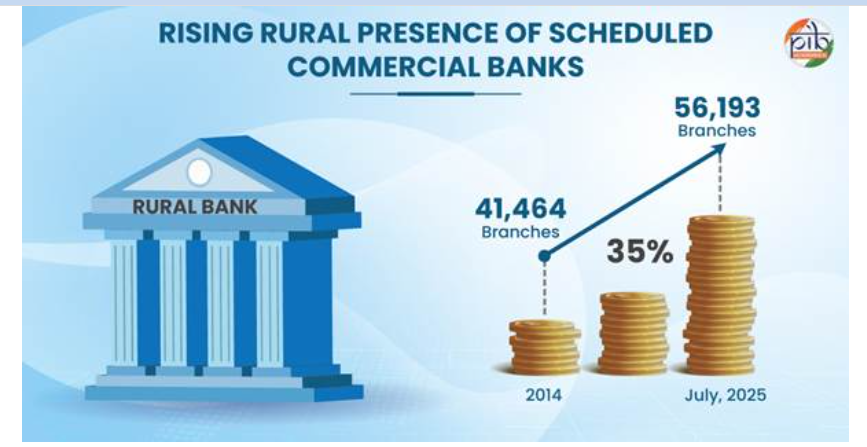
- Around 120 SCBs operate in India. Their rural branches increased from 41,464 in 2014 to 56,193 by July 2025. Rural services are provided through branches, Business Correspondents, digital platforms, PMJDY accounts and Direct Benefit Transfer systems.
2. Regional Rural Banks (RRBs)
- RRBs were established under the RRB Act, 1976 to provide credit to small and marginal farmers, agricultural labourers, artisans and small entrepreneurs.
- Currently, 28 RRBs operate through more than 22,000 branches in 700 districts.
3. Cooperative Banks
Rural cooperative credit institutions follow a multi-tier structure comprising State Cooperative Banks, District Central Cooperative Banks, Primary Agricultural Credit Societies and Agriculture and Rural Development Banks.
The network includes:
- 1,458 Urban Cooperative Banks
- 34 State Cooperative Banks
- 352 District Central Cooperative Banks
They promote banking access in rural and remote areas.
4. Small Finance Banks
- Small Finance Banks were introduced after the Union Budget 2014–15 and are licensed by RBI. They provide savings and credit facilities to small businesses, marginal farmers, micro-industries and unorganised-sector entities.
- Currently, 11 Small Finance Banks are operational.
Policy Framework for Rural Credit
SHG-Bank Linkage and DAY-NRLM
- The Self-Help Group-Bank Linkage Programme was initiated by NABARD to connect rural SHGs with the formal banking system.
- It has particularly benefited rural women who earlier lacked access to formal credit due to absence of credit history.
- The National Rural Livelihoods Mission was launched in 2010 by restructuring the Swarnajayanti Gram Swarozgar Yojana. It was renamed Deendayal Antyodaya Yojana – National Rural Livelihoods Mission with effect from 29 March 2016.
Key data:
- 10.05 crore rural women mobilised into more than 90.90 lakh SHGs till July 2025.
- DAY-NRLM is implemented across the country except Delhi and Chandigarh.
- As of 10 July 2026, over 19.83 lakh SHGs were operational.
- Loan disbursement of ₹13.28 lakh crore has been recorded since inception.
- Around 50,548 Bank Sakhis have been deployed.
- Bank Sakhis helped SHGs access bank credit of over ₹12.18 lakh crore since 2013–14, as on February 2026.
Bank Sakhis assist SHG members in opening accounts, preparing loan applications, submitting documents and ensuring timely repayment. This also helps reduce NPAs.
Primary Agricultural Credit Societies
- Primary Agricultural Credit Societies are grassroots-level institutions of the short-term cooperative credit structure.
- They directly interact with rural borrowers and provide loans. They also support repayment, distribution and marketing of agricultural inputs and produce.
- PACS form the base of the cooperative credit system and act as the final link between borrowers and higher financing institutions such as SCBs and RBI/NABARD.
- In 2023, the Government approved a plan to establish 2 lakh new multipurpose PACS, Dairy and Fishery Cooperative Societies across all panchayats over five years.
Progress so far:
- 32,836 new societies registered as on 20 January 2026.
- 15,793 dairy and fishery cooperatives strengthened.
- Out of 79,630 approved PACS, 61,842 PACS migrated to the Common ERP-based national software as on 10 March 2026.
This shows the shift towards digitised and multipurpose cooperative credit institutions.
Modified Interest Subvention Scheme
The Modified Interest Subvention Scheme is a Central Sector Scheme that provides short-term credit to farmers at affordable rates through the Kisan Credit Card.
Main features:
- Farmers receive short-term loans at 7% interest.
- Lending institutions receive 1.5% interest subvention.
- Farmers who repay promptly get an additional incentive of up to 3%.
- Effective interest rate for prompt repayment can fall to 4%.
The Union Budget 2025–26 introduced important changes:
- Loan limit under MISS through KCC increased from ₹3 lakh to ₹5 lakh.
- Lending limit for fisheries and allied activities increased from ₹2 lakh to ₹5 lakh.
- From January 2025, collateral-free short-term agricultural loan limit increased from ₹1.6 lakh to ₹2 lakh per borrower.
This aims to improve access to credit amid rising input costs and inflation.
PM Dhan Dhanya Krishi Yojana
- PM Dhan Dhanya Krishi Yojana was approved in July 2025 to catalyse growth in 100 low-performing agricultural districts.
- It follows a saturation-based convergence of 36 Central schemes across 11 Ministries.
Key objectives include:
- Enhancing access to short-term and long-term agricultural credit
- Improving agricultural productivity
- Promoting crop diversification
- Encouraging sustainable agricultural practices
- Strengthening irrigation infrastructure
- Augmenting post-harvest storage capacity at panchayat and block levels
Committees are being formed at the District, State and National levels for planning, implementation and monitoring.
Based on cumulative output from inception to May 2026, top-performing districts are:
- Banka, Bihar
- Mahoba, Uttar Pradesh
- Charaideo, Assam
- Kishanganj, Bihar
- Tikamgarh, Madhya Pradesh
Strengthening Rural Financial Inclusion
Financial inclusion has become a central pillar of rural credit expansion. Several schemes and digital tools have improved access to banking, credit and welfare delivery.
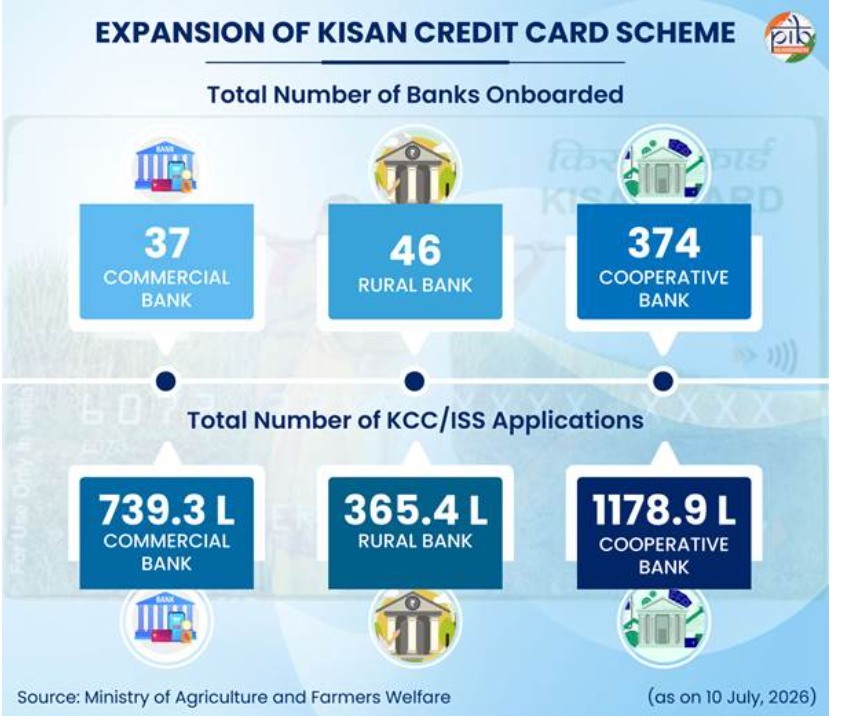
Kisan Credit Card
The Kisan Credit Card scheme provides adequate and timely credit support from the banking system.
It offers:
- ATM-enabled debit card
- One-time documentation
- Provision for cost escalation
- Multiple withdrawals within the sanctioned limit
KCC loans support:
Short-term crop cultivation
Post-harvest operations
Marketing-related expenses
Household consumption needs
Working capital for farm maintenance
Investment credit for allied and non-farm activities
KCC coverage includes:
- Owner cultivators
- Tenant farmers
- Oral lessees
- Sharecroppers
- SHGs of farmers
- Joint Liability Groups
- In 2019, KCC was extended to allied sectors such as dairy, fisheries and animal husbandry.
- The e-KCC portal introduced by NABARD enables end-to-end digitisation for RRBs and Rural Cooperative Banks. Farmers can apply digitally or through nearby Common Service Centres, with loan sanction possible in about two days.
Financial literacy on KCC is promoted through:
- Centres for Financial Literacy
- Financial Literacy Camps
- RBI’s annual Financial Literacy Week
Pradhan Mantri Jan Dhan Yojana
Pradhan Mantri Jan Dhan Yojana provides universal banking access through at least one basic bank account per household.
It supports:
- Credit access
- Insurance
- Pension
- RuPay debit cards
- Direct Benefit Transfer
- JAM Trinity-based welfare delivery
- Linkage of KCC with RuPay platform
Jan Samarth Portal
- The Jan Samarth Portal, launched in June 2022, is a one-stop digital platform linking government-sponsored loan and subsidy schemes, including KCC.
It provides:
- Access to beneficiaries
- Support to financial institutions
- Interface for government agencies
- Scheme guidance through digital processes
- End-to-end coverage of linked schemes
The portal aims to streamline credit delivery and promote inclusive growth.
Jan Dhan Darshak App
The Jan Dhan Darshak App helps citizens locate banking service points such as:
- Bank branches
- ATMs
- Bank Mitras
- Common Service Centres
It also helps the Government monitor banking access in villages.
As of 6 March 2025, 99.92% of villages had a banking outlet within a 5 km radius. Villages in Dadra and Nagar Haveli achieved full coverage.
Significance of Rural Credit Expansion
Agricultural Growth
- Timely credit supports crop production, allied activities, mechanisation, irrigation and farm investment.
Inclusive Rural Development
- Formal credit reduces dependence on informal borrowing and supports rural households, small farmers and vulnerable groups.
Women-Led Financial Inclusion
- SHG-Bank Linkage and DAY-NRLM have mobilised rural women into organised credit networks.
Rural Entrepreneurship
- Schemes such as MUDRA and PMJDY-linked banking access help support small and micro enterprises.
Digital Transformation
- Platforms such as Jan Samarth, e-KCC and Jan Dhan Darshak App make rural credit delivery faster and more accessible.
Strengthening Cooperative Credit
- PACS digitisation and expansion of multipurpose societies strengthen the grassroots credit system.
Conclusion
India’s rural credit system has evolved from an informal and fragmented structure into a diversified, institution-led and policy-driven ecosystem. Institutions such as NABARD, Scheduled Commercial Banks, RRBs, Cooperative Banks, PACS and Small Finance Banks are expanding access to affordable and timely credit. Policy measures such as Priority Sector Lending, Ground Level Credit targets, KCC, MISS, DAY-NRLM, PMJDY, Jan Samarth Portal and PACS digitisation are strengthening financial inclusion. With deeper digitisation, wider institutional reach and targeted credit delivery, rural credit can become a powerful driver of inclusive rural development, agricultural growth and long-term economic resilience.