Table of Contents
Relevance: UPSC GS Paper III: Energy Security, Indian Economy, Maritime Security and Infrastructure
For Prelims:
- One Nation, One Election, Constitution (129th Amendment) Bill, 2024, Article 82A, Articles 83 and 172, Model Code of Conduct, Election Commission of India, Constructive No-Confidence Motion, Basic Structure Doctrine, Kesavananda Bharati Case, 73rd and 74th Amendments, CAPF, EVM, VVPAT, Common Electoral Roll
For Mains:
- Federalism, parliamentary democracy, free and fair elections, electoral reforms, campaign finance transparency, regional representation, collective responsibility, political accountability, democratic mandate, administrative continuity
Why in News?
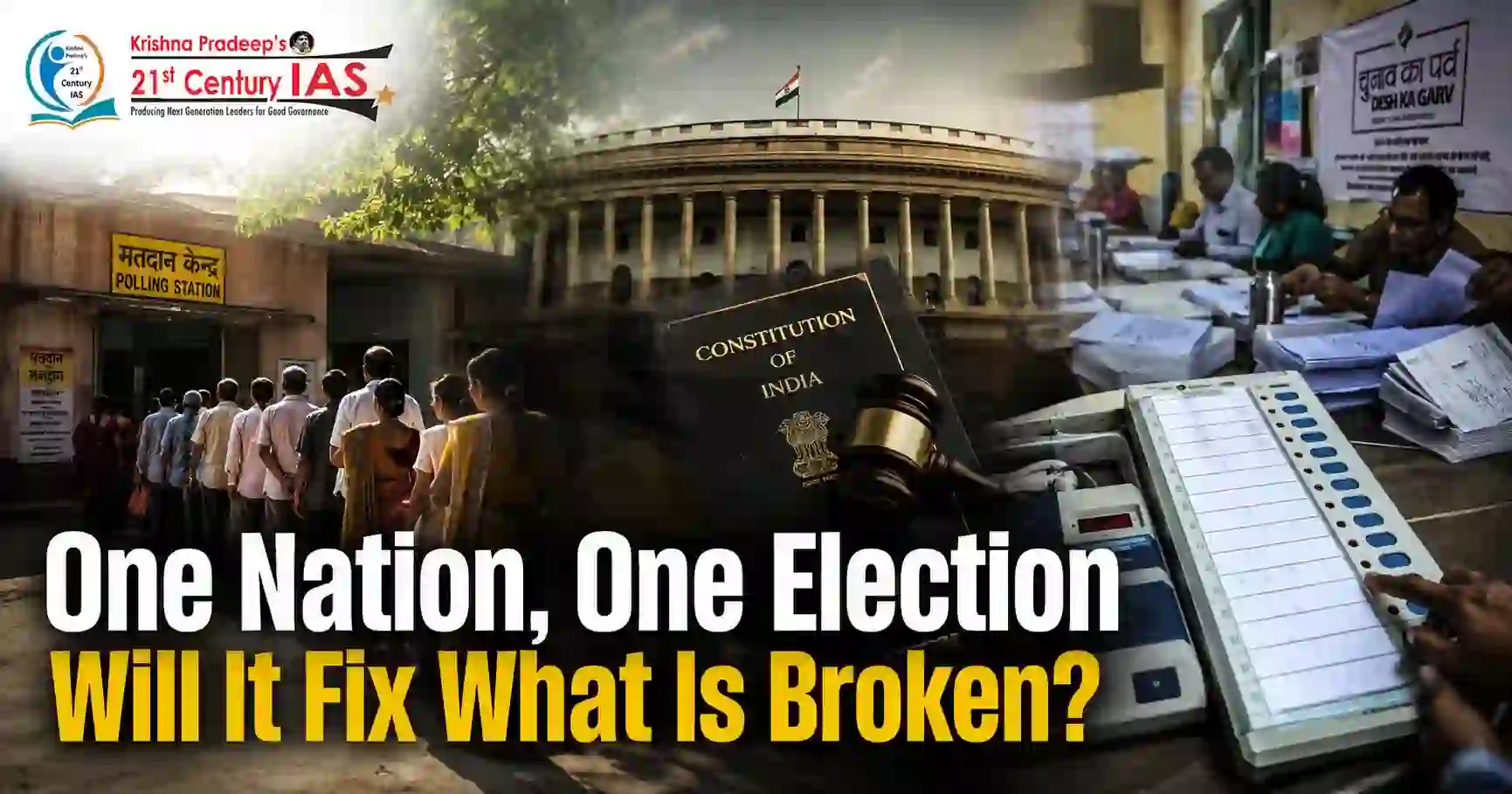
The Constitution (129th Amendment) Bill, 2024 seeks to institutionalise One Nation, One Election by synchronising elections to the Lok Sabha and State Legislative Assemblies through a proposed Article 82A and amendments to Articles 83 and 172. The proposal has revived debate on whether simultaneous elections can improve governance efficiency or whether they may create constitutional, federal and democratic complications.
What is One Nation, One Election?
- One Nation, One Election refers to the proposal to synchronise India’s electoral calendar so that elections to the Lok Sabha and State Legislative Assemblies are held together within a common election cycle.
- In its broader political sense, ONOE is often discussed as including local body elections also. However, the Constitution (129th Amendment) Bill, 2024 defines simultaneous elections mainly in relation to the Lok Sabha and State Legislative Assemblies. Local body elections are not included in the present Bill, though the Kovind Committee recommended that they may be aligned within 100 days of Lok Sabha and Assembly elections.
Historical Background
- Simultaneous elections were the normal practice in India during the early post-Independence period.
- From 1951 to 1967, elections to the Lok Sabha and State Legislative Assemblies were largely held together during the first four general election cycles: 1952, 1957, 1962 and 1967.
- This synchronisation was disrupted during 1968–69 due to premature dissolution of several State Assemblies. The cycle was further broken when the 4th Lok Sabha, elected in 1967, was dissolved ahead of schedule in 1970, leading to fresh national elections in 1971.
- Since then, India has followed a staggered electoral calendar, with elections taking place in different States at different times.
Constitution (129th Amendment) Bill, 2024
The Constitution (129th Amendment) Bill, 2024 is the main legal instrument proposed to implement ONOE.
Its key features include:
- Insertion of a new Article 82A to create a framework for simultaneous elections.
- Amendment of Article 83, which deals with the duration of Parliament.
- Amendment of Article 172, which deals with the duration of State Legislatures.
- The President may notify an appointed date, linked to the first sitting of a new Lok Sabha.
- The terms of State Assemblies elected after the appointed date may be adjusted to end with the Lok Sabha’s term.
- If the Lok Sabha or a State Assembly is dissolved before completing its term, fresh elections will be held only for the unexpired term.
- The Election Commission may recommend deferring a specific State election in case of localised exigencies.
- Local bodies have been strategically excluded from the current Bill.
A companion Union Territories Laws (Amendment) Bill, 2024 seeks to extend the synchronisation framework to legislatures of Delhi, Puducherry and Jammu and Kashmir.
Committee Recommendations on ONOEThe idea of simultaneous elections has been examined by several institutions. Election Commission Report, 1983: Law Commission, 170th Report, 1999: Parliamentary Standing Committee, 2015: NITI Aayog Discussion Paper, 2017: Law Commission Draft, 2018: Kovind Committee, 2023–24: |
Arguments in Favour of ONOE
1. Reduction in Public Expenditure
- Repeated elections require separate spending on polling arrangements, security deployment, transport and election administration. Proponents argue that simultaneous elections can reduce duplication of election-related costs.
- According to the Centre for Media Studies, the 2024 general election cost was estimated at around ₹1.35 lakh crore, more than double the ₹60,000 crore spent in 2019.
- The Joint Parliamentary Committee has reportedly stated that simultaneous elections to Lok Sabha, Assemblies and local bodies may save nearly ₹7 lakh crore by reducing repeated expenditure on security movement, procurement and election logistics.
2. Reduced Model Code of Conduct Disruptions
- The Model Code of Conduct restricts governments from announcing new schemes and major policy decisions during elections. A typical MCC period lasts around 45 to 60 days.
- Supporters argue that frequent elections place different parts of the country under MCC for long periods, affecting administration and development decisions. ONOE may limit this restriction to a single predictable election window.
3. Administrative Continuity
Frequent elections require repeated deployment of civil servants, police forces, teachers and local administrative machinery. Simultaneous elections may allow officials to focus on routine governance and long-term implementation for a stable five-year period.
4. Optimised Security Deployment
Elections require large-scale deployment of Central Armed Police Forces and State police. A synchronised election cycle may allow a single coordinated security plan, reducing repeated movement and fatigue of security personnel.
5. Possible Economic Benefits
Supporters cite macroeconomic modelling suggesting that simultaneous elections may improve GDP growth by reducing policy uncertainty and stabilising public expenditure patterns. Some findings presented before the JPC reportedly suggest that ONOE may boost GDP growth by up to 1.6 percentage points.
6. Reduction in Voter Fatigue
Repeated elections may lead to voter fatigue, especially in urban areas. A common election window may increase voter interest and make it easier for migrant workers to participate in multiple elections at once.
Constitutional and Federal Concerns
1. Basic Structure Doctrine
- In Kesavananda Bharati v. State of Kerala, 1973, the Supreme Court held that parliamentary democracy and free and fair elections are part of the Constitution’s basic structure.
- Any amendment that weakens federalism, democratic accountability or free and fair elections may face constitutional scrutiny.
2. Collective Responsibility and Parliamentary System
- India follows a parliamentary system where the executive remains in office only as long as it enjoys majority support in the legislature.
- ONOE creates a challenge when a government loses majority mid-term. If elections are restricted to a fixed cycle, questions arise over whether the government should continue, whether President’s Rule should be imposed, or whether elections should be held only for the remaining term.
- The proposed constructive no-confidence motion, borrowed from Germany, requires a no-confidence motion to be accompanied by support for an alternative government. Critics argue that this may distort India’s parliamentary tradition and allow weak governments to remain in office.
3. Extension or Curtailment of Assembly Terms
- To reach the first synchronised cycle, some State Assembly terms may have to be extended or shortened.
- This raises a democratic concern because Articles 83 and 172 use the phrase “no longer”, indicating that legislative terms should not normally exceed five years. Extending a term without voter approval may violate the democratic mandate, while curtailing a term may deny voters the full tenure for which they elected a government.
4. Impact on Federalism and Regional Parties
- Simultaneous elections may create a wave effect, where voters choose the same party at both national and State levels.
- This may structurally benefit larger national parties and weaken regional parties. Local and regional concerns such as agrarian distress, coastal livelihoods, flood management, regional identity and State-specific governance issues may be overshadowed by national campaigns.
5. Local Self-Government Question
- The 73rd and 74th Constitutional Amendments created a separate constitutional space for panchayats and municipalities. Their elections are conducted by State Election Commissions, not the Election Commission of India.
- If local body elections are included within ONOE, it may affect the autonomy of the third tier of government. If they are excluded, election-related expenditure, security deployment and governance disruption will still continue through municipal and panchayat election cycles.
Administrative and Financial Challenges
1. Concentrated MCC Freeze
- Under the present system, the MCC applies in different States at different times. Under ONOE, the freeze may become a single national freeze, affecting developmental announcements across all States at the same time.
- This may concentrate governance disruption rather than eliminate it.
2. Short-Term Legislatures after Mid-Term Dissolution
- The proposed unexpired term rule means that if an Assembly is dissolved mid-cycle, the new Assembly may serve only the remaining period of the national cycle.
- This could create extremely short legislative terms and reduce the time available for governments to implement policies effectively.
3. EVM and VVPAT Requirements
Simultaneous elections would require separate voting machines for all tiers at the same time.
Official estimates indicate a need for approximately:
- 46.75 lakh Ballot Units
- 33.63 lakh Control Units
- 36.62 lakh VVPATs
The Election Commission has estimated recurring replacement and upgrading costs of around ₹10,000 crore every 15 years, given the fixed lifespan of these machines.
4. Security Personnel Pressure
- The current multi-phase election model allows security forces to be moved and redeployed across States. Simultaneous elections would require security coverage across all polling stations at the same time.
- This may create a shortage of trained central security personnel, particularly in sensitive regions.
Why ONOE May Not Fix Electoral Pathologies
The strongest criticism is that ONOE reorganises the electoral calendar but does not address the deeper problems of elections.
The major pathologies include:
- Unlimited political party spending
- Cash distribution to voters
- Opaque political funding
- Criminalisation of politics
- Misuse of state machinery
- Weak enforcement of expenditure limits
- Limited autonomy of election management institutions
Government expenditure on elections is reported to be less than 0.1% of its own budget. The larger concern is unaccounted political spending. The Centre for Media Studies estimated election-related expenditure of over ₹1,00,000 crore for the 2024 Lok Sabha election alone.
Thus, ONOE may concentrate campaign spending into one cycle but may not reduce black money unless campaign finance reforms are implemented.
Reforms Needed Beyond ONOE
Electoral reform should focus not only on the timing of elections but also on the integrity of the process.
Key reforms include:
- Mandatory disclosure of all political donations
- Enforceable expenditure limits for parties and candidates
- Stronger monitoring of cash distribution to voters
- Disqualification or stricter screening of criminally tainted candidates
- Greater autonomy and institutional capacity for the Election Commission of India
- Separate expenditure caps for Assembly and Lok Sabha candidates contesting in the same constituency
- Media and airtime regulation to protect regional parties
- Strong safeguards against misuse of state machinery
- Consensus-building with States and regional parties before major constitutional changes
A transparent legislative process and deep inter-State consensus are essential before restructuring India’s electoral calendar.
Conclusion
The push for One Nation, One Election represents a major attempt to restructure India’s electoral system in the name of administrative efficiency, fiscal savings and governance continuity. However, the proposal raises serious concerns relating to federalism, parliamentary accountability, regional representation, local self-government, basic structure doctrine and electoral fairness. ONOE may streamline the electoral calendar, but it cannot by itself cure deeper electoral problems such as black money, criminalisation, opaque funding and misuse of state machinery. India’s reform priority should therefore combine electoral calendar debate with stronger campaign finance regulation, institutional autonomy of the Election Commission and protection of the federal democratic mandate.
UPSC PYQ
Q. Consider the following statements: (2017)
- The Election Commission of India is a five-member body.
- Union Ministry of Home Affairs decides the election schedule for the conduct of both general elections and bye-elections.
- Election Commission resolves the disputes relating to splits/mergers of recognised political parties.
Which of the statements given above is/are correct?
(a) 1 and 2 only
(b) 2 only
(c) 2 and 3 only
(d) 3 only
Answer: D
CARE MCQ
Q. Consider the following statements regarding One Nation, One Election:
- The Constitution (129th Amendment) Bill proposes insertion of Article 82A.
- The Bill proposes amendments to Articles 83 and 172.
- The present Bill directly includes panchayat and municipal elections within its text.
- The proposal may raise concerns related to federalism and parliamentary democracy.
Which of the statements given above are correct?
(a) 1, 2 and 4 only
(b) 1 and 3 only
(c) 2, 3 and 4 only
(d) 1, 2, 3 and 4
Correct Answer: (a) 1, 2 and 4 only
Explanation
Statement 1 is correct: The Bill proposes insertion of a new Article 82A for simultaneous elections.
Statement 2 is correct: It proposes amendments to Articles 83 and 172, dealing with the duration of Parliament and State Legislatures.
Statement 3 is incorrect: The current Bill excludes municipal and panchayat elections from its specific text.
Statement 4 is correct: The proposal may affect federalism, parliamentary accountability, State autonomy and regional representation.
FAQs
Q. What is One Nation, One Election?
It is a proposal to synchronise Lok Sabha and State Assembly elections.
Q. Which Article is proposed to be inserted for ONOE?
The Bill proposes insertion of Article 82A.
Q. Which Articles are proposed to be amended?
Articles 83 and 172 are proposed to be amended.
Q. Were simultaneous elections held earlier in India?
Yes. They were largely held together from 1951 to 1967.
Q. Why is ONOE constitutionally sensitive?
It may affect parliamentary democracy, federalism, Assembly terms and free and fair elections.
Q. Does ONOE solve political black money?
No. It changes election timing but does not directly solve opaque funding or unaccounted campaign spending.