Table of Contents
Relevance: GS Paper II – Polity | Fundamental Rights | Judiciary | Governance
For Prelims:
Article 21, Right to Life, Right to Safe Travel, National Highways, Right of Way (ROW), Suo Motu Case, Highway Blackspots, Supreme Court Directions, National Highways Authority of India (NHAI), Road Safety
For Mains:
constitutional morality, positive obligations of State, road safety governance, infrastructure accountability, judicial activism, public safety, human dignity, transport justice, welfare state, administrative responsibility
Why in News?
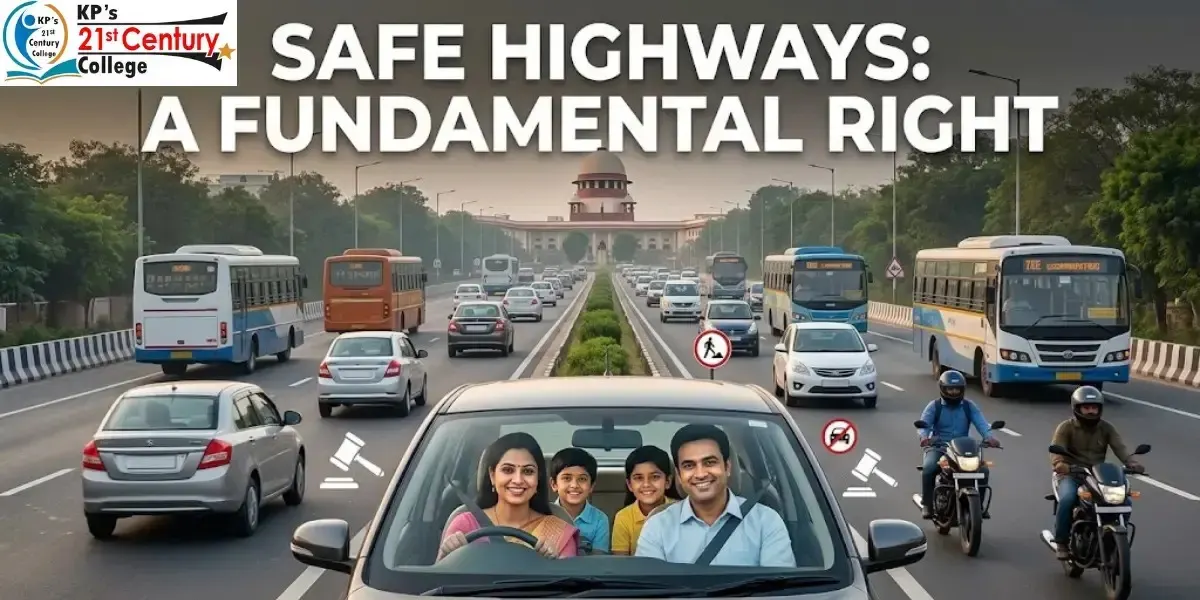
- The Supreme Court of India has declared that the right to safe travel on highways is a part of the fundamental Right to Life under Article 21 of the Constitution.
- The judgment came during a suo motu proceeding initiated after major road accidents in Rajasthan and Telangana in November 2025 caused the death of 34 people.
- The Court observed that roads, especially National Highways and expressways, cannot be allowed to become death traps due to illegal constructions, poor parking management, and administrative negligence.
- It emphasized that the State has a constitutional duty not only to avoid unlawful deprivation of life but also to actively create conditions for safe living, including secure public roads.
Supreme Court Judgment
- The Supreme Court held that safe movement on highways is not merely an administrative matter but a fundamental constitutional guarantee linked to the Right to Life.
- The Court stated that citizens using public roads must not be exposed to avoidable risks caused by poor planning, illegal encroachments, dangerous parking practices, and failure to remove accident-prone blackspots.
- It prohibited the establishment of new dhabas, eateries, fuel points, and commercial structures within the right-of-way of National Highways.Heavy vehicles were directed to park only in designated parking bays and authorized wayside amenities.
- The Court stressed that failure to ensure road safety amounts to failure of governance and violation of constitutional responsibility.
What is the Right to Safe Travel?
- The Right to Safe Travel means that every citizen has the right to use roads and highways without facing unreasonable danger arising from State neglect or infrastructural deficiencies.
- It includes safe road design, proper signage, controlled access, removal of illegal encroachments, scientific traffic management, and prompt correction of accident-prone zones.
- It also includes protection from hazards such as unauthorized roadside structures, illegal parking of heavy vehicles, poor lighting, damaged roads, and lack of emergency response systems
- This concept transforms road safety from a policy issue into a rights-based constitutional obligation.
Article 21 and Expansion of Right to Life
- Article 21 states:
“No person shall be deprived of his life or personal liberty except according to procedure established by law.” - Originally, Article 21 was interpreted narrowly in the A.K. Gopalan v. State of Madras case, where the Supreme Court held that as long as there was a law and the procedure prescribed by that law was followed, deprivation of life or liberty was valid.
- However, in the landmark Maneka Gandhi v. Union of India case, the Court gave Article 21 a broad and dynamic interpretation. It held that the procedure must be just, fair, and reasonable, and not arbitrary, oppressive, or fanciful.
- After this judgment, the meaning of “life” under Article 21 expanded far beyond mere physical survival. The Court held that life means living with human dignity and includes all those aspects that make life meaningful, complete, and worth living.
Why Highway Safety Became a Constitutional Issue
- National Highways constitute only around 2% of India’s total road network but account for nearly 30% of all road fatalities.
- This disproportionate number shows that highways are among the most dangerous spaces for road users despite being the most important transport corridors.
- High-speed traffic combined with poor infrastructure management, roadside encroachments, and absence of scientific parking arrangements increases fatal accident risks.
- Illegal dhabas and roadside commercial establishments often create sudden vehicle stoppages and dangerous turning points.
- Blackspots—locations with repeated accidents—continue to exist because of poor administrative follow-up.
National Highways and Road Safety Crisis
- India records one of the highest numbers of road accident deaths in the world.
- National Highways and expressways, despite better engineering standards, often become sites of high-impact fatal crashes because of speed and unsafe roadside conditions.
- Common causes include over-speeding, fatigue, drunken driving, poor lane discipline, unauthorized access points, roadside settlements, and unregulated parking.
- The National Highways Authority of India (NHAI) and State transport departments often face criticism for weak enforcement and delayed correction of known hazards.
- The Court’s intervention reflects the urgency of shifting from reactive accident response to preventive road governance.
Constitutional Basis of State Responsibility
- Article 21 imposes a positive obligation on the State to protect life.
- This means the State must not only avoid arbitrary action but must also actively ensure conditions necessary for safe existence.
- Road safety falls within this obligation because unsafe highways directly threaten life and dignity.
- Directive Principles such as Article 38 and Article 39 also support this approach by requiring the State to promote welfare and protect human well-being.
- The welfare state model demands that infrastructure be designed for public safety rather than only economic efficiency.
- Therefore, highway safety becomes part of constitutional governance rather than mere transport administration
Important Judgments Related to Article 21
A.K. Gopalan v. State of Madras (1950) The Court gave a narrow interpretation and held that if procedure prescribed by law is followed, deprivation of liberty is valid. Maneka Gandhi v. Union of India (1978) The Court held that procedure must be fair, just, and reasonable and connected Articles 14, 19, and 21 as the “Golden Triangle.” Hussainara Khatoon v. State of Bihar (1979) Recognized the Right to Speedy Trial under Article 21. Olga Tellis v. Bombay Municipal Corporation (1985) Recognized the Right to Livelihood as part of Right to Life. K.S. Puttaswamy v. Union of India (2017) Recognized the Right to Privacy as a Fundamental Right under Article 21. Common Cause v. Union of India (2018) Recognized the Right to Die with Dignity and passive euthanasia. The present highway safety ruling adds the Right to Safe Travel to this expanding constitutional framework. |
Challenges in Implementation
- Removal of illegal roadside structures often faces political and local resistance.
- Coordination between NHAI, State Governments, police departments, and local bodies remains weak.
- Enforcement against heavy vehicle parking violations is inconsistent across states.
- Many highways still lack proper emergency trauma response systems and scientific blackspot correction.
- Data collection on accident causes is often poor, limiting effective policy intervention.
- Without institutional accountability, judicial directions may remain weak at the ground level.
Way Forward
- India must adopt a rights-based approach to road safety rather than treating it only as a transport issue. NHAI and State authorities should conduct mandatory safety audits of all major highways and expressways.
- Accident blackspots must be corrected within fixed timelines with public accountability mechanisms.
- Integrated parking infrastructure and regulated wayside amenities should replace informal roadside stoppages.
- Technology such as AI surveillance, speed cameras, GIS-based blackspot mapping, and emergency response networks should be expanded.
- Road safety education and strict enforcement must complement infrastructure reforms.
Conclusion
The Supreme Court’s declaration that safe highway travel is part of Article 21 marks a major evolution in Indian constitutional law.
It recognizes that the right to life includes not only survival but safe and dignified movement in public spaces.
By linking road safety with fundamental rights, the Court has placed direct constitutional responsibility on the State to prevent avoidable deaths.
This judgment transforms highways from mere transport corridors into spaces where the Constitution itself must protect life.
CARE MCQ
Q. With reference to Article 21 of the Constitution of India, consider the following statements:
- It is available only to citizens of India.
- The Supreme Court has interpreted it to include the Right to Privacy and Right to Safe Travel.
- Article 21 can be suspended during a National Emergency.
Which of the statements given above is/are correct?
A. 2 only
B. 1 and 2 only
C. 2 and 3 only
D. 1, 2 and 3
Ans: (a)
Explanation
Statement 1 is incorrect : Article 21 is available to both citizens and non-citizens.
Statement 2 is correct : the Supreme Court has recognized both the Right to Privacy and the Right to Safe Travel under Article 21.
Statement 3 is incorrect : After the 44th Constitutional Amendment, Articles 20 and 21 cannot be suspended even during a National Emergency.
Q.Consider the following statements with reference to the Maneka Gandhi case (1978):
Statement-I: The Passport Act, 1967 could be subjected to judicial review on the ground that it affected fundamental rights.
Statement-II: The Supreme Court held that the expression “procedure established by law” under Article 21 must be just, fair, and reasonable, and not arbitrary, fanciful, or oppressive.
Which one of the following is correct in respect of the above statements?
(a) Both Statement-I and Statement-II are correct and Statement-II is the correct explanation for Statement-I
(b) Both Statement-I and Statement-II are correct but Statement-II is not the correct explanation for Statement-I
(c) Statement-I is correct but Statement-II is incorrect
(d) Statement-I is incorrect but Statement-II is correct
Ans: (a)
Explanation:
Statement-I is correct:
In the Maneka Gandhi v. Union of India (1978) case, the petitioner challenged the impounding of her passport under the Passport Act, 1967 without being given proper reasons or an opportunity to be heard. The Supreme Court examined whether such a law and executive action could violate fundamental rights, especially under Articles 14, 19, and 21.
The Court held that even a law passed by Parliament could be subjected to judicial review if it violated fundamental rights. Thus, the Passport Act was open to constitutional scrutiny. Therefore, Statement-I is correct.
Statement-II is correct:
Before this judgment, Article 21 was interpreted narrowly after the A.K. Gopalan case, where “procedure established by law” meant any procedure enacted by law, regardless of fairness.
In the Maneka Gandhi case, the Supreme Court expanded this interpretation and held that such procedure must be just, fair, and reasonable, and should not be arbitrary, oppressive, or unreasonable. This introduced the concept of substantive due process into Indian constitutional law and linked Article 21 with Articles 14 and 19. Hence, Statement-II is correct.
Why Statement-II explains Statement-I:
Because the Court interpreted Article 21 to require fairness and reasonableness, any law affecting personal liberty—including the Passport Act—could be tested on these grounds. This is exactly why the Passport Act became subject to judicial review. Therefore, Statement-II directly explains Statement-I.
Q.With reference to landmark Supreme Court judgments, consider the following statements:
- In the Maneka Gandhi case, the Court expanded the scope of Article 21 by ruling that the “procedure established by law” must be fair, just, and reasonable.
- In the Indra Sawhney case, the Court upheld 27% reservation for OBCs and stated that the total reservation should generally not exceed 50%.
- In the S.R. Bommai case, the Court made the imposition of President’s Rule under Article 356 subject to judicial review and laid down safeguards against its misuse.
Which of the statements given above is/are correct?
(a) 1 and 2 only
(b) 2 and 3 only
(c) 1 and 3 only
(d) 1, 2 and 3
Ans: (d)
Explanation:
Statement 1 is correct: The Maneka Gandhi judgment (1978) transformed the interpretation of Article 21 by declaring that any law affecting life and personal liberty must follow a procedure that is fair, just, and reasonable. It rejected the narrow interpretation of Article 21 and established a broader protection of civil liberties.
Statement 2 is correct: In Indra Sawhney v. Union of India (1992), also known as the Mandal case, the Supreme Court upheld the 27% reservation for Other Backward Classes (OBCs) in central services. It also laid down the important principle that total reservations should generally not exceed 50%, except in extraordinary circumstances, and introduced the concept of the creamy layer.
Statement 3 is correct: In S.R. Bommai v. Union of India (1994), the Supreme Court held that the use of Article 356 (President’s Rule) is subject to judicial review. It ruled that the majority of a government should be tested on the floor of the House and not decided arbitrarily by the Governor or the Centre. This judgment became a major safeguard for Indian federalism.
Q. Consider the following pairs of Supreme Court cases and their primary subject matter:
- Vishaka v. State of Rajasthan — Legal recognition of the third gender
- K.S. Puttaswamy v. Union of India — Declaration of Right to Privacy as a fundamental right
- Navtej Singh Johar v. Union of India — Decriminalization of consensual homosexual acts
Which of the pairs given above is/are correctly matched?
(a) 1 and 2 only
(b) 2 and 3 only
(c) 1 and 3 only
(d) 1, 2 and 3
Ans: (b)
Explanation:
Pair 1 is incorrectly matched: The Vishaka case (1997) dealt with sexual harassment of women at the workplace and led to the famous Vishaka Guidelines, which served as the basis for later workplace harassment laws. It was not related to third gender recognition.
The legal recognition of the third gender was given in NALSA v. Union of India (2014). Therefore, Pair 1 is incorrect.
Pair 2 is correctly matched: In K.S. Puttaswamy v. Union of India (2017), the Supreme Court unanimously declared that the Right to Privacy is a fundamental right protected under Article 21 and linked with dignity, liberty, and personal autonomy. Therefore, Pair 2 is correct.
Pair 3 is correctly matched: In Navtej Singh Johar v. Union of India (2018), the Supreme Court struck down the part of Section 377 of the IPC that criminalized consensual homosexual relations between adults. This was a major judgment for LGBTQ+ rights in India. Therefore, Pair 3 is correct.
FAQs
Q1. Which Article protects the Right to Safe Travel?
The Supreme Court has held that safe travel on highways is protected under Article 21 as part of the Right to Life.
Q2. Why did the Supreme Court intervene?
It acted after fatal highway accidents in Rajasthan and Telangana exposed serious road safety failures.
Q3. What is the right-of-way (ROW) on highways?
It is the legally designated land area reserved for the highway and its safe functioning, where unsafe constructions are restricted.
Q4. Can new dhabas be built near National Highways?
The Court has prohibited new dhabas and commercial establishments within the right-of-way of National Highways.
Q5. Which case expanded Article 21 the most?
The most important case is Maneka Gandhi v. Union of India (1978), which made Article 21 broad, dynamic, and rights-oriented.