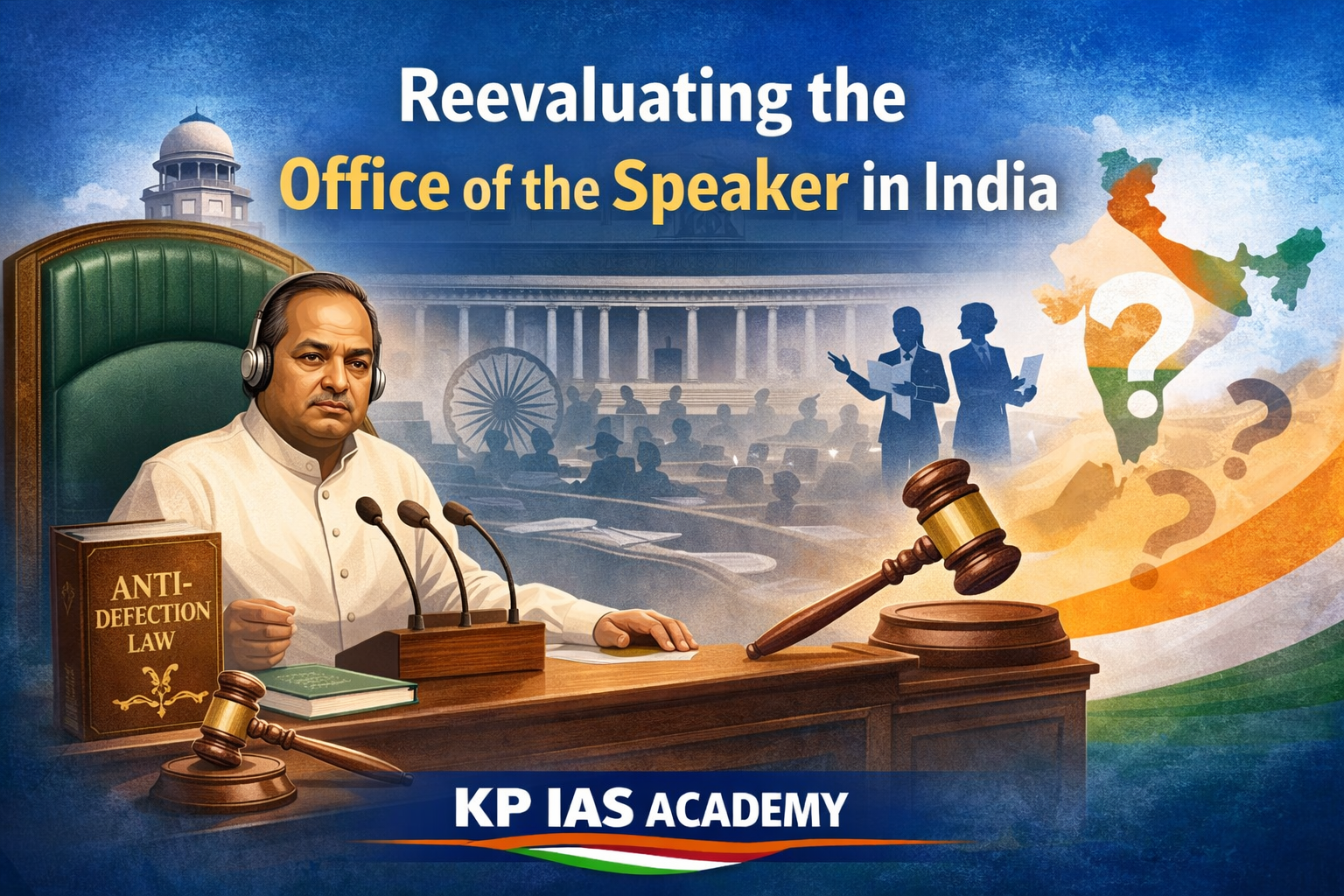
Reevaluating the Office of the Speaker in India
Table of Contents
Relevance: GS Paper II – Polity and Governance – Parliament and State Legislatures – Structure, Functioning, Conduct of Business and Powers & Privileges.
For Prelims:
- Speaker of Lok Sabha, Article 94(c), Removal of Speaker, Rules of Procedure (Lok Sabha Rules 200–203), Money Bill certification, Anti-defection law, Deputy Speaker.
For Mains:
- Parliamentary democracy, neutrality of Speaker, parliamentary conventions, legislative accountability, separation of powers in legislature.
Why in News?
A no-confidence motion against Lok Sabha Speaker Om Birla was moved by Opposition members during the Budget Session of Parliament.
Although the motion is unlikely to succeed, it has revived the debate on the neutrality, accountability, and constitutional role of the Speaker in India’s parliamentary democracy.

Constitutional Position of the Speaker
The Speaker of the Lok Sabha is the presiding officer of the lower house of Parliament and occupies a central role in ensuring the smooth functioning of parliamentary democracy.
Constitutional Provisions
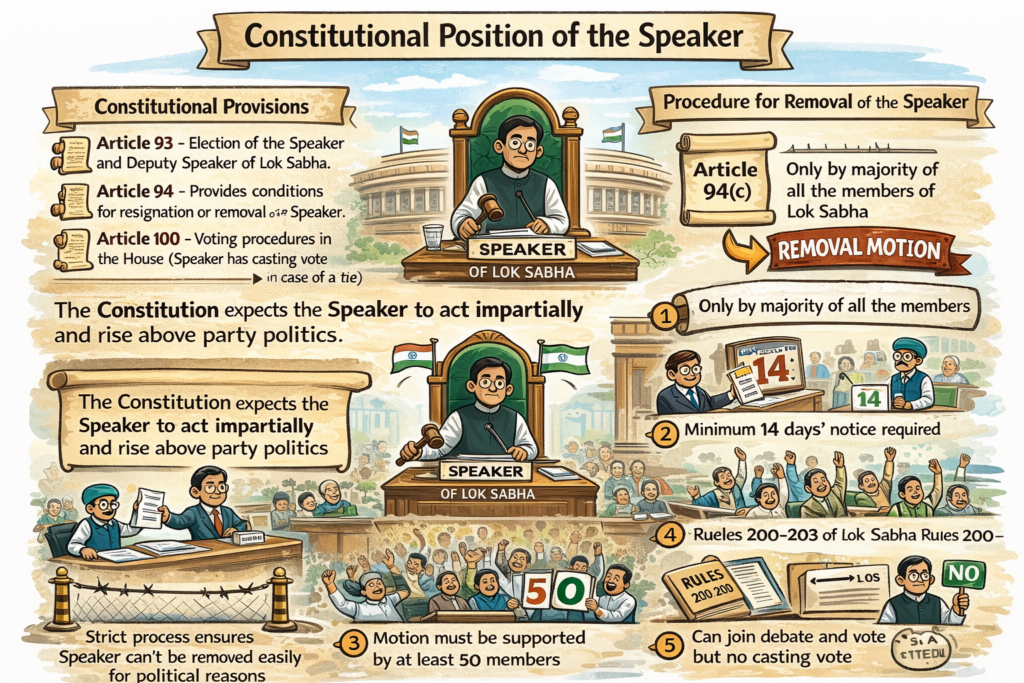
- Article 93 – Election of the Speaker and Deputy Speaker of Lok Sabha.
- Article 94 – Provides conditions for resignation or removal of the Speaker.
- Article 100 – Voting procedures in the House (Speaker has a casting vote in case of a tie).
The Constitution expects the Speaker to act impartially and rise above party politics once elected.
Powers and Functions of the Speaker
The Speaker exercises wide procedural and administrative powers.
Key Functions
1. Presiding Over Proceedings
Maintains order and ensures orderly debate in the Lok Sabha.
2. Interpretation of Rules
Interprets the Rules of Procedure and Conduct of Business.
3. Disciplinary Powers
Can suspend or discipline members for disorderly conduct.
4. Certification of Money Bills
The Speaker’s decision regarding whether a bill is a Money Bill is final.
5. Anti-Defection Decisions
Acts as the authority deciding disqualification under the Tenth Schedule.
6. Protection of Members’ Rights
Safeguards parliamentary privileges and rights of MPs.
These powers make the Speaker one of the most influential constitutional authorities in Parliament.
Procedure for Removal of the Speaker
The Constitution provides a strict procedure to ensure the stability of the office.
Constitutional Provision
Article 94(c) – The Speaker can be removed by a resolution passed by a majority of all the members of the Lok Sabha.
Procedure
- A written notice must be submitted to the Secretary-General of Lok Sabha.
- Minimum 14 days’ notice is required.
- The motion must be supported by at least 50 members to be admitted for discussion.
- Rules 200–203 of Lok Sabha Rules govern the procedure.
- The Speaker can participate in the debate and vote initially, but cannot exercise a casting vote in case of a tie.
The stringent process ensures that the Speaker cannot be removed easily due to political pressure.
Rare No-Confidence Motions Against Speakers
Such motions are extremely rare in India’s parliamentary history.
Previous Attempts
| Year | Speaker | Result |
| 1954 | G.V. Mavalankar | Motion failed |
| 1966 | Hukam Singh | Motion failed |
| 1987 | Balram Jakhar | Motion failed |
These examples show that removing a Speaker is politically and procedurally difficult.
Debate on the Present Motion Against the Speaker
Opposition MPs have raised several concerns regarding the functioning of the Speaker’s office.
Key Allegations by Opposition
- Mass suspension of MPs, including the suspension of 100 Opposition members in December 2023.
- Microphones switched off during speeches of Opposition members.
- Failure to appoint a Deputy Speaker for the last 12 years.
- Restrictions on discussions related to certain issues raised by the Opposition.
The Opposition argues that Parliament must allow both government authority and opposition voice.
Government’s Response
The ruling side argues that the Speaker must maintain discipline and decorum in the House, especially when disruptions occur.
Issues and Challenges in the Speaker’s Office
Several structural and political challenges affect the functioning of the Speaker.
1. Perception of Politicisation
- Decisions related to Money Bills and anti-defection cases are often seen through a partisan lens.
2. Weakening of Parliamentary Conventions
- Traditionally, Speakers maintained strict neutrality, but political competition has weakened these conventions.
3. Rising Parliamentary Disruptions
- Frequent confrontations between ruling and opposition parties lead to procedural deadlocks.
4. Delay in Appointment of Deputy Speaker
- The absence of a Deputy Speaker in Lok Sabha for over a decade raises concerns regarding institutional balance.
5. Erosion of Public Trust
- Allegations of bias can reduce public confidence in parliamentary institutions.
Way Forward
To strengthen the credibility of the Speaker’s office, several reforms may be considered.
1. Reinforcing Neutrality
- Political parties must reaffirm the tradition that the Speaker acts above party politics.
2. Greater Transparency
- Clear explanations for major procedural decisions can reduce allegations of bias.
3. Strengthening Parliamentary Conventions
- Reviving established conventions can improve trust between government and opposition.
4. Codification of Best Practices
- Guidelines regarding discretionary powers of the Speaker may help reduce disputes.
5. Regular Institutional Dialogue
- Consultations between government and opposition can improve legislative productivity.
Conclusion
The office of the Speaker is a cornerstone of India’s parliamentary democracy, responsible for ensuring fair debate and maintaining institutional balance. While the high constitutional threshold protects the Speaker from political pressure, the credibility of the office ultimately depends on perceived neutrality and adherence to parliamentary conventions. Strengthening transparency and restoring trust among political actors are essential for preserving the dignity of Parliament.
UPSC PYQ
Q. With reference to the Speaker of the Lok Sabha, consider the following statements: While any resolution for the removal of the Speaker of the Lok Sabha is under consideration— (UPSC 2024)
- He/She shall not preside.
- He/She shall not have the right to speak.
- He/She shall not be entitled to vote on the resolution in the first instance.
Which of the statements given above is/are correct?
A) 1 only
B) 1 and 2 only
C) 2 and 3 only
D) 1, 2 and 3
Answer: A) 1 only
Explanation
This provision comes from Article 96 of the Constitution of India.
- Statement 1 – Correct:
When a resolution for the removal of the Speaker is under consideration, the Speaker shall not preside over the sitting of the House, though he/she may remain present. - Statement 2 – Incorrect:
The Speaker can speak and participate in the proceedings of the House during the debate on the removal resolution. - Statement 3 – Incorrect:
The Speaker can vote in the first instance on the resolution but cannot exercise a casting vote in case of a tie.
Constitutional Source:
- Article 96(1) – Constitution of India (Speaker or Deputy Speaker not to preside while a resolution for his/her removal is under consideration).
CARE MCQ
Q. With reference to the Speaker of the Lok Sabha, consider the following statements:
- The Speaker can be removed by a resolution passed by a majority of all the members of the Lok Sabha.
- During the debate on a motion for his/her removal, the Speaker cannot participate in the proceedings.
- The decision of the Speaker regarding certification of a Money Bill is final.
How many of the above statements are correct?
(a) Only one
(b) Only two
(c) All three
(d) NoneAnswer: (b) Only two
Explanation
Statement 1 – Correct: Article 94(c) provides that the Speaker can be removed by a majority of all the members of Lok Sabha.
Statement 2 – Incorrect: During the debate on the motion for removal, the Speaker may participate and vote initially, but cannot exercise a casting vote in case of a tie.
Statement 3 – Correct: The Speaker’s decision regarding Money Bill certification is final