- Foundations of Molecular Biology and Cytology
- Introduction and Principles of Biotechnology
- Tools of Genetic & Techniques of Genetic Engineering
- Advanced Genetic Techniques
- Bio Technology in Healthcare, Medicine, and Diagnostics (Red Biotechnology)
- Agricultural Biotechnology
- Animal and Aquaculture Biotechnology
- Environmental Biotechnology
- Industrial Biotechnology and Energy Production
- Biotechnology Prelims Mcq
- UPSC Mains Previous Year Questions –Biotechnology
Recombinant Vaccine
What are Recombinant Vaccines
Recombinant vaccines are produced by inserting genes encoding antigens from a pathogen into microbial cells, which then express these proteins. These antigens, when administered, stimulate an immune response without using the whole pathogen.
Types of Recombinant Vaccines
1. Live Genetically Modified Vaccines
- In this type, a live pathogenic organism (bacteria or virus) is genetically modified to make it non-pathogenic by deleting or inactivating one or more of its genes. These genetically weakened agents, when introduced into the host, trigger an immune response without causing disease.
- A subtype includes vector-based vaccines, where a gene from a different pathogen is inserted into a harmless carrier virus. For example, Vaccinia virus, a member of the poxvirus family with a large double-stranded DNA genome, has been used to create multivalent vaccines by inserting genes from pathogens like Hepatitis B virus, Herpes simplex virus, and Influenza virus.
The process involves:
- Cloning a portion of vaccinia virus DNA into a plasmid insertion vector.
- Inserting antigenic genes from multiple pathogens into this plasmid.
- Recombining this with the vaccinia virus genome to create a recombinant vaccinia virus capable of expressing foreign antigens.
- This method enables the development of polyvalent vaccines, offering protection against multiple diseases simultaneously.
2. Recombinant Subunit Vaccines
- Subunit vaccines contain only a specific part of the pathogen, usually a protein antigen, rather than the whole organism. These proteins can be synthetically produced or expressed from cloned genes in microbial systems such as yeast (eukaryotic) or E. coli (prokaryotic).
- An excellent example is the Hepatitis B vaccine, where the surface antigen gene HBsAg is cloned into the pMA56 yeast plasmid vector and expressed in Saccharomyces cerevisiae. This gene is fused with a strong promoter and other regulatory sequences to ensure effective expression and selection in yeast cells. The resulting protein is purified and used for immunization.
- This was the first recombinant subunit vaccine licensed for public use in 1987, marketed under names like Recombivax® and Engerix-B®.
3. DNA Vaccines
- DNA vaccines represent a breakthrough in vaccine technology. Here, the gene encoding the antigenic protein is cloned into a plasmid DNA vector, which includes promoter, terminator, origin of replication, and selection markers. This plasmid DNA is then injected directly into the muscle of the patient using methods such as a gene gun or nasal spray.
- Once inside the body, the muscle cells take up the DNA, express the antigen, and initiate a humoral and cellular immune response. DNA vaccines are considered safe, do not involve live pathogens, and can be rapidly developed in response to emerging diseases.
4. RNA Vaccines
- RNA vaccines consist of messenger RNA (mRNA) encoding the desired antigen. Upon injection, antigen-presenting cells (APCs) take up the mRNA and produce the protein antigen, triggering both antibody-mediated and cell-mediated immune responses.
Since RNA is unstable, various modifications like 5’ capping, 3’ poly-A tail, and formulation in lipid nanoparticles (LNPs) are used to improve stability and cellular uptake. RNA vaccines offer several advantages:
- Rapid development and adaptation to viral mutations.
- Cell-free production, reducing the risk of contamination.
- Low-dose requirement, and potential for single-dose protection.
During the COVID-19 pandemic, RNA vaccines such as Pfizer-BioNTech and Moderna emerged as highly effective tools. While India used Covaxin (inactivated virus) and Covishield (adenovirus-based DNA vaccine), RNA vaccine platforms were also rapidly developed globally in response to emerging variants.
- Efforts are ongoing to improve the thermostability of RNA vaccines using lyophilization (freeze-drying) and thermostable nanoparticle formulations, making them easier to store and distribute.
Edible Vaccines
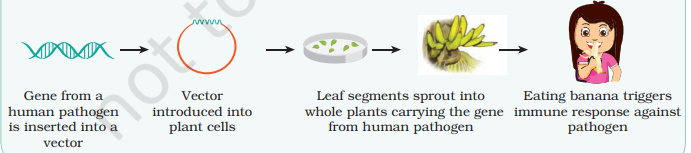
A unique application of recombinant DNA technology is the development of edible plant-based vaccines. Here, antigenic genes are inserted into crop plants like banana, tobacco, tomato, and rice using bacterial vectors such as Agrobacterium tumefaciens or microprojectile bombardment.
When these genetically modified plant parts are consumed, they trigger the mucosal immune system to respond. For instance, Hepatitis B vaccine has been successfully developed using banana as a delivery medium. Banana is ideal due to its digestibility, availability, and palatability, especially for children.