

- Foundations of Molecular Biology and Cytology
- Introduction and Principles of Biotechnology
- Tools of Genetic & Techniques of Genetic Engineering
- Advanced Genetic Techniques
- Bio Technology in Healthcare, Medicine, and Diagnostics (Red Biotechnology)
- Agricultural Biotechnology
- Animal and Aquaculture Biotechnology
- Environmental Biotechnology
- Industrial Biotechnology and Energy Production
- Biotechnology Prelims Mcq
- UPSC Mains Previous Year Questions –Biotechnology
Meristem
Plants grow differently from animals. While animals grow uniformly across their bodies up to a certain age, plants continue to grow throughout their lifespan. However, this growth does not happen everywhere at once. It is restricted to specific regions within the plant. These active growth regions contain specialized, continuously dividing tissues known as meristematic tissues or simply meristem.
Characteristics of Meristematic Cells: The primary function of a meristem is to produce new cells for the plant’s growth. To achieve this, the cells in these regions have specific features:
- They are highly active and divide rapidly.
- They have dense cytoplasm and thin cell walls.
- They have prominent nuclei.
- They usually lack vacuoles, as they do not need to store food; their main job is rapid division.
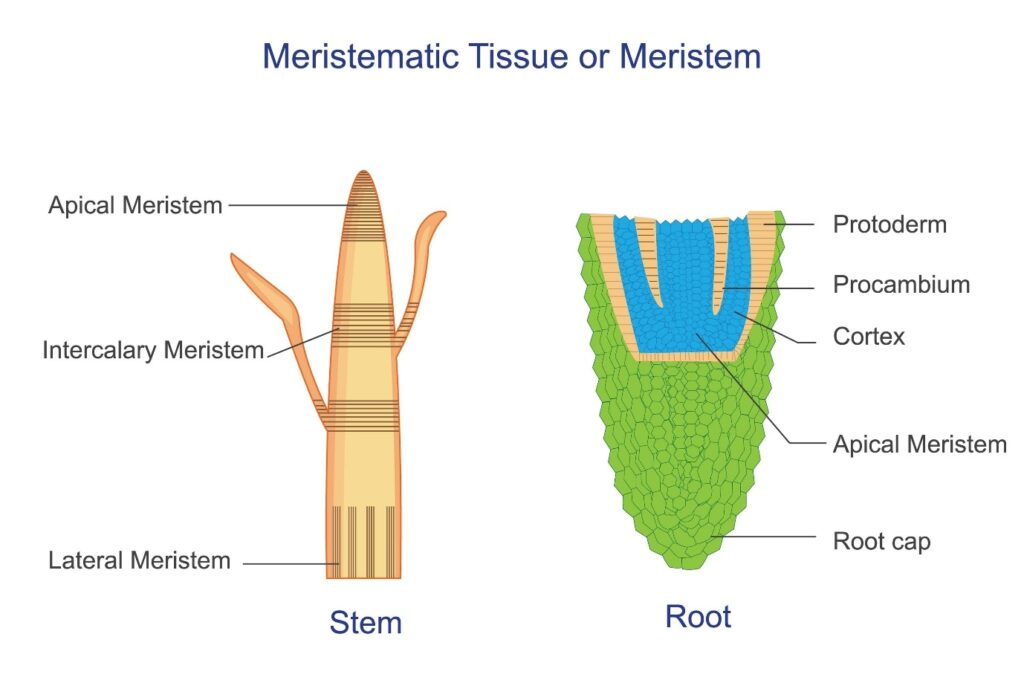
Types of Meristematic Tissue: Based on their location in the plant body, meristems are classified into three main types:
- Apical Meristem: This tissue is located at the growing tips of stems and roots. Its continuous division increases the length of the stem and the roots. This process is known as primary growth. It allows the plant to reach sunlight above ground and water deep in the soil.
- Lateral Meristem: Found beneath the bark (often called cambium) and in vascular bundles of dicot roots and stems. The lateral meristem is responsible for increasing the thickness or girth of the plant. This process is known as secondary growth, which turns thin green stems into thick, woody tree trunks.
- Intercalary Meristem: This tissue is located at the base of leaves or internodes (the space between two nodes on a stem). It is commonly found in grasses and bamboo. It helps in increasing the length of the internodes and allows the plant to quickly regrow parts that are eaten by grazing animals.
Significance of Meristem in Plant Biotechnology:
Beyond natural plant growth, the apical meristem holds special importance in modern agriculture and tissue culture. The rate of cell division in the apical meristem is so rapid that viruses cannot keep up with it. Therefore, even if a plant is heavily infected with a virus, its apical meristem remains completely virus-free. Scientists extract this meristem and grow it in a laboratory using tissue culture to cultivate healthy, disease-free crops from infected parent plants.
Plants need sunlight, water, oxygen, and minerals to grow—these are external factors. But plants also have internal chemicals that control how they grow, when they flower, how fruits ripen, or when leaves fall. These internal chemicals are called plant hormones or phytohormones.
Plant hormones are divided based on their functions:
1.Growth Promoters – These help in plant growth.
o Auxins – Help in cell elongation and root formation.
o Gibberellins – Help in stem growth, seed germination, and flowering.
o Cytokinins – Promote cell division and delay aging in leaves.
2. Growth Inhibitors – This slow down growth.
o Abscisic Acid – Helps in closing stomata and promotes dormancy (resting phase) in seeds and buds.
2. Both Growth Promoter and Inhibitor
o Ethylene – It promotes fruit ripening but also helps in leaf fall and flower aging.
