Why in News?
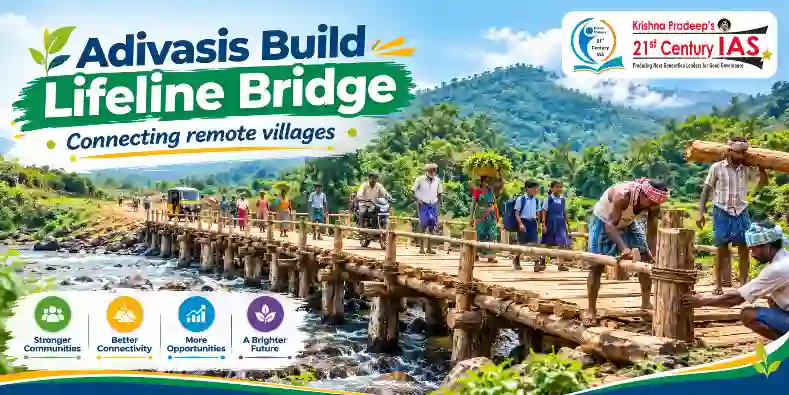
Nearly 100 Adivasis from eight villages constructed a 100-metre wooden bridge across a stream between Lothugedda and Boyapadu in Chintapalli mandal of Andhra Pradesh’s Alluri Sitarama Raju district. The community acted after the earlier bridge, built by the Panchayat Raj Department, was washed away in 2024 and was not replaced.
Community Construction of the Bridge
Construction began on August 8, 2026, and was completed on August 15, when the villagers also celebrated Independence Day.
The participating villages were:
- Boyapadu
- Vanajajula
- Kappala
- K. Bennavaram
- Karakapalli
- Godugumamidi
- T. Korukonda
- Mulagondi
The community used timber collected from forest trees and contributed labour without spending money on construction. The completed structure can support pedestrians, motorcycles and autorickshaws.
A similar bridge built by Adivasis at T. Korukonda in the previous year was reported to be functioning despite exposure to seasonal weather.
Why was the Bridge Necessary?
The absence of a crossing created difficulties in accessing essential services.
- Children faced obstacles while travelling to school.
- Patients struggled to reach hospitals.
- Farmers and forest-dependent families could not easily transport produce.
- Residents faced difficulty reaching weekly tribal markets or shandies.
- Motorised transport between the villages remained disrupted.
The bridge therefore served as an essential communication link rather than merely a local convenience.
Wider Infrastructure Deficit
- The incident reflects the continuing shortage of all-weather roads, culverts and bridges in remote Agency areas.
- A culvert at Chinna Gangavaram in Darakonda panchayat of G.K. Veedhi mandal was recently washed away following heavy rain. Such failures show the vulnerability of local infrastructure to intense rainfall and stream flow.
Government records indicate that several works have been sanctioned in ASR district, including:
- A bridge between Jajigonda and Bodidevulu in Paderu
- A low-level causeway between Chamagedda and Nadimveedhi
- A four-vent slab culvert between Akuru and Badigunta
- A ₹1.89-crore bridge on the Ganugurolu–Bangarubudi road in G. Madugula mandal
The central governance issue is therefore timely execution, quality control and maintenance of sanctioned projects.
Constitutional
- Many tribal habitations in the district fall within Scheduled Areas governed by the Fifth Schedule of the Constitution.
- Article 46 directs the State to promote the educational and economic interests of Scheduled Tribes and protect them from social injustice and exploitation.
- The Panchayats (Extension to Scheduled Areas) Act, 1996, strengthens the role of Gram Sabhas in local planning and management of community resources. Tribal participation should therefore be incorporated into infrastructure planning rather than being limited to emergency self-help.
Conclusion
The wooden bridge reflects both the resilience of Adivasi communities and the continuing infrastructure gap in remote Agency areas. Tribal participation should complement, but cannot replace, the State’s responsibility to provide safe and reliable public infrastructure. Responsive administration and climate-resilient engineering are essential for inclusive regional development.