Table of Contents
Relevance: UPSC GS Paper III: MSMEs, employment, inclusive growth, digital economy and skill development
Prelims: PM Vishwakarma, Central Sector Scheme, Ministry of MSME, 18 traditional trades, Udyam Assist Platform, Common Service Centres, GeM, ONDC, One Station One Product, AVSAR, TRIFED.
Mains: Artisan economy, informal sector, financial inclusion, cultural preservation, skill upgradation, enterprise formalisation, digital inclusion, market linkages, Guru-Shishya tradition, inclusive growth.
Why in News?
PM Vishwakarma, launched on 17 September 2023, is approaching its third anniversary. The scheme has achieved its registration target of 30 lakh beneficiaries.It has provided traditional artisans with skill training, modern toolkits, collateral-free loans, digital transaction incentives and wider market access. A concurrent evaluation by IIM Mumbai also found that a large proportion of surveyed beneficiaries reported income improvements after training.
About PM Vishwakarma
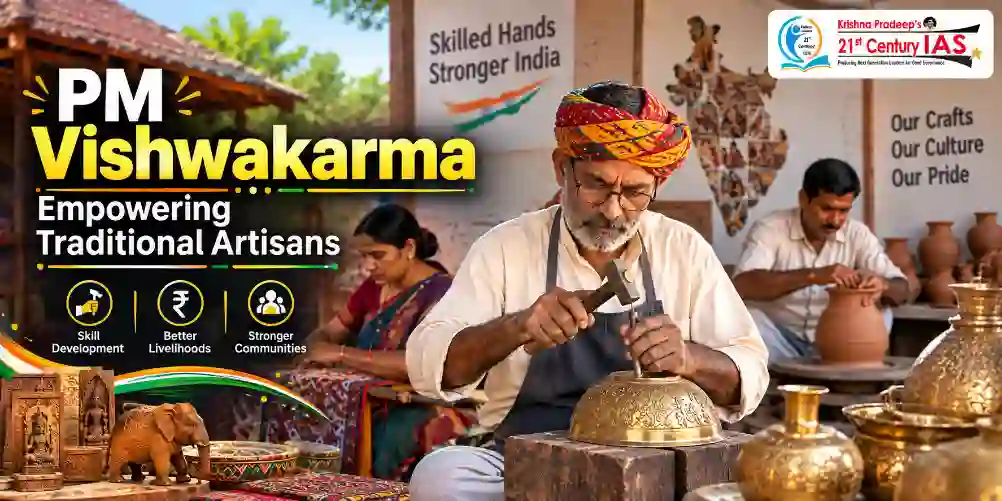
PM Vishwakarma is a Central Sector Scheme designed to provide end-to-end support to artisans and craftspeople engaged in traditional, family-based occupations.
The scheme recognises that traditional artisans contribute to:
- India’s cultural heritage;
- the rural and urban informal economy;
- local employment;
- family-based skill transmission; and
- production of handmade goods and services.
It was launched with an outlay of ₹13,000 crore for the period from 2023–24 to 2027–28. The scheme covers artisans working in 18 notified traditional trades.
The Ministry of Micro, Small and Medium Enterprises is the nodal ministry. The scheme is implemented with support from the Ministry of Skill Development and Entrepreneurship and the Department of Financial Services.
Objectives of the Scheme
PM Vishwakarma seeks to:
- recognise artisans as Vishwakarmas;
- improve their skills through structured training;
- provide modern and efficient tools;
- facilitate access to affordable institutional credit;
- promote digital transactions;
- strengthen branding, packaging and marketing;
- connect artisans with domestic and global supply chains;
- promote formalisation of informal micro-enterprises; and
- preserve the Guru-Shishya parampara and family-based traditional knowledge.
Guiding Pillars
The scheme is based on three principles:
- Samman: Recognition and respect for traditional artisans
- Samarthya: Improvement of skills, productivity and enterprise capacity
- Samriddhi: Higher income, market access and long-term prosperity
Who Is Eligible?
The scheme is open to artisans and craftspeople who:
- are at least 18 years of age;
- work with their hands and tools;
- are engaged in one of the 18 notified traditional trades;
- work in the unorganised sector;
- are self-employed; and
- satisfy the prescribed family and credit-related conditions.
Important Eligibility Conditions
- One beneficiary per family: Registration is limited to one member of a family. For this purpose, a family includes the husband, wife and unmarried children.
- No government employee: A person in government service and members of his or her family are not eligible.
- Credit-related restriction: Applicants should generally not have availed loans under similar government credit-based self-employment schemes during the preceding five years.
- However, beneficiaries of Pradhan Mantri MUDRA Yojana and PM SVANidhi who have fully repaid their loans are eligible.
Traditional Trades Covered
PM Vishwakarma covers the following 18 family-based traditional trades:
- Carpenter
- Boat maker
- Armourer
- Blacksmith or metalsmith
- Hammer and toolkit maker
- Locksmith
- Goldsmith
- Potter
- Sculptor and stone breaker
- Cobbler, shoesmith and footwear artisan
- Mason
- Basket, mat and broom maker or coir weaver
- Doll and toy maker
- Barber
- Garland maker
- Washerman
- Tailor
- Fishing-net maker
Major Components of PM Vishwakarma
Recognition
After registration and verification, every eligible beneficiary receives:
- a PM Vishwakarma Certificate; and
- a PM Vishwakarma Identity Card.
The certificate provides formal recognition to artisans whose occupations have traditionally remained outside organised economic systems.
Skill Upgradation
Training introduces artisans to modern tools, improved production techniques, innovative designs, digital payments, entrepreneurship and marketing.
- Basic Training: Five to seven days
- Advanced Training: Fifteen days or more
- Training stipend: ₹500 per day
Skill training seeks to improve product quality and productivity without removing the traditional character of the craft.
Toolkit Incentive
Eligible beneficiaries receive a toolkit incentive of up to ₹15,000 to purchase modern tools relevant to their occupation.
Improved tools can:
- reduce physical effort;
- increase production speed;
- improve product quality; and
- strengthen workplace safety.
Collateral-Free Credit Support
The scheme provides collateral-free Enterprise Development Loans of up to ₹3 lakh in two tranches.
First Tranche
- Loan amount: Up to ₹1 lakh
- Repayment period: 18 months
- Eligibility: Completion of Basic Training
Second Tranche
- Loan amount: Up to ₹2 lakh
- Repayment period: 30 months
- Eligibility: Timely repayment of the first loan and either adoption of digital transactions or completion of Advanced Training
The beneficiary pays a concessional interest rate of 5%. The government bears an interest subvention of up to 8%.
Digital Transaction Incentive
Beneficiaries receive ₹1 for every eligible digital payment or receipt, subject to a maximum of 100 transactions per month.
The incentive encourages artisans to:
- create formal transaction records;
- reduce dependence on cash;
- improve financial transparency;
- establish a digital business history; and
- access formal credit more easily.
Marketing Support
The scheme provides support through:
- branding and packaging;
- quality certification;
- trade fairs and exhibitions;
- advertising and publicity;
- e-commerce onboarding;
- Government e-Marketplace;
- buyer-seller linkages; and
- domestic and international market promotion.
Formalisation Through Udyam Assist
- PM Vishwakarma beneficiaries are onboarded on the Udyam Assist Platform.
- The platform registers informal micro-enterprises and provides them with an Udyam Registration Number and certificate. This helps artisans enter the formal MSME ecosystem and access applicable government benefits.
- Formalisation can improve their access to banking services, markets, procurement opportunities and enterprise-development programmes.
Progress Under PM Vishwakarma
As of 15 September 2026, the scheme recorded the following progress:
- Registration target of 30 lakh beneficiaries achieved
- More than 24.37 lakh artisans completed Basic Training
- More than 18.16 lakh beneficiaries received toolkits
- Over 6.19 lakh loans, worth approximately ₹5,316 crore, sanctioned
- More than 8.11 lakh beneficiaries received digital incentives
- Over ₹42 crore disbursed as digital transaction incentives
- More than 12,000 artisans trained to use artificial intelligence tools
The AI training covers areas such as:
- product design;
- branding;
- packaging;
- marketing; and
- digital presentation of products.
Market Access Initiatives
Exhibitions and Outreach
The scheme has organised:
- more than 1,500 awareness programmes and camps;
- over 50 workshops;
- 82 trade fairs;
- 37 State-level exhibitions; and
- more than 50 flash-mob awareness activities.
The first PM Vishwakarma National Exhibition-cum-Trade Fair was held at Dilli Haat, New Delhi, from 17 to 31 January 2026.
More than 117 artisans participated, recording sales of over ₹2 crore. The event attracted more than 60,000 visitors, including foreign diplomats and senior government officials.
E-Commerce Integration
More than 30,000 beneficiaries have been onboarded on platforms such as:
- Government e-Marketplace
- Open Network for Digital Commerce
- Meesho
- Amazon
- Fabindia
- Sulekha
The Ministry of MSME has also signed an MoU with Amazon to facilitate the onboarding of eligible artisans.
Market Support for Divyangjan Artisans
- The scheme uses the One Station One Product initiative to provide retail space to Divyangjan Vishwakarma artisans at selected high-footfall railway stations.
- More than 42 Divyangjan beneficiaries, representing different trades, have received stalls across 14 States and Union Territories.
- Artisan stalls have also been established at airports, including Bhopal and Chandigarh, under the AVSAR scheme of the Ministry of Civil Aviation.
Branding and Packaging
- In collaboration with the Indian Institute of Packaging, workshops were organised across six cities. Around 1,500 artisans, with 250 participants from each city, were trained in packaging and branding.
- The Ministry has also collaborated with TRIFED to organise Tribal Artisan Melas and connect tribal PM Vishwakarma beneficiaries with platforms such as Tribes India.
- Products have also been displayed through stalls in selected hotels and resorts in States and Union Territories such as Bihar, Gujarat, Goa, Himachal Pradesh, Odisha and Puducherry.
Significance of PM Vishwakarma
Recognition of Informal Workers
Traditional artisans have often remained outside formal databases and welfare systems. Certification, identity cards and Udyam registration give them an officially recognised economic identity.
Preservation of Cultural Heritage
The scheme supports the transmission of traditional skills through families and the Guru-Shishya tradition. It links cultural preservation with viable livelihood opportunities.
Financial Inclusion
Collateral-free loans reduce dependence on informal moneylenders. Concessional interest lowers the cost of enterprise development.
Modernisation Without Displacement
Skill training and toolkits introduce modern technology while allowing artisans to retain their traditional occupations and local identity.
Women and Social Empowerment
Many traditional occupations involve women and socially vulnerable communities. Training, formal credit and market access can improve their income and participation in household decisions.
Digital Inclusion
Digital transaction incentives, AI training and e-commerce onboarding connect traditional artisans with the expanding digital economy.
Local Employment
The scheme promotes self-employment and decentralised production. It can reduce distress migration by creating livelihood opportunities within local communities.
Major Challenges
- Low digital literacy: Some artisans may find e-commerce, digital payments and AI tools difficult to use.
- Unequal market access: Artisans in remote regions may remain disconnected from transport, logistics and organised markets.
- Working-capital constraints: Toolkit support alone may not meet the recurring cost of raw materials and production.
- Design and quality gaps: Traditional products must meet changing consumer preferences without losing authenticity.
- Credit absorption: Some beneficiaries may hesitate to borrow because of uncertain market demand and repayment concerns.
- Intermediary dependence: Artisans may receive only a small portion of the final sale price.
- Limited social security: Credit and skills do not automatically provide health insurance, pensions or protection against livelihood shocks.
- Risk of standardisation: Excessive commercialisation may reduce regional diversity and weaken the cultural identity of traditional crafts.
- Monitoring quality: Achieving registration targets must be followed by assessment of income, productivity and enterprise sustainability.
Way Forward
- Develop trade-specific artisan clusters with common production and storage facilities.
- Provide continuous mentoring after completion of formal training.
- Strengthen partnerships with design institutes, technical universities and packaging institutions.
- Improve transport, logistics and digital support in remote craft-producing regions.
- Facilitate access to working capital and suitable micro-insurance products.
- Promote direct-to-consumer marketing to reduce dependence on intermediaries.
- Use geographical indications and authenticity certification to protect traditional knowledge.
- Reserve suitable procurement opportunities for artisan products on GeM.
- Provide regional-language digital training and assisted e-commerce services.
- Link artisans with social-security schemes, pensions and health protection.
- Measure success through sustained income, loan repayment, market expansion and enterprise continuity—not merely registration numbers.
Conclusion
PM Vishwakarma provides an integrated framework of recognition, skills, tools, credit, digital incentives and marketing support to traditional artisans. It seeks to transform hereditary skills into sustainable micro-enterprises without separating them from their cultural roots. Its long-term success will depend on continuous mentoring, fair market access, social security and protection of craft diversity. A strong artisan economy can support inclusive growth while preserving India’s living cultural heritage.
CARE MCQ
Q1. Consider the following statements regarding PM Vishwakarma:
- It is a Central Sector Scheme covering 18 traditional trades.
- It provides collateral-free Enterprise Development Loans in two tranches.
- Registration is directly approved by Common Service Centres without verification by local bodies.
Which of the statements given above are correct?
(a) 1 only
(b) 1 and 2 only
(c) 2 and 3 only
(d) 1, 2 and 3
Answer: (b) 1 and 2 only
Statement-wise Explanation
Statement 1 is correct: PM Vishwakarma is a Central Sector Scheme covering 18 notified family-based traditional trades.
Statement 2 is correct: It provides collateral-free loans of up to ₹3 lakh—₹1 lakh in the first tranche and ₹2 lakh in the second.
Statement 3 is incorrect: Applications are submitted through CSCs, but verification and approval involve the Gram Panchayat or Urban Local Body, District Implementation Committee and Screening Committee.
FAQs
1. When was PM Vishwakarma launched?
It was launched on 17 September 2023.
2. How many traditional trades are covered?
The scheme covers 18 family-based traditional trades.
3. What is the maximum collateral-free loan available?
An eligible beneficiary can receive up to ₹3 lakh in two tranches.
4. What toolkit support is provided?
Eligible artisans receive a toolkit incentive of up to ₹15,000.
5. How does the scheme promote formalisation?
Beneficiaries receive official recognition and are onboarded on the Udyam Assist Platform.
6. What are the three pillars of PM Vishwakarma?
The three pillars are Samman, Samarthya and Samriddhi.