Table of Contents
Relevance: GS Paper III: Agriculture, rural economy, MSMEs, inclusive growth, environment and green technology
Prelims: Bamboo, Bambusoideae, Poaceae, Indian Forest Act, 1927, 2017 amendment, National Bamboo Mission, NECTAR, engineered bamboo, Gadchiroli Agarbatti Project, CSIR-NEERI, Self-Help Groups.
Mains: Green economy, rural entrepreneurship, women-led development, bamboo value chain, sustainable construction, tribal livelihoods, circular economy, local value addition, bioeconomy, climate-resilient livelihoods.
Why in News?
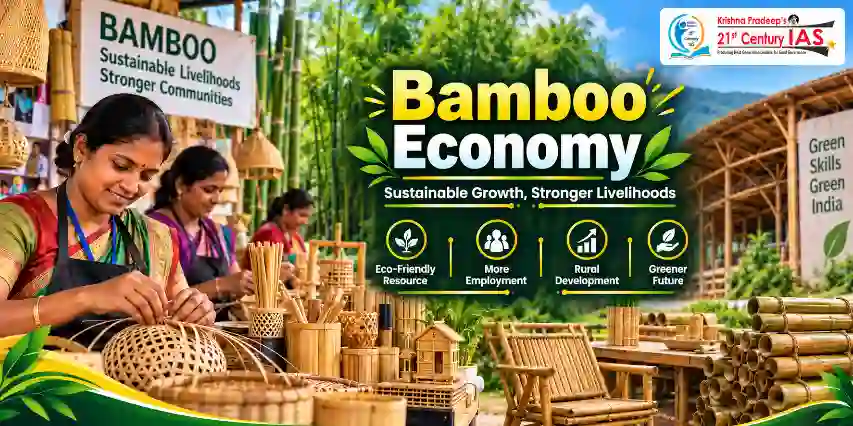
Bamboo has gained attention as a sustainable resource capable of supporting rural employment, tribal livelihoods, women-led enterprises, handicrafts, construction and green industries.At the SARAS Aajeevika Mela 2026 in Gurugram, bamboo products made by rural women entrepreneurs demonstrated how traditional skills, policy reforms and government support are transforming bamboo into a modern commercial resource.
About Bamboo
Bamboo belongs to the subfamily Bambusoideae of the grass family Poaceae. It includes more than 115 genera and 1,400 species distributed mainly across tropical, subtropical and mild temperate regions.
Important Characteristics
- Bamboo is an evergreen and perennial plant.
- It has woody and usually hollow stems that develop from underground rhizomes.
- Some bamboo species can grow by nearly 30 centimetres a day under favourable conditions.
- Bamboo regenerates rapidly after harvesting, making it a renewable biological resource.
- It is generally propagated through vegetative methods such as stem cuttings because its flowering and seed production are irregular.
- It grows well in warm climates and well-drained sandy to clay soils.
- It is often called “poor man’s timber” because of its affordability, versatility and importance to rural livelihoods.
Bamboo is used to produce baskets, fishing equipment, musical instruments, furniture, incense sticks, food products, housing materials, handicrafts and modern construction components.
India’s bamboo resources are concentrated mainly in the northeastern States of Arunachal Pradesh, Assam, Manipur, Meghalaya, Mizoram, Nagaland, Sikkim and Tripura.
Policy Reform of 2017
- Under the Indian Forest Act, 1927, bamboo was legally treated as a “tree”. Consequently, its harvesting, transit and transportation were subject to forestry regulations. This discouraged farmers and private enterprises from taking up bamboo cultivation outside forests.
- In 2017, the Act was amended to exclude bamboo grown on non-forest land from the definition of a tree.
Impact of the Reform
The amendment:
- simplified harvesting and transportation of bamboo grown outside forests;
- encouraged commercial bamboo cultivation by farmers;
- promoted investment in processing and manufacturing;
- created opportunities for artisans, Self-Help Groups and MSMEs;
- facilitated local value addition in bamboo-rich regions; and
- strengthened the potential of bamboo as an agricultural and industrial raw material.
However, bamboo located inside notified forest areas continues to be regulated under applicable forest laws.
India’s Emerging Bamboo Economy
Bamboo is moving beyond its traditional association with handicrafts. It is increasingly used in furniture, interior decoration, processed foods, renewable energy and construction materials.
Different States illustrate this transition:
- Sikkim: Women-led enterprises produce furniture, handicrafts, incense sticks and interior decoration products.
- Tripura: Manufacturers are adopting technology to improve bamboo-product manufacturing.
- Nagaland: SHGs and local enterprises are producing bamboo food items, furniture and handicrafts.
- Mizoram: Scientific cultivation is being promoted through tissue culture and poly-house management.
- Assam: Women artisans are connecting traditional bamboo skills with urban markets and trade exhibitions.
This diversification can reduce the dependence of rural producers on the sale of untreated bamboo poles and enable them to earn more through finished products.
National Bamboo Mission
- The National Bamboo Mission (NBM) was launched in 2006–07. It has been implemented as a restructured Centrally Sponsored Scheme since 2018–19.
- The Mission promotes the holistic development of the bamboo sector through a cluster-based approach. It connects farmers, processors, manufacturers and markets across the bamboo value chain.
Major Areas of Support
- Expansion of bamboo cultivation on suitable non-forest land
- Establishment and strengthening of nurseries
- Availability of quality planting material
- Processing and value-addition facilities
- Training and capacity-building for farmers and artisans
- Development of markets for bamboo products
- Creation of linkages between farmers and industries
- Promotion of region-specific bamboo varieties and products
The Mission seeks to establish bamboo as “Green Gold”—a renewable resource that supports livelihoods, industrial growth and the green bioeconomy.
Farm-Level Impact
- In Madhya Pradesh, farmer Vijay Patidar shifted towards bamboo cultivation after suffering losses from conventional crops. With assistance under the Mission, he planted around 4,000 bamboo saplings.
- He earned approximately ₹75,000 from selling bamboo poles within two years. The plantation also allowed him to intercrop chilli, capsicum, ginger and garlic. This shows that bamboo can function as both a long-term asset and a source of livelihood diversification.
Technology and Value Addition
- The economic potential of bamboo depends on processing, product design, machinery, skills and market access. Without these facilities, farmers may receive only a small share of the value generated from the final product.
- The North East Centre for Technology Application and Reach (NECTAR) has supported the application of bamboo technology in:
- food and agro-processing;
- manufacturing machinery;
- construction materials;
- renewable energy;
- industrial products;
- furniture and interior design.
- These interventions are estimated to generate around 30 million man-days of employment annually. They have also increased value addition in bamboo commodities from about 10% to as high as 70%.
Skill Development
In June 2026, CSIR–National Environmental Engineering Research Institute (CSIR-NEERI), Nagpur, organised a five-day bamboo-handicraft training programme for women SHGs.
The programme covered:
- bamboo harvesting and treatment;
- processing techniques;
- handicraft production;
- product development and design;
- entrepreneurship;
- branding and marketing.
It also demonstrated the possibility of cultivating bamboo on reclaimed fly-ash dumping sites, connecting livelihood creation with the productive restoration of degraded land.
Engineered Bamboo
- Engineered bamboo is a composite material manufactured by binding and compressing bamboo fibres, strips or particles. It provides bamboo with greater uniformity, strength and durability for construction and industrial applications.
- More than 42 lakh square feet of engineered bamboo structures have been created for disaster relief and rehabilitation. In Chhattisgarh, 576 school classrooms made from engineered bamboo provide educational space for nearly 20,000 children.
Importance of Engineered Bamboo
- Expands bamboo use beyond conventional handicrafts
- Provides a renewable alternative to some traditional construction materials
- Creates demand for processed bamboo
- Encourages innovation in architecture and interior design
- Supports prefabricated construction for schools and disaster relief
- Increases income opportunities across the value chain
Quality standards, fire resistance, structural testing and long-term durability must be ensured before engineered bamboo is adopted on a wider scale.
Women-Led Bamboo Enterprises
- Women’s SHGs are becoming important participants in bamboo cultivation, processing, handicrafts and marketing.
Gadchiroli Agarbatti Project
The Gadchiroli Agarbatti Project was started in Maharashtra in 2012 to establish bamboo-based incense-stick production centres.
By 2020:
- 32 production centres had been established;
- around 1,100 persons were employed;
- nearly 90% of the workers were women;
- women earned approximately ₹5,000 per month; and
- annual employment increased from around 45–60 days to more than 225 days.
The project brought employment closer to women’s homes, reduced physically strenuous work and lowered dependence on forests for subsistence income. It also strengthened their technical skills, confidence and leadership.
| Major Success Stories
Vishakha Didi—Assam
Chimi Ongmu Bhutia—Sikkim
|
Significance of the Bamboo Sector
Rural and Tribal Livelihoods
Bamboo provides income to farmers, forest-dependent communities, artisans and tribal households. Local processing can create employment within villages and reduce distress migration.
Women’s Empowerment
SHG-based enterprises allow women to acquire skills, earn independent incomes and participate in business decisions. They promote the transition from livelihood assistance to women-led entrepreneurship.
Green Industrialisation
Bamboo is a rapidly renewable biological resource. Its use in furniture, construction and industrial products can support the development of a low-carbon bioeconomy.
Agricultural Diversification
Bamboo offers a long-term source of income and can be combined with suitable intercrops during the early years of plantation. This can reduce dependence on a single agricultural commodity.
Development of Northeast India
The Northeast possesses extensive bamboo resources and traditional knowledge. Processing industries, design centres and market linkages can convert this natural advantage into employment and regional development.
Restoration of Degraded Land
Bamboo can be considered for selected degraded areas, including scientifically reclaimed industrial sites. Such plantations must be based on suitable species, local ecology and proper land assessment.
Challenges
- Weak processing infrastructure: Many bamboo-producing regions lack treatment, storage and manufacturing facilities.
- Limited market access: Rural artisans often depend on intermediaries and have inadequate access to organised markets.
- Quality concerns: Lack of uniform standards affects the use of bamboo in construction and high-value manufacturing.
- Inadequate planting material: Farmers may not have easy access to certified, region-appropriate bamboo varieties.
- Long gestation period: Commercial returns may take time, requiring financial support during the initial years.
- Skill and design gaps: Traditional producers need training in modern design, branding, packaging and digital marketing.
- Fragmented value chain: Weak coordination among cultivators, processors, manufacturers and buyers restricts value addition.
- Ecological risks: Large monoculture plantations and the introduction of unsuitable species may affect local biodiversity and water availability.
Way Forward
- Develop bamboo clusters near major cultivation areas with common processing and treatment facilities.
- Improve access to certified planting material and scientific cultivation advice.
- Create assured purchase arrangements between farmer groups and industries.
- Develop national standards for engineered bamboo, furniture and construction products.
- Expand credit, insurance and working-capital support for SHGs and bamboo-based MSMEs.
- Promote geographical and cultural branding of traditional bamboo products.
- Strengthen e-commerce, government procurement and participation in national exhibitions.
- Encourage collaboration among agricultural universities, design institutes, research organisations and artisans.
- Support bamboo cultivation through region-specific ecological assessments rather than uniform plantation models.
- Integrate bamboo enterprises with rural development, tribal welfare, women’s livelihood and green-skilling programmes.
Conclusion
India’s bamboo sector is changing from a traditional livelihood activity into a diversified green-enterprise ecosystem. The 2017 regulatory reform, the National Bamboo Mission, technological innovation and women-led SHGs have expanded its commercial possibilities. Stronger processing infrastructure, quality standards, finance and market access can enable bamboo to support inclusive rural development. Its growth must remain ecologically responsible and ensure that farmers, artisans, women and tribal communities receive a fair share of the value created.
CARE MCQ
Q1. Consider the following statements regarding bamboo in India:
- Bamboo is botanically classified under the grass family Poaceae.
- The 2017 amendment removed bamboo grown on non-forest land from the definition of a tree under the Indian Forest Act, 1927.
- Following the amendment, bamboo located inside notified forests became completely exempt from forest regulations.
Which of the statements given above are correct?
(a) 1 only
(b) 1 and 2 only
(c) 2 and 3 only
(d) 1, 2 and 3
Answer: (b) 1 and 2 only
Explanation
Statement 1 is correct: Bamboo belongs to the subfamily Bambusoideae of the grass family Poaceae.
Statement 2 is correct: The 2017 amendment excluded bamboo grown on non-forest land from the legal definition of a tree, simplifying its harvesting and transportation.
Statement 3 is incorrect: The reform primarily concerned bamboo grown outside forest areas. Bamboo within notified forests remains subject to applicable forest laws.
FAQs
1. Why is bamboo called “poor man’s timber”?
Bamboo is affordable, widely available and used for housing, furniture, tools, handicrafts and several livelihood activities.
2. What major legal change concerning bamboo was made in 2017?
Bamboo grown outside forest areas was removed from the definition of a tree under the Indian Forest Act, 1927.
3. What is the main objective of the National Bamboo Mission?
It promotes the complete bamboo value chain, including cultivation, quality planting material, processing, skills and marketing.
4. What is engineered bamboo?
It is a composite material produced by binding and compressing bamboo fibres, strips or particles for construction and industrial use.
5. How does bamboo promote women’s empowerment?
Bamboo-based SHGs and enterprises provide women with local employment, income, technical skills and leadership opportunities.
6. Why is bamboo important for Northeast India?
The region has extensive bamboo resources, traditional knowledge and strong potential for handicrafts, food processing, construction and MSME development.