Why in News?
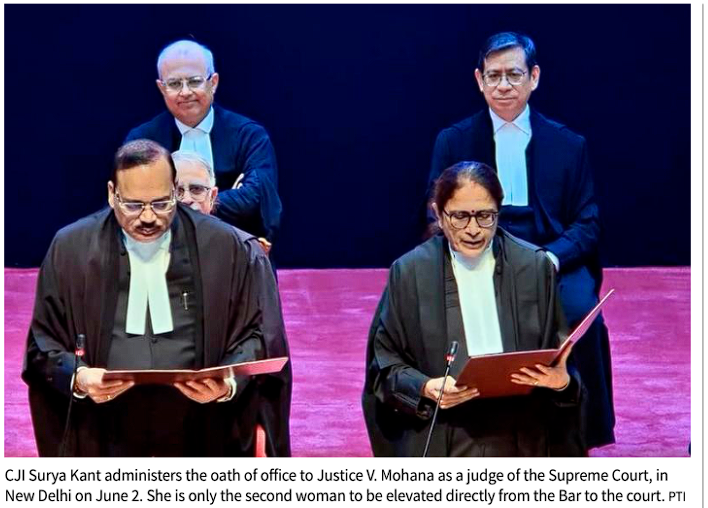
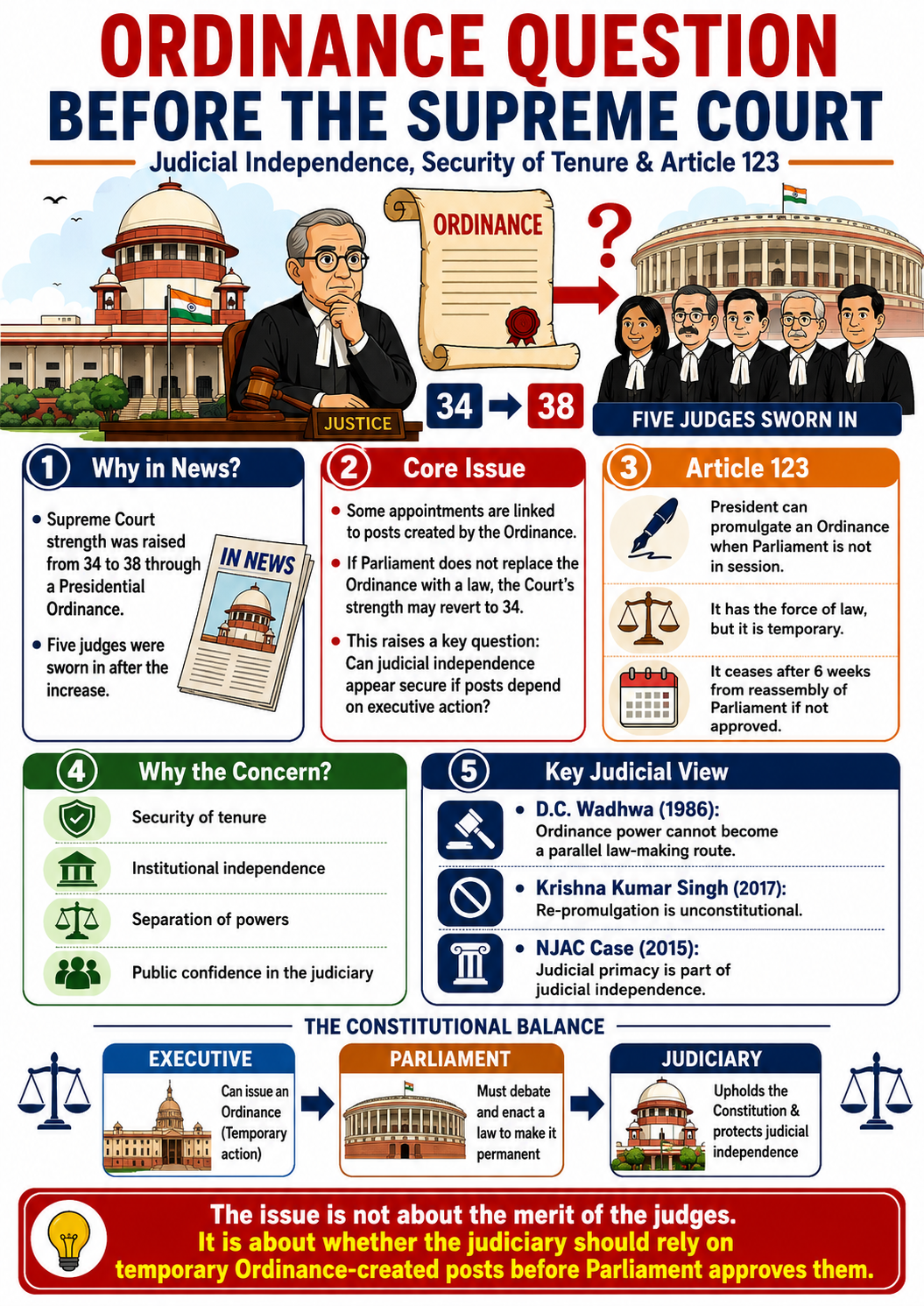
Five judges were recently sworn in to the Supreme Court of India after the sanctioned strength of the Court was increased from 34 to 38 through a Presidential Ordinance.
The issue has raised important constitutional questions about judicial independence, security of tenure, and the judiciary’s institutional distance from the executive.
The concern is not about the merit of the judges. The concern is about whether the Supreme Court should accept appointments to posts created through an Ordinance when Parliament is yet to approve the law.
What is the Issue?
The Supreme Court currently has judges appointed against posts created by an Ordinance.
The key issue is this:
If Parliament does not replace the Ordinance with a law, the sanctioned strength of the Supreme Court may revert to 34. This may create uncertainty regarding the status of judges appointed to the Ordinance-created posts.
This raises a larger question:
“Can judicial independence appear secure if the continuance of judicial posts depends on executive action and later parliamentary approval?”
Constitutional Provision: Article 123
Article 123 of the Indian Constitution gives the President power to promulgate Ordinances when Parliament is not in session.
An Ordinance has the same force and effect as an Act of Parliament, but it is temporary. It must be placed before both Houses of Parliament and will cease to operate after six weeks from the reassembly of Parliament if it is not approved.
In simple words, an Ordinance is an emergency law-making power of the executive, but it cannot become a substitute for regular parliamentary law-making.
Background of the Ordinance
The sanctioned strength of the Supreme Court was increased from 34 to 38 judges through an Ordinance.
Out of the five judges sworn in:
- Four had served as Chief Justices of High Courts.
- One came from the Bar.
- Three appointments were against existing vacancies.
- Two appointments were directly linked to the newly created posts under the Ordinance.
The concern is that if the Ordinance lapses or is rejected, the constitutional status of the posts may become uncertain.
Collegium’s Acceptance and Concerns
- The Supreme Court Collegium accepted the Ordinance-created increase in strength and recommended appointments.
- This has raised concerns because the judiciary has traditionally defended its independence from executive influence.
- The issue is whether accepting temporary posts created by the executive may create an impression that the Court’s institutional strength depends on executive goodwill.
- Even if the appointment of individual judges is valid, the larger concern is about the appearance of independence.
Judicial Independence and Security of Tenure
Judicial independence has two important aspects:
1. Actual Independence
- Judges must be free from pressure by the executive, legislature, media or powerful groups.
2. Appearance of Independence
The judiciary must also appear independent in the eyes of the public.
If judicial posts are created temporarily by Ordinance and appointments are made before parliamentary approval, questions may arise about:
- Security of tenure
- Institutional independence
- Executive influence
- Separation of powers
- Public confidence in the Court
Security of tenure is a basic requirement for judicial independence. A judge should not feel that his or her continuation depends on the government’s future action.
Important Supreme Court Judgments
1. D.C. Wadhwa v. State of Bihar, 1986
- The Supreme Court held that repeated re-promulgation of Ordinances is unconstitutional. Ordinance-making cannot become a parallel law-making power.
2. Krishna Kumar Singh v. State of Bihar, 2017
- The Supreme Court ruled that Ordinance-making power is not a substitute for legislative power. Re-promulgation of Ordinances without placing them before the legislature is against constitutional principles.
3. Supreme Court Advocates-on-Record Association v. Union of India, 2015
- The Supreme Court struck down the 99th Constitutional Amendment and the National Judicial Appointments Commission Act. The Court held that judicial primacy in appointments is part of judicial independence.
- These judgments show that the Court has repeatedly protected judicial independence and limited executive overreach.
Larger Constitutional Question
The issue is not merely administrative. It is a question of constitutional principle.
The larger question is:
“Should the judiciary rely on Ordinance-created posts when the Ordinance itself depends on later approval by Parliament?”
If the Ordinance is approved, the issue may disappear legally. But if it is not approved, uncertainty may arise.
Even before such uncertainty arises, the very dependence on a temporary executive law-making instrument can create discomfort regarding the independence of the judiciary.
Challenges
1. Temporary Nature of Ordinance
- An Ordinance is not a permanent law. It needs parliamentary approval.
2. Security of Tenure
- Judges appointed to Ordinance-created posts may face uncertainty if the Ordinance lapses.
3. Executive Dependence
- The judiciary may appear dependent on executive action for its institutional expansion.
4. Constitutional Morality
- Ordinance power should be used only when immediate action is necessary, not as a routine law-making tool.
5. Institutional Trust
- Any appearance of executive influence may affect public confidence in the judiciary.
Way Forward
- The strength of the Supreme Court should preferably be increased through a regular parliamentary law, not by Ordinance.
- Ordinance-making power must be used only in genuine urgency.
- Judicial appointments should avoid situations that create uncertainty about tenure.
- Parliament must debate and decide such changes transparently.
- The Collegium should consider not only legal validity but also the institutional appearance of independence.
- Clear safeguards are needed when Ordinances affect constitutional institutions.
- Judicial manpower planning should be done in advance to avoid emergency-style expansion.
Conclusion
The increase in Supreme Court strength may be necessary because of rising caseloads and vacancies. However, the method used to create additional posts is constitutionally sensitive.
The judiciary must remain independent not only in reality but also in public perception. Ordinance-created judicial posts may create doubts about security of tenure and institutional autonomy. Therefore, matters affecting the composition and strength of the Supreme Court should ideally be handled through full parliamentary scrutiny and regular legislation.
A strong judiciary requires adequate judges, but it also requires constitutional methods that preserve its independence, dignity and public trust.