Why in News?
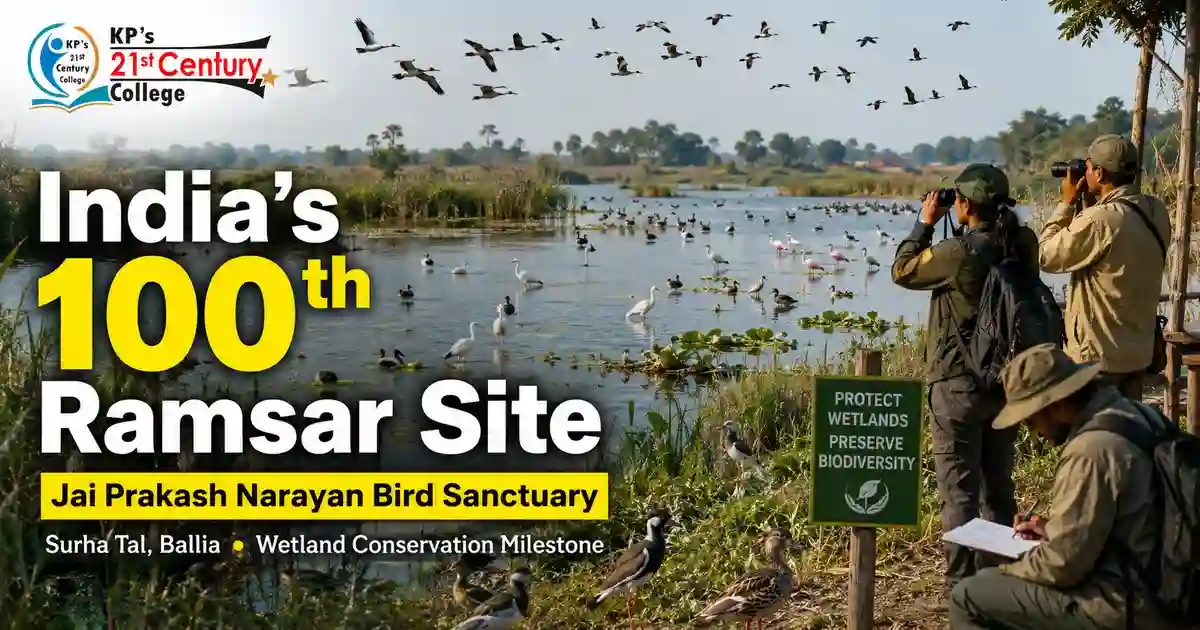
The Jai Prakash Narayan Bird Sanctuary, also known as Surha Tal, in Ballia district of Uttar Pradesh, has been declared India’s 100th Ramsar Site.The announcement was made by Prime Minister Narendra Modi on World Environment Day, 5 June 2026.
What are Ramsar Sites?
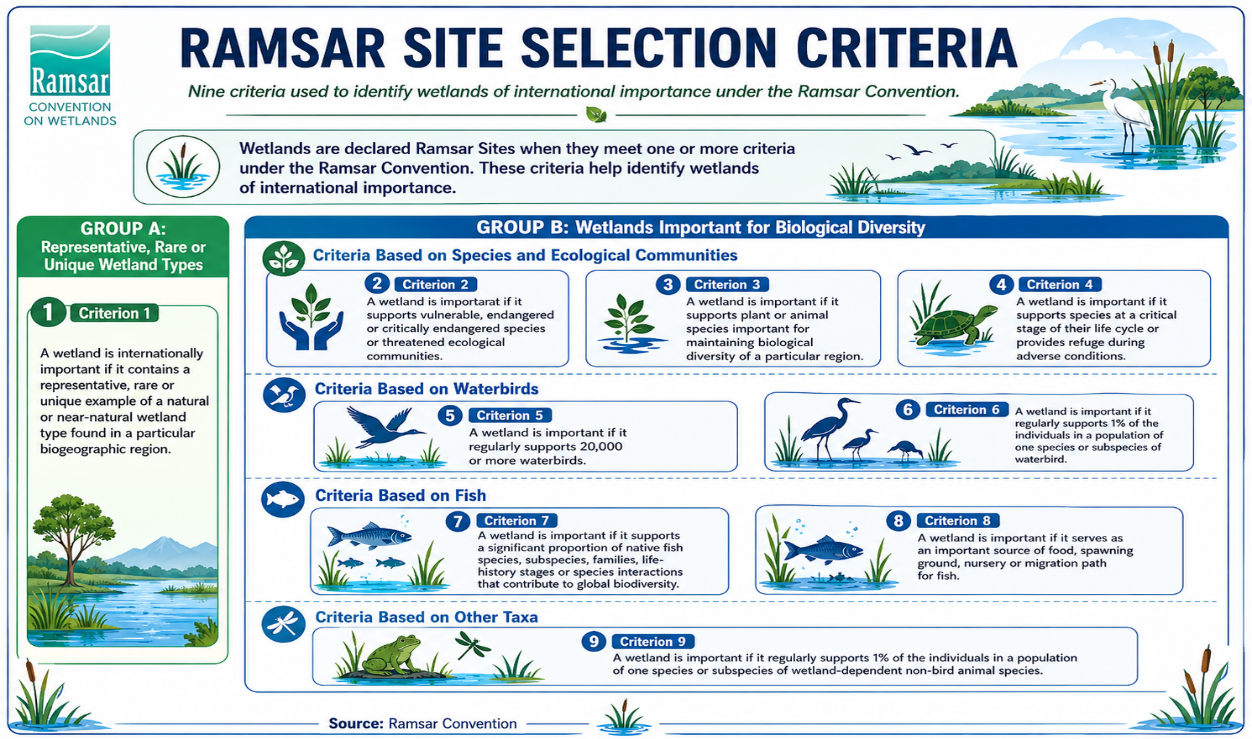
- Ramsar Sites are wetlands of international importance designated under the Ramsar Convention.
- A wetland may include marshes, fens, peatlands, lakes, rivers, floodplains, coastal wetlands and shallow marine areas up to six metres deep at low tide.
- The Ramsar Convention defines wetlands as areas of marsh, fen, peatland or water, whether natural or artificial, permanent or temporary, with static or flowing water, fresh, brackish or saline.
- In India, the Wetlands (Conservation and Management) Rules, 2017 exclude river channels, paddy fields, drinking water tanks and water bodies specifically created for aquaculture, salt production, recreation or irrigation.
Ramsar Convention
- The Ramsar Convention is also known as the Convention on Wetlands.
- It was adopted in 1971 in Ramsar, Iran and came into force in 1975. The convention works under the broad framework of international wetland conservation.
- Its main objective is the conservation and wise use of wetlands.
Key Facts
- Adopted: 1971
- Place: Ramsar, Iran
- Came into force: 1975
- India joined: 1982
- World Wetlands Day: 2 February
- Largest Ramsar Site in the world: Pantanal, South America
- Largest Ramsar Site in India: Sundarbans, West Bengal
- Smallest Ramsar Site in India: Vembanur Wetland Complex, Tamil Nadu
Montreux Record
- The Montreux Record was adopted in 1990 at Montreux, Switzerland.
- It is a register of Ramsar Sites where ecological character has changed, is changing, or is likely to change due to human interference, pollution or other factors.
- It identifies Ramsar Sites that need priority conservation attention.
India and Ramsar Convention
- India became a contracting party to the Ramsar Convention in 1982.
- With the addition of Jai Prakash Narayan Bird Sanctuary, India now has 100 Ramsar Sites.
- India’s Ramsar network covers wetlands across all States and Union Territories and reflects the country’s diverse wetland ecosystems such as lakes, marshes, mangroves, floodplains, coastal wetlands and high-altitude wetlands.
India’s Ramsar Achievement
With 100 Ramsar Sites, India has achieved an important global milestone.
Global Position
- India has the highest number of Ramsar Sites in Asia.
- India ranks 3rd globally.
- The United Kingdom has the highest number of Ramsar Sites with 176 sites.
- Mexico ranks second with 144 sites.
- India ranks third with 100 sites.
About Jai Prakash Narayan Bird Sanctuary
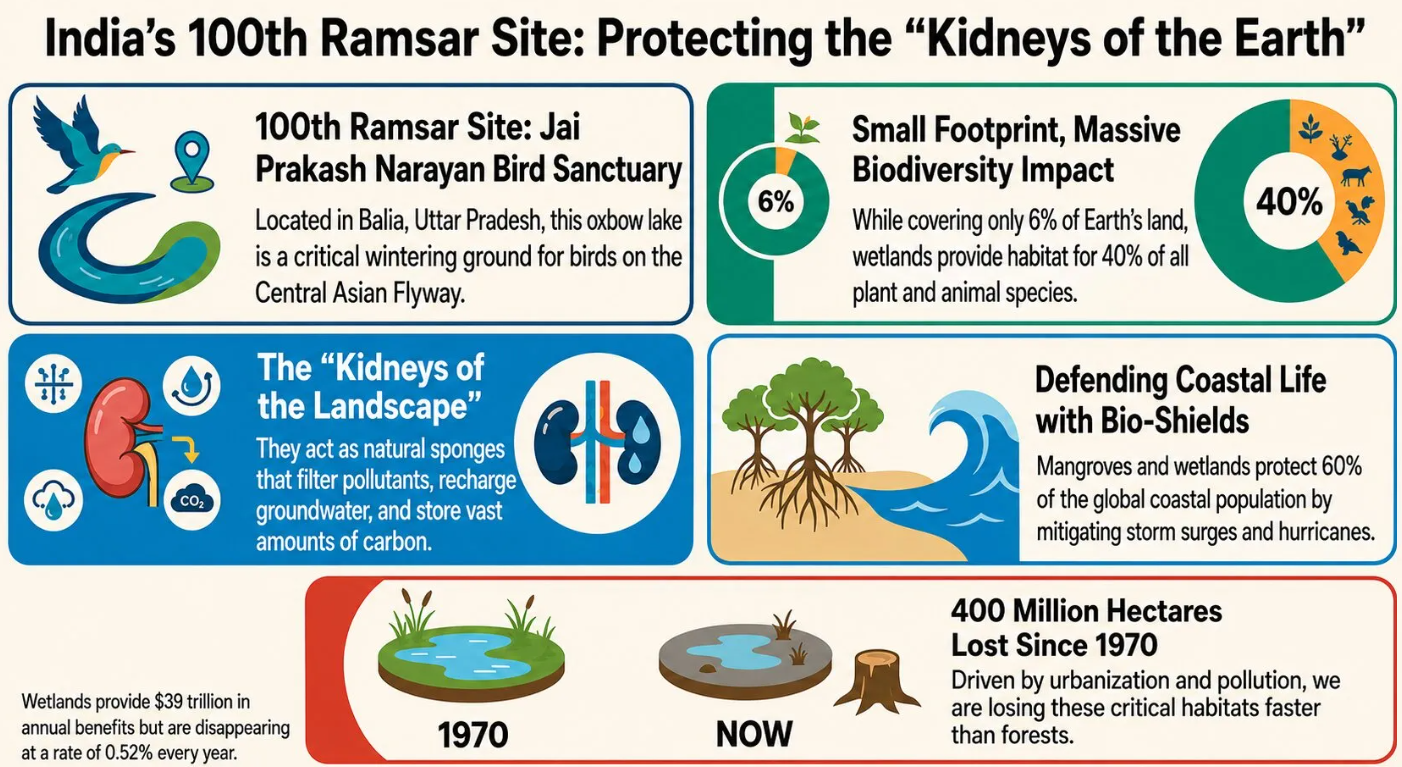
- Jai Prakash Narayan Bird Sanctuary is the 13th Ramsar Site in Uttar Pradesh.
- Earlier in 2026, other Uttar Pradesh wetlands such as Shekha Jheel Bird Sanctuary in Aligarh district and Patna Bird Sanctuary in Etah district were also added to the Ramsar list.
- The Jai Prakash Narayan Bird Sanctuary is located at Surha Tal in Ballia district of eastern Uttar Pradesh.
- It lies in the middle stretch of the Ganga River basin.
- The Uttar Pradesh government originally declared it a bird sanctuary in 1991.
Formation and Ecology
- Surha Tal is a large natural oxbow lake. An oxbow lake is formed when a river changes its course and leaves behind a curved water body.
- The wetland was formed by the meandering course of the Ganga River.
- It receives freshwater inflow through three primary channels. During the monsoon season, it expands widely over floodplains and marshes.
- This makes Surha Tal an important floodplain wetland and a valuable habitat for birds, fish and other wetland-dependent species.
Biodiversity of Surha Tal
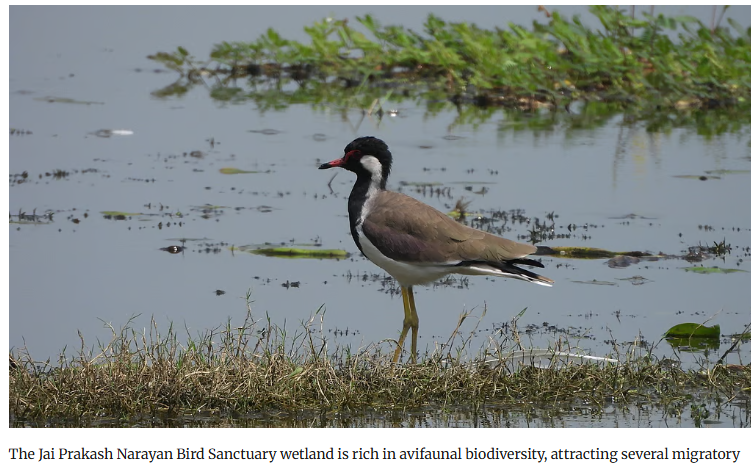
- Surha Tal is rich in avifaunal biodiversity and attracts both migratory and resident birds.
Avifauna
The sanctuary lies on the Central Asian Flyway. It serves as a critical stopover and wintering ground for migratory birds from Siberia and Central Asia.
Important bird species include:
- Common Pochard
- Indian River Tern
- Sarus Crane
- Bar-headed Goose
Aquatic Life
The wetland supports:
- More than 221 plant species
- Around 66 fish species
Important fish species include:
- Wallago attu
- Bagarius bagarius
Cultural Importance
- Surha Tal is linked with local historical, religious and traditional beliefs.
- This makes it not only an ecological site but also a socio-ecological landscape in eastern Uttar Pradesh.
- The Ramsar recognition can help promote conservation with local community participation and sustainable eco-tourism.
Importance of Wetlands
- Wetlands are among the most productive ecosystems on Earth.
They provide many ecological and social benefits:
- Support biodiversity, provide habitat for migratory and resident birds, Recharge groundwater, Control floods, reduce drought impact, Store carbon, purify water, Support fisheries and livelihoods, protect communities from cyclones and extreme events, Contribute to water and food security
Wetlands are therefore important for climate resilience, disaster risk reduction and human well-being.
Recent Developments in Wetland Conservation in India
1. Wetlands of India Portal
The Wetlands of India Portal was launched on 2 October 2021 by the Ministry of Environment, Forest and Climate Change.
It provides information on India’s wetlands, data repositories, capacity-building materials and dashboards for States and Union Territories.
2. National Wetland Decadal Change Atlas
Prepared by the Space Applications Centre, Ahmedabad, this atlas highlights changes in wetlands across India over the past decade.
3. Centre for Wetland Conservation and Management
The Centre for Wetland Conservation and Management was established on World Wetlands Day 2021.
It focuses on research, knowledge gaps and scientific support for wetland conservation.
4. Wetlands Rejuvenation Programme
Launched by MoEFCC in 2020, the programme aims to rejuvenate over 500 wetlands across India through baseline information, stakeholder participation and management planning.
5. National Plan for Conservation of Aquatic Ecosystems
In 2013, the National Wetlands Conservation Programme and the National Lake Conservation Plan were merged to create the National Plan for Conservation of Aquatic Ecosystems.
It reflects a holistic government approach to protecting wetlands and lakes.
6. Amrit Dharohar Scheme
Launched in the Union Budget 2023–24, the Amrit Dharohar Scheme aims to optimise wetland use over three years.
Its goals include:
- Enhancing biodiversity
- Increasing carbon stock
- Promoting eco-tourism
- Generating income for local communities
7. Integration with Namami Gange
The Namami Gange Programme integrates wetland conservation with river basin management.
This provides a model for linking river rejuvenation with wetland protection.
8. National Wildlife Action Plan
The National Wildlife Action Plan 2017–2031 emphasises conservation of inland aquatic ecosystems, including wetlands.
It recognises wetlands as important habitats for biodiversity and ecosystem services.
Ramsar Sites in India: State-wise List
| S.No | Ramsar Site | State/UT | Designated Year |
| 1 | Kolleru Lake | Andhra Pradesh | 2002 |
| 2 | Deepor Beel | Assam | 2002 |
| 3 | Kanwar (Kabar) Taal | Bihar | 2020 |
| 4 | Nagi Bird Sanctuary | Bihar | 2023 |
| 5 | Nakti Bird Sanctuary | Bihar | 2023 |
| 6 | Nanda Lake | Goa | 2022 |
| 7 | Khijadia WLS | Gujarat | 2021 |
| 8 | Nalsarovar BS | Gujarat | 2012 |
| 9 | Thol Lake | Gujarat | 2021 |
| 10 | Wadhvana Wetland | Gujarat | 2021 |
| 11 | Bhindawas WLS | Haryana | 2021 |
| 12 | Sultanpur NP | Haryana | 2021 |
| 13 | Chandra Taal | Himachal Pradesh | 2005 |
| 14 | Pong Dam Lake | Himachal Pradesh | 2002 |
| 15 | Renuka Lake | Himachal Pradesh | 2005 |
| 16 | Ranganathittu BS | Karnataka | 2022 |
| 17 | Magadi Kere Conservation Reserve | Karnataka | 2024 |
| 18 | Ankasamudra Bird Conservation Reserve | Karnataka | 2024 |
| 19 | Aghanashini Estuary | Karnataka | 2024 |
| 20 | Ashtamudi Wetland | Kerala | 2002 |
| 21 | Sasthamkotta Lake | Kerala | 2002 |
| 22 | Vembanad-Kol Wetland | Kerala | 1905 |
| 23 | Bhoj Wetland | Madhya Pradesh | 2002 |
| 24 | Sakhya Sagar | Madhya Pradesh | 2022 |
| 25 | Sirpur Wetland | Madhya Pradesh | 2022 |
| 26 | Yashwant Sagar | Madhya Pradesh | 2022 |
| 27 | Tawa Reservoir | Madhya Pradesh | 2024 |
| 28 | Lonar Lake | Maharashtra | 2020 |
| 29 | Nandur Madhameshwar | Maharashtra | 2019 |
| 30 | Thane Creek | Maharashtra | 2022 |
| 31 | Loktak Lake | Manipur | 1990 |
| 32 | Pala Wetland | Mizoram | 2021 |
| 33 | Ansupa Lake | Odisha | 2021 |
| 34 | Bhitarkanika Mangroves | Odisha | 2002 |
| 35 | Chilika Lake | Odisha | 1981 |
| 36 | Hirakud Reservoir | Odisha | 2021 |
| 37 | Satkosia Gorge | Odisha | 2021 |
| 38 | Tampara Lake | Odisha | 2021 |
| 39 | Beas CnR | Punjab | 2019 |
| 40 | Harike Wetland | Punjab | 1990 |
| 41 | Kanjli Wetland | Punjab | 2002 |
| 42 | Keshopur-Miani CmR | Punjab | 2019 |
| 43 | Nangal WLS | Punjab | 2019 |
| 44 | Ropar Wetland | Punjab | 2002 |
| 45 | Keoladeo National Park | Rajasthan | 1981 |
| 46 | Sambhar Lake | Rajasthan | 1990 |
| 47 | Chitrangudi BS | Tamil Nadu | 2021 |
| 48 | Gulf of Mannar Marine BR | Tamil Nadu | 2022 |
| 49 | Kanjirankulam BS | Tamil Nadu | 2022 |
| 50 | Karikili BS | Tamil Nadu | 2022 |
| 51 | Koonthankulam BS | Tamil Nadu | 2021 |
| 52 | Pallikaranai Marsh Reserve Forest | Tamil Nadu | 2022 |
| 53 | Pichavaram Mangrove | Tamil Nadu | 2022 |
| 54 | Point Calimere WLS & BS | Tamil Nadu | 2002 |
| 55 | Suchindram Theroor Wetland Complex | Tamil Nadu | 2022 |
| 56 | Udhayamarthandapuram BS | Tamil Nadu | 2022 |
| 57 | Vaduvur BS | Tamil Nadu | 2022 |
| 58 | Vedanthangal BS | Tamil Nadu | 2022 |
| 59 | Vellode BS | Tamil Nadu | 2022 |
| 60 | Vembannur Wetland Complex | Tamil Nadu | 2022 |
| 61 | Karaivetti Bird Sanctuary | Tamil Nadu | 2024 |
| 62 | Longwood Shola Reserve Forest | Tamil Nadu | 2024 |
| 63 | Nanjarayan Bird Sanctuary | Tamil Nadu | 2024 |
| 64 | Kazhuveli Bird Sanctuary | Tamil Nadu | 2024 |
| 65 | Rudrasagar Lake | Tripura | 2005 |
| 66 | Hokera Wetland | UT of Jammu & Kashmir | 2005 |
| 67 | Hygam Wetland CnR | UT of Jammu & Kashmir | 2022 |
| 68 | Shallbugh Wetland CnR | UT of Jammu & Kashmir | 2022 |
| 69 | Surinsar-Mansar Lakes | UT of Jammu & Kashmir | 2005 |
| 70 | Wular Lake | UT of Jammu & Kashmir | 1990 |
| 71 | Tso Kar | UT of Ladakh | 2020 |
| 72 | Tsomoriri | UT of Ladakh | 2002 |
| 73 | Bakhira WLS | Uttar Pradesh | 2021 |
| 74 | Haiderpur Wetland | Uttar Pradesh | 2021 |
| 75 | Nawabganj BS | Uttar Pradesh | 2019 |
| 76 | Parvati Arga BS | Uttar Pradesh | 2019 |
| 77 | Saman BS | Uttar Pradesh | 2019 |
| 78 | Samaspur BS | Uttar Pradesh | 2019 |
| 79 | Sandi BS | Uttar Pradesh | 2019 |
| 80 | Sarsai Nawar Jheel | Uttar Pradesh | 2019 |
| 81 | Sur Sarovar (Keetham Lake) | Uttar Pradesh | 2020 |
| 82 | Upper Ganga River (Brijghat to Narora) | Uttar Pradesh | 2005 |
| 83 | Asan Barrage | Uttarakhand | 2020 |
| 84 | East Kolkata Wetlands | West Bengal | 2002 |
| 85 | Sundarban Wetland | West Bengal | 2019 |
| 86 | Sakkarakottai Bird Sanctuary | Tamil Nadu | 2025 |
| 87 | Therthangal Bird Sanctuary | Tamil Nadu | 2025 |
| 88 | Khecheopalri Wetland | Sikkim | 2025 |
| 89 | Udhwa Lake | Jharkhand | 2025 |
| 90 | Khichan (Phalodi) | Rajasthan | 2025 |
| 91 | Menar (Udaipur) | Rajasthan | 2025 |
| 92 | Gokul Jalashay | Bihar | 2025 |
| 93 | Udaipur Jheel | Bihar | 2025 |
| 94 | Gogabeel Lake | Bihar | 2025 |
| 95 | Siliserh Lake | Rajasthan | 2025 |
| 96 | Kopra Jalashay | Chhattisgarh | 2025 |
| 97 | Patna Bird Sanctuary | Uttar Pradesh | 2026 |
| 98 | Chhari-Dhand | Kutch, Gujarat | 2026 |
| 99 | Shekha Jheel Bird Sanctuary | Uttar Pradesh | 2026 |
| 100 | Jai Prakash Narayan Bird Sanctuary | Uttar Pradesh | 2026 |
Challenges
- Encroachment around wetlands
- Pollution from nearby settlements and agriculture
- Excessive fishing pressure
- Invasive species
- Siltation and reduction in water spread
- Climate change and irregular rainfall
- Lack of local awareness
- Poor inter-departmental coordination
- Risk of unregulated tourism
- Conflict between livelihood use and conservation needs
Way Forward
- Prepare a scientific management plan for Surha Tal.
- Monitor bird, fish and plant diversity regularly.
- Prevent encroachment and pollution.
- Promote community-based wetland conservation.
- Control invasive species.
- Regulate fishing and tourism.
- Strengthen local awareness programmes.
- Link wetland conservation with sustainable livelihoods.
- Use the Ramsar tag to promote research and eco-tourism.
- Ensure coordination among forest, irrigation, tourism and local governance departments.
- Integrate wetland conservation with river basin management and climate adaptation planning.
Conclusion
The designation of Jai Prakash Narayan Bird Sanctuary / Surha Tal as India’s 100th Ramsar Site is a proud milestone in India’s environmental journey.Wetlands are not wastelands. They are living ecosystems that support biodiversity, water security, climate resilience and local livelihoods.The success of this Ramsar recognition will depend on strong protection, scientific management, community participation and sustainable use. Surha Tal can become a model for conserving wetlands while supporting people and nature together.