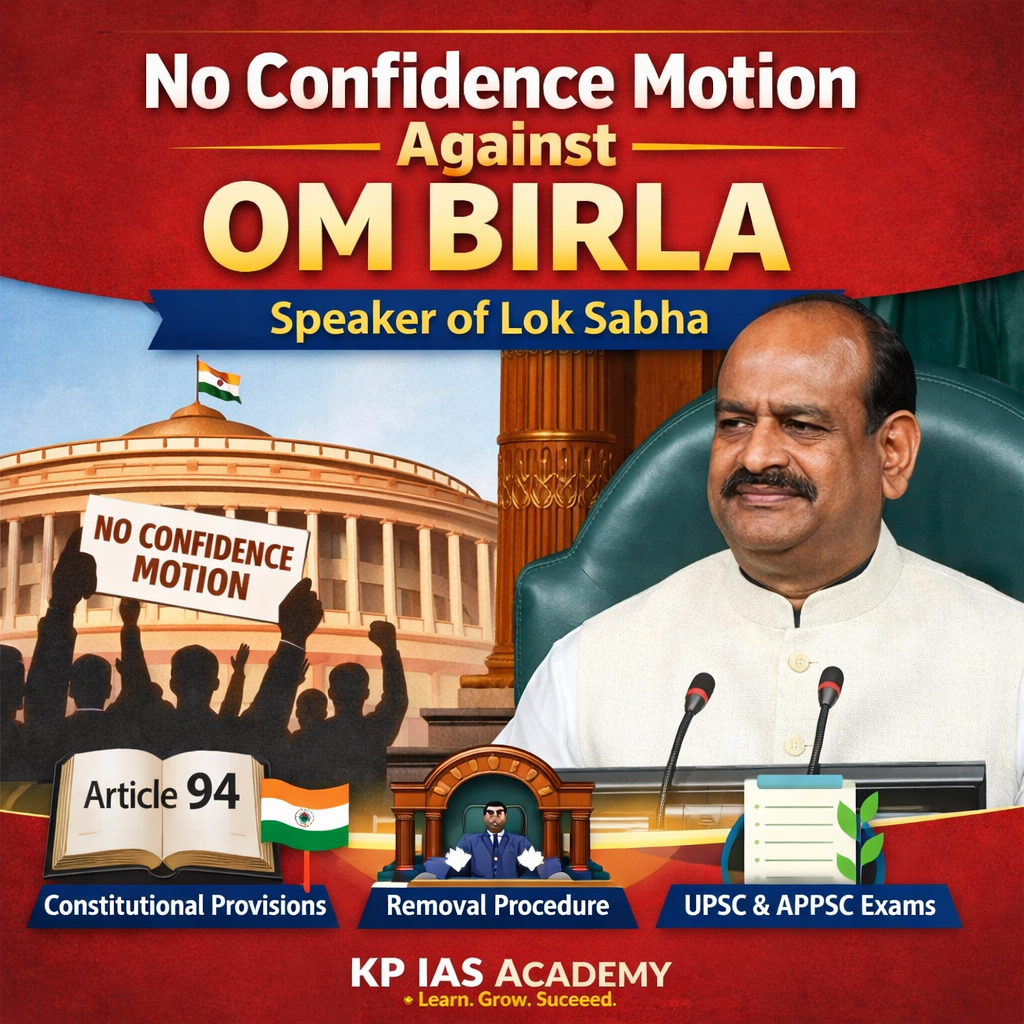
No-Confidence Motion Against Om Birla
Table of Contents
Relevance:
GS Paper – 2: Parliament, State Legislature, Executive, Representation of People’s Act
For Prelims:
- Coalition government, Speaker and a Deputy Speaker, simple majority, adjournments, no-confidence and censure motions, Business Advisory Committee, the General Purposes Committee and the Rules Committee, rights and privileges
For Mains:
- Key facts about the speaker in India, Role of Speaker in Coalition Government
What is the current issue?
- The Opposition moved a no-confidence motion against Lok Sabha Speaker Om Birla on February 10, 2026.
- Reasons cited include:
- Not allowing Leader of Opposition Rahul Gandhi to quote or speak about former Army Chief Gen MM Naravane’s unpublished memoir.
- The Speaker’s statement suggesting Prime Minister Narendra Modi could have been attacked inside the House.
- Lok Sabha sources say the motion will now be examined and processed as per rules.
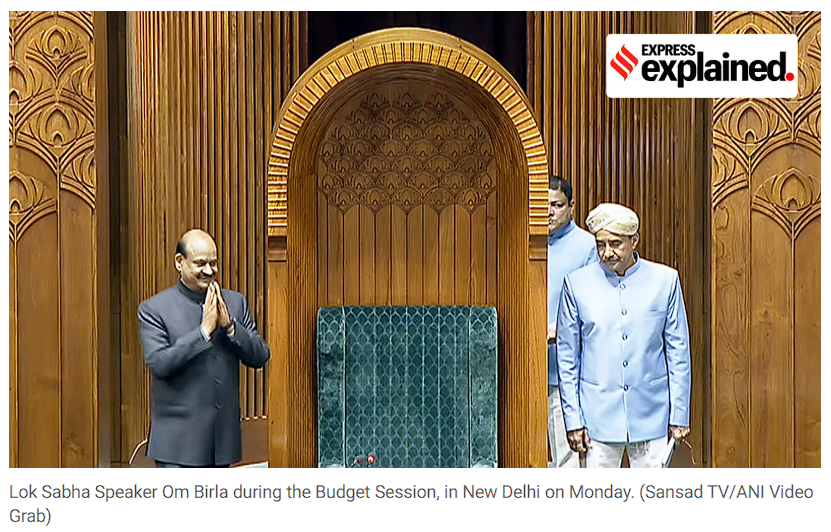
Can the Lok Sabha Speaker be removed?
- Yes, the Lok Sabha Speaker can be removed.
- This provision does not apply to the Rajya Sabha Chairman.
- The removal process is provided under Article 94(c) of the Constitution of India.
Constitutional basis (Article 94)
Under Article 94, a Speaker or Deputy Speaker vacates office if:
- 94(a): They cease to be a member of the Lok Sabha.
- 94(b): They resign by submitting a written resignation.
- 94(c): They are removed by a resolution passed by a majority of all the then members of the Lok Sabha.
- Removal requires a special and stringent procedure.
Constitutional Provisions Related to Speaker/Deputy Speaker
- Article 93/178: Appointment of the Speaker and Deputy Speaker of the Lok Sabha/ Legislative Assembly.
- Article 94/179: Vacation/resignation/removal from the offices of Speaker and Deputy Speaker of the Lok Sabha/Legislative Assembly.
- Article 95/180: Power of the Deputy Speaker or other person(s) to perform the duties of the office of or to act as the Speaker of the Lok Sabha/Legislative Assembly.
- Article 96/181: The Speaker or the Deputy Speaker not to preside while a resolution for his removal from office is under consideration.
- Article 97/186: Salaries and allowances of the Speaker and Deputy Speaker.
Judicial Provisions Related to Speaker / Deputy Speaker
- Kihoto Hollohan vs Zachillhu (1993):
Speaker’s decisions under the Tenth Schedule are not final and are subject to judicial review on grounds like malafide, perversity, or constitutional violation. - Nabam Rebia vs Deputy Speaker (2016):
A Speaker cannot decide disqualification petitions under the anti-defection law while a removal notice against them is pending. - Keisham Meghachandra Singh vs Speaker, Manipur LA (2020):
Disqualification pleas must be decided within three months, except in extraordinary circumstances. - Subhash Desai vs Principal Secretary, Governor of Maharashtra (2023):
Speaker directed to set a clear timeline for deciding disqualification petitions; undue delay undermines democracy.
Process For Removal of Lok Sabha Speaker
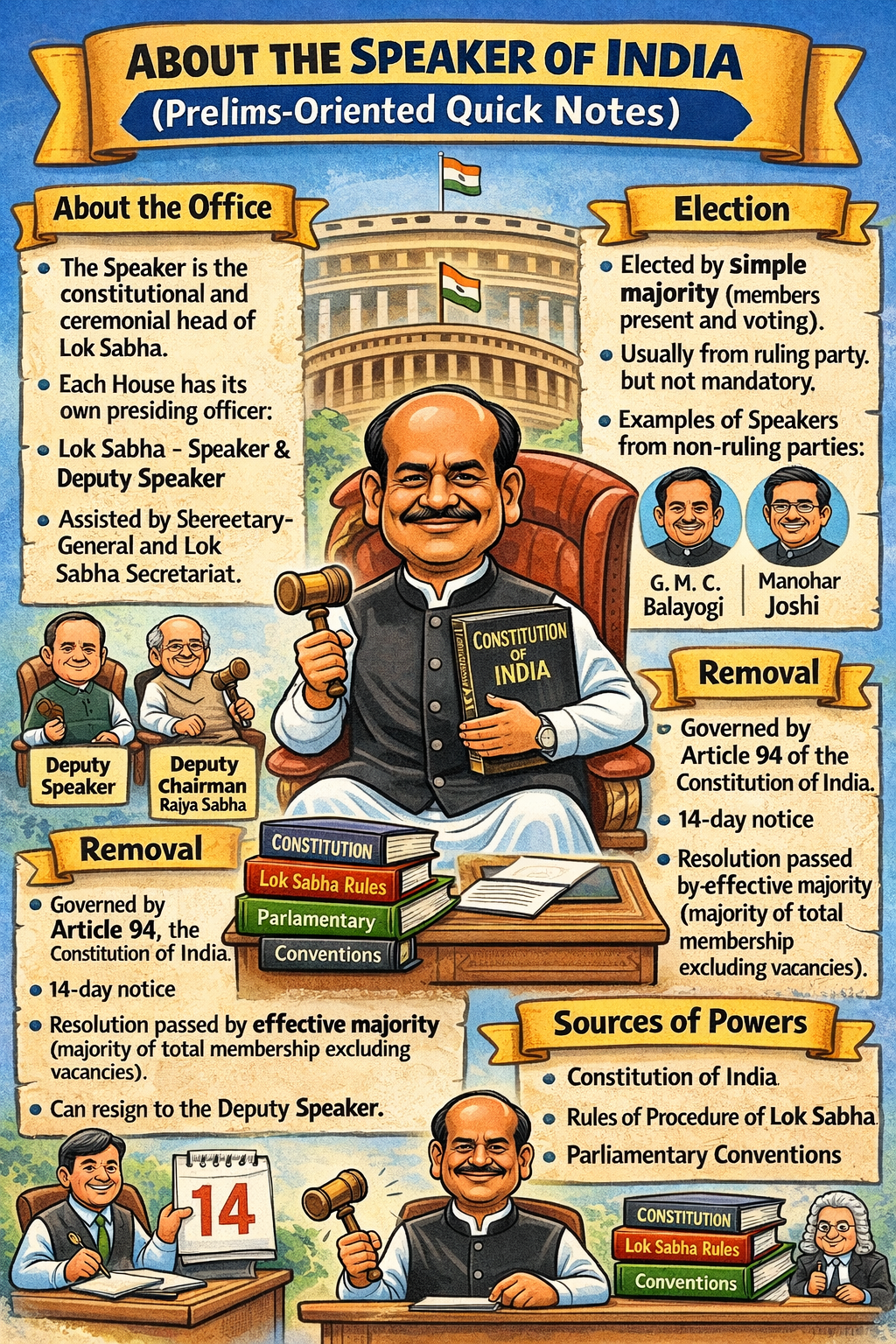
- Article 94(c) allows a Speaker to be removed by a resolution of the House.
- A member must give at least 14 days’ written notice to move a resolution for removal.
- The motion must be backed by at least 50 MPs to be admitted for discussion.
- The Speaker cannot preside over the House while the motion is pending, but may attend and defend himself, as per Article 96.
- The resolution must pass by a majority of all members of the Lok Sabha (effective majority).
- If passed, the Speaker is removed immediately but remains an MP. If rejected, the Speaker continues in office.
Since the notice has the required signatures, the motion can be taken up after the 14-day notice period. The Budget Session is in recess after February 13.
Who can initiate the removal process?
- Any Lok Sabha member can give notice.
- Notice must be:
- In writing
- Submitted to the Secretary-General of the Lok Sabha
- The notice may be given jointly by two or more members.
Mandatory notice period
- A resolution for removal cannot be moved unless at least 14 days’ prior notice is given.
- After receiving notice:
- A motion for leave to move the resolution is listed in the List of Business.
- The date fixed must be any day after 14 days from receipt of notice.
Minimum support required (critical condition)
- At the time of seeking leave:
- At least 50 members must stand up in support of the motion.
- This establishes that the House’s quorum requirement is met.
What happens if 50 or more MPs rise?
- The presiding officer declares that “leave has been granted”.
- The resolution is scheduled for discussion:
- Within 10 days of leave being granted.
- It is included in the List of Business.
What happens if fewer than 50 MPs rise?
- The presiding officer declares that the member:
- “Has not the leave of the House”
- The motion fails immediately and goes no further.
Rules governing the process
- Governed by Rules 200 to 203 of the:
- Rules of Procedure and Conduct of Business in Lok Sabha
- Additional guideline under Rule 200A:
- The resolution must:
- Be specific in charges
- Be clearly and precisely worded
- Not include:
- Arguments
- Inferences
- Irony or sarcasm
- Imputations
- Defamatory statements
- The resolution must:
Debate rules once motion is admitted
- Members who submitted the motion:
- Cannot speak immediately after admission
- On the scheduled discussion day:
- Movers may speak only if allowed by the presiding officer
- Speaking time is capped at 15 minutes
- Discussion must be:
- Strictly confined to the charges mentioned in the resolution
Role and rights of the Speaker during the motion
- The Speaker:
- Does not vacate office during discussion
- Has the right to speak and participate in proceedings
- Has the right to vote in the first instance
- Cannot exercise a casting vote in case of a tie
What if the Lok Sabha is dissolved?
- Even after dissolution:
- The Speaker continues in office
- Vacates the post only immediately before the first meeting of the next Lok Sabha
Has this happened before?
Yes — three times in Indian parliamentary history:
- 1954 – Against GV Mavalankar (first Lok Sabha Speaker)
- 1966 – Against Hukam Singh
- 1987 – Against Balram Jakhar
None of the Speakers were removed as a result of these motions.
Conclusion
- Removing a Lok Sabha Speaker is constitutionally possible but politically difficult.
- It requires:
- Prior notice
- Procedural compliance
- Minimum MP support
- Majority of all existing members, not just those present
- Historically, no Speaker has ever been removed through this process.
UPSC PYQ
Q. With reference to Deputy Speaker of Lok Sabha, consider the following statements: (2022)
- As per the Rules of Procedure and Conduct of Business in Lok Sabha, the election of Deputy Speaker shall be held on such date as the Speaker may fix.
- There is a mandatory provision that the election of a candidate as Deputy Speaker of Lok Sabha shall be from either the principal opposition party or the ruling party.
- The Deputy Speaker has the same power as of the Speaker when presiding over the sitting of the House and no appeal lies against his rulings.
- The well-established parliamentary practice regarding the appointment of Deputy Speaker is that the motion is moved by the Speaker and duly seconded by the Prime Minister.
Which of the statements given above are correct?
(a) 1 and 3 only
(b) 1, 2 and 3
(c) 3 and 4 only
(d) 2 and 4 only
Ans: (b)
CARE MCQ
Q. Consider the following statements regarding removal of the Lok Sabha Speaker:
- The Speaker can be removed by a majority of members present and voting.
- A minimum 14-day notice is required before moving the resolution.
- At least 50 members must support the motion for it to be admitted.
Which of the statements given above is/are correct?
A) 1 only
B) 2 and 3 only
C) 1 and 3 only
D) 1, 2 and 3
Answer: B
Explanation:
Statement 1 is incorrect — removal requires an absolute majority, not just present and voting.
Statement 2 is correct – A minimum 14-day notice is required before moving the resolution.
Statement 3 is correct – At least 50 members must support the motion for it to be admitted.