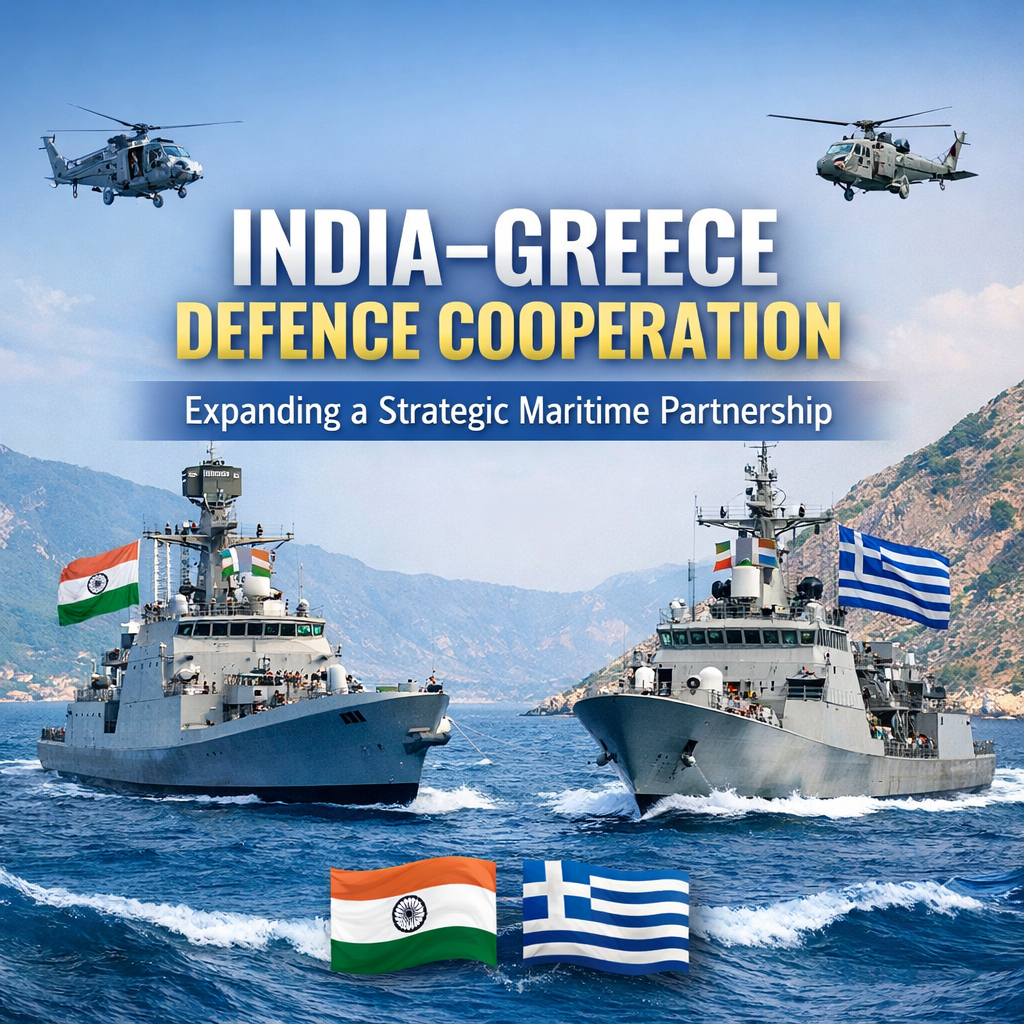
India–Greece Defence Cooperation: Expanding a Strategic Maritime Partnership
Table of Contents
Relevance:
GS Paper II – International Relations
Important Keywords
For Prelims:
- India–Greece Strategic Partnership, Joint Declaration of Intent (JDoI), Information Fusion Centre–Indian Ocean Region (IFC-IOR), India–Middle East–Europe Economic Corridor (IMEC), Indo-Pacific Oceans Initiative (IPOI)
For Mains:
- Defence Industrial Cooperation, Maritime Security Architecture, Geopolitical Balancing in the Mediterranean, Turkey–Pakistan Axis, Multi-Alignment in Foreign Policy
Why in News?
India and Greece signed a Joint Declaration of Intent (JDoI) to enhance defence industrial cooperation following bilateral talks between Defence Minister Rajnath Singh and his Greek counterpart Nikolaos-Georgios Dendias in New Delhi.
The agreement marks the beginning of a structured five-year roadmap to deepen military, industrial, and maritime collaboration between the two nations.
Key Developments
- Signing of a Joint Declaration of Intent to strengthen defence industrial cooperation.
- Exchange of a Bilateral Military Cooperation Plan for 2026.
- Announcement of positioning a Greek International Liaison Officer at the Information Fusion Centre–Indian Ocean Region (IFC-IOR), Gurugram.
- Commitment to expand defence production linkages under:
- India’s Aatmanirbhar Bharat
- Greece’s defence modernisation programme under Agenda 2030.
Both countries reiterated that their relationship is anchored in shared values of peace, stability, freedom of navigation, and mutual respect.

Evolution of India–Greece Relations
1. Historical Linkages (Ancient Period)
- Relations date back nearly 2,500 years.
- Alexander’s campaign in 326 BCE reached northwestern India.
- The Mauryan period saw the Greek ambassador Megasthenes at Chandragupta Maurya’s court.
- The Gandhara school of art reflected Indo-Greek cultural synthesis.
- Trade exchanges existed between ancient Indian kingdoms and Hellenistic regions.
2. Strategic Partnership (Modern Era)
- Bilateral ties elevated to a Strategic Partnership in August 2023.
- Greece supports:
- India’s stand on Kashmir
- India’s bid for a permanent seat in the UNSC
- India supports Greece’s stance on the Cyprus issue, advocating a bi-zonal, bi-communal federation under UNSC resolutions.
Strategic Significance of India–Greece Cooperation
1. Defence and Maritime Cooperation
- Strengthens defence industrial collaboration.
- Enhances interoperability through structured military engagement.
- IFC-IOR liaison improves maritime domain awareness.
- Both nations support a rules-based international order.
2. Gateway to Europe
- Greece’s location in the Eastern Mediterranean makes it a strategic gateway.
- Greek ports like Piraeus could become entry points for Indian goods under the India-Middle East-Europe Economic Corridor (IMEC).
- Greece controls nearly 20% of global shipping tonnage, offering logistical advantages.
3. Geopolitical Balancing
- Acts as a counterweight to the Turkey–Pakistan axis.
- Turkey’s defence cooperation with Pakistan enhances the geopolitical value of India–Greece alignment.
- Expands India’s strategic footprint from the Indo-Pacific to the Mediterranean.
- Supports convergence between:
- India’s Indo-Pacific Oceans Initiative (IPOI)
- Mediterranean maritime security architecture.
Challenges in India–Greece Relations
1. Limited Economic Engagement
- Bilateral trade stands at approximately USD 2 billion.
- Trade remains concentrated in primary commodities.
- Limited high-value technological or services cooperation.
2. Connectivity Constraints
- Absence of direct shipping lines increases logistics costs.
- Heavy reliance on trans-shipment routes.
3. The China Factor
- Port of Piraeus is majority-owned by China’s COSCO Shipping.
- Raises concerns over strategic supply-chain vulnerabilities.
- Creates a long-term geopolitical dilemma for India’s European connectivity strategy.
4. Institutional Gaps
- Lack of a structured 2+2 Dialogue mechanism.
- Limited foreign policy coordination frameworks.
- Need for stronger institutional continuity.
Way Forward: Strengthening the Partnership
1. Operationalising IMEC
- Accelerate corridor implementation.
- Establish Greece as a principal European entry point for Indian trade.
2. Green Maritime Cooperation
- Develop green shipping corridors.
- Collaborate in hydrogen and ammonia-based maritime fuels.
3. Labour Mobility Cooperation
- Implement Migration and Mobility Partnership Agreement.
- Address Greece’s labour shortage through legal skilled migration channels.
4. Strategic Grouping
- Consider a minilateral framework involving:
- India
- Greece
- Cyprus
- Israel (or France)
- Focus on energy security and joint naval patrols.
5. Digital Connectivity
- Collaborate on submarine cable systems to bypass chokepoints like Suez.
Conclusion
The Indo-Greek kingdom set up in north Afghanistan in the beginning of the second century BC was (IAS 1999)
Explanation: The Indo-Greek kingdom in north Afghanistan during the early 2nd century BC was established in Bactria.
- Bactria
- Scythia
- Zedrasia
- Aria
Explanation: The Indo-Greek kingdom in north Afghanistan during the early 2nd century BC was established in Bactria.
- After the decline of Seleucid control, Diodotus declared independence around 250 BC, founding the Greco-Bactrian Kingdom.
- Bactria was located in present-day northern Afghanistan and parts of Central Asia.
- Later rulers such as Demetrius expanded into north-western India, leading to the rise of the Indo-Greek Kingdom.
- Bactria served as the base from which Greek rulers entered and established control over parts of the Indian subcontinent.
UPSC PYQ
Q. With reference to Deputy Speaker of Lok Sabha, consider the following statements: (2022)
The Indo-Greek kingdom set up in north Afghanistan in the beginning of the second century BC was (IAS 1999)
Explanation: The Indo-Greek kingdom in north Afghanistan during the early 2nd century BC was established in Bactria.
- Bactria
- Scythia
- Zedrasia
- Aria
Explanation: The Indo-Greek kingdom in north Afghanistan during the early 2nd century BC was established in Bactria.
- After the decline of Seleucid control, Diodotus declared independence around 250 BC, founding the Greco-Bactrian Kingdom.
- Bactria was located in present-day northern Afghanistan and parts of Central Asia.
- Later rulers such as Demetrius expanded into north-western India, leading to the rise of the Indo-Greek Kingdom.
- Bactria served as the base from which Greek rulers entered and established control over parts of the Indian subcontinent.
CARE MCQ
Q. Consider the following statements regarding removal of the Lok Sabha Speaker:
Consider the following statements regarding India–Greece relations:
- The Mauryan dynasty was contemporary to Alexander.
- The Gandhara school of art reflects Indo-Greek cultural influence.
- India and Greece elevated their ties to a Strategic Partnership in 2023.
- Only one
- Only two
- All three
- None
- Statement 1 – Correct Alexander invaded north-western India in 326 BC. The Mauryan dynasty, particularly under Chandragupta Maurya, was broadly contemporary to the period following Alexander’s campaigns. Greek ambassador Megasthenes visited Chandragupta Maurya’s court, as referenced in ancient texts.
- Statement 2 – Correct The Gandhara school of art emerged as a fusion of Indian and Greek artistic traditions. It developed in the north-western region of the Indian subcontinent and is a classic example of Indo-Greek cultural synthesis.
- Statement 3 – Correct India and Greece elevated their bilateral relations to the level of a Strategic Partnership in August 2023, marking a significant strengthening of diplomatic and strategic cooperation.