Why in News?
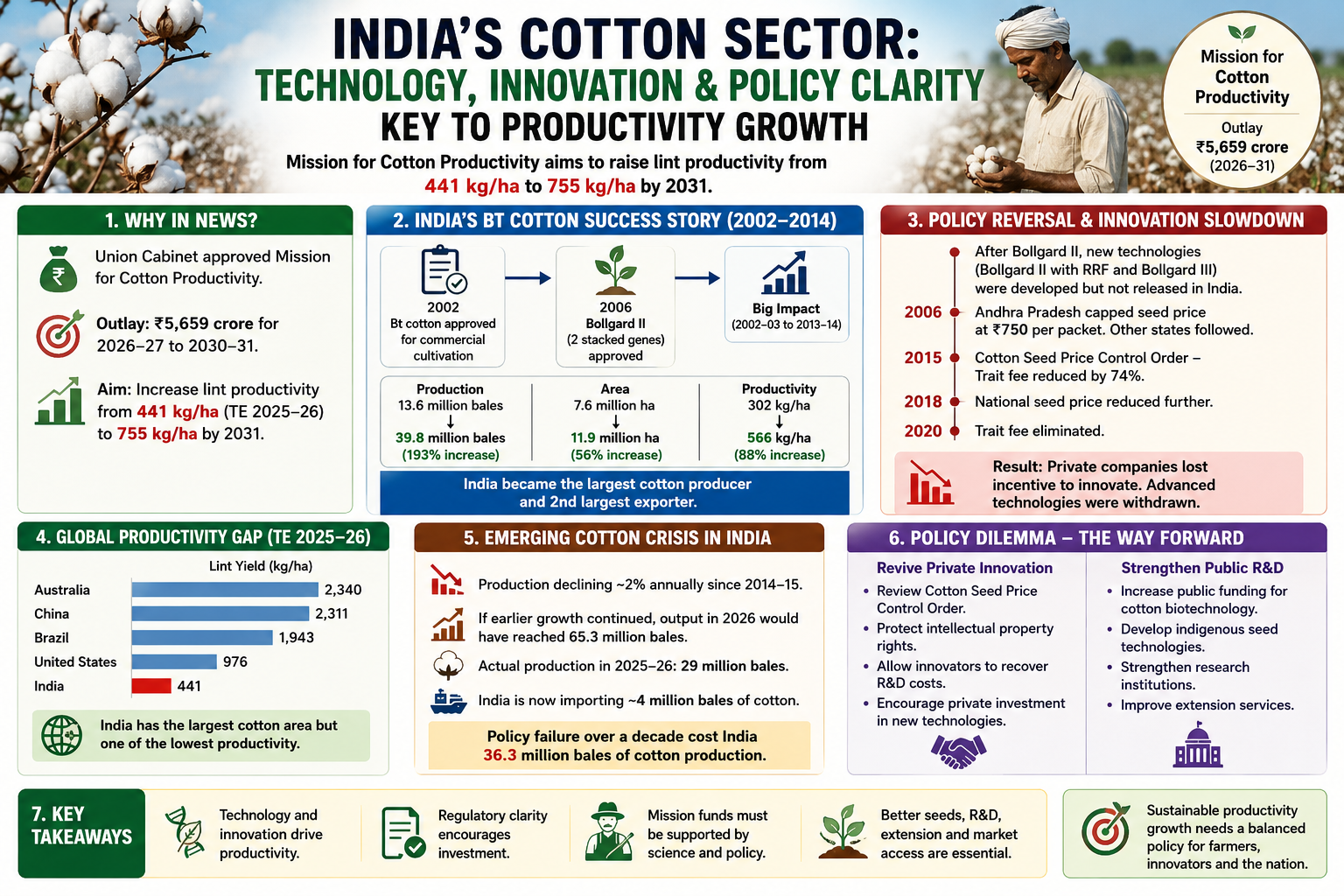
The Union Cabinet approved the Mission for Cotton Productivity with an outlay of ₹5,659 crore for the period 2026–27 to 2030–31.
The mission aims to raise India’s cotton lint productivity from 441 kg per hectare in the triennium ending 2025–26 to 755 kg per hectare by 2031. The mission is important because India’s cotton sector is facing declining productivity, technological stagnation and growing import dependence.
What is the Mission for Cotton Productivity?
- The mission is a Central initiative to improve cotton productivity in India.
- It will run from 2026–27 to 2030–31.
- Its approved outlay is ₹5,659 crore.
- It aims to increase lint productivity from 441 kg/ha to 755 kg/ha by 2031.
- It seeks to address productivity stagnation in cotton cultivation.
- It is linked to India’s textile economy, farmer income and agricultural competitiveness.

India’s Bt Cotton Success Story
- A major shift came in 2002, when India approved the commercial cultivation of Bt cotton.
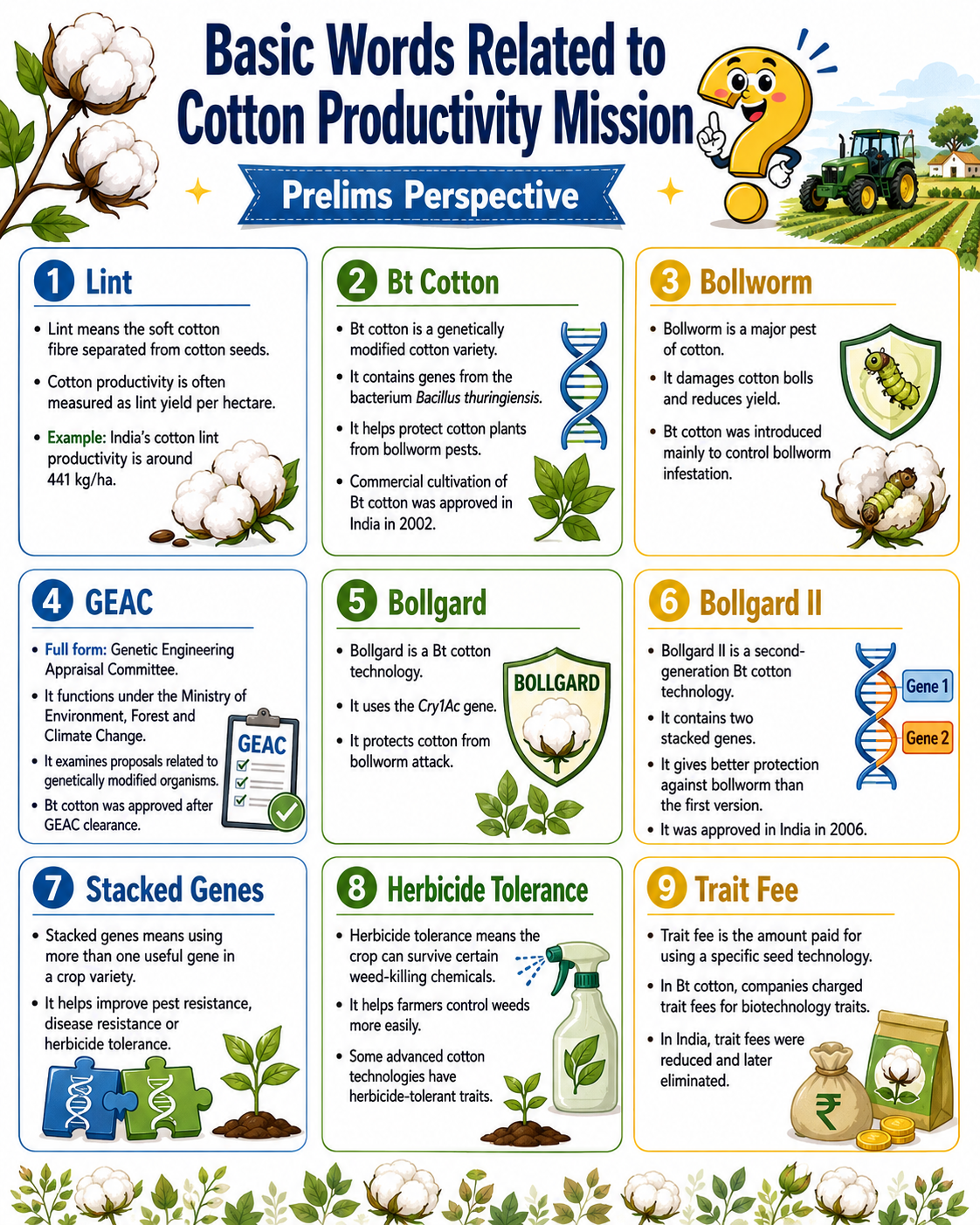
- The approval was given after clearance by the Genetic Engineering Appraisal Committee.
- The first Bt cotton hybrids used the Cry1Ac gene to control bollworm infestation.
- In 2006, Bollgard II was approved with two stacked genes for better pest resistance.
- Impact between 2002–03 and 2013–14:
| Indicator | 2002–03 | 2013–14 | Change |
| Cotton production | 13.6 million bales | 39.8 million bales | 193% increase |
| Cotton area | 7.6 million ha | 11.9 million ha | 56% increase |
| Productivity | 302 kg/ha | 566 kg/ha | 88% increase |
- India became the largest cotton producer and the second-largest exporter of cotton.
- This period showed how biotechnology can transform agricultural productivity and farmer incomes.
Policy Reversal and Innovation Slowdown
- After Bollgard II, newer technologies such as Bollgard II with Roundup Ready Flex and Bollgard III were developed.
- These technologies included:
- Three stacked genes
- Herbicide-tolerant traits
- Better pest management
- Improved weed control
- However, these advanced technologies were not commercialised in India.
Role of Price Controls
| Year | Policy Step | Impact |
| 2006 | Andhra Pradesh capped seed price at ₹750 per packet | Reduced seed company returns |
| 2015 | Cotton Seed Price Control Order | Trait fee reduced by 74% |
| 2018 | National seed price reduced further | Lowered commercial incentive |
| 2020 | Trait fee eliminated | Reduced incentive for private innovation |
- Due to price controls and weak intellectual property protection, private biotechnology firms reduced interest in bringing advanced cotton technologies to India.
- This slowed down seed innovation and technological renewal in cotton farming.
Global Cotton Productivity Gap
India has the world’s largest cotton-growing area, but its productivity is far below global competitors.
Cotton Lint Yield: TE 2025–26
| Country | Cotton Productivity |
| Australia | 2,340 kg/ha |
| China | 2,311 kg/ha |
| Brazil | 1,943 kg/ha |
| United States | 976 kg/ha |
| India | 441 kg/ha |
- The productivity gap reflects differences in:
- Biotechnology adoption
- Seed innovation
- R&D investment
- Regulatory support
- Agronomic practices
- Brazil has achieved high productivity even though a large share of its cotton is rainfed.
Emerging Cotton Crisis in India
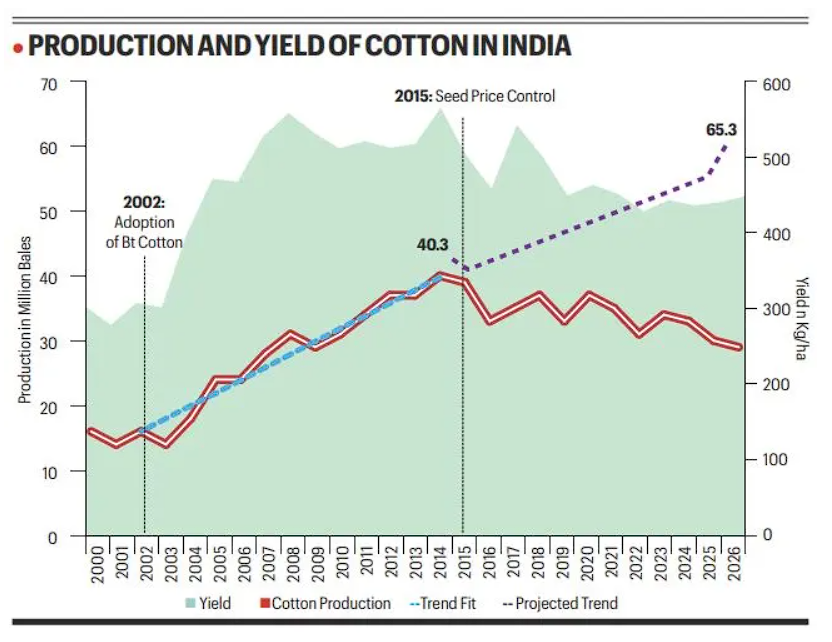
- India’s cotton production has been declining at an average annual rate of around 2% since 2014–15.
- If India had continued on the earlier growth path between 2002 and 2014, cotton output in 2026 could have reached 65.3 million bales.
- Actual cotton production in 2025–26 is around 29 million bales.
- The gap of 36.3 million bales shows the cost of productivity stagnation.
- India has moved from being a net exporter to importing around 4 million bales of cotton.
- This raises concerns for:
- Farmer income
- Textile industry competitiveness
- Cotton self-sufficiency
- Export potential
Key Concerns with the Mission
- The target of 755 kg/ha by 2031 is ambitious.
- India currently lacks access to next-generation cotton biotechnology used by global competitors.
- Advanced GM cotton varieties remain unavailable to Indian farmers.
- Private-sector innovation has weakened due to price controls.
- Public-sector R&D remains underfunded.
- Regulatory approval for biotechnology remains long and uncertain.
- Even if India achieves 755 kg/ha, it will remain far below Brazil, China and Australia.
Policy Dilemma
India faces two major choices.
1. Revive Private Innovation
- Reconsider the Cotton Seed Price Control Order.
- Strengthen intellectual property protection.
- Allow innovators to recover R&D investment.
- Encourage private seed companies to bring advanced technologies.
2. Expand Public Sector R&D
- Increase public funding for cotton biotechnology.
- Develop indigenous seed technologies.
- Strengthen agricultural universities and research institutions.
- Improve extension services for farmers.
- Promote locally suitable, climate-resilient cotton varieties.
Significance
- Cotton is a major fibre crop and supports millions of farmers.
- It is closely linked with India’s textile and garment industry.
- Higher productivity can reduce import dependence.
- Improved cotton output can support farmer incomes.
- Technology-led cotton growth can improve rural employment.
- Cotton productivity is important for India’s export competitiveness.
- The mission can help revive India’s position in global cotton markets.
Challenges
- Low cotton productivity compared to global competitors.
- Slow adoption of advanced biotechnology.
- Price controls reducing incentives for seed innovation.
- Weak public agricultural R&D funding.
- Pest resistance and weed management problems.
- Rainfed nature of much of India’s cotton cultivation.
- Fragmented landholdings and uneven extension services.
- Regulatory uncertainty around GM crops.
- Risk of increased import dependence.
Way Forward
- Create a balanced seed policy that protects farmers and encourages innovation.
- Review trait fee and seed price regulation without hurting affordability.
- Strengthen the GEAC approval process with scientific transparency.
- Promote next-generation cotton technologies after proper biosafety evaluation.
- Increase public investment in cotton biotechnology and plant breeding.
- Improve extension services for pest management, irrigation and soil health.
- Promote climate-resilient and region-specific cotton varieties.
- Encourage public-private partnerships in seed research.
- Link the mission with textile value chain needs.
- Ensure farmer access to affordable and advanced seed technologies.
Conclusion
The Mission for Cotton Productivity recognises the seriousness of India’s cotton crisis. Its target of raising productivity is welcome, but productivity cannot rise sustainably without technological renewal.
India’s cotton success between 2002 and 2014 showed the power of biotechnology. However, policy uncertainty, price controls and weak R&D have slowed innovation. The long-term revival of cotton requires a balanced framework that protects farmers, supports scientific innovation, strengthens public research and provides access to advanced seed technologies.
Without addressing these structural issues, the mission may improve outcomes only partially and fail to restore India’s global cotton competitiveness.