Table of Contents
Relevance: APPSC – Environment | Geography | Coastal Regulation | Natural Resource Governance
For Prelims:
Illegal Sand Mining, Coastal Regulation Zone (CRZ), MMDR Act 1957, Minor Minerals, Sustainable Sand Mining Management Guidelines 2016, Coastal Erosion, Salinisation, Beach Sand Mining, Prakasam District, Kothapatnam
For Mains:
Environmental Governance, Coastal Ecosystem Protection, Illegal Mining, Resource Management, Sustainable Development, Coastal Erosion, Administrative Regulation
Why in News?
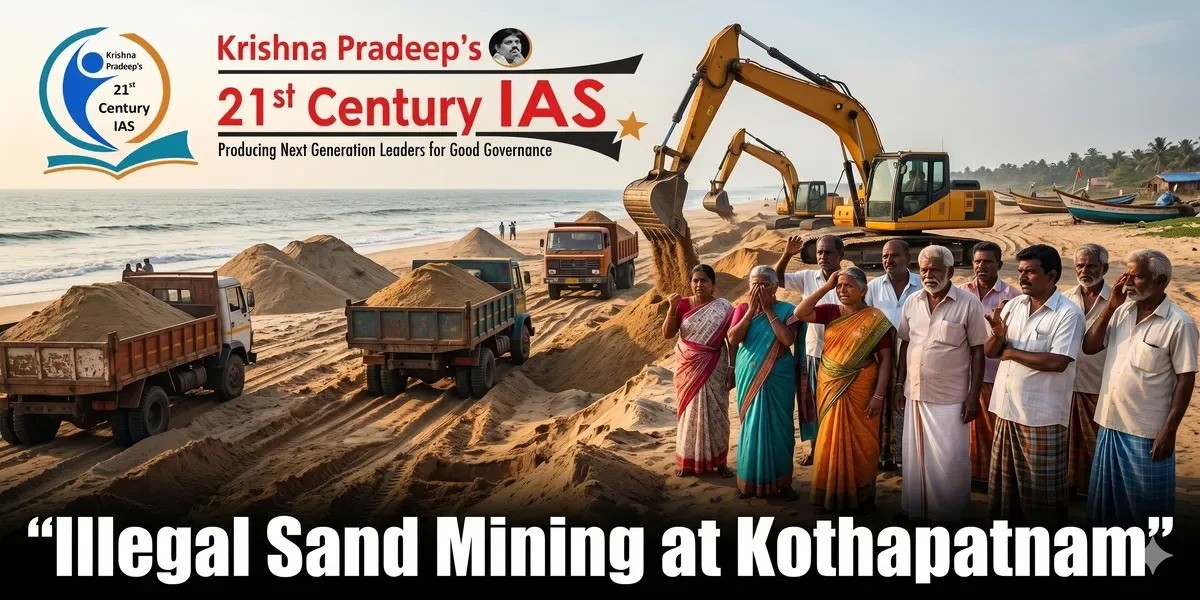
- Large-scale illegal sand mining has been reported near K. Pallepalem beach in Kothapatnam mandal of Prakasam district in Andhra Pradesh.
- Locals and social activists have alleged that beach sand is being excavated using heavy machinery and transported through tractors despite strict legal restrictions under Coastal Regulation Zone (CRZ) rules.
- Concerns have been raised regarding coastal erosion, groundwater salinisation, and threats to marine biodiversity.
- Similar illegal sand extraction has also been reported in the Bahuda River region near the Andhra Pradesh–Odisha interstate border.

Background of the Issue
- Sand is one of the most important natural resources used in construction activities such as buildings, roads, bridges, and infrastructure development. Increasing urbanisation and construction demand have led to excessive extraction of sand from rivers, beaches, and coastal zones.
- While legal mining is regulated through government permissions, illegal mining takes place without scientific assessment or environmental safeguards.
- In coastal areas, beach sand mining is particularly dangerous because beaches act as natural barriers against sea erosion and storms.
- At K. Pallepalem village, large quantities of beach sand were reportedly being removed for private construction purposes, including shrimp hatchery construction, raising serious environmental concerns.
What is Illegal Sand Mining?
- illegal sand mining refers to the unauthorised extraction of sand from riverbeds, floodplains, coastal areas, or other natural sources without valid permits or in violation of environmental laws.
- It often involves removal of sand beyond permissible limits, mining in restricted zones, or extraction without environmental clearance.
- Sand is a crucial raw material for construction (concrete, roads, buildings), which drives high demand and leads to unregulated exploitation.
- Such mining causes riverbank erosion, lowering of groundwater levels, destruction of aquatic habitats, and increased flood vulnerability.
- It also affects infrastructure like bridges and embankments by destabilising riverbeds.
- In India, it violates laws such as the Mines and Minerals (Development and Regulation) Act, 1957, Environment Protection Act, 1986, and rules related to sustainable sand mining.
- Illegal sand mining is often linked with organised networks, corruption, and weak enforcement mechanisms, making it a serious governance challenge.
- It is a major environmental and socio-economic issue, especially in river-rich states, requiring strict regulation and sustainable alternatives.
Coastal Regulation Zone (CRZ) Rules
The Coastal Regulation Zone (CRZ) framework regulates activities along India’s coastal stretches to protect sensitive coastal ecosystems.
These rules were issued under the Environment Protection Act, 1986.
Main Objective
- Protection of beaches
- Conservation of sand dunes
- Prevention of coastal erosion
- Protection of mangroves and marine biodiversity
- Regulation of developmental activities near coastlines
Important Rule
- CRZ regulations strictly prohibit large-scale sand mining in coastal areas because removal of beach sand weakens the natural coastal defence system.
- In some villages, limited manual sand collection for local domestic needs may be informally tolerated, but mechanised commercial mining is prohibited.
Mines and Minerals (Development and Regulation) Act, 1957 and Sand as Minor Mineral
- The Act is the principal legislation governing the regulation of mining and development of minerals in India, providing a framework for licensing, leasing, and control over mineral resources.
- The Act classifies minerals into major minerals and minor minerals, with sand being notified as a minor mineral.
- The Act empowers State Governments to regulate minor minerals, including granting quarry leases, fixing royalty rates, and enforcing rules for extraction.
- The Act allows States to frame their own rules for minor minerals under Section 15, leading to state-specific sand mining policies.
- Sand, as a minor mineral, is primarily used in construction activities such as concrete, plastering, and infrastructure development, making it economically significant.
- The classification of sand as a minor mineral places responsibility on States for monitoring and preventing illegal mining activities.
- The Act has been amended multiple times, notably in 2015, to strengthen transparency, introduce auctions, and curb illegal mining.
- Illegal sand mining occurs when extraction is carried out without permits, beyond approved limits, or in ecologically sensitive zones, violating provisions of the Act.
Sustainable Sand Mining Management Guidelines, 2016
The Government of India introduced the Sustainable Sand Mining Management Guidelines (SSMMG), 2016 to prevent illegal and unscientific mining.
|
Environmental Impact of Illegal Sand Mining
Illegal sand mining causes serious ecological damage, especially in coastal areas.
1. Coastal Erosion
Removal of beach sand weakens the natural coastal barrier, making shorelines more vulnerable to sea erosion and cyclones.
2. Salinisation of Groundwater
Beach sand helps prevent seawater intrusion. When sand is removed, saline water can enter groundwater systems, making water unsuitable for drinking and agriculture.
3. Threat to Marine Biodiversity
Beach ecosystems support nesting grounds, marine organisms, and coastal vegetation. Disturbance affects biodiversity and ecological stability.
4. Damage to Agriculture
Saltwater intrusion and land degradation reduce agricultural productivity in nearby coastal villages.
5. River and Coastal Instability
Unregulated extraction changes the natural sediment balance and damages long-term coastal sustainability.
Implications for Andhra Pradesh
Illegal sand mining affects not only the environment but also governance and public trust.
It reflects:
- Weak enforcement of mining laws
- Revenue loss to the State
- Environmental degradation of coastal districts
- Increased disaster vulnerability
- Administrative failure in regulating natural resources
Since Andhra Pradesh has a long coastline and major infrastructure growth, sustainable sand management is especially important.
Challenges in Controlling Illegal Sand Mining
- The problem is aggravated by political patronage and organised mining mafia networks, which undermine regulatory mechanisms.
- The issue is compounded by weak enforcement at the local level, including shortage of staff and limited administrative capacity.
- The situation is worsened due to the absence of regular and scientific monitoring of mining activities across riverbeds and coastal zones.
- The challenge is intensified by rapid urbanisation and high demand for construction materials, leading to excessive and illegal extraction of sand.
- The problem persists due to poor coordination among key agencies such as revenue authorities, police, mining departments, and coastal regulatory bodies.
Way Forward
- There is a need for strict enforcement of Coastal Regulation Zone (CRZ) norms and provisions of the Mines and Minerals (Development and Regulation) Act, 1957.
- The solution lies in adopting technology-based monitoring systems, including drones, satellite surveillance, and GIS tools for real-time tracking.
- Effective control requires strong legal and penal action against illegal mining networks and mafias.
- Better outcomes can be achieved through institutional coordination among police, mining departments, and local administration.
- Long-term sustainability demands promotion of alternatives such as manufactured sand (M-sand) to reduce dependence on natural sand resources.
Conclusion
Illegal sand mining near K. Pallepalem beach highlights the growing challenge of balancing construction demand with environmental protection.
Beach ecosystems are not merely land resources but critical natural barriers protecting coastal communities. Protecting them requires strict enforcement, scientific regulation, and responsible governance.
Without strong action, illegal mining can cause irreversible damage to Andhra Pradesh’s coastline and long-term ecological security.
CARE MCQ
Q. With reference to sand mining in India, consider the following statements:
- Sand is classified as a minor mineral under the MMDR Act, 1957.
- Coastal Regulation Zone (CRZ) rules permit unrestricted mechanised beach sand mining.
- Sustainable Sand Mining Management Guidelines, 2016 aim to regulate scientific extraction of sand.
Which of the statements given above are correct?
A. 1 and 3 only
B. 2 and 3 only
C. 1 and 2 only
D. 1, 2 and 3
Ans: (a)
Explanation
Statement 1 is correct : sand is treated as a minor mineral under the MMDR Act.
Statement 2 is incorrect : CRZ rules restrict large-scale and mechanised beach sand mining.
Statement 3 is correct : SSMMG 2016 promotes scientific and sustainable mining practices.
Q.With reference to sand mining in India, consider the following statements:
- Sand is classified as a minor mineral under the Mines and Minerals (Development and Regulation) Act, 1957.
- Regulation of sand mining is primarily the responsibility of the Central Government.
- District Survey Report (DSR) is required before granting sand mining leases.
Which of the statements given above is/are correct?
A. 1 and 3 only
B. 2 and 3 only
C. 1 only
D. 1, 2 and 3
Ans: (a)
Explanation:
- Statement 1 is correct: Sand is notified as a minor mineral under the MMDR Act, and hence its regulation falls under a specific category distinct from major minerals like coal or iron ore.
- Statement 2 is incorrect (trap): Regulation of minor minerals, including sand, is primarily the responsibility of State Governments, not the Centre.
- Statement 3 is correct: As per the Sustainable Sand Mining Management Guidelines, 2016, preparation of a District Survey Report (DSR) is mandatory before granting mining leases to ensure scientific and sustainable extraction.
Q. Consider the following statements regarding the Bahuda River:
- It originates in the Eastern Ghats.
- It flows through both Odisha and Andhra Pradesh.
- It is a tributary of the Godavari River.
Which of the statements given above is/are correct?
A. 1 and 2 only
B. 2 and 3 only
C. 1 and 3 only
D. 1, 2 and 3
Ans: (a)
- Statement 1 is correct: The Bahuda River originates in the Eastern Ghats, which is a discontinuous mountain range along the eastern coast of India. Many short, seasonal rivers of Odisha and Andhra Pradesh, including Bahuda, take origin from these hills and flow eastward.
- Statement 2 is correct: The river flows from Odisha into Andhra Pradesh, making it an inter-state river. This is an important mapping fact, as many east-flowing rivers of this region cross state boundaries before draining into the Bay of Bengal.
- Statement 3 is incorrect : The Bahuda River is not a tributary of the Godavari River. Instead, it is an independent east-flowing river that drains directly into the Bay of Bengal.
Q.With reference to the Sustainable Sand Mining Management Guidelines, 2016, consider the following statements:
- Preparation of a District Survey Report (DSR) is a prerequisite for granting sand mining leases.
- The Guidelines mandate replenishment studies to determine sustainable extraction levels.
- The Guidelines allow unrestricted sand mining in non-perennial rivers due to seasonal flow.
Which of the statements given above is/are correct?
A. 1 and 2 only
B. 2 and 3 only
C. 1 and 3 only
D. 1, 2 and 3
Ans: (a)
Explanation:
- Statement 1 is correct: The Guidelines require a District Survey Report (DSR) to identify viable and environmentally safe mining zones.
- Statement 2 is correct: Replenishment studies are essential to ensure that extraction does not exceed natural regeneration of sand.
- Statement 3 is incorrect (very close trap): Even in non-perennial rivers, mining is regulated and restricted, not unrestricted.
APPSC MAINS QUESTION
Q.Illegal sand mining in coastal Andhra Pradesh is both an environmental and governance challenge.
Discuss the causes, impacts, and policy measures required to ensure sustainable sand mining.
(250 Words)
FAQs
Q1. Why is beach sand mining dangerous?
Because it causes coastal erosion, groundwater salinisation, biodiversity loss, and weakens natural protection against storms and cyclones
Q2. Under which law is sand classified as a minor mineral?
Under the Mines and Minerals (Development and Regulation) Act, 1957.
Q3. Which rules regulate activities in coastal areas?
Coastal Regulation Zone (CRZ) Rules regulate coastal activities
Q4. What is SSMMG 2016?
It is the Sustainable Sand Mining Management Guidelines, 2016 introduced to regulate scientific and environmentally safe extraction of sand.
Q5. What is an alternative to river and beach sand?
Manufactured Sand (M-sand) is a major sustainable alternative used in construction.