Why in News?
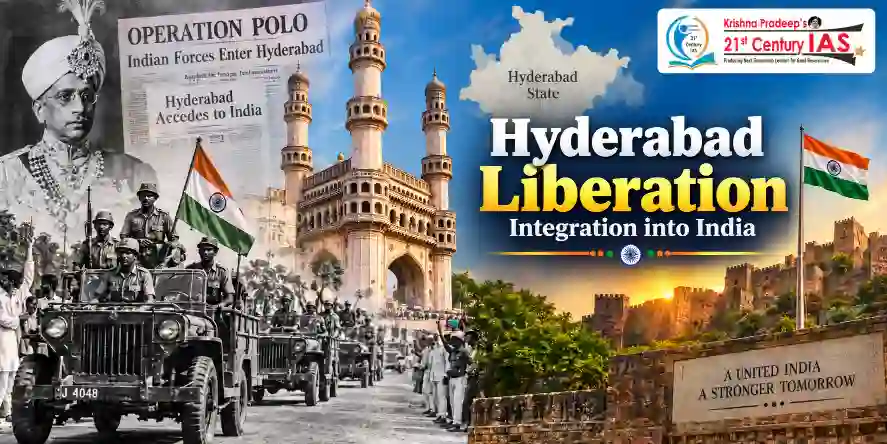
September 17 was observed as Hyderabad Liberation Day, commemorating the integration of the erstwhile Hyderabad princely State into the Indian Union in 1948. The Union Government has organised official celebrations since 2022. The 2026 programme was scheduled at Secunderabad Parade Grounds, with Vice-President C.P. Radhakrishnan as the chief guest.

Historical Background
- At the time of Indian Independence, Hyderabad was the largest princely State. It was ruled by the seventh Nizam, Mir Osman Ali Khan, and included areas that are now part of:
- Telangana
- Maharashtra’s Marathwada region
- Karnataka’s Kalyana-Karnataka region
- The Nizam initially sought to remain independent rather than join India or Pakistan. Hyderabad signed a Standstill Agreement with India in November 1947 to maintain existing administrative arrangements while negotiations continued.
- The situation deteriorated because of political uncertainty, feudal oppression, communal tensions and the activities of the Razakars, a paramilitary organisation associated with the Majlis-e-Ittehadul Muslimeen.
- At the same time, peasants in Telangana were already engaged in an armed struggle against landlords, forced labour and feudal exploitation.
Operation Polo
- The Indian government initiated military action against Hyderabad State on September 13, 1948. The operation was officially described as a “Police Action” and was codenamed Operation Polo.
- Indian troops entered Hyderabad State at around 5 a.m. The operation continued until September 17, when the Nizam’s forces surrendered and a ceasefire was announced.
- The name “Operation Polo” is commonly associated with Hyderabad’s large number of polo grounds. However, explanations regarding the precise origin of the codename vary.
Important Timeline
| Date | Development |
| November 1947 | Standstill Agreement between Hyderabad and India |
| December 4, 1947 | Failed assassination attempt on the Nizam |
| September 13, 1948 | Operation Polo began |
| September 17, 1948 | Hyderabad forces surrendered |
| September 18, 1948 | Jawaharlal Nehru appealed against communal hostility through All India Radio |
| September 19, 1948 | Indian Army columns entered Secunderabad amid public gatherings |
| 1951 | Telangana Peasant Armed Struggle formally ended |
Impact on Civilian Life
The military operation significantly disrupted everyday life in Hyderabad and Secunderabad.
- An emergency was declared.
- Banks reduced their working hours.
- Hospitals displayed Red Cross or Red Crescent flags.
- Several telephone connections were disconnected.
- Suburban bus services were suspended, although routes connecting Secunderabad and Afzalgunj continued.
- Cinema halls restricted their screenings.
- Residents were instructed to darken windows and store essential supplies.
After the military action, crowds welcomed Indian Army columns with flags, flower petals and garlands. However, the period also witnessed looting, assaults and communal violence. Muslim families were displaced from some localities, while earlier Razakar violence had affected non-Muslims, political opponents and rural communities.
These experiences explain why memories of 1948 differ among families and regions.
Why is September 17 Known by Different Names?
Police Action
- The term refers specifically to the Indian military operation conducted between September 13 and 17, 1948.
- Although officially called a Police Action, it was carried out by the armed forces. Some historians therefore consider the expression inadequate for describing the scale of the operation.
Integration Day
- “Integration” highlights Hyderabad State’s incorporation into the Indian Union. It places the event within the broader process of unifying princely States after Independence.
- This term also reflects the fact that the Nizam was not immediately exiled and continued to hold a constitutional position during the subsequent transition.
Liberation Day
- “Liberation” emphasises the end of the Nizam’s political authority, Razakar violence and autocratic-feudal governance.
- For communities that experienced landlordism, forced labour or political repression, the term represents freedom from the existing ruling system.
- Thus, the three expressions refer to different dimensions of the same historical transition rather than three separate events.
Political Transition after 1948
- The Nizam was not removed from Hyderabad or sent into exile. Military administration was initially established under Major General J.N. Chaudhuri.
- After the Constitution came into force in 1950, Mir Osman Ali Khan became the Rajpramukh of Hyderabad State. He continued in that constitutional position until the reorganisation of States in 1956.
- This arrangement shows that Hyderabad’s transition involved both military action and political accommodation.
Telangana Peasant Armed Struggle
September 17 did not end every conflict in Telangana.
The Telangana Peasant Armed Struggle had begun against:
- Feudal landlordism
- Vetti or forced labour
- Illegal exactions
- Evictions
- Concentration of agricultural land
- Repression by the Nizam’s forces and Razakars
Led mainly by communist organisations, the movement continued after Operation Polo and lasted until 1951.
Therefore, Hyderabad’s integration and the Telangana agrarian struggle must be studied as related but distinct historical processes.
Role of Literature and Journalism
- Songs, poetry, journalism and folk traditions helped spread political awareness among peasants, workers and ordinary citizens.
Bandi Yadagiri
- His revolutionary song “Bandenaka Bandi Katti” became closely associated with resistance to landlords and feudal oppression.
Makhdoom Mohiuddin
- The revolutionary Urdu poet participated in the progressive writers’ movement and mobilised peasants and workers against autocratic and feudal structures.
Daasarathi Krishnamacharyulu
- Daasarathi opposed the Nizam’s regime and was imprisoned in Nizamabad and Gulbarga. His prison poetry became an important part of Telangana’s literary memory.
Shoebullah Khan
- The Urdu journalist and editor of Imroz criticised the regime and Razakar violence. He was assassinated in August 1948.
Kaloji Narayana Rao
- Kaloji was a poet, freedom fighter and political activist who opposed autocracy and feudalism. He was associated with the Hyderabad State Congress and progressive movements.
Revolutionary Activism
- On December 4, 1947, Narayan Rao Pawar, Jagdish Arya and Gandaiah Arya attempted to assassinate the Nizam near Gunfoundry. The attempt failed, and the Nizam escaped unharmed.
- Together, cultural and political resistance challenged censorship, mobilised people and preserved memories that were often absent from official records.
Conclusion
September 17, 1948 was a turning point in Hyderabad’s transition from princely rule to the Indian constitutional system. “Police Action”, “integration” and “liberation” each illuminate a particular part of that process. A balanced understanding must recognise political unification, anti-feudal resistance, cultural mobilisation and the suffering of civilians together.