Table of Contents
Relevance: GS Paper III – Agriculture | Horticulture | Rural Economy | Agricultural Diversification
For Prelims:
High-Value Crops (HVCs), Horticulture, MIDH, Coconut Development Board, Directorate of Cashewnut and Cocoa Development, Agarwood, CITES, Intercropping, Chilgoza, Gross Value Output (GVO), FPOs
For Mains:
crop diversification, horticulture-led growth, agro-processing, export-oriented agriculture, nutritional security, climate-resilient agriculture, regional specialization, post-harvest management, value chain development, rural livelihoods
Why in News?
The Union Budget 2026–27 has introduced a crop-specific and regionally differentiated strategy to accelerate diversification into high-value crops across India’s coastal regions, North Eastern States, and Himalayan areas.
The focus is on promoting crops such as coconut, cashew, cocoa, agarwood, walnuts, almonds, sandalwood, and pine nuts to improve farmer income and strengthen export-oriented agriculture.
This marks a shift from cereal-dominated farming toward horticulture-led rural development.
What are High-Value Crops?
- High-Value Crops (HVCs) mainly refer to horticultural crops such as fruits, vegetables, flowers, spices, plantation crops, medicinal plants, aromatic plants, and nuts
- It generates significantly higher income per unit of land compared to traditional crops like rice, wheat, and pulses.
- They are called high-value because they provide better returns, higher employment opportunities, stronger export potential, and improved nutritional security.
- Examples include coconut, cashew, cocoa, spices, medicinal herbs, floriculture crops, walnuts, almonds, and agarwood.
- These crops are generally labour-intensive and support agro-processing industries, making them important for rural transformation.
Why Crop Diversification is Necessary?
- Indian agriculture has remained heavily dependent on cereals, especially rice and wheat, leading to regional imbalance, groundwater depletion, and declining profitability for farmers.
- Excessive cereal cultivation has created environmental stress, particularly in Punjab, Haryana, and western Uttar Pradesh where groundwater extraction is severe.
- Diversification toward horticulture and plantation crops improves farm profitability while reducing ecological pressure.
- High-value crops also create resilience against market shocks because farmers are not dependent on a single crop.
- They strengthen nutrition security by increasing the supply of fruits, vegetables, nuts, and other nutrient-rich produce.
Horticulture as a Driver of Agricultural Growth
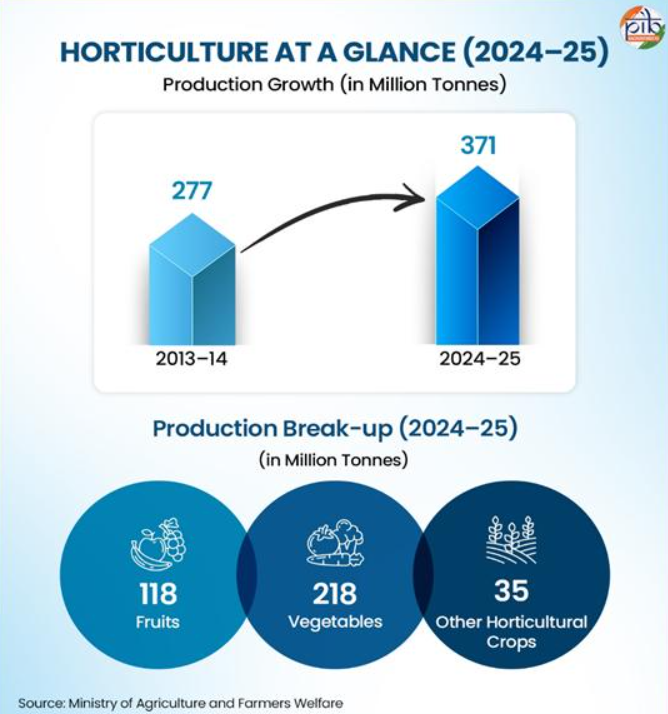
- Horticulture has become one of the fastest-growing segments of Indian agriculture.
- It contributes nearly 37% of the Gross Value Output (GVO) of the agricultural crops sub-sector despite occupying less land compared to cereals.
- India’s total horticultural production reached 370.74 million tonnes in 2024–25, reflecting strong productivity growth.
- The sector has grown at approximately 4.45% over the last decade, which is higher than the growth rate of traditional field crops.
- India is the world’s largest producer of onions and shallots and ranks second globally in vegetables, fruits, and potatoes.
- This shows that horticulture is now a major engine of agricultural income and rural employment.
Region-Specific High-Value Crop Strategy
Coastal Regions
- The coastal states are being promoted for coconut, cashew, cocoa, and sandalwood cultivation.
- India ranks second globally in coconut production with around 22.44% of world output and supports nearly 30 million livelihoods through the coconut economy.
- The policy focus is on replacing old and low-yielding coconut trees with high-yielding varieties and promoting Indian cashew as a premium export brand.
- Cocoa is being promoted as an intercrop in coconut and arecanut plantations because partial sunlight conditions are suitable for cocoa cultivation.
- This intercropping model provides additional income without requiring extra land.
North Eastern Region
- The North East is being positioned as a major centre for agarwood cultivation.
- India has nearly 150 million agarwood trees, and about 90% are concentrated in Tripura and Assam.
- Agarwood is used in the global Oud perfume industry and has very high export value.
- Tripura alone has the potential for nearly ₹2,000 crore annual turnover through sustainable agarwood cultivation and regulated exports aligned with CITES norms.
- This creates strong opportunities for tribal livelihoods and export earnings.
Himalayan and Hilly Regions
- Jammu and Kashmir, Himachal Pradesh, and other hill regions are being promoted for walnuts, almonds, and Chilgoza pine nuts.
- These crops are highly suitable for cold climates and offer significantly higher income than conventional farming.
- High-density plantation models are being promoted to improve productivity and maximize land efficiency.
- This supports tribal incomes and reduces migration from hilly areas.
Institutional Support for Diversification
Mission for Integrated Development of Horticulture (MIDH)
- MIDH is a centrally sponsored scheme for the holistic development of horticulture.
- It supports nursery development, protected cultivation, organic farming, post-harvest management, and cold-chain infrastructure.
- It is the main policy instrument for strengthening horticulture diversification.
Coconut Development Board
- It works for the integrated development of coconut cultivation and industry across India.
- It supports productivity improvement, processing, marketing, and value addition such as virgin coconut oil and coconut-based products.
Directorate of Cashewnut and Cocoa Development
- This institution supports research, nursery modernization, and farmer training related to cashew and cocoa production.
- It helps improve export competitiveness and productivity.
Farmer Producer Organizations (FPOs)
- FPOs are being promoted to organize small farmers engaged in coconut, cashew, cocoa, and other horticultural crops.
- They improve bargaining power, processing capacity, and market access.
Challenges in High-Value Crop Diversification
- High-value perennial crops such as sandalwood and agarwood require high initial investment and have long gestation periods, making adoption difficult for small farmers.
- Unlike cereals, horticultural crops are highly perishable and require strong cold-chain and post-harvest infrastructure. Without this, farmers face major losses.
- Climate change affects crops such as walnuts and almonds because changing snowfall patterns and temperature increases directly reduce productivity.
- Small and fragmented landholdings make it difficult to achieve economies of scale in processing and exports.
- Meeting international phytosanitary and quality standards remains a major challenge for accessing premium global markets such as the EU and USA.
- Weak branding and limited value addition reduce export competitiveness.
Significance for India
- High-value crop diversification improves farmer income and supports the national goal of doubling farmers’ income through better profitability.
- It strengthens export-oriented agriculture and reduces dependence on low-value cereal production.
- Labour-intensive horticulture creates more rural employment, especially for women and tribal communities.
- It promotes agro-processing industries such as food processing, essential oils, nut processing, and plantation-based industries.
- Diversification also improves climate resilience by reducing overdependence on water-intensive crops.
- It contributes to better national nutrition through increased availability of fruits, vegetables, nuts, and spices.
Way Forward
- Post-harvest management must be strengthened through cold storage, grading, packaging, and food processing infrastructure under MIDH.
- Indian products such as sandalwood, Indian cocoa, and premium cashew should be developed as global brands by 2030 to command higher international prices.
- More FPOs should be promoted in fragmented sectors like coconut and cashew for collective marketing and better price realization.
- Geospatial mapping and digital monitoring should be expanded for crops like agarwood and nut orchards to improve yield estimation and policy targeting.
Conclusion
High-value crop diversification represents a major structural transformation in Indian agriculture from subsistence farming to a market-linked, export-driven, and income-oriented system.
The Union Budget 2026–27 reflects a strategic move toward region-specific horticulture development based on agro-climatic strengths.
If supported by infrastructure, branding, institutions, and farmer participation, high-value crops can become the foundation of a more prosperous and resilient rural economy.
CARE MCQ
Q. With reference to High-Value Crop Diversification in India, consider the following statements:
- High-value crops generate higher net returns per unit of land compared to cereals.
- Cocoa is promoted as an intercrop in coconut plantations due to suitable shade conditions.
- Agarwood cultivation in India is mainly concentrated in the Himalayan region.
Which of the statements given above are correct?
A. 1 and 2 only
B. 2 and 3 only
C. 1 and 3 only
D. 1, 2 and 3
Ans: (a)
Explanation
Statement 1 is correct : high-value crops such as fruits, nuts, spices, and plantation crops provide significantly higher returns than staple cereals.
Statement 2 is correct: cocoa grows well under partial shade and is widely promoted as an intercrop in coconut and arecanut plantations.
Statement 3 is incorrect : agarwood cultivation is mainly concentrated in the North Eastern States, especially Tripura and Assam, not in the Himalayan region.
2.Consider the following statements:
Statement-I: Kharif crops are sown in the months of March to April.
Statement-II: Kharif crops require abundant rainfall and are harvested after the monsoon.
Which one of the following is correct in respect of the above statements?
(a) Both Statement-I and Statement-II are correct and Statement-II explains Statement-I
(b) Both Statement-I and Statement-II are correct, but Statement-II does not explain Statement-I
(c) Statement-I is correct, but Statement-II is incorrect
(d) Statement-I is incorrect, but Statement-II is correct
Ans: (d)
Explanation:
Statement-I is incorrect: Kharif crops are generally sown with the onset of the Southwest Monsoon, usually during the months of June to July, and not in March–April. These crops depend heavily on monsoon rainfall for their growth and are therefore closely linked with the rainy season. Crops such as rice, maize, cotton, soybean, groundnut, and millets are major Kharif crops.
March–April is typically associated with the harvesting period of many Rabi crops or the sowing of short-duration Zaid crops, not Kharif crops. Hence, the statement is factually incorrect.
Statement-II is correct: Kharif crops require high temperature, humidity, and abundant rainfall during their growing season. Since they are sown at the beginning of the monsoon, they grow during the rainy months and are generally harvested after the monsoon ends, usually between September and October. Their dependence on rainfall makes monsoon performance extremely important for agricultural output and food security in India.
Thus, this statement correctly describes both the climatic requirement and harvesting pattern.
Q.Consider the following crops and their primary growing seasons in India:
- Wheat is primarily grown in the Rabi season.
- Rice is primarily grown in the Kharif season.
- Mustard is primarily grown in the Zaid season.
- Cotton is primarily grown in the Kharif season.
How many of the above statements are correct?
(a) Only one
(b) Only two
(c) Only three
(d) All four
Ans: (c)
Explanation:
Statement 1 is correct: Wheat is one of the most important Rabi crops in India. It is sown during the winter months, usually from October to December, and harvested in spring, generally between March and April. It requires cool weather during growth and bright sunshine during ripening.
Statement 2 is correct: Rice is primarily a Kharif crop in India. It is sown during the monsoon season and harvested after the rains. It requires high temperature, high humidity, and abundant water supply, making it ideal for cultivation during the rainy season. Though rice is also grown as a Rabi crop in some southern states, its primary season remains Kharif.
Statement 3 is incorrect: Mustard is mainly a Rabi crop, not a Zaid crop. It is sown in winter after the monsoon and harvested before summer. Zaid crops are short-duration summer crops grown between Rabi and Kharif seasons, such as watermelon, cucumber, and some vegetables. Therefore, associating mustard with the Zaid season is incorrect.
Statement 4 is correct: Cotton is primarily a Kharif crop. It requires high temperature, light rainfall, and a long frost-free period. It is sown with the onset of the monsoon and harvested later in the year. Black soil regions of Maharashtra, Gujarat, and Telangana are major cotton-growing areas.
Q. With reference to pulse cultivation in India, consider the following statements:
- Pulses improve soil fertility by fixing atmospheric nitrogen through symbiotic bacteria in their root nodules.
- Gram is predominantly cultivated during the kharif season under high rainfall conditions.
Which of the statements given above is/are correct?
(a) 1 only
(b) 2 only
(c) Both 1 and 2
(d) Neither 1 nor 2
Ans: (a)
Explanation:
Statement 1 is correct: Pulses belong to the leguminous family and have the special ability to fix atmospheric nitrogen with the help of Rhizobium bacteria present in their root nodules. This improves soil fertility and reduces dependence on chemical fertilizers, making pulses important in sustainable agriculture and crop rotation systems.
Statement 2 is incorrect: Gram (chickpea) is primarily a rabi crop, not a kharif crop. It is generally sown after the monsoon and requires relatively low rainfall and cool climatic conditions for growth. It thrives best in areas with moderate temperature and well-drained loamy soils. Therefore, linking gram mainly with the kharif season is incorrect.
TSPSC MAINS QUESTION
Q.“High-Value Crop Diversification is essential for transforming Indian agriculture from subsistence-oriented farming to income-oriented farming.” Discuss in the context of regional crop planning, farmers’ income enhancement, and sustainable agricultural development in India. [250 WORDS]
FAQs
Q1. What are High-Value Crops?
They are crops such as fruits, vegetables, flowers, spices, plantation crops, nuts, and medicinal plants that provide higher income per unit of land than traditional crops like rice and wheat.
Q2. Which scheme supports horticulture diversification in India?
The Mission for Integrated Development of Horticulture (MIDH) is the main scheme supporting horticulture development
Q3. Why is crop diversification important?
It improves farmer income, reduces ecological pressure from cereal monoculture, strengthens nutrition security, and supports export-oriented agriculture.
Q4. Why is agarwood important?
Agarwood has very high export value due to its use in perfumes and luxury fragrance industries, especially in the global Oud market
Q5. What is intercropping in horticulture?
It is the cultivation of one crop along with another, such as cocoa with coconut, to improve land productivity and provide additional income.