

Table of Contents
Relevance: TGPSC Telangana History and Culture
Prelims
Gajalakshmi, Rashtrakuta Dynasty, Yanagandla, Kulcharam Mandal, Medak, Padmasana, Samudra Manthan, Nataraja, Ananda Tandava, Black Granite, Kotha Telangana Charitra Brundam
Mains
Cultural Heritage, Sculptural Iconography, Community Conservation, Archaeological Documentation, Heritage Neglect, Digital Preservation
Why in News?
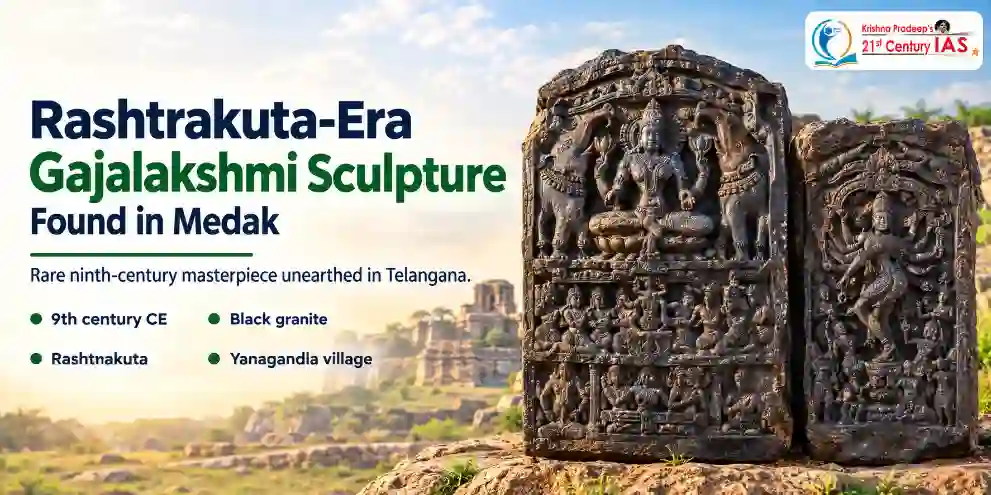
- A rare ninth-century Gajalakshmi sculpture belonging to the Rashtrakuta period was found lying neglected at Yanagandla village in Telangana.
- Historians described the double-sided sculpture as a masterpiece requiring immediate protection and preservation.
Discovery at a Glance
| Particular | Details |
| Location | Yanagandla village, Kulcharam mandal, Medak district |
| Period | Ninth century CE |
| Dynasty | Rashtrakuta |
| Material | Black granite |
| Front side | Gajalakshmi and Samudra Manthan |
| Reverse side | Twelve-armed Nataraja performing Ananda Tandava |
| Present condition | Lying neglected without proper protection |
Sculptural Features
Gajalakshmi Representation
- Goddess Lakshmi is shown seated in Padmasana.
- She holds lotus flowers in both hands.
- Elephants are depicted anointing the goddess.
- Gajalakshmi generally represents prosperity, fertility and auspiciousness.
Samudra Manthan Panel
- The upper section depicts Samudra Manthan, or the churning of the ocean.
- It shows gods and demons participating in the churning.
- Historians stated that this combination with Gajalakshmi had not previously been reported in Telangana or Andhra Pradesh.
Nataraja Sculpture
The reverse side depicts:
- Lord Shiva as a 12-armed Nataraja;
- Shiva performing the Ananda Tandava; and
- Brahma and Vishnu seated on either side with folded hands.
Conclusion
The Gajalakshmi–Nataraja sculpture is an important link to Telangana’s Rashtrakuta-era heritage. Its rare iconography gives it historical, artistic and academic value. Scientific conservation, official documentation and local participation are essential to preserve it for future generations.
CARE MCQ
Q. Consider the following statements regarding the Gajalakshmi sculpture discovered in Medak:
- It belongs to the ninth-century Rashtrakuta period.
- It was carved from black granite.
- Its front side depicts Gajalakshmi along with Samudra Manthan.
- Its reverse side depicts a 12-armed Vishnu performing Ananda Tandava.
Which of the statements given above are correct?
(a) 1 and 2 only
(b) 1, 2 and 3 only
(c) 2, 3 and 4 only
(d) 1, 2, 3 and 4
Answer: (b) 1, 2 and 3 only
Explanation
- Statement 1 is correct: The sculpture dates to the ninth century CE during the Rashtrakuta period.
- Statement 2 is correct: It was carved from black granite.
- Statement 3 is correct: The front depicts Gajalakshmi with a rare representation of Samudra Manthan above it.
- Statement 4 is incorrect: The reverse depicts Lord Shiva as a 12-armed Nataraja, not Vishnu, performing the Ananda Tandava.
FAQs
Q. Where was the sculpture discovered?
At Yanagandla village in Kulcharam mandal of Medak district.
Q. To which period does it belong?
The ninth-century Rashtrakuta period.
Q. What does the front side depict?
Gajalakshmi with elephants and a Samudra Manthan panel.
Q. What appears on the reverse side?
A 12-armed Nataraja performing the Ananda Tandava.
Q. Why is the sculpture considered rare?
Its combined representation of Gajalakshmi, Samudra Manthan and Nataraja has not previously been reported in Telangana or Andhra Pradesh.