Can Ethanol Blending Transform India’s Energy Security Without Creating Food and Environmental Stress?
Table of Contents
Relevance: GS Paper III – Energy, Environment, Agriculture, Sustainable Development
For Prelims:
- Ethanol Blending, Ethanol (C₂H₅OH), E10, E20, Biofuels, Flex-Fuel Vehicles (FFVs), Ethanol Blended Petrol (EBP) Programme, 1G/2G/3G Ethanol
For Mains:
- Energy Security, Biofuel Policy, Food-Fuel Conflict, Renewable Energy Transition, Agricultural Diversification, Carbon Emissions, Sustainable Development
Why in News?
- Recent disruptions in global oil supplies have once again exposed India’s vulnerability due to its heavy dependence on crude oil imports. This situation has renewed focus on accelerating ethanol blending in petrol as a means to enhance energy security and reduce import dependence.
- The present crisis is also being viewed as an opportunity to undertake structural reforms in energy policy, similar to Brazil’s response to the oil shocks of the 1970s.
Background and Context
- India imports a significant proportion of its crude oil requirements, making its energy security vulnerable to global price fluctuations and geopolitical disruptions.
- To address this challenge, the government has been promoting ethanol blending under the Ethanol Blended Petrol (EBP) Programme since 2003. Over time, blending targets have been progressively increased, culminating in the achievement of 20% blending (E20) in 2025, well ahead of the initial 2030 target.
Concept of Ethanol Blending
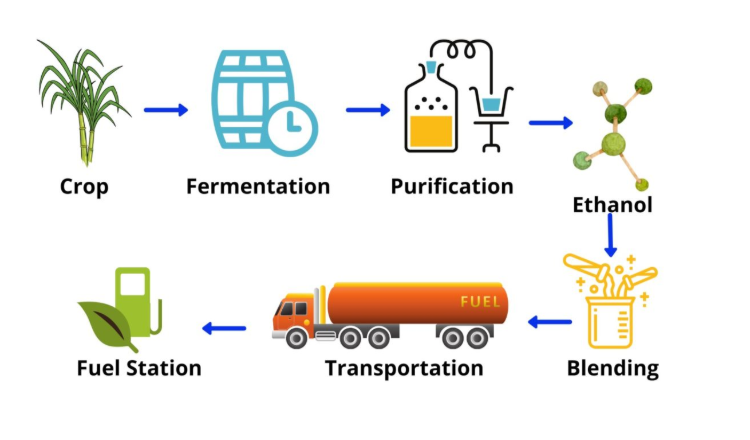
- Ethanol blending refers to the process of mixing ethanol, a renewable biofuel, with petrol to produce a cleaner and more sustainable fuel. Ethanol (C₂H₅OH) is typically produced through the fermentation of crops such as sugarcane, maize, and wheat.
- This approach represents a strategic shift towards diversifying the energy mix by incorporating renewable, domestically produced fuels into conventional fossil fuel systems.
Nature and Characteristics
- Ethanol blending is characterised by its reliance on renewable agricultural feedstock, which creates a direct linkage between the energy and agricultural sectors. It contributes to reducing carbon emissions when compared to conventional fossil fuels, thereby supporting climate goals.
- The programme is implemented through gradual scaling of blending targets, such as E10 and E20, allowing for a phased transition. However, its success is closely tied to agricultural cycles and climatic conditions, which influence the availability of feedstock.
Global Example – Brazil Model
- Brazil’s Proálcool Programme, launched in 1975 after the global oil crisis, is widely regarded as a successful model of ethanol adoption. The programme promoted ethanol through subsidies, pricing support, and mandatory blending requirements of around 30%.
- Brazil also introduced flex-fuel vehicles capable of running on petrol, ethanol, or a combination of both. Over time, it developed an integrated ecosystem linking sugarcane cultivation, ethanol production, and fuel distribution infrastructure, making ethanol a central component of its energy strategy.
Status of Ethanol Blending in India
|
Types of Ethanol
- Ethanol production can be classified into different generations based on feedstock and technology. First-generation (1G) ethanol is produced from food crops such as sugarcane and maize. Second-generation (2G) ethanol is derived from agricultural residues, such as crop stubble.
- More advanced forms include third-generation (3G) ethanol from algae and fourth-generation (4G) ethanol produced using genetically engineered biomass. The shift towards advanced generations is crucial for long-term sustainability.
Core Issues Involved
- A key issue in ethanol blending is the potential conflict between food and fuel, as the use of food crops for ethanol production may affect food availability and prices. Another concern relates to water usage, particularly in the case of sugarcane, which is a highly water-intensive crop.
- Additionally, dependence on agricultural feedstock introduces variability in supply due to monsoon fluctuations, making the system less predictable. The compatibility of vehicles with higher ethanol blends and the adequacy of infrastructure are also important considerations.
Causes / Drivers
- The primary driver of ethanol blending is the need to reduce dependence on imported crude oil and enhance energy security. Environmental concerns, particularly the need to reduce carbon emissions, have also played a significant role.
- Furthermore, ethanol blending provides an additional source of income for farmers by creating demand for agricultural produce. It also supports the utilisation of agricultural waste, thereby addressing issues such as stubble burning.
Implications
- Economic Implications
Ethanol blending reduces the import bill for crude oil and strengthens India’s foreign exchange position. It also stimulates investment in the biofuel and agricultural sectors.
- Environmental Implications
The use of ethanol-blended fuel leads to lower greenhouse gas emissions compared to conventional petrol, contributing to climate mitigation efforts.
- Agricultural Implications
The programme provides a stable market for crops such as sugarcane and maize, thereby supporting farmers’ incomes. However, it may also lead to distortions in cropping patterns.
- Energy Security Implications
By diversifying the energy mix, ethanol blending enhances resilience against global oil shocks and supply disruptions.
Institutional Mechanism
- Ethanol blending in India is implemented through the Ethanol Blended Petrol Programme under the Ministry of Petroleum and Natural Gas. It involves coordination between multiple stakeholders, including oil marketing companies, distilleries, and agricultural producers.
- Policy support includes pricing mechanisms, subsidies, and regulatory frameworks to ensure adequate supply and distribution.
International Dimension
- Globally, there is a growing shift towards renewable fuels as countries attempt to meet their climate commitments under international agreements. Brazil and the United States are leading examples of large-scale ethanol adoption.
- India’s ethanol programme aligns with global trends in energy transition, while also strengthening its position in discussions on sustainable development and climate action.
Government Initiatives
- The government has taken several measures to promote ethanol blending, including advancing the E20 target timeline, expanding distillery capacity, and encouraging the production of second-generation ethanol.
- It has also promoted the adoption of flex-fuel vehicles and provided financial incentives to support the biofuel industry.
Challenges / Criticisms
- The diversion of food crops for ethanol production raises concerns about food security and inflation. The cultivation of water-intensive crops such as sugarcane may exacerbate water scarcity in already stressed regions.
- In addition, the dependence on monsoon conditions introduces uncertainty in supply. The lack of adequate infrastructure, including storage and transportation facilities, remains a bottleneck.
- There are also concerns regarding vehicle compatibility, as older vehicles may not perform efficiently with higher ethanol blends.
Way Forward
- India should prioritise the transition towards second-generation ethanol derived from agricultural residues to minimise the food-fuel conflict. Strengthening supply chain infrastructure, including storage and blending facilities, will be essential for scaling up the programme.
- The promotion of flex-fuel vehicles and technological innovation can further support the transition. At the same time, policy stability and coordination among stakeholders will be crucial for ensuring long-term sustainability.
Conclusion
Ethanol blending represents a strategic shift towards a more sustainable and self-reliant energy system in India. While it offers significant benefits in terms of energy security, environmental sustainability, and rural development, it also poses challenges related to resource use and policy design.
The long-term success of the programme will depend on balancing these competing considerations and ensuring a transition that is both efficient and equitable.
UPSC PYQ
Q. Examine the role of biofuels in enhancing energy security in India. What are the challenges associated with their adoption? (GS III)
UPSC PRELIMS MCQ
Q. With reference to biofuels in India, consider the following statements: (UPSC CSE 2020)
- Biofuels can be produced from biomass such as agricultural residues and organic waste.
- The Government of India has set targets for blending ethanol with petrol.
- Biodiesel in India is mainly produced from non-edible oilseeds.
Which of the statements given above is/are correct?
(a) 1 only
(b) 1 and 2 only
(c) 1, 2 and 3
(d) 2 and 3 only
Answer: (c)
Explanation
• Statement 1 – Correct: Biofuels are produced from biomass such as crop residues, sugarcane, corn, algae, and organic waste.
• Statement 2 – Correct: India promotes ethanol blending with petrol to reduce crude oil imports and carbon emissions.
• Statement 3 – Correct: Biodiesel in India is mainly produced from non-edible oilseeds such as Jatropha curcas and Pongamia pinnata.
CARE MCQ
Q. Consider the following statements regarding ethanol blending:
- Ethanol is a renewable fuel produced primarily through fermentation of agricultural crops.
- Higher ethanol blending always improves vehicle efficiency in all types of vehicles.
- Second-generation ethanol is produced from agricultural residues.
Which of the statements given above is/are correct?
(a) 1 and 3 only
(b) 2 and 3 only
(c) 1 only
(d) 1, 2 and 3
Answer: (a)