Table of Contents
Relevance : GS Paper III – Science & Technology, Renewable Energy, Infrastructure, Energy Security, Climate Change
For Prelims:
- Energy Storage, Battery Energy Storage System, Pumped Hydro Storage, Lithium Iron Phosphate Battery, Central Electricity Authority, Non-Fossil Fuel Capacity, Grid Stability, Renewable Energy
For Mains:
- Renewable Energy Integration, Grid Flexibility, Energy Security, Import Dependence, Clean Energy Transition, Round-the-Clock Renewable Power, Battery Supply Chain, Climate Commitments
Why in News?
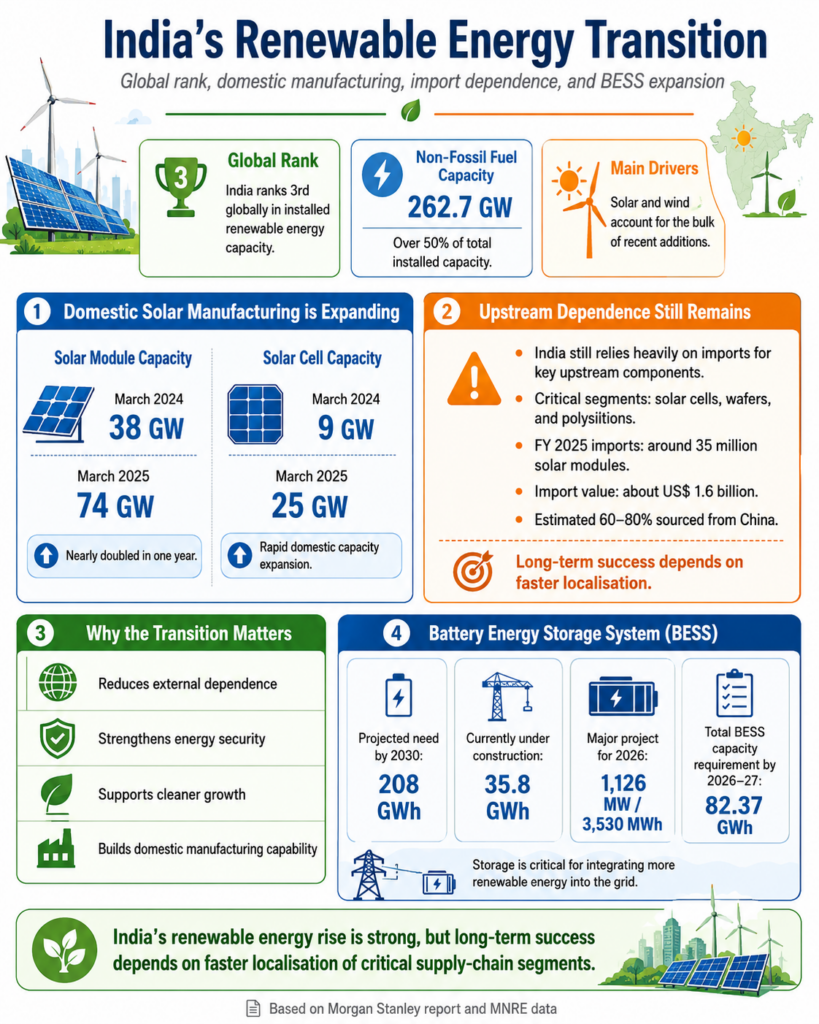
- India is rapidly expanding its renewable energy capacity, but a major challenge is emerging: renewable electricity is not always available when demand is high.
- Solar power falls to zero after sunset, while wind generation changes with weather conditions.
- This creates a mismatch between electricity generation and demand, making energy storage systems essential for grid stability. India’s renewable sources account for about 53% of installed power capacity, but energy storage deployment is still limited.
What is Energy Storage?
Energy storage refers to systems that store surplus electricity during periods of high generation and release it when demand rises or renewable generation falls. In simple terms, it helps save excess solar or wind power for later use.
This is important because electricity demand often peaks in the evening or night, when solar generation is unavailable. Storage can therefore make renewable energy more reliable and help supply round-the-clock clean power.
Major Types of Energy Storage
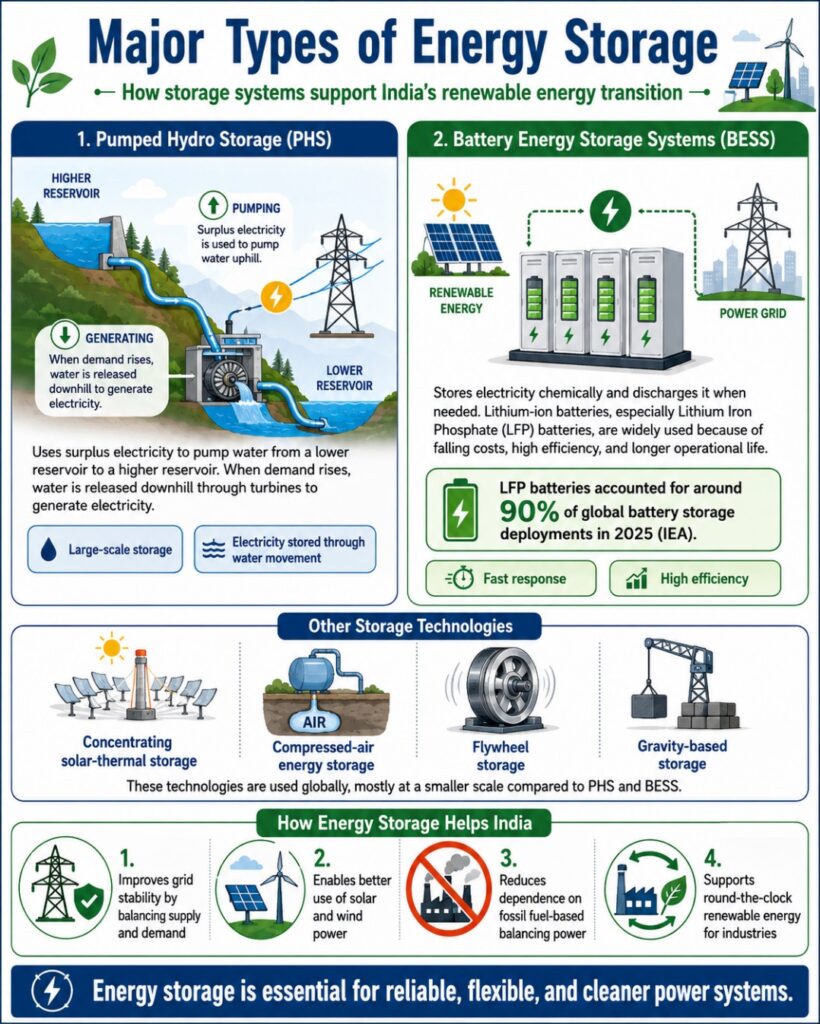
The two most widely used storage systems are Pumped Hydro Storage and Battery Energy Storage Systems.
- Pumped Hydro Storage (PHS) uses surplus electricity to pump water from a lower reservoir to a higher reservoir. When demand rises, water is released downhill through turbines to generate electricity.
- Battery Energy Storage Systems (BESS) store electricity chemically and discharge it when needed. Lithium-ion batteries, especially Lithium Iron Phosphate (LFP) batteries, are widely used because of falling c osts, high efficiency and longer operational life. LFP batteries accounted for around 90% of global battery storage deployments in 2025, according to the International Energy Agency.
Other storage technologies include concentrating solar-thermal storage, compressed-air energy storage, flywheel storage, and gravity-based storage. These are used globally, but mostly at a smaller scale compared to PHS and BESS.
India’s Energy Storage Capacity
India’s energy storage capacity has not grown at the same pace as its renewable energy capacity. At present, India has around 0.27 GW of BESS capacity and about 7.2 GW of pumped hydro storage capacity.
The Central Electricity Authority projects a major expansion by 2035–36, with total energy storage capacity expected to reach 174 GW / 888 GWh. This includes 80 GW / 321 GWh of BESS and 94 GW / 567 GWh of pumped storage projects.
Storage systems of around four to six hours are expected to become increasingly important beyond 2030, as India’s non-fossil fuel capacity is projected to rise from about 283 GW to 786 GW by 2035–36.
Need for Energy Storage in India
Energy storage is becoming critical because renewable power is intermittent. Solar power is available mainly during the day, while wind energy fluctuates with weather. Without storage, the grid may face surplus power during some hours and shortages during others.
Energy storage can help India in five major ways:
- It improves grid stability by balancing supply and demand.
- It enables better use of solar and wind power.
- It reduces dependence on fossil fuel-based balancing power.
- It supports round-the-clock renewable energy for industries.
- It helps meet India’s climate and clean energy goals.
Global Energy Storage Scenario
Globally, PHS and BESS are the most widely deployed electricity storage technologies. Battery storage is growing very rapidly. The International Energy Agency notes that 108 GW of new battery storage capacity was deployed globally in 2025, which was 40% more than in 2024.
China continues to dominate global battery storage deployment, followed by the United States and Europe. Storage is also expanding in Australia and parts of West Asia, where it is being used for renewable integration and electricity security.
Challenges
- Low existing storage capacity: India’s storage capacity is still small compared to its renewable energy expansion.
- Import dependence: India imports nearly 75–80% of lithium-ion cells, which form a major share of battery storage cost.
- Supply chain risk: Global battery manufacturing is heavily concentrated in one Asian country, creating risks of price volatility and trade disruptions.
- High project cost: Grid-scale BESS and pumped storage projects require large investments.
- Long gestation period: Pumped hydro projects need land, environmental approvals and long construction timelines.
- Grid integration issues: Storage must be supported by transmission planning, forecasting and flexible grid management.
Government Initiatives / Policy Support
The CEA’s National Generation Adequacy Plan provides a roadmap for scaling energy storage to support India’s renewable energy growth up to 2035–36.
The Government has approved a Viability Gap Funding scheme to support 30 GWh of BESS capacity, funded through ₹5,400 crore from the Power System Development Fund. It has also encouraged co-locating energy storage systems with solar projects for better grid stability and cost efficiency.
The Ministry of Power has also issued guidelines to promote Pumped Storage Projects, including measures related to project allotment, environmental clearance and transmission charge waivers.
Way Forward
India should treat storage as a core part of renewable energy planning, not as an add-on. Expansion of solar and wind must be matched with timely investment in BESS, pumped hydro and transmission infrastructure.
Key steps include:
- Promote domestic manufacturing of battery cells and storage components.
- Diversify battery supply chains to reduce import dependence.
- Fast-track pumped storage projects with proper environmental safeguards.
- Encourage hybrid projects combining solar, wind and storage.
- Use BESS for short-duration storage and PHS for long-duration storage.
- Support research in alternative storage technologies such as sodium-ion batteries, gravity storage and green hydrogen.
- Strengthen forecasting, smart grids and demand-side management.
Conclusion
India’s renewable energy transition has entered a new phase. Adding solar and wind capacity is no longer enough; the country must also build large-scale energy storage capacity. Storage will decide whether India can manage renewable intermittency, ensure grid stability and provide reliable clean power.
A strong storage ecosystem, supported by domestic manufacturing, policy incentives and grid planning, is essential for India’s energy security and climate goals.
UPSC PYQ
Q.Which one of the following is a non-conventional source of energy? (NDA-I, 2025)
A. Petroleum
B. Natural Gas
C. Tidal energy
D. Coal
Answer: C
Explanation:
- Petroleum, Natural Gas, and Coal are conventional (fossil fuel) sources of energy.
- Tidal energy is a renewable and non-conventional source of energy generated from ocean tides.
CARE MCQ
Q. With reference to Pumped Hydro Storage, consider the following statements:
- It stores energy by pumping water to a higher reservoir.
- It releases water downhill through turbines to generate electricity.
- It stores electricity only through chemical batteries.
How many of the above statements are correct?
A.Only one
B. Only two
C. All the three
D. None
Answer: B
Explanation:
- Statement 1 is correct: PHS uses surplus power to pump water uphill.
- Statement 2 is correct: Stored water is released downhill to generate electricity.
- Statement 3 is incorrect: Chemical storage refers to batteries, not pumped hydro.
Additional Information:
PHS is generally suitable for longer-duration energy storage.
FAQs
Q.What is energy storage?
It stores surplus electricity and supplies it when demand rises.
Q.Why does India need energy storage?
Solar and wind power are intermittent, so storage helps maintain grid stability.
Q.What are the main storage technologies?
Pumped Hydro Storage and Battery Energy Storage Systems.
Q.What is the key challenge for India?
Low storage capacity and high dependence on imported lithium-ion cells.