Why in News?
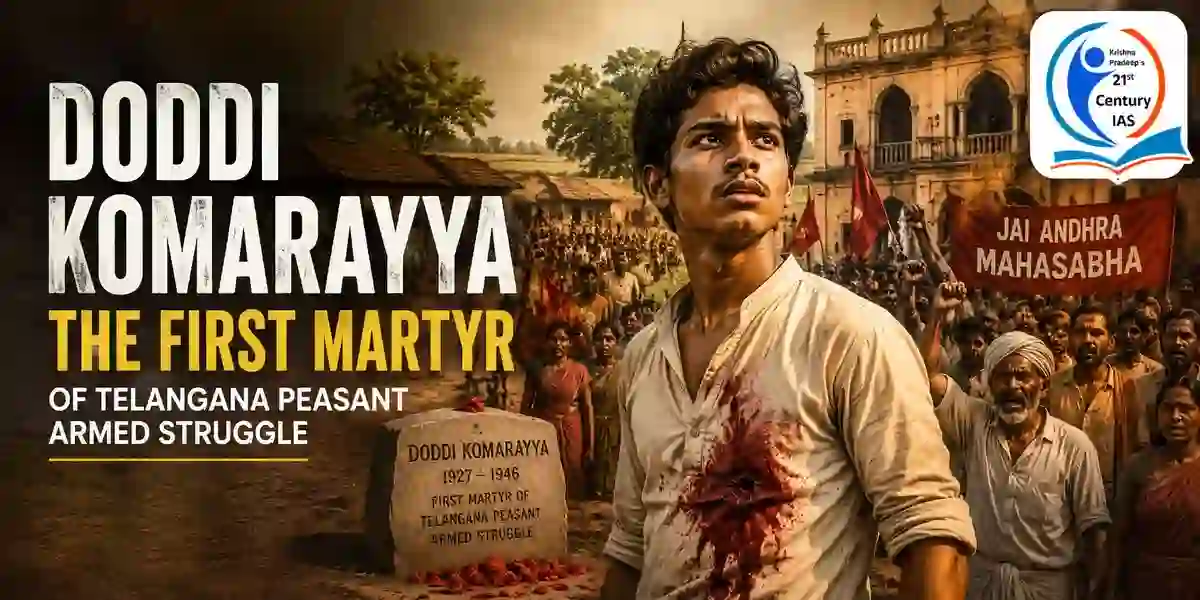
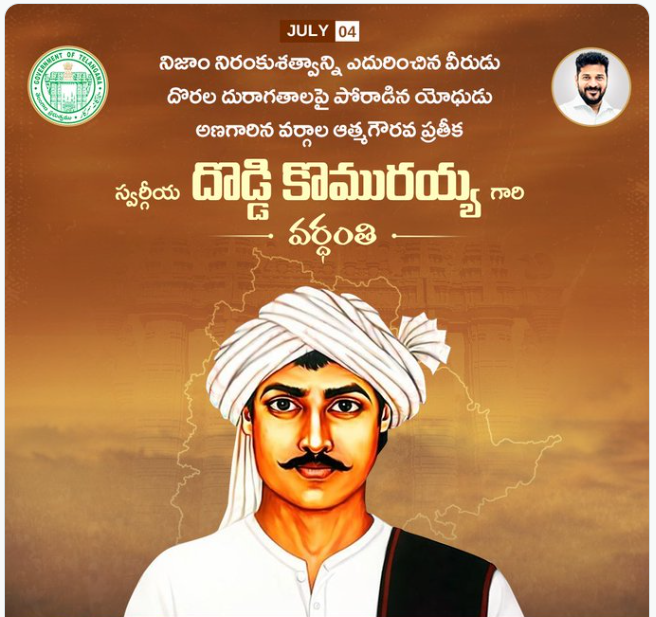
Telangana Chief Minister A. Revanth Reddy paid tributes to Doddi Komarayya on his 80th death anniversary, remembering him as a warrior who fought against oppression, injustice and exploitation.Doddi Komarayya is recognised as the first martyr of the Telangana Peasant Armed Struggle. His death at the young age of 19 became a turning point in the struggle against the autocratic rule of the Nizam and the exploitation of feudal landlords.
Who was Doddi Komarayya?
- Doddi Komarayya, also spelled Komaraiah, Komraiah or Komurayya, was a young peasant from Kadavendi village, now associated with the Jangaon region of Telangana.
- He was born into a poor shepherd family belonging to the Kuruma/Golla/Yadava community. His birth is widely associated with 3 April 1927, though some accounts place it in the early 1920s.
- Komarayya’s political awakening was shaped by the atmosphere of peasant resistance in Telangana. His elder brother Doddi Mallayya, a village-level leader associated with the Communist Party and the Andhra Mahasabha, influenced him deeply and drew him towards the growing movement against feudal exploitation.
Feudal Oppression in Kadavendi
- Kadavendi was part of a deeply unequal rural order under the Nizam’s rule. The region was dominated by powerful deshmukh families who controlled land, labour and village life.
- The Visunuru family of deshmukhs exercised strong control over the area. Ramachandra Reddy of Visunuru held authority over nearly 60 villages and 40,000 acres of land, reflecting the scale of feudal power in the region.
- In Kadavendi, Janamma, also known as Janakamma or Dorasani, was remembered for her harsh rule. Peasants faced forced labour, arbitrary fines, heavy rents and physical punishments.
- The system denied peasants basic dignity. They had little control over land, water or their own labour. This oppressive environment created the conditions for organised rural resistance.
Role of Andhra Mahasabha and Peasant Mobilisation
- The Telangana Peasant Armed Struggle grew out of the anger of peasants against feudal exploitation and the Nizam’s autocratic rule.
- Organisations such as the Andhra Mahasabha and the Communist Party of India played an important role in mobilising peasants across Telangana.
The movement demanded:
- Abolition of vetti, or forced labour
- End to arbitrary landlord power
- Protection of peasants from exploitation
- Land rights and dignity for rural communities
- Distribution of land to the landless
- Social equality and self-respect
Doddi Komarayya became part of this wider wave of political awakening. His life symbolised the courage of ordinary peasants who challenged an entrenched feudal order.
Martyrdom on 4 July 1946
- On 4 July 1946, Doddi Komarayya led a protest procession through Kadavendi village against the tyranny of Janamma.
- The procession moved towards her fortified mansion, known as a gadi, while peasants raised slogans such as “Jai Andhra Mahasabha.”
- During the protest, a hired gunman named Miskin Ali opened fire. Komarayya was shot in the stomach.
- Even as he fell, he continued to raise the slogan of the peasant movement. His death transformed a local protest into a powerful symbol of resistance.
- His martyrdom ignited the armed phase of the Telangana Peasant Movement and gave momentum to a struggle that later spread across a wide region.
Significance of His Sacrifice
First martyr of the armed struggle:
- Doddi Komarayya is remembered as the first martyr of the armed phase of the Telangana Peasant Movement.
Spark for wider rebellion:
- His death transformed localised protests into a wider armed resistance against feudal oppression.
Symbol of peasant courage:
- Coming from a poor shepherd family, Komarayya represented the courage of marginalised rural communities.
Fight against bonded labour:
- The movement associated with him challenged vetti, a system that forced peasants into unpaid and exploitative labour.
Land and dignity:
- The struggle demanded land for the landless and dignity for the oppressed.
Legacy of social justice:
- Komarayya’s martyrdom continues to represent the values of justice, equality and self-respect.
Relevance for Social Justice
- Doddi Komarayya’s legacy is important because his life connects history with continuing questions of social justice.
- His struggle reminds society of the need to resist:
- Feudal domination
- Landlessness
- Bonded labour
- Caste and community-based marginalisation
- Rural exploitation
- Denial of dignity and self-respect
- The Telangana Peasant Armed Struggle was not only a political revolt. It was also a social movement for dignity, land and freedom from exploitation.
- Komarayya’s sacrifice shows how ordinary individuals from oppressed communities can become symbols of historic transformation.
Conclusion
Doddi Komarayya occupies a special place in Telangana’s history as the first martyr of the Telangana Peasant Armed Struggle.
Born into a poor shepherd family in Kadavendi, he rose as a symbol of resistance against Nizam-era autocracy and feudal exploitation. His martyrdom on 4 July 1946 gave momentum to a wider struggle for land, dignity and social justice.
Even after eight decades, his life continues to inspire generations to uphold justice, equality, courage and self-respect.