Calls for a National Judicial Policy & Revival of NJAC
Table of Contents
Source: The Hindu
Relevance: GS Paper 2: Polity & Governance – Judiciary, Separation of Powers, Appointment to Higher Judiciary, Judicial Reforms
Key Concepts for Prelims and Mains:
For Prelims:
- Chief Justice of India, National Judicial Appointments Commission, Collegium system
For Mains:
- Appointment process for higher judiciary: Collegium system vs NJAC, judicial policy.
Why in News?
Chief Justice of India Surya Kant has:
- Called for a National Judicial Policy to reduce wide divergence in functioning across courts.
- Indicated that the Supreme Court will examine a plea seeking revival of the National Judicial Appointments Commission (NJAC), questioning the existing Collegium system.

Background / Present Status
Present system:
- Appointments to SC & HCs are made through the Collegium system (judges recommending judges).
- NJAC + 99th Constitutional Amendment (2014), which tried to replace the Collegium, were struck down by SC in 2015 (Fourth Judges Case) as violative of the basic structure – judicial independence.
Judicial performance concerns:
- Pendency of >5 crore cases, large vacancies, and infrastructure gaps.
- Divergent HC judgments on issues like bail, reservations, personal laws, creating uncertainty and forum shopping.
Why is a National Judicial Policy Being Demanded?
Resolve Divergent Judgments
- Different HCs/SC benches often give conflicting rulings.
- A policy could standardise principles, promote consistent use of precedent, and improve predictability for citizens and businesses.
Bridge Access-to-Justice Gaps
- Delays, high costs, long distance to courts, language barriers hurt marginalised sections.
- Policy can push uniform norms for legal aid, local language facilities, ADR, e-courts, etc.
Address Structural & Infrastructure Deficits
- Around one-third of HC posts vacant; poor court infrastructure at district level.
- Policy can guide capacity-building, staffing norms, court infrastructure standards.
Standardise Technology & Case Management
- Uneven adoption of e-filing, virtual hearings, digitisation across states.
- Policy could create common minimum tech standards and data-based case management.
Promote Judicial Harmony While Preserving Independence
- Common framework to uphold constitutional values while respecting HC autonomy.
Constitutional Provisions – Appointment of Judges
- Art. 124: Appointment of SC judges by President after consultation with CJI & other judges.
- Art. 217: Appointment of HC judges by President after consultation with CJI, Governor, and HC Chief Justice.
- Art. 126: Acting CJI.
- Art. 127: Ad hoc SC judges from HCs.
- Art. 128: Retired SC judges can sit & act as judges.
Concerns / Criticism about a National Judicial Policy
- One-size-fits-all risk: States differ in caseload, infrastructure, digital readiness.
- Fear of Executive Influence: If policy is steered by government, may affect separation of powers and judicial independence.
- Implementation Constraints: Many courts lack staff, funds, IT systems, making uniform standards difficult.
- High Court Autonomy: Under Articles 214–226, HCs control their own procedure & administration; may resist centralised norms.
- Weak Data Systems: Poor, non-standard judicial statistics make evidence-based policy difficult.
What is the National Judicial Appointments Commission (NJAC)?
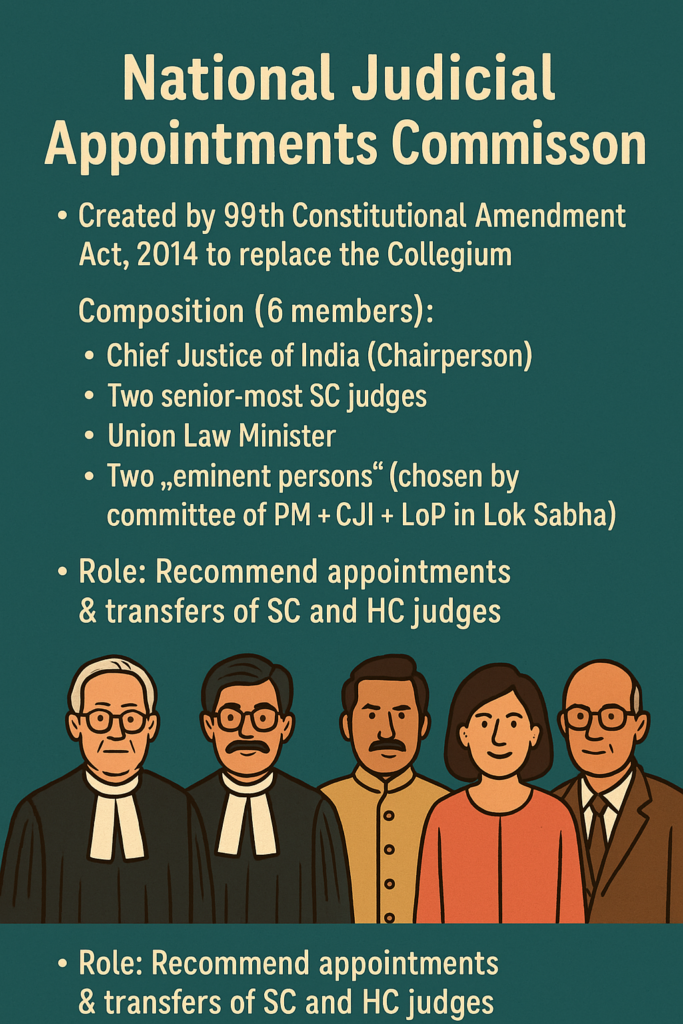
- Created by 99th Constitutional Amendment Act, 2014 to replace the Collegium.
- Composition (6 members):
- Chief Justice of India (Chairperson)
- Two senior-most SC judges
- Union Law Minister
- Two “eminent persons” (chosen by committee of PM + CJI + LoP in Lok Sabha).
- Role: Recommend appointments & transfers of SC and HC judges.
Why was NJAC Struck Down? – Fourth Judges Case (2015)
- Executive & non-judicial veto (any 2 members could block a name) → undermined judicial primacy.
- Criteria for eminent persons vague → risk of political capture.
- Govt is the largest litigant → executive influence in appointments seen as threat to impartiality & basic structure.
- Result: NJAC + 99th Amendment declared unconstitutional; Collegium restored.
Difference between Collegium vs NJAC
| Aspect | Collegium System | NJAC |
| Primacy | Judiciary has effective primacy. | Shared with executive & eminent persons. |
| Transparency | Criticised as opaque, no published criteria, “judges appointing judges”. | Promised broader participation & potential for more transparent procedures. |
| Veto | No formal veto; government can return names once. | Any two members (incl. non-judges) could veto. |
| Main Risk | Nepotism, lack of accountability. | Political interference, erosion of independence. |
Measures to Strengthen Judiciary
a) Judicial Policy with Flexibility
- Broad national standards + regional adaptability.
b) Case Management Reforms
- Uniform rules for filing, adjournments, disposal timelines.
c) Fill Vacancies Time-bound
- Transparent, criteria-based appointments (within Collegium or revised system).
d) Improve Access to Justice
- Regional courts, local-language services, legal aid, mobile courts.
- Strengthen ADR, especially mediation.
Conclusion
A National Judicial Policy can strengthen coherence, reduce delays, and improve justice delivery.
However, reforms must avoid risks to judicial independence—a core element of the Constitution’s basic structure—especially as NJAC revival debates re-emerge. The future lies in balanced reforms that combine efficiency with independence.
UPSC PYQ
Q. Consider the following statements: UPSC (2019)
- The 44th Amendment to the Constitution of India introduced an Article placing the election of the Prime Minister beyond judicial review.
- The Supreme Court of India struck down the 99th Amendment to the Constitution of India as being violative of the independence of judiciary.
Which of the statements given above is/are correct?
(a) 1 only
(b) 2 only
(c) Both 1 and 2
(d) Neither 1 nor 2
Ans: (b)
Explanation
Statement 1 — Incorrect
- The 44th Constitutional Amendment Act, 1978 did NOT place the election of the Prime Minister beyond judicial review.
- What it actually inserted was Article 329A, but only for election disputes involving the Prime Minister and Speaker, and that too was later deleted.
- Therefore, the claim in the statement is incorrect.
Statement 2 — Correct
- In Supreme Court Advocates-on-Record Association vs Union of India (2015), the Supreme Court struck down the 99th Constitutional Amendment Act, which created the National Judicial Appointments Commission (NJAC).
- Reason: It violated the Basic Structure, particularly judicial independence.
- Therefore, statement 2 is correct.
Hence, the answer is (b) 2 only.
CARE MCQ
Q. Consider the following statements:
- The Supreme Court has held judicial independence to be a part of the Basic Structure of the Constitution.
- The National Judicial Appointments Commission (NJAC) was upheld by the Supreme Court in 2015.
Which of the statements given above is/are correct?
(a) 1 only
(b) 2 only
(c) Both 1 and 2
(d) Neither 1 nor 2
Correct Answer: (a)
Explanation
- Statement 1 — Correct
Judicial independence was declared part of the Basic Structure in Kesavananda Bharati (1973) and reaffirmed in multiple judgments including the 4th Judges Case (2015). - Statement 2 — Incorrect
The NJAC Act (2014) and 99th Amendment were struck down, not upheld.
The Supreme Court held NJAC unconstitutional for compromising judicial independence.