Armed Forces to Procure Additional Heron Mk II UAVs Under Emergency Provisions
Table of Contents
Source: The Hindu
Relevance: GS-III – Defence Technology, Internal Security, Indigenisation, International Relations
Key Concepts for Prelims and Mains:
For Prelims:
- Heron Mk II • MALE UAV • Satellite Communication (SATCOM), Electro-Optics • SAR Radar , Emergency Procurement • IAI, Endurance UAV • Indo-Israel Defence Cooperation
For Mains:
- Defence Indigenisation • UAV Capability Enhancement, Technological Self-Reliance • Border Surveillance, India–Israel Defence Partnership
Why in News?
The Indian armed forces have signed contracts for additional satellite-linked Heron Mk II Unmanned Aerial Vehicles (UAVs) under emergency procurement after Operation Sindoor.
According to Israeli defence industry sources:
- Army and Air Force have placed new orders
- Indian Navy is procuring Heron Mk II for the first time
- Navy will transition from older Searcher UAVs to this more advanced platform
Under emergency procurement rules, the armed forces can acquire systems up to ₹300 crore swiftly to address immediate operational needs.
What is the Heron Mk II?
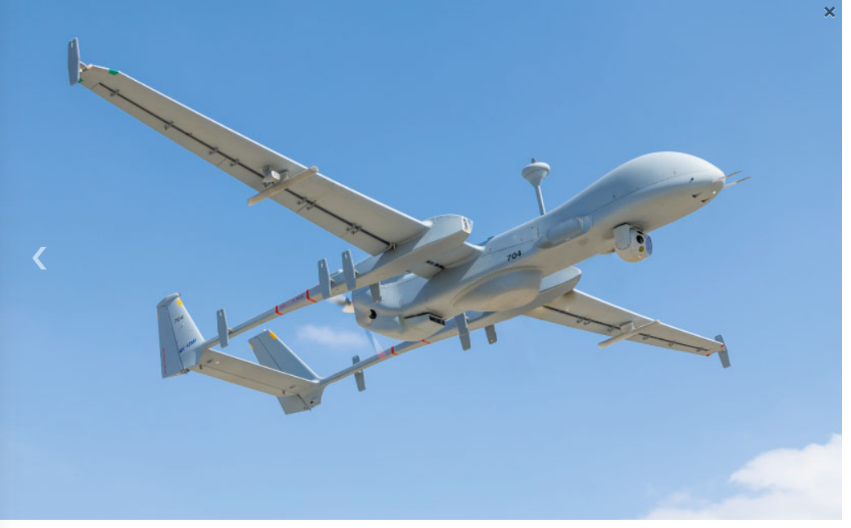
The Heron Mk II is a Medium Altitude Long Endurance (MALE) UAV developed by Israel Aerospace Industries (IAI).
It is an upgraded version of the original Heron UAV, designed for:- Long-range reconnaissance
- Signals intelligence
- Border surveillance
- Multi-sensor missions
A Unmanned Aerial Vehicle (UAV), commonly called a drone, is an aircraft that flies without a pilot onboard. It is operated either remotely by a human or autonomously using onboard computers. UAVs can carry cameras, sensors, communication systems, or weapons, and are widely used for surveillance, mapping, and military missions. Because they do not carry a crew, UAVs can fly longer, farther, and more efficiently than manned aircraft.
This platform is already operational with the Israeli Air Force and over 20 global militaries.
Key Features of Heron Mk II
Endurance
- Capable of flying 24–45 hours continuously
- Suitable for persistent surveillance missions
Altitude
- Operates up to 35,000 ft, ideal for high-altitude border areas
Speed
- Maximum speed: 150 knots
Payload Capacity
- Up to 500 kg (half a tonne)
- Supports multiple payloads simultaneously
Sensors & Intelligence Systems
- EO/IR (Electro-Optical) sensors for day-night monitoring
- Synthetic Aperture Radar (SAR) for high-resolution imaging
- ELINT, COMINT, SIGINT sensors for electronic intelligence
- Communication relay systems
- Encrypted satellite communication (SATCOM)
Flight Automation
- Fully automated take-off and landing
- Operable beyond line-of-sight due to satellite link
Operational Capabilities
- Performs reconnaissance, surveillance, and target acquisition
- Conducts electronic warfare and signals monitoring
- Provides real-time intelligence to Army, IAF, and Navy
- Can operate from remote ground stations
- Excellent performance in deserts, mountains, and maritime zones
Current Deployment in India
- The Indian Army has already deployed Heron Mk II at forward bases in the northern sector
- The Air Force uses them for high-altitude ISR missions
- The Navy will now deploy them for:
- Maritime surveillance
- Anti-piracy operations
- Coastal security
- Monitoring Chinese and Pakistani naval activities
Heron Mk II is becoming a critical component of India’s border management and maritime domain awareness.
Strategic Significance for India
1. Strengthening High-Altitude ISR
Heron Mk II is ideal for surveillance along:
- LAC (China)
- LoC (Pakistan)
- Maritime boundaries
2. Enhanced Situational Awareness
Real-time intelligence strengthens:
- Anti-infiltration operations
- Counter-terror grid
- Maritime surveillance
3. Improves Jointness
Army, Navy, Air Force using the same platform strengthens inter-operability.
4. Boosts Long-Endurance ISR Capability
Critical in Ladakh, Arunachal Pradesh, Western desert, and vast maritime zones.
Emergency Procurement Rules
Under current MoD guidelines:
- Armed forces can procure systems worth up to ₹300 crore
- Purchases are fast-tracked to address urgent operational requirements
- Operation Sindoor triggered a need for enhanced unmanned ISR capability
Future Plans & Indo-Israel Collaboration
- India and IAI are examining co-production of Heron Mk II
- Plans to upgrade older Heron systems into the more advanced Mk II SATCOM version
- Joint development may lead to export-capable systems
Drone in India
India’s UAV journey began in 1998 with the induction of the Israeli Searcher Mark-I. Since then, most defence drones have been imported from Israel and the US. The Indian drone market, valued at ₹29 billion (2020), is projected to surge to ₹1.5 trillion by 2026, reflecting rapid growth and diversification.
India now aims to become a global drone hub by 2030, focusing on indigenous manufacturing, innovation, and simplified regulations.
Key Government Initiatives
1. Make in India for Drones
Promotes domestic production and reduces reliance on imports.
2. Production-Linked Incentive (PLI) Scheme
Financial incentives for drone and drone-component manufacturers, including software firms.
3. Drone (Amendment) Rules, 2022
- Major simplification of regulations
- Fewer approvals and licences
- No DGCA pilot licence needed for non-commercial flight of nano & micro drones
- Other drone operations require prior approval
4. Digital Sky Platform
A single-window online portal for:
- Flight permissions
- Licensing
- Manufacturing authorisation
- Drone airspace maps (Green/Yellow/Red zones)
Challenges
- Dependence on foreign UAV technology until Indian alternatives mature
- SATCOM bandwidth limitations in high-density operations
- Need for better anti-jamming protection
- Potential vulnerability to enemy air defence or EW systems
- Training and logistical integration for the Navy
Conclusion
The procurement of Heron Mk II UAVs marks a major enhancement in India’s ISR, surveillance, and electronic intelligence capabilities.With their long endurance, advanced sensors, and SATCOM link, these UAVs strengthen India’s preparedness along the LAC, LoC, and in maritime domains.
The ongoing Indo-Israel industrial partnership further boosts India’s journey toward self-reliance in defence UAV technology.
UPSC PYQ
Q. With reference to Unmanned Aerial Vehicles (UAVs), consider the following statements:
(UPSC Prelims 2025)
- All types of UAVs can do vertical landing.
- All types of UAVs can do automated hovering.
- All types of UAVs can use battery only as a source of power supply.
How many of the statements given above are correct?
a) Only one
b) Only two
c) All three
d) None
Correct Answer: (d) None
Explanation:
Statement 1: All UAVs can do vertical landing — Incorrect
• Only VTOL UAVs (rotary-wing, multirotor, helicopter drones) can land vertically.
• Fixed-wing UAVs cannot do vertical landing—they require a runway, catapult, or arresting gear.
Statement 2: All UAVs can hover — Incorrect
• Multirotor and helicopter-type UAVs can hover in place.
• Fixed-wing UAVs cannot hover; they need continuous forward motion to generate lift.
Statement 3: All UAVs use only battery power — Incorrect
• UAVs use multiple power sources:
– Lithium batteries (small drones)
– Gasoline/diesel engines (Heron, Predator, Reaper)
– Hybrid systems, solar power, fuel cells
• Large military UAVs do not rely on batteries alone.
CARE MCQ
Q. Consider the following characteristics related to the Heron Mk II Unmanned Aerial Vehicle (UAV):
- It can reach an altitude of 35,000 feet and stay airborne for up to 45 consecutive hours.
- It belongs to the Military Aircraft group and is used in both Air and Naval domains.
- It is designed only for short-range reconnaissance and cannot carry multiple sensors.
How many of the above statements are correct?
(a) Only one
(b) Only two
(c) All three
(d) None
Correct Answer: (b) Only two
Explanation
Statement 1 – Correct
The Heron Mk II can operate at 35,000 feet, fly at 150 knots, and stay airborne for up to 45 hours, giving it long-endurance capability.
Statement 2 – Correct
It falls under the Military Aircraft group and is deployed in both Air and Naval domains, making it a multi-service UAV.
Statement 3 – Incorrect
The Heron Mk II is not a short-range UAV.
It can carry multiple advanced sensors simultaneously, such as radars, EO/IR systems, and SIGINT payloads, enabling long-range surveillance and multi-mission flexibility.