Best IAS Coaching in Hyderabad 2026: How to Choose the Right UPSC Coaching Institute
Hyderabad has quietly become one of India’s most important civil services preparation centres. Aspirants from across Telangana and Andhra Pradesh — and increasingly from Karnataka, Tamil Nadu and Odisha — now prepare here instead of moving to Delhi, because the city offers the same academic depth at a fraction of the living cost, with faculty who understand South Indian aspirants and both English and Telugu medium requirements.
That abundance creates a different problem. Search “best IAS coaching in Hyderabad” and you will find a dozen ranked lists, most of them paid placements, each declaring a different institute number one. None of them know your subject background, your optional, your budget, or how much hand-holding you need.
This guide is for aspirants who have already decided to prepare and now need to choose where. It gives you a transparent evaluation framework, an honest comparison of established institutes, a realistic view of fees, and a checklist to use on your campus visit — so the decision is yours, made on evidence, not on advertising.
Which Is the Best IAS Coaching in Hyderabad in 2026?
There is no single best IAS coaching institute in Hyderabad for every aspirant. The right choice depends on faculty access, mentorship depth, Prelims-cum-Mains integration, test series quality, answer-writing evaluation, batch size, medium of instruction and your budget. Shortlist two or three institutes, attend demo classes, verify course structure and fees directly, then decide. KP’s 21st Century IAS Academy is one of the established options aspirants in Hyderabad evaluate on these criteria.
Key takeaways
- No institute is objectively “number one” — fit beats brand.
- Evaluate on 14 measurable criteria, listed below, not on hoardings.
- Always attend a demo class and speak to a current student before paying.
- Verify fees, batch size and faculty allocation in writing before enrolling.
- Hyderabad aspirants can integrate UPSC with APPSC and TGPSC because roughly 70% of the syllabus overlaps.
Why Hyderabad Is a Major Hub for UPSC Preparation
Three things make UPSC preparation in Hyderabad work.
- A dense, walkable coaching belt. Most established institutes sit within a few kilometres of each other around RTC X Roads, Ashok Nagar, Kavadiguda, Himayatnagar, Chikkadpally and Jawahar Nagar. You can attend a demo class at three institutes in one morning — something almost impossible in a sprawled city. Shared hostels, mess facilities, photocopy shops and reading rooms have grown around this belt, which keeps monthly living costs materially lower than Delhi’s Old Rajinder Nagar.
- A genuinely bilingual ecosystem. Hyderabad is one of the few UPSC hubs where serious Telugu-medium preparation and English-medium preparation coexist at scale. Telugu Literature optional, Telugu-medium General Studies batches and Telugu current affairs compilations are all locally available. For an aspirant from a Telugu-medium schooling background, this is a decisive advantage over relocating north.
- Overlap with state services. This is the strategic point most aspirants miss. A candidate preparing in Hyderabad is simultaneously within reach of APPSC and TGPSC Group 1 and Group 2 opportunities. Because the core General Studies syllabus is largely shared, IAS preparation in Hyderabad can be structured to produce three exam-ready outcomes instead of one. We cover this in detail in the section on integrated preparation below.
- Peer environment. Study circles, discussion groups, library culture and access to faculty who have themselves cleared or taught these exams for decades matter more than most aspirants expect. Preparation is a two-to-three-year discipline problem as much as a knowledge problem, and environment is what sustains it.
How to Choose the Best IAS Coaching in Hyderabad: A 14-Point Framework
Use these criteria as a scorecard. Rate each institute on your shortlist from 1 to 5, and weight the ones that matter to your situation.
1. Faculty experience — and faculty access
Everyone advertises “expert faculty.” The question that matters is different: who actually teaches your batch, and can you reach them after class? Ask for subject-wise faculty names, how many years they have taught that subject, and whether the demo-class teacher is the one who will take your regular sessions. An institute that names its faculty publicly, subject by subject, is giving you something you can verify.
2. UPSC-focused curriculum
The syllabus is the contract. Ask to see the module plan mapped against the official UPSC Prelims syllabus and UPSC Mains syllabus. If a programme cannot show you which lecture covers which syllabus item, it is running a timetable, not a curriculum.
3. Prelims + Mains integration
This is the single biggest quality differentiator in UPSC coaching. Prelims and Mains are not separate exams — they test the same syllabus at different depths, with only about ten to twelve weeks between them. Programmes that teach GS for Prelims and then “start Mains later” waste an entire cycle. A Prelims-cum-Mains integrated design teaches each topic once, at Mains depth, and layers MCQ practice and answer writing on top of it simultaneously.
4. Answer-writing practice from day one
Mains is decided by writing, not by knowing. Ask three specific questions: How many answers will I write per week? Who evaluates them? Do I get written feedback or only a score? An institute that returns evaluated copies with margin comments is doing something structurally different from one that publishes model answers and calls it evaluation.
5. Test series quality
Count the tests, then look past the count. What matters is sectional tests + full-length tests + discussion sessions + performance analytics. A test you do not analyse is a wasted Sunday. Check whether test discussion is scheduled into the timetable or left to you. You can sample an institute’s standard through open practice resources before paying — KPIAS, for example, publishes topic-wise Prelims practice and a free Prelims 2026 target programme.
6. Current affairs system
Current affairs is a daily discipline, not a monthly magazine. The right question is: how does this institute convert news into exam-ready notes? Look for a structured daily/weekly system with Prelims-oriented and Mains-oriented outputs. KPIAS runs a “Current Affairs Reverse Engineering” method that works backwards from how UPSC actually frames questions — see the UPSC current affairs articles and the linked Mains practice questions to judge the standard yourself before enrolling.
7. Personal mentorship
Classroom teaching is one-to-many. Mentorship is one-to-one. Ask: Will I be assigned a named mentor? How often do we meet? Is progress reviewed weekly or “whenever you need”? Large-batch institutes often market mentorship but deliver occasional group counselling. The difference shows up in month seven, when motivation dips.
8. Optional subject guidance
Your optional carries 500 marks. Check whether the institute teaches your optional in-house, with which faculty, and whether optional classes clash with GS classes. Hyderabad has genuine strength in Telugu Literature, Public Administration, Anthropology, Sociology, Geography, History and Political Science & International Relations — but strength varies sharply by institute. KPIAS publishes PSIR optional study material publicly, which lets you assess depth before committing.
9. Study material
Ask to hold the actual material, not a sample brochure. Good UPSC material is concise and conceptual, built around previous-year question patterns. Bulk is a warning sign, not a feature. Cross-check any material against UPSC Prelims PYQs and Mains PYQs — if the material does not reflect what has actually been asked, it will not serve you in the hall.
10. Batch size
Ask for the number, not the adjective. A 40-student batch and a 300-student batch are different products regardless of what the brochure says. Smaller batches mean you get called on, your doubts get heard, and your answer copies get read by someone who recognises your handwriting.
11. Online and offline flexibility
The best current answer for most aspirants is hybrid: live classes with recorded backup. Check whether recordings are included or charged separately, how long access lasts, and whether online students get the same test evaluation and mentorship as classroom students.
12. Student support infrastructure
Library hours, doubt-clearing slots, hostel assistance, peer study groups, and someone to call when your plan falls apart. These are not extras. Over a two-year preparation, they determine whether you finish.
13. Results and track record — verified only
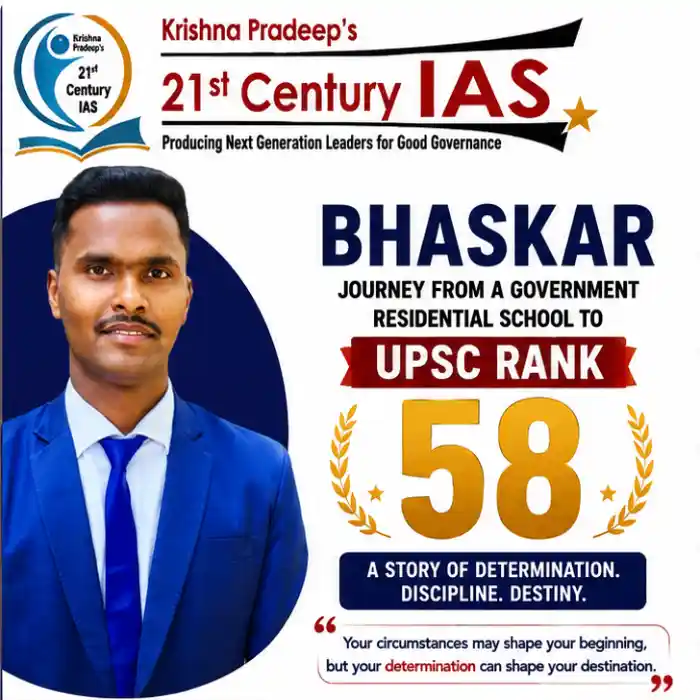
Treat every results claim as unverified until you can trace it. A credible institute names the candidate, the rank, the year and the exam, and can connect you to that person. KPIAS, for instance, publishes individual documented outcomes such as Dharavath Bhaskar’s UPSC CAPF AIR 58 story rather than aggregate selection numbers. Ask any institute on your shortlist to do the same, and cross-check against the official result PDFs on upsc.gov.in.
14. Fees and value for money
Compare cost per delivered unit, not headline price. Two programmes at the same fee can differ by 300 lecture hours, 20 tests and an optional subject. The highest fee in Hyderabad does not reliably indicate the best preparation, and the lowest rarely includes evaluation-heavy components like answer-writing feedback.
Top IAS Coaching Institutes in Hyderabad: A Comparison
The institutes below are among the names that recur most consistently in the Hyderabad UPSC coaching landscape. This is not a ranking. Course structures, faculty allocation and fees change every cycle, so the final column tells you exactly what to confirm before you pay.
| Institute | Commonly known for | Preparation focus | Learning mode | Likely suits | What to verify |
| KP’s 21st Century IAS Academy (KPIAS) | 1-on-1 mentorship with weekly progress check-ins; answer writing from day one; integrated UPSC + Group exam design | Prelims + Mains integrated, GS + optional, test series | Offline (RTC X Roads) + online; Telugu portal available | Aspirants wanting structured mentorship, and those targeting UPSC alongside APPSC/TGPSC | Current batch dates, fee for your chosen programme, optional subject faculty |
| RC Reddy IAS Study Circle | One of Hyderabad’s oldest study circles; long-standing Telugu-medium reputation; extensive printed material | Classroom GS, Prelims + Mains | Primarily offline (Himayatnagar) | Aspirants who prefer traditional classroom rigour and material depth | Batch size, current faculty, test evaluation process |
| La Excellence IAS Academy | Structured curriculum, current affairs and answer-writing programmes | GS foundation, Prelims + Mains, current affairs | Offline + online | English-medium aspirants wanting strong current affairs systems | Programme inclusions, optional availability, fee breakup |
| Brain Tree IAS Academy | Long-established; associated with Anthropology and Public Administration optionals | GS foundation, optional-led preparation | Primarily offline | Aspirants choosing Anthropology or Public Administration | Whether your optional is taught this cycle, and by whom |
| Analog IAS Academy | Subject-specialist teaching; UPSC and state PSC coverage | GS, Prelims + Mains, state PSC | Offline + online | Aspirants wanting subject-wise specialist faculty | Faculty for your weak subjects, test series schedule |
| AKS IAS Academy | UPSC and state services coaching with mentorship positioning | GS, Prelims + Mains, state PSC | Offline + online | Aspirants combining UPSC with Group exams | Mentorship format, batch strength, refund policy |
| Pragnya IAS Academy | Faculty pool including retired civil servants; current affairs publications | GS, Prelims + Mains, interview guidance | Offline + online | Aspirants who value ex-bureaucrat interaction | Which faculty take regular classes vs guest sessions |
Verify the latest course details, fees and faculty directly with the institute before enrolling. Third-party “top 10” lists — including the ones ranking these same institutes in different orders — are frequently paid placements and are not independently audited.
KP’s 21st Century IAS Academy: What Aspirants Should Evaluate
Since you are reading this on the KPIAS site, here is the fair version — what the academy actually offers, stated plainly enough for you to compare it against anyone else on your shortlist.
- Track record and leadership. KP’s 21st Century IAS Academy has been preparing civil services aspirants in Hyderabad since 2003, under chairman P. Krishna Pradeep, with coaching across all three stages of the Civil Services Examination — Preliminary, Mains and the Personality Test.
- Named subject faculty. The academy publishes faculty by subject rather than as a generic “expert panel” — including Dr. Bhavani Shankar (Essay, Telugu Literature), Ashish Chatterjee (Society & Social Justice, Sociology), Prof. C. Ganesh (Sociology), Dr. Srihari Kakarla (Geography) and Dr. Naga Sridhar (History). Attend a demo and judge the teaching for yourself; the point is that the names are checkable.
- Mentorship with weekly progress check-ins. The academy’s stated model is 1-on-1 personal mentorship with weekly reviews, rather than mentorship on request. Ask, during your campus visit, who your mentor would be and to see a sample weekly review.
- Answer writing from day one. Mains writing practice begins at the start of the programme instead of after the syllabus is complete — the sequencing that most distinguishes serious Mains preparation.
- Prelims + Mains test series with feedback. Integrated test series across both stages, with evaluation feedback rather than scores alone. You can sample the standard for free through the UPSC study material and practice sections before paying anything.
- Optional subject focus. Dedicated coaching for your chosen optional, including Telugu Literature — relevant for Telugu-medium aspirants who often struggle to find optional support outside Hyderabad.
- Daily current affairs. A structured daily current affairs system with simplified, updated notes, plus downloadable monthly current affairs compilations.
- Interview stage support. Interview guidance sessions for candidates who reach the Personality Test.
- Both modes, both languages. Offline classroom coaching at RTC X Roads plus online delivery through the online course platform, and a dedicated Telugu-language portal for Telugu-medium aspirants.
- Fee transparency. Programme fees are published openly on the online platform rather than quoted only on enquiry — for example, the Group 1 Nirantara Sadhana 2026 programme is listed at ₹38,500 and the Group 2 programme at ₹15,000. Ask for the same transparency from every institute you shortlist.
- A long-horizon option. The Unlimited UPSC UTSAV programme offers continued access across attempts rather than a fresh fee each cycle — worth evaluating if you expect a multi-attempt journey, which statistically most successful candidates have.
None of this makes KPIAS automatically right for you. It makes it checkable. Run the 14-point framework above on KPIAS and on two competitors, and go with the score.
Why Mentorship Matters More Than Most Aspirants Expect
Ask any candidate who cleared on their second or third attempt what changed, and the answer is rarely “better notes.” It is usually structure, feedback and someone holding them to it.
- A study plan built for you. An engineering graduate with a Sociology optional and eight months to Prelims needs a different plan from an Arts graduate starting fresh. Generic timetables fail because they are generic.
- Weak-area identification you cannot do alone. Aspirants systematically over-study what they enjoy. A mentor reading your test analytics sees that you have taken Polity five times and Economy never.
- Answer-writing feedback that compounds. The gap between a 7-mark and an 11-mark answer is structure, not knowledge — and you cannot see your own structural habits without someone marking them.
- Revision discipline. Month-one content is gone by month four without a scheduled revision cycle. Mentors enforce cycles; motivation does not.
- Attempt strategy. Whether to attempt this year, how many optional revisions remain, when to switch from input to output mode — these are judgement calls, and judgement is what mentorship supplies.
If mentorship is your deciding factor, ask every shortlisted institute for the mentor-to-student ratio. The number will tell you more than the brochure.
UPSC Coaching Fees in Hyderabad 2026
Honest answer: published fees vary too widely for a single figure to be meaningful, and any article quoting one exact number for “IAS coaching fees in Hyderabad” is guessing.
Third-party directory sites list full General Studies programmes in Hyderabad anywhere from roughly ₹80,000 to ₹1,80,000, with some listings running higher. Those figures are not institute-confirmed and frequently lag the current cycle. Treat them as a rough ceiling and floor, not a quote.
What actually drives the number:
| Fee component | What changes the price |
| Foundation / long-term GS course | Duration (6 months to 2 years), lecture hours, medium |
| Prelims + Mains integrated course | Whether Mains is bundled or sold separately |
| Optional subject | In-house vs external faculty; some optionals cost more |
| Test series | Number of tests; whether evaluation is included |
| Mentorship | Group counselling vs assigned 1-on-1 mentor |
| Mode | Online is typically materially cheaper than classroom |
| Study material | Included, or billed separately |
| Access period | Single cycle vs multi-attempt access |
Before you pay, get these four things in writing: the total inclusive fee, exactly what is not included, the instalment schedule, and the refund or batch-transfer policy. A verbal quote is not a fee structure.
Fees vary by programme and batch. Aspirants should confirm the current fee directly with the institute before enrolling. For KPIAS programmes, current published prices are on the courses page, or you can contact the academic team directly.
Online vs Offline IAS Coaching in Hyderabad
| Factor | Online coaching | Offline coaching |
| Flexibility | High — pause, rewind, re-watch | Fixed schedule, fixed venue |
| Classroom interaction | Limited; chat or scheduled doubt slots | Immediate, in person |
| Faculty access | Structured windows only | Before and after class, informally |
| Peer learning | Weak unless a group is deliberately built | Built in — study circles form naturally |
| Travel | None | 1–2 hours daily in Hyderabad traffic |
| Revision | Recordings make revision efficient | Depends on your own notes |
| Discipline | Requires strong self-regulation | Externally enforced by attendance |
| Cost | Typically lower; no relocation or hostel cost | Higher, plus living costs |
- Choose offline if you are a first-time aspirant, you struggle with self-discipline, you want faculty access and peer groups, and you can reach the coaching belt without a punishing commute.
- Choose online if you are working, studying in a final year, based outside Hyderabad, on a tighter budget, or repeating with a syllabus you already know.
- Choose hybrid if you can. Most serious aspirants in 2026 do: classroom for structure and accountability, recordings for revision. Confirm that hybrid access is included in the fee and not an upsell.
Best IAS Coaching in Hyderabad for Different Types of Aspirants
For UPSC beginners
Prioritise a foundation programme that starts from NCERT-level concepts and builds to Mains depth, with strong mentorship. Start with the exam overview and the 2026 Civil Services notification details before you spend money — understanding the exam’s shape changes what you look for in an institute.
For college students
Look for weekend or evening batches and recorded access. Starting in your second or third year of degree gives you the single biggest structural advantage available in this exam: time.
For working professionals
Online or hybrid with recorded lectures is close to non-negotiable. Verify weekend test schedules and whether mentorship happens outside office hours.
For first-time aspirants
Batch size and mentorship matter more than brand. You will need someone to notice when you drift — a 300-seat hall will not.
For repeat aspirants
Skip generic foundation courses. What you need is test series, answer-writing evaluation and targeted mentorship on why the last attempt fell short. Consider multi-attempt access programmes rather than paying a fresh full fee.
For Telugu-medium aspirants
Confirm that GS is taught in Telugu — not just that Telugu material exists — and that your optional is supported. Telugu Literature optional coaching is a Hyderabad strength. The Telugu portal is a useful starting point.
For English-medium aspirants
Most Hyderabad institutes run full English-medium programmes. Focus on answer-writing evaluation quality and current affairs systems rather than medium availability.
For aspirants preparing for UPSC + State PSC
This is the highest-leverage path available to a Hyderabad aspirant — covered next.
UPSC + APPSC + TGPSC: The Integrated Preparation Advantage
If you are preparing in Hyderabad, preparing only for UPSC is leaving value on the table.
Roughly 70% of the syllabus is common across UPSC, APPSC Group 1 and TGPSC Group 1 — Indian and world geography, Indian history, polity and governance, economy, science and technology, environment, society, art and culture, international relations, ethics and current affairs. The remaining 30% is state-specific: Telangana or Andhra Pradesh history, geography, economy, society, the Telangana movement, the AP Reorganisation Act 2014, and regional current affairs. UPSC additionally requires an optional subject, which the state Group exams do not.
The practical consequence: one well-built study plan can make you exam-ready for three commissions. Group 1 posts — Deputy Collector, DSP, RTO, Assistant Commissioner of State Tax — are serious administrative careers, not consolation prizes, and their notification cycles are more frequent than UPSC’s single annual attempt.
Read the full method in our guide to integrated preparation for UPSC and Group exams, and see how the same approach is applied to state services in our APPSC Group 1 coaching guide for 2026. Official notifications should always be cross-checked on upsc.gov.in and psc.ap.gov.in.
When you evaluate an institute, ask directly: does your programme design for this overlap, or do you sell UPSC and Group courses as two unrelated products? The answer separates strategic institutes from transactional ones.
Checklist: What to Verify Before Joining an IAS Academy
Take this to your campus visit. Ask for answers, not assurances.
- Faculty credentials — subject-wise names, years of experience, who teaches your batch
- Course structure — module plan mapped to the official syllabus
- Prelims coverage — MCQ practice volume and CSAT handling
- Mains coverage — whether Mains depth is taught from the start
- Answer-writing evaluation — who evaluates, and do you get written feedback
- Test frequency — sectional and full-length; is discussion timetabled
- Mentorship — named mentor, review frequency, mentor-to-student ratio
- Current affairs — the daily system, not just the monthly magazine
- Optional subject — taught in-house this cycle, by whom, no GS clash
- Study material — hold the actual material; concise beats bulky
- Batch size — the number, in writing
- Doubt support — scheduled slots or “come find us”
- Results — named candidates, rank, year; can you speak to one
- Fee structure — total inclusive, exclusions, instalments
- Refund / batch-transfer policy — in writing, before payment
- Online / offline options — is hybrid included or an upsell
- Student reviews — Google reviews and current students, not testimonial pages
- Demo class — attended at a minimum of two institutes before deciding
Common Mistakes Aspirants Make When Choosing IAS Coaching
- Choosing on brand recognition alone. The biggest name is not automatically the best fit, and reputation often lags the current faculty roster by years.
- Choosing on advertising. Hoardings, sponsored “top 10” lists and Instagram campaigns are marketing budgets, not quality signals.
- Choosing on a topper’s photograph. A single AIR tells you almost nothing about what a 400-student batch experiences. Ask what proportion of the batch cleared Prelims.
- Ignoring who actually teaches. The demo-class star is sometimes not your regular faculty. Ask explicitly.
- Treating answer writing as a later problem. It is the skill that decides Mains, and it takes months to build.
- Skipping test series to “finish the syllabus first.” The syllabus is never finished. Tests are how you learn what “enough” looks like.
- Comparing fees instead of value. ₹90,000 with evaluated answer writing and a 1-on-1 mentor can be cheaper per outcome than ₹60,000 without either.
- Joining a large batch without checking support ratios. Batch size is fine if support scales with it. Usually it does not.
- Not visiting the classroom. Fifteen minutes in the actual room tells you more than fifteen brochures.
- Not asking about the refund policy. Circumstances change. Find out before you pay, not after.
Frequently Asked Questions
Which is the best IAS coaching in Hyderabad in 2026?
There is no single best IAS coaching in Hyderabad for every aspirant. The right institute depends on faculty access, mentorship, Prelims-cum-Mains integration, test series quality, batch size, medium and budget. Shortlist two or three institutes, attend demo classes, verify fees and course structure directly, then decide using the 14-point framework in this guide.
Which is the best UPSC coaching institute in Hyderabad?
Institutes that recur consistently in Hyderabad’s UPSC landscape include KP’s 21st Century IAS Academy, RC Reddy IAS Study Circle, La Excellence, Brain Tree, Analog IAS, AKS IAS and Pragnya IAS Academy. Each has different strengths — optional subjects, current affairs systems, Telugu-medium depth, mentorship models. Match those strengths to your specific needs rather than accepting a ranked list.
How much does IAS coaching cost in Hyderabad?
Fees vary widely by programme, duration and mode. Third-party directories list full General Studies programmes from roughly ₹80,000 to ₹1,80,000, but these figures are not institute-confirmed. Online programmes typically cost materially less than classroom. Confirm the current fee, exclusions and refund policy directly with the institute before enrolling.
Which area in Hyderabad is famous for IAS coaching?
The coaching belt is concentrated around RTC X Roads, Ashok Nagar, Kavadiguda, Himayatnagar, Chikkadpally and Jawahar Nagar. Most established institutes, hostels, libraries and study facilities are within a few kilometres of this cluster, which makes comparing institutes in person straightforward.
Is Hyderabad good for UPSC preparation?
Yes. Hyderabad offers an established faculty ecosystem, both English and Telugu-medium preparation, a dense coaching belt with supporting infrastructure, and living costs well below Delhi’s. It is also the natural base for aspirants who want to prepare for UPSC alongside APPSC and TGPSC Group exams.
Is UPSC coaching necessary to become an IAS officer?
No, coaching is not mandatory, and candidates clear the Civil Services Examination through self-study every year. Coaching mainly buys structure, evaluated answer-writing practice, curated current affairs and mentorship. If you can build those four things independently and stay disciplined, self-study is viable.
Can I prepare for UPSC without coaching in Hyderabad?
Yes. Hyderabad has libraries, study circles, peer groups and free resources that support self-study. Many aspirants take a hybrid route — self-study for input, with a paid test series and answer-writing evaluation for output, which is considerably cheaper than a full programme.
Which is better: online or offline IAS coaching?
Offline suits beginners, those who need external discipline, and anyone who values faculty access and peer learning. Online suits working professionals, students in a final year, and aspirants outside Hyderabad. For most aspirants in 2026, hybrid — live classes with recorded access — is the strongest option.
How long should I join IAS coaching for?
Foundation programmes typically run 6 to 18 months depending on design. First-time aspirants usually need 12 to 18 months of structured preparation before a serious attempt. Repeat aspirants often need only a test series, answer-writing evaluation and mentorship rather than a full course.
What should I look for in an IAS coaching institute?
Named subject faculty you can verify, a syllabus-mapped curriculum, integrated Prelims and Mains teaching, answer writing from day one, evaluated test series, genuine 1-on-1 mentorship, optional subject support, a manageable batch size, transparent fees, and a written refund policy.
Is UPSC coaching available in Telugu in Hyderabad?
Yes. Hyderabad is one of India’s strongest centres for Telugu-medium civil services preparation, including Telugu-medium General Studies batches, Telugu study material and Telugu Literature optional coaching. Confirm that classes themselves are conducted in Telugu, not merely that Telugu material is supplied.
Which IAS coaching is best for beginners in Hyderabad?
Beginners should prioritise a foundation programme that begins at NCERT level, a smaller batch, and strong mentorship over brand name. The ability to get personal attention in your first year matters more than any other factor at this stage.
Which is better for UPSC: Hyderabad or Delhi?
Both work. Delhi has greater scale and more optional-subject options; Hyderabad has lower living costs, bilingual preparation, a compact coaching belt and overlap with APPSC and TGPSC opportunities. For most aspirants from Telangana and Andhra Pradesh, Hyderabad offers comparable quality at significantly lower total cost.
Can I prepare for UPSC and APPSC together?
Yes, and in Hyderabad it is the strategically sensible default. Roughly 70% of the syllabus is common between UPSC and APPSC Group 1. Build the common core first, then layer Andhra Pradesh-specific topics and your UPSC optional on top of it, using a single combined study plan rather than two separate ones.
Can UPSC and TGPSC preparation be integrated?
Yes. The same 70% common core applies to TGPSC Group 1 and Group 2, with Telangana-specific history, geography, economy, society and the Telangana movement forming the state-specific portion. Note that state exams test factual recall more heavily than UPSC, so factual revision needs its own slot in the plan.
Does IAS coaching include both Prelims and Mains preparation?
It depends on the programme, which is why you must ask. Some institutes sell Prelims and Mains as separate products. Integrated Prelims-cum-Mains programmes teach each topic at Mains depth while layering MCQ practice on top, which is more efficient and better matches the exam’s actual structure.
Does IAS coaching include answer writing?
Not always, and not always meaningfully. Confirm how many answers you will write weekly, who evaluates them, and whether you receive written feedback or only a score. Model answers published without individual evaluation are not answer-writing training.
Does IAS coaching include current affairs?
Most programmes include current affairs, but the systems differ sharply. Look for a structured daily process that converts news into Prelims-ready facts and Mains-ready arguments, rather than a monthly magazine handed out at the end of each month.
How important is mentorship for UPSC preparation?
For most aspirants it is the difference between preparing and preparing effectively. Mentorship supplies a personalised plan, weak-area identification, answer-writing feedback, revision discipline and attempt strategy — none of which a classroom lecture can provide. Ask for the mentor-to-student ratio before you enrol.
Final Verdict
The right IAS coaching institute is the one whose faculty, mentorship, curriculum, test series, learning environment and support system match your preparation needs — your starting point, your optional, your medium, your budget and how much structure you need to stay consistent for two years.
No article, including this one, can name that institute for you. What it can do is give you the questions. Shortlist two or three of the institutes above, run the 14-point framework, attend demo classes at each, ask for the checklist items in writing, and speak to at least one current student who is not on a testimonial page.
If KPIAS is on your shortlist, evaluate it on exactly those terms: named subject faculty, 1-on-1 mentorship with weekly progress reviews, answer writing from day one, integrated Prelims and Mains test series, optional subject support including Telugu Literature, online and offline delivery, and published programme fees.
If you are planning to begin UPSC preparation in Hyderabad, explore the KPIAS UPSC programmes, speak with the academic team, and understand the course structure before you decide. Visit the academy at RTC X Roads, Hyderabad, call 91335 27733 / 91335 17733, or send an enquiry to arrange a demo class.
Whichever institute you choose, start now. In this exam, an early, structured start compounds more than any other advantage.