Last updated: September 2026 · This guide is for graduates and final-year students preparing for TGPSC Group 1, APPSC Group 1, or both, and deciding where and how to prepare in Hyderabad.
Introduction
A Group 1 post is still the shortest credible route to a Deputy Collector, DSP or Assistant Commissioner’s chair in the Telugu states — and 2026–27 is an unusually live window for both commissions. The Telangana Public Service Commission has just closed out a 563-post Group 1 cycle at a pace it had not managed in a decade and has signalled a move to a more regular notification calendar; Andhra Pradesh’s 2026 exam calendar has put Group 1 back on the table. The gap between “notification out” and “exam day” is shrinking, which means preparation that starts after the notification has already started late.
Hyderabad sits at the centre of this. Ashok Nagar, Chikkadpally, RTC X Roads and Himayatnagar hold three decades of Group 1 teaching, Telugu- and English-medium material, libraries, hostels and the peer group that keeps you honest. That density is also the problem: every banner in those lanes claims to be the best TGPSC and APPSC Group 1 coaching in Hyderabad for 2026–2027, and almost none of those claims are independently verifiable.
This guide is written to make you a harder customer — what each exam tests, where the two syllabi overlap, what Group 1 coaching in Hyderabad actually costs, and a 15-point checklist to take into any counselling room.
Which is the Best TGPSC and APPSC Group 1 Coaching in Hyderabad?
There is no single institute that is objectively “best” for every aspirant. The right choice depends on faculty depth in state-specific subjects, curriculum coverage of Prelims and Mains, mentorship quality, test-series rigour, current affairs support, answer-writing evaluation, study material, batch size, learning mode and your own starting level. Verify each of these before you pay. KP’s 21st Century IAS Academy (KPIAS), Hyderabad, is one institute aspirants can evaluate on these parameters — its Group 1 programmes, integrated UPSC–Group approach, test series and published fees are all open to inspection.
The 60-second checklist: demand a demo class, ask for the current batch’s test schedule, ask who evaluates Mains answers, confirm the state-specific syllabus is taught by a specialist, and get the fee in writing with inclusions listed.
TGPSC and APPSC Group 1: What Aspirants Should Know
What TGPSC Group 1 is
TGPSC Group 1 (the Telangana State and Subordinate Service, Group-I Services examination) is conducted by the Telangana Public Service Commission for posts including Deputy Collector, Deputy Superintendent of Police (Category II), District Registrar, Assistant Commissioner of Commercial Taxes, District Tribal/Backward Classes Welfare Officers and Assistant Treasury Officer. It runs in stages: a Preliminary screening test, a descriptive Main examination, and a final personality-test/interview stage where the notification provides for one.
The written structure, as set out in the TGPSC Group 1 scheme of examination:
| Stage | Structure | Marks |
| Prelims | One objective paper — General Studies & Mental Ability, 150 questions, 150 minutes | 150 (screening only) |
| Mains — General English | Qualifying paper, X-class standard | 150 (qualifying) |
| Mains Paper I | General Essay (three essays, one from each section, 50 marks each) | 150 |
| Mains Paper II | History, Culture and Geography (India + Telangana) | 150 |
| Mains Paper III | Indian Society, Constitution and Governance | 150 |
| Mains Paper IV | Economy and Development (India + Telangana) | 150 |
| Mains Paper V | Science & Technology and Data Interpretation | 150 |
| Mains Paper VI | Telangana Movement and State Formation | 150 |
| Mains total | Six merit papers, three hours each | 900 |
Two things in that table decide most results. Prelims marks screen but don’t count toward merit — yet you cannot reach Mains without clearing it. And Paper VI is 150 marks of pure Telangana Movement and State Formation, a paper with no equivalent anywhere else in Indian competitive examinations. You can read the full TGPSC Group 1 Prelims syllabus and the paper-wise TGPSC Group 1 Mains syllabus before you plan anything else.
What APPSC Group 1 is
APPSC Group 1 is conducted by the Andhra Pradesh Public Service Commission for posts including Deputy Collector, Deputy Superintendent of Police (Civil), Assistant Commissioner of State Tax, District Registrar, Municipal Commissioner and District Social Welfare Officer. It also runs as Prelims → Mains → Interview/Personality Test.
The structure from the most recent APPSC Group 1 scheme:
| Stage | Structure | Marks |
| Prelims Paper I | General Studies, 120 questions, 2 hours | 120 (screening only) |
| Prelims Paper II | General Mental Ability, Psychological Abilities, Science & Technology, 120 questions, 2 hours | 120 (screening only) |
| Mains | Seven papers of 150 marks each, 180 minutes per paper — Telugu and English are qualifying language papers; General Essay plus four General Studies papers count for merit | Merit papers count toward the final list |
| Interview | Personality test, weightage as per the notification in force | — |
APPSC Prelims carries negative marking of one-third of a mark per wrong answer, and qualifying thresholds have typically been set around 30% for General category candidates and 25% for reserved categories. That single difference changes how you attempt the paper compared with TGPSC. The APPSC Group 1 Prelims syllabus and the APPSC Group 1 Mains syllabus and exam pattern set out the topic-by-topic detail.
Eligibility, in broad terms
Both exams require a bachelor’s degree from a recognised university, with additional subject qualifications for a handful of technical posts. Age windows are broadly 18–46 for TGPSC Group 1 with the usual category relaxations; APPSC age limits vary by post. Both commissions require prior online registration — OTR for TGPSC, OTPR for APPSC — which is worth completing before a notification drops, because application windows are short.
Official information vs coaching guidance. Vacancy counts, age limits, fee structures, negative marking and interview weightage are fixed by the commission in each notification, and they do change between cycles. Always confirm them at tgpsc.gov.in and psc.ap.gov.in. Everything in the rest of this article — strategy, institute selection, study sequencing — is coaching guidance, not official policy.
Where the 2026–27 cycle stands, honestly
As of September 2026:
- TGPSC has completed the Group 1 recruitment for 563 posts, running Prelims, Mains and appointments at an unusually fast pace, and has begun collecting Group 1 cadre vacancy data from departments ahead of a fresh notification. The commission has also announced a shift toward a regular, frequent notification calendar.
- APPSC has Group 1 on its 2026 exam calendar. Secondary websites currently report conflicting vacancy figures (roughly 91 versus 149 posts) and conflicting notification dates. We are not going to pick one for you — treat every such number as unconfirmed until the PDF is on psc.ap.gov.in.
The planning implication is the same either way: the notification is a starting gun, not a starting date. With Prelims commonly held within a few months of notification, a candidate who begins structured preparation now has a lead of two full revision cycles over one who waits.
TGPSC Group 1 vs APPSC Group 1: A Side-by-Side Comparison
| Factor | TGPSC Group 1 | APPSC Group 1 |
| Conducting commission | Telangana Public Service Commission (TGPSC/TSPSC), tgpsc.gov.in | Andhra Pradesh Public Service Commission (APPSC), psc.ap.gov.in |
| State focus | Telangana administration and services | Andhra Pradesh administration and services |
| Prelims | Single objective paper, General Studies & Mental Ability, 150 questions / 150 marks, 150 minutes; screening only | Two objective papers, 120 questions / 120 marks each (240 total), 2 hours each; screening only; one-third negative marking |
| Mains | Qualifying General English + six descriptive papers of 150 marks each = 900 merit marks | Seven papers of 150 marks each; Telugu and English qualifying; General Essay + four GS papers count for merit |
| State-specific topics | Telangana history, culture, geography, economy, society, and a dedicated Telangana Movement & State Formation paper | Andhra Pradesh history, culture, geography, economy, society, and the AP Reorganisation Act, 2014 |
| Current affairs | National + Telangana state affairs, schemes and government orders | National + Andhra Pradesh state affairs, schemes and government orders |
| Preparation overlap | High — the General Studies core is largely common | High — the General Studies core is largely common |
| Best preparation approach | Build the common GS core first, then layer Telangana-specific content and Paper VI | Build the common GS core first, then layer AP-specific content; train for negative marking in Prelims |
The short version: the two exams share a brain and differ in their skin. The General Studies foundation — polity, economy, history, geography, environment, science and technology, society — transfers almost completely. What does not transfer is the state layer, and the state layer is where selections are decided, because that is where factual precision separates candidates.
Can You Prepare for TGPSC and APPSC Group 1 Together?
Yes — and for a large number of aspirants it is the more rational choice, particularly for candidates with roots or eligibility in both states, or for anyone who wants a second live attempt within the same preparation window.
What is common (prepare once, use twice)
| Common area | Where it shows up |
| Indian Polity and Governance | Both Prelims; TGPSC Paper III; APPSC GS papers |
| Indian Economy | Both Prelims; TGPSC Paper IV; APPSC GS papers |
| Indian History and Art & Culture | Both Prelims; TGPSC Paper II; APPSC GS papers |
| Indian and World Geography | Both Prelims; TGPSC Paper II; APPSC GS papers |
| Environment and disaster management | Both Prelims and Mains |
| Science & Technology | Both Prelims; TGPSC Paper V; APPSC Prelims Paper II and GS |
| Indian Society and social issues | TGPSC Paper III; APPSC GS papers |
| National current affairs | Every stage of both exams |
| Essay and answer-writing skill | TGPSC Paper I; APPSC General Essay |
| Data interpretation and mental ability | TGPSC Paper V and Prelims; APPSC Prelims Paper II |
This common core is the same core that carries into UPSC Civil Services — which is why KPIAS treats it as one syllabus rather than three. The academy’s guide to integrated preparation for UPSC and Group exams sets out the working estimate it teaches from: roughly 70% of the syllabus is common across UPSC, TGPSC Group 1 and APPSC Group 1, with the remaining 30% being state-specific plus, for UPSC, the optional subject.
Where preparation genuinely diverges
- Telangana-specific: Telangana history and cultural heritage (Satavahanas to Asaf Jahis), Telangana geography and economy, Telangana social issues, and the entire Telangana Movement and State Formation paper covering 1948–2014.
- Andhra Pradesh-specific: AP history and culture, AP geography and economy, AP society, and the Andhra Pradesh Reorganisation Act, 2014 and its consequences.
- Regional current affairs: two separate state news streams, two sets of welfare schemes, two budgets.
- Exam temperament: APPSC Prelims punishes guessing through negative marking; TGPSC’s single-paper Prelims rewards breadth and speed.
How to run both without collapsing
- Spend the first phase almost entirely on the common GS core — don’t split your attention in month one.
- Attach the state layer to the topic you’re already studying: finish Modern Indian History, then do the Telangana and AP threads of that same period while the context is fresh.
- Keep one timetable. Two plans means neither gets finished.
- Maintain two thin current-affairs notebooks (TG and AP) against one thick national one.
- Practise answer writing in the format of whichever Mains comes first, then adapt.
Sequencing is exactly where self-study breaks down, which is the argument for an integrated Group exam preparation approach over two parallel courses.
How to Choose the Best Group 1 Coaching in Hyderabad: A 15-Point Framework
Use this as a checklist in the counselling room. Ask for each item; note which institute refuses to answer.
- Experienced faculty. Ask who teaches each subject, not how many faculty the institute employs — specifically, who teaches Telangana Movement (TGPSC Paper VI) or the AP-specific papers, and for how many years. Sit in a demo class first.
- Updated syllabus coverage. Ask for the topic-wise plan mapped to the current official syllabus, with dates. An institute that can’t show a completion schedule usually doesn’t have one.
- Prelims + Mains integrated preparation. Because Prelims marks don’t count toward merit, Group 1 rewards Mains-depth content from day one. Coaching that “starts Mains later” wastes the gap between the two exams.
- Answer writing practice. Ask when it starts. If the answer is “after Prelims”, you get two months to build a skill that takes six.
- Test series. Check frequency, whether tests are integrated into the course or sold separately, and whether solutions are discussed in class.
- Current affairs. Ask how state-specific current affairs are delivered — daily class, notes, magazine, or left to you.
- Personal mentorship. Ask what it concretely means: how often, one-to-one or group, and who conducts it.
- Doubt-clearing support. Ask about the channel and the turnaround time for after-class questions.
- Study material. Ask to see it physically — whether it is current, available in your medium, and original rather than photocopied.
- Revision strategy. Ask what happens in the last 45 days. Institutes with a real revision architecture say so immediately.
- Batch size. A 40-student room and a 300-student room are different products at the same price. Ask the current strength, not the cap.
- Online and offline classes. Check recording availability and duration, and whether online students get the same tests and evaluation.
- Student performance tracking. Ask whether test performance is reviewed with the student over time, or merely published as a rank list.
- Previous results. Ask for named candidates with ranks from the most recent cycle. Treat unverifiable aggregate claims as marketing.
- Fee transparency. Get the total in writing — tuition, material, test series, GST, renewal fees — and the refund policy before you pay.
Why KPIAS for TGPSC and APPSC Group 1 Preparation?
KP’s 21st Century IAS Academy operates from RTC X Roads, Hyderabad, and coaches for UPSC Civil Services alongside TGPSC and APPSC Group 1 and Group 2. What follows is drawn from the academy’s own published programme information — apply the same 15-point scrutiny to it that you would to anyone else.
- Integrated preparation as the default, not an add-on. KPIAS teaches the common GS core once and layers state-specific content onto it — the approach set out in its UPSC and Group exam integrated preparation framework. For anyone targeting TGPSC Group 1, APPSC Group 1 and UPSC in one window, that removes most of the duplication.
- Group 1 programmes for both states. The academy runs Nirantara Sadhana Group 1 programmes for TGPSC Group 1 and APPSC Group 1, structured as intensive 150-day cycles. As published for the 2026 APPSC cycle, the programme comprised 94 classroom lectures, 3,500+ practice MCQs, 300 Mains analytical questions, 24 integrated tests and a Single Master Material set, in a hybrid online-plus-classroom format. A new APPSC Group 1 batch commenced on 6 September 2026. Confirm the current cycle’s dates and contents before enrolling.
- Tests built into the course, not bolted on. Integrated tests run through the programme rather than clustering at the end, so Prelims MCQs, Mains descriptive answers and essays are practised in parallel. A separate APPSC Group 1 test series is also available for candidates preparing elsewhere who need only assessment.
- Mentorship and progress checks. KPIAS states that it provides one-to-one mentorship with weekly progress check-ins and answer-writing practice from day one, in both online and offline modes.
- Current affairs with an exam filter. The academy publishes daily CARE (Current Affairs Reverse Engineering) material separately for TGPSC and APPSC, plus monthly state current-affairs magazines, so state news arrives already shaped into exam questions.
- Free material you can test the teaching against. Before paying anything, you can work through the TGPSC Group 1 study material, the APPSC Group 1 study material, topic-wise Prelims practice, and previous-year papers for TGPSC Group 1 and APPSC Group 1. This is the cheapest possible due diligence on any institute: judge the free material, then decide.
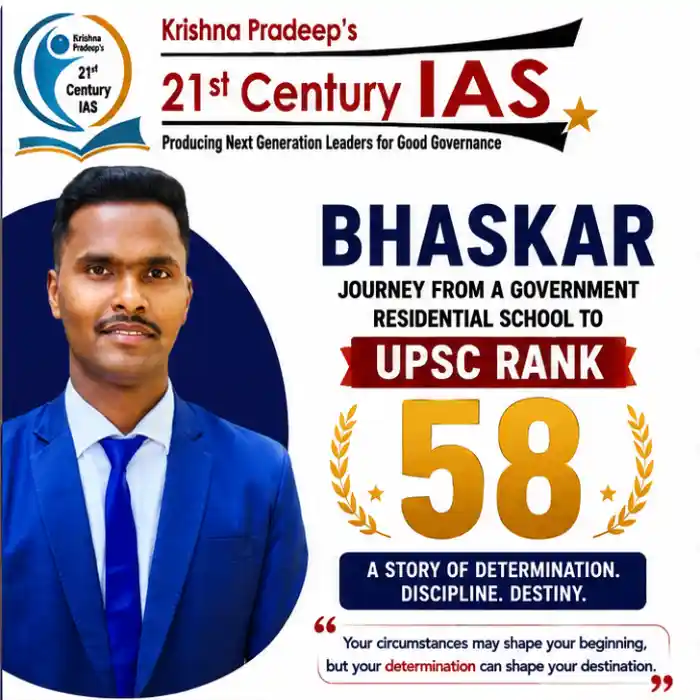
- Results, stated specifically. KPIAS publishes named candidate outcomes rather than aggregate claims — for example, Dharavath Bhaskar’s AIR 58 in UPSC CAPF AC. Ask any institute, including this one, for named and verifiable results from the most recent cycle.
KPIAS does not claim guaranteed selection, and no institute honestly can. Coaching supplies structure, material, evaluation and correction. The study hours remain yours.
Next step: browse the current Group 1 course line-up, or speak with the academic team about which programme fits your starting level.
TGPSC Group 1 Coaching Fees in Hyderabad
Group 1 coaching fees in Hyderabad vary widely, and the headline number is rarely the whole number. What actually drives the figure:
- Course duration — a 150-day intensive costs less than an 18-month foundation course
- Scope — Prelims-only, Mains-only, or Prelims + Mains integrated
- Test series — included in the course fee or charged separately
- Mentorship — one-to-one mentoring is usually priced in
- Mode — online programmes typically cost less than classroom
- Study material — included, or billed on top
- Batch structure — smaller or weekend batches often carry a premium
- GST — check whether the quoted figure includes it
Published KPIAS figures (as listed at the time of writing — verify current pricing):
| Programme | Listed fee |
| TGPSC Group 1 Nirantara Sadhana 2026 | ₹38,500 |
| TGPSC Group 2 Nirantara Sadhana 2026 | ₹15,000 |
For competitor fees, ask the institute directly and get the inclusions listed in writing. Published third-party “fee ranges” for Hyderabad institutes are frequently outdated and should not be used as a basis for comparison.
APPSC Group 1 Coaching Fees in Hyderabad
The same variables apply to APPSC Group 1 coaching fees, with one addition: if you are also preparing for APPSC Group 2, ask whether the institute offers a combined or upgrade pathway rather than two full fees.
Published KPIAS figures (verify current pricing):
| Programme | Listed fee |
| APPSC Group 1 Nirantara Sadhana 2026 | ₹38,500 |
| APPSC Group 1 Preparation Booster Test Series 2026 | ₹14,999 |
| APPSC Group 2 Nirantara Sadhana 2026 | ₹15,000 |
| APPSC Group 2 Test Series (4,500+ MCQs) | ₹999 |
For a deeper look at APPSC-specific programme structure and course comparison, see the dedicated guide to APPSC Group 1 coaching in Hyderabad.
A note on cost-per-outcome. A ₹15,000 course that you cannot follow is more expensive than a ₹40,000 course you complete. Judge fees against contact hours, number of evaluated tests and mentorship access — not against each other in isolation.
Online vs Offline Group 1 Coaching
| Factor | Online | Offline |
| Flexibility | High — recordings let you fit classes around work or college | Low — fixed timings, fixed location |
| Classroom interaction | Limited; depends on live-session format | High — immediate back-and-forth |
| Faculty interaction | Chat, forums, scheduled calls | Direct, before and after class |
| Peer learning | Weak unless the institute runs active groups | Strong — study circles form naturally |
| Travel | None | Daily commute, or relocation to Hyderabad |
| Revision | Excellent — rewatch difficult topics | Depends on your notes |
| Discipline | Requires self-enforcement; easy to fall behind | Externally enforced by attendance |
| Cost | Usually lower; no hostel or travel costs | Higher total cost including living expenses |
| Best suited for | Working professionals, final-year students, aspirants outside Hyderabad, repeat aspirants who know the syllabus | First-time aspirants, candidates who need structure, anyone who has struggled with consistency |
A balanced recommendation: if this is your first attempt and you have not yet proved to yourself that you can hold a 6–8 hour daily routine without supervision, choose offline or hybrid. If you have already cleared a Prelims, or you are working, online with a disciplined test schedule is usually the better trade. Hybrid programmes — classroom plus recordings — remove most of the compromise, and are worth asking about specifically.
Who Should Join Group 1 Coaching in Hyderabad?
Fresh graduates. The highest-return group — a full 12–18 month cycle with no competing commitments. Prioritise foundation depth over exam-year shortcuts.
Final-year students. Start the common GS core now and finish your degree with a year of preparation already banked. Confirm you’ll meet the degree requirement by the application date.
Working professionals. Choose weekend or online-with-recordings formats, protect a fixed daily slot, and plan 18–24 months rather than 12. Don’t drop the test series to save time — it’s the only thing that tells you whether the hours are working.
First-time aspirants. You need structure and sequencing more than additional content. Coaching earns its fee here.
Repeat aspirants. Diagnose before enrolling. If you cleared Prelims but not Mains, you need answer evaluation and content depth, not another foundation batch — ask for a Mains-only or test-series-only option.
UPSC aspirants. Your GS foundation already covers most of the Group 1 core. What you need is the state layer and a shift from UPSC’s analytical framing to Group 1’s factual precision — see the integrated Group exam preparation approach before buying a separate course.
APPSC aspirants. Get the AP-specific layer from a specialist and train deliberately for Prelims negative marking.
TGPSC aspirants. Treat Paper VI (Telangana Movement and State Formation) as a subject in its own right from month one, not a final-month cram.
Aspirants preparing for multiple government exams. The Group 1 GS core covers a large share of Group 2, Group 3 and SSC-level syllabi. Sequence downward from the hardest exam, not upward from the easiest.
Best Group 1 Preparation Strategy for 2026–2027
| Stage | When | What you do | Where coaching helps |
| 1. Understand the syllabus | Week 1 | Print the commission’s official syllabus — not a coaching brochure — and keep it in front of you all year | Mapping syllabus lines to actual reading, where most self-starters lose two months |
| 2. Analyse previous-year papers | Weeks 1–2 | Read 3–5 years of papers before studying, for depth level, repeat areas and state-question style: TGPSC Group 1 PYQs, APPSC Group 1 PYQs | Trend analysis and per-topic weightage across cycles |
| 3. Build foundations | Months 1–5 | NCERTs (Class 6–12), then standard reference books; one page of condensed notes per topic, handwritten | Lectures that compress this and hold the pace |
| 4. Start current affairs | Day 1, permanently | One newspaper daily plus a monthly compilation | Exam-filtered daily notes |
| 5. Prelims preparation | Months 4–8 | Topic-wise MCQs as each subject finishes; for APPSC, a personal rule for when to guess under negative marking | Topic-wise Prelims practice tied to the class schedule |
| 6. Mains answer writing | Months 3–12 | One answer a day from month three — not after Prelims | Evaluated answers with written feedback; unevaluated practice builds fluency, not marks |
| 7. Mock tests | Month 6 onward | Full-length papers under exam conditions, handwritten; analyse each for longer than you took to write it | Realistic difficulty calibration and ranking against a real cohort |
| 8. Revision | Final 60 days | Three passes over condensed notes, shrinking each time — scheduled with dates, not left to spare time | Rapid-revision modules and grand tests |
| 9. Interview preparation | Post-Mains | Application/DAF analysis, mock panels, state-specific awareness, six months of current affairs | Mock panels with practising faculty and former officers |
Group 1 Current Affairs Preparation
Most aspirants read current affairs. Far fewer convert it. The difference between the two decides 100–200 marks across Prelims and Mains.
What to cover: one national daily plus a Telugu-state daily, capped at 60–90 minutes; central and state government schemes with objective, funding pattern, target group and status; Telangana-specific items (state budget, irrigation projects, industrial and IT policy, GOs) and Andhra Pradesh-specific items (state budget, capital and infrastructure, welfare schemes, AP Reorganisation Act implementation); and the standard national streams — economy, polity, environment and international affairs — at Mains depth.
Reading vs converting. Reading means knowing a scheme was launched. Converting means holding a one-page note with the scheme’s objective, implementing ministry, funding split, coverage numbers, criticisms and two possible exam angles — one MCQ-shaped, one essay-shaped. Only the second survives to exam day.
A workable system: read daily → tag each item to a syllabus topic → write it into the topic’s note, not into a chronological diary → revise monthly with a compilation. KPIAS publishes daily CARE articles and monthly magazines separately for Telangana and Andhra Pradesh, which does the tagging step for you.
Group 1 Test Series and Answer Writing
A test series is the only honest feedback in the entire preparation. Evaluate it on nine points:
- Test quality — are questions written for this exam, or recycled from a generic GS bank?
- Exam relevance — does the paper reflect the commission’s actual style and depth?
- Difficulty calibration — deliberately brutal papers demoralise; easy papers mislead. You want realistic.
- Detailed solutions — explanations that teach, not answer keys
- Performance analysis — sectional and topic-level breakdowns, not just a total
- Answer evaluation — who evaluates Mains answers, how long they take, and whether comments are specific
- Model answers — provided for every descriptive question
- Time management training — full-length papers under real timing, handwritten
- Revision feedback — does the analysis tell you what to go back and re-study?
On answer writing. TGPSC Mains demands six three-hour descriptive papers, one of them three essays. That is a physical skill as much as an intellectual one — handwriting stamina, structure under time pressure, and finishing every question. Candidates who prepare only on a laptop discover this in the exam hall. Start with TGPSC Mains practice or APPSC Mains practice and build up.
Common Mistakes While Choosing Group 1 Coaching
- Choosing from advertisements. Hoardings measure marketing budget, not teaching.
- Choosing by brand name alone. A famous institute with a faculty change since last cycle is a different product.
- Choosing purely on fees. Both extremes fail — the cheapest course you abandon, and the expensive one you picked as a proxy for quality.
- Ignoring who actually teaches. Demo classes are often taken by the best speaker, not your batch’s faculty. Ask directly.
- Ignoring mentorship. Twelve months without a course correction is twelve months of compounding the same error.
- Ignoring the test series. Content without assessment feels productive and isn’t.
- Ignoring state-specific content. Institutes strong on national GS are sometimes thin on Telangana Movement or AP-specific papers. That thinness costs a full Mains paper.
- Ignoring answer writing. Selection is decided in Mains, and Mains is a writing exam.
- Not sitting in a real class. A demo is a performance; a regular class is the product.
- Not checking the current course structure. Last year’s brochure and this year’s batch can differ substantially.
- Assuming coaching guarantees selection. No institute can promise a result determined by a commission, a cut-off and your own study hours. Any that does is telling you something useful about itself.
Frequently Asked Questions
Which is the best TGPSC Group 1 coaching in Hyderabad?
No institute is objectively best for every aspirant. Evaluate faculty for Telangana-specific papers, Prelims-plus-Mains integration, test series quality, answer evaluation and batch size, and sit in a class before enrolling. KPIAS, R.C. Reddy IAS Study Circle, Ekam IAS Academy and Pragnya IAS Academy are among the institutes that publicly offer TGPSC Group 1 coaching in Hyderabad.
Which is the best APPSC Group 1 coaching in Hyderabad?
Apply the same framework, with added weight on AP-specific content and Prelims negative-marking strategy. Institutes with publicly stated APPSC Group 1 programmes include KPIAS, Sarat Chandra IAS Academy, Ekam IAS Academy and Pragnya IAS Academy. Verify current batch details with each.
Which is the best Group 1 coaching institute in Hyderabad?
The one whose faculty, test series and mentorship match your starting level and learning mode. Use the 15-point checklist in this article rather than any published ranking — most such rankings are unverified.
How much does Group 1 coaching cost in Hyderabad?
It varies by duration, scope and mode. KPIAS lists its TGPSC and APPSC Group 1 Nirantara Sadhana programmes at ₹38,500 each and its APPSC Group 1 test series at ₹14,999. Longer foundation courses at other institutes cost more. Always confirm what the fee includes and whether GST is extra.
Is Hyderabad good for Group 1 preparation?
Yes. Hyderabad has three decades of accumulated Group 1 teaching concentrated around Ashok Nagar, Chikkadpally, RTC X Roads and Himayatnagar, with Telugu-medium and English-medium options, libraries, hostels and a large peer community. It remains the main preparation hub for both Telangana and Andhra Pradesh aspirants.
Can I prepare for TGPSC and APPSC Group 1 together?
Yes. The General Studies core — polity, economy, history, geography, environment, science and technology, society and national current affairs — is largely common. Build that core once, then add the Telangana-specific and Andhra Pradesh-specific layers separately.
What is the difference between TGPSC Group 1 and APPSC Group 1?
TGPSC Prelims is a single 150-mark objective paper; APPSC Prelims has two papers of 120 marks each with one-third negative marking. TGPSC Mains has six merit papers of 150 marks each (900 total) including a dedicated Telangana Movement paper; APPSC Mains has seven papers of 150 marks each, of which Telugu and English are qualifying. The state-specific content differs entirely.
Is Group 1 coaching necessary?
Not mandatory. Candidates do clear Group 1 through self-study. Coaching helps most with syllabus sequencing, state-specific content, evaluated answer writing and sustained accountability — which is also where most self-study attempts break down.
Can I prepare for Group 1 without coaching?
Yes, if you can build a syllabus-mapped plan, source reliable state-specific material, and arrange honest evaluation of your Mains answers. Many aspirants self-study the content and buy only a test series.
How long does it take to prepare for Group 1?
For a first-time aspirant starting from scratch, 12–18 months of consistent preparation is realistic. Working professionals should plan 18–24 months. Candidates with a UPSC or Group 2 base can compress this considerably.
Is online or offline Group 1 coaching better?
Offline suits first-time aspirants who need external structure. Online suits working professionals, final-year students and repeat aspirants who already know the syllabus. Hybrid programmes with recorded access remove most of the trade-off.
Which books are useful for Group 1 preparation?
Start with NCERTs (Class 6–12) for history, geography, polity, economy and science, then standard reference books for each subject, then state-specific material — Telangana history, economy and the Telangana Movement, or Andhra Pradesh history, economy and the AP Reorganisation Act, 2014. Add one newspaper and a monthly current affairs compilation.
How should beginners start Group 1 preparation?
Read the official syllabus, then three to five years of previous-year papers, then begin NCERTs. Start current affairs on day one. Add MCQ practice from month four and answer writing from month three.
How important are current affairs for Group 1?
Very. Current affairs appear directly in Prelims and indirectly across every Mains paper, and state-specific current affairs are where many candidates lose marks. Convert what you read into topic-wise notes rather than a chronological diary.
How should I prepare for Group 1 Mains?
Cover the syllabus at Mains depth from the start, write one answer daily from month three, get answers evaluated by someone qualified, study model answers, and practise complete three-hour papers by hand before the exam.
Is answer writing necessary for Group 1?
Yes. Merit is decided by Mains, and Mains is entirely descriptive — 900 marks of written papers for TGPSC. Structure, time management and handwriting stamina are trainable skills, and untrained candidates lose marks they have the knowledge to score.
What should I look for before joining Group 1 coaching?
Faculty for state-specific papers, a dated syllabus completion plan, integrated Prelims and Mains teaching, evaluated answer writing, test frequency, mentorship format, batch strength, study material you have physically seen, and a written fee breakdown with refund policy.
Can UPSC preparation help with Group 1 preparation?
Substantially. The General Studies core overlaps heavily — KPIAS works with an estimate of around 70% commonality across UPSC, TGPSC Group 1 and APPSC Group 1. What you add is the state layer, and a shift toward greater factual precision.
Can APPSC and UPSC preparation be done together? Yes. Build the common GS core, add AP-specific content and the UPSC optional subject, and run one combined timetable rather than two separate ones.
Can TGPSC and UPSC preparation be done together? Yes, with the same logic. The additional TGPSC-specific load is Telangana history, geography, economy, society and the Telangana Movement and State Formation paper, which has no UPSC equivalent and needs its own study block.
When is the next TGPSC Group 1 notification?
As of September 2026, TGPSC has completed the 563-post Group 1 cycle and has begun collecting fresh Group 1 vacancy data from departments, with a move toward a more regular notification calendar. No date is confirmed. Check tgpsc.gov.in for official announcements.
When is the next APPSC Group 1 notification?
APPSC Group 1 features on the 2026 Andhra Pradesh exam calendar, but secondary sources report conflicting vacancy counts and dates. Treat those figures as unverified and check psc.ap.gov.in for the official notification.
Conclusion
The question you started with — which is the best TGPSC and APPSC Group 1 coaching in Hyderabad for 2026–2027 — has no single answer, and anyone who gives you one quickly is selling. What it has is a method: check who will actually teach your state-specific papers, insist on Prelims-plus-Mains integration, demand evaluated answer writing from month three, ask the real batch strength, and get the fee in writing. Do that at three institutes and your shortlist writes itself — Hyderabad’s advantage is that you can walk into all three in an afternoon.
Your next three steps: read the official syllabus, work a previous-year paper to calibrate depth, and sit in one demo class this week.
Explore next: Group 1 programmes and current batches · The integrated UPSC and Group exam approach · Speak with the KPIAS academic team