Why in News?
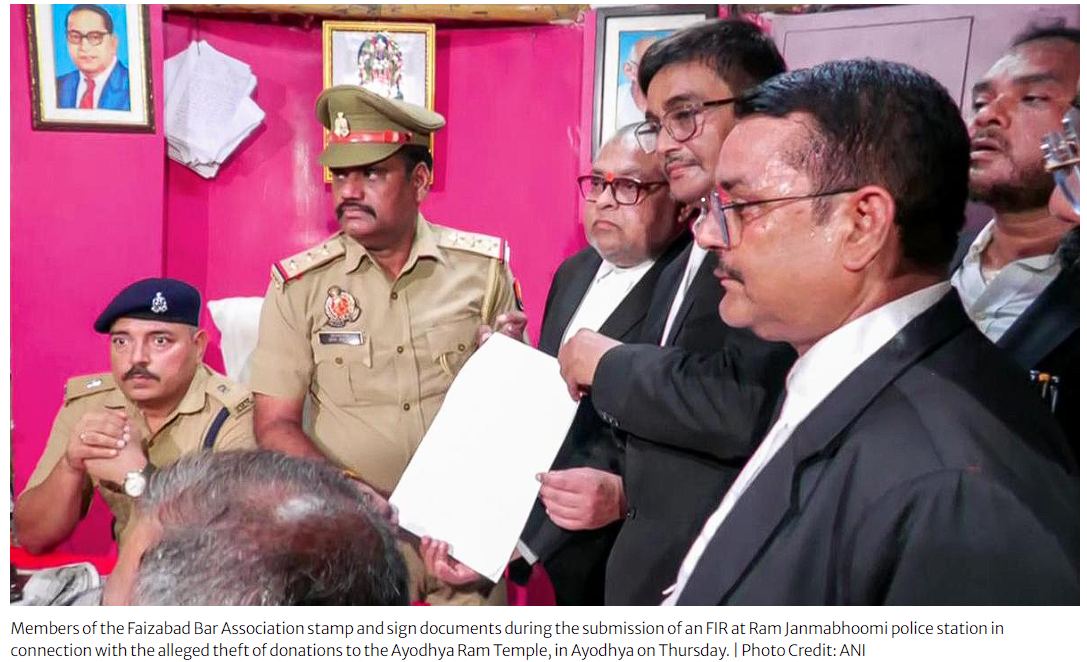
The Faizabad/Ayodhya Bar Association reportedly passed a resolution stating that its members would not represent the accused in the alleged Ayodhya Ram Temple funds embezzlement case.
The resolution raised an important constitutional question: Can a Bar Association collectively prevent lawyers from representing a particular accused?
The legal position is clear. Such resolutions are illegal, unconstitutional and contrary to professional ethics.
Core Legal Issue
A criminal trial is not decided by public anger, social reputation or the popularity of the accused. It is decided by law, evidence and judicial procedure.
Even a person accused of the most serious offence has the right to be defended in court. A Bar Association cannot collectively deny this right by passing a boycott resolution.
The issue involves two connected rights:
- The right of the accused to legal representation.
- The professional freedom and duty of an advocate to appear for a client.
Constitutional Right of an Accused
Article 22(1): Right to Counsel
Article 22(1) of the Constitution says that no arrested person shall be denied the right to consult and be defended by a legal practitioner of his choice.
This gives constitutional protection to the accused person’s right to legal representation.
Article 21: Fair Trial
The Supreme Court has interpreted the right to fair trial as part of the right to life and personal liberty under Article 21.
A trial cannot be fair if the accused is denied legal assistance.
Article 14: Equality before Law
Article 14 ensures equality before law and equal protection of laws. Even an unpopular accused cannot be excluded from constitutional protection.
Article 39A: Equal Justice and Legal Aid
Article 39A directs the State to ensure that justice is not denied because of economic or other disabilities. It forms the basis of free legal aid in India.
Together, these provisions create the constitutional foundation for the right to legal representation.
Supreme Court’s Position
The Supreme Court has repeatedly held that Bar Association resolutions refusing representation to an accused are invalid.
A.S. Mohammed Rafi v. State of Tamil Nadu, 2010
In this case, a Bar Association had resolved that its members would not represent police personnel accused after a conflict between lawyers and police in Coimbatore.
The Supreme Court held that such resolutions are:
- Wholly illegal
- Against professional ethics
- Against constitutional values
- Null and void
The Court made it clear that every accused, however disliked by society, has the right to be defended in a court of law.
It also stated that lawyers should ignore and defy such unlawful resolutions if they wish to uphold democracy and rule of law.
Bar Council of India Rules
The Bar Council of India Rules on professional conduct say that an advocate is generally bound to accept any brief in a court, tribunal or authority where he practises, provided the fee is consistent with his standing and the nature of the case.
The rules allow an advocate to refuse a brief only in special circumstances.
However, such refusal is an individual professional decision. It cannot be converted into a collective boycott by a Bar Association.
Can an Individual Advocate Refuse a Brief?
Yes, an individual advocate may refuse a case in special circumstances.
But a Bar Association cannot:
- Threaten lawyers with fines
- Remove membership
- Socially boycott advocates
- Prevent filing of bail applications
- Obstruct access to court
- Stop any advocate from appearing for an accused
The Uttarakhand High Court in Kuldeep Agarwal v. State of Uttarakhand, 2019 clarified that “special circumstances” apply to an individual advocate, not to a Bar Association as a collective body.
Previous Instances of Bar Boycott
Bar Associations have passed similar resolutions in several high-profile cases.
Ajmal Kasab Case
After the 2008 Mumbai terror attacks, some lawyers opposed legal representation for Ajmal Kasab. Eventually, a lawyer was appointed under security, ensuring a fair trial.
Delhi Gangrape Case, 2012
Lawyers at Saket courts passed a resolution refusing to represent the accused.
Hyderabad Veterinary Doctor Case, 2019
Lawyers reportedly declined to represent the accused in the rape and murder case.
Gurugram School Murder Case, 2017
The Supreme Court directed that lawyers must not obstruct representation of the accused, emphasising that the right to counsel is essential for rule of law.
How Courts Have Responded
Courts have consistently rejected Bar Association boycotts.
Uttarakhand High Court, 2019
- The Court declared a Bar Association resolution null and void when it threatened action against advocates representing an accused in the murder of an advocate.
- It also directed the State Bar Council to act against such resolutions in future.
Karnataka High Court, 2020
- The Court criticised lawyers who objected to advocates representing Kashmiri students accused of raising pro-Pakistan slogans. It described such obstruction as unacceptable and warned that it could amount to contempt.
Madras High Court, 2025
- The Court reiterated that Bar Associations cannot formally or informally prevent advocates from appearing for an accused. It observed that the Bar is not a trade union but an institution of constitutional importance.
Why Legal Representation Matters
Protects Rule of Law
- If lawyers refuse to defend accused persons based on public opinion, criminal justice becomes mob-driven rather than law-driven.
Ensures Fair Trial
- A fair trial requires that both prosecution and defence are heard before an impartial court.
Protects Victims Too
- Convictions based on proper trial and evidence are stronger and less vulnerable to appeal.
Preserves Professional Ethics
- An advocate is not endorsing the alleged crime by defending an accused. The lawyer is helping the court test evidence and ensure due process.
Prevents Miscarriage of Justice
- Without defence counsel, innocent persons may be wrongly convicted and guilty persons may escape due to procedural irregularities.
Conclusion
Bar Associations cannot legally refuse to represent an accused or prevent their members from doing so. Such resolutions violate Article 22(1), weaken the right to fair trial under Article 21, offend Article 14, and go against the professional duties of advocates under the Bar Council of India Rules.
The constitutional message is clear: every accused has the right to legal representation, and every trial must be conducted according to law, not public emotion.