Relevance: GS Paper II (Governance, Land Reforms) | GS Paper III (Agriculture) | APPSC (Land Administration)
For Prelims:
Pattadar Passbook, Land Titling, Presumptive Title, Conclusive Title, State Emblem of India Act 2005, Record of Rights (RoR)
For Mains:
Land governance, property rights, administrative reforms, digitisation, agrarian security
Why in News?
The Andhra Pradesh government has distributed revised pattadar passbooks to farmers in Nandyal district, replacing earlier documents and emphasising accuracy, legal validity, and neutrality by incorporating the State Emblem.
Pattadar Passbook: Legal Nature and Record System
A pattadar passbook is an official land ownership document issued to farmers, recording details such as ownership, extent of land, survey number, and type of land.
It forms part of the Record of Rights (RoR) system maintained by the State, which serves as primary evidence for land transactions, agricultural loans, and dispute resolution.
In Andhra Pradesh, the passbook acts as a facilitating document rather than conclusive proof of ownership, reflecting India’s broader presumptive land record system.
Land Titling Systems in India: Conceptual Shift
- India traditionally follows a presumptive land titling system, where ownership is inferred from possession and historical records, but the State does not guarantee title.
- In contrast, a conclusive titling system provides legally guaranteed ownership, where the State assumes responsibility for correctness of land records.
This distinction is important for prelims:
- Presumptive system → disputes possible, courts decide ownership
- Conclusive system → state-certified ownership, minimal disputes
Andhra Pradesh Land Titling Act and Policy Reversal
- The State earlier attempted to introduce conclusive titling through a Land Titling Act aimed at eliminating disputes and modernising land governance.
- However, concerns emerged regarding errors in surveys, concentration of authority, and difficulty in correcting mistakes.
- The present government under N. Chandrababu Naidu repealed the Act and shifted focus to correcting records rather than guaranteeing titles.
- This reflects a broader governance debate between reform ambition and administrative capacity.
Role of State Emblem and Legal Authenticity
- The issuance of passbooks bearing the State Emblem strengthens the legal credibility of documents.
- The use of the emblem is regulated under the State Emblem of India (Prohibition of Improper Use) Act, 2005, which ensures that official symbols are used only for authorised purposes.
The shift away from political imagery towards the State Emblem reinforces:
- Institutional neutrality
- Legal sanctity of documents
- Public trust in governance
Governance Issues in Land Administration
- Land administration remains a sensitive issue due to multiple structural challenges.
- Errors in land surveys and digitisation processes can lead to disputes and litigation.
- Frequent policy changes create uncertainty and affect farmer confidence.
- Land remains a key economic asset in rural India, linking agriculture, credit access, and social security.
- Thus, land governance is not only an administrative issue but also a political and socio-economic concern.
Way Forward
There is a need to strengthen accuracy in land surveys using modern technologies such as GIS and satellite mapping.
Institutional mechanisms must be developed to ensure transparent grievance redressal for correcting land records. A gradual transition toward conclusive titling can be considered only after ensuring data accuracy and administrative preparedness.
Digitisation should be complemented with legal safeguards and public awareness to build trust among farmers.
Conclusion
The reissue of pattadar passbooks in Andhra Pradesh highlights the importance of reliable land records in ensuring agricultural security and governance credibility. While reforms in land titling remain necessary, they must be implemented cautiously, balancing efficiency with accuracy and protecting the rights of farmers.
CARE MCQ
Q. Consider the following statements:
- India follows a conclusive land titling system.
- Pattadar passbooks serve as conclusive proof of ownership.
- The State Emblem of India (Prohibition of Improper Use) Act, 2005 regulates the use of official symbols.
Which of the statements given above are correct?
(a) 1 and 2 only
(b) 2 and 3 only
(c) 3 only
(d) 1, 2 and 3
Ans: (c)
Explanation:
Statement 1 is incorrect: India follows a presumptive land titling system, where ownership is not guaranteed by the state and land records are subject to legal disputes.
Statement 2 is incorrect: Pattadar passbooks are only record-of-rights documents and serve as evidence of possession/claims, but they are not conclusive proof of ownership.
Statement 3 is correct: The State Emblem of India (Prohibition of Improper Use) Act, 2005 regulates the use of the national emblem and prevents its misuse.
Q. With reference to water rights and river disputes involving Andhra Pradesh, consider the following statements:
- The Krishna River water dispute is adjudicated by a tribunal constituted under the Inter-State River Water Disputes Act.
- Andhra Pradesh has no share in the Godavari River waters as most of the river flows through other states.
- The Polavaram Project has been declared a national project by the Government of India.
Which of the statements given above are correct?
(a) 1 and 3 only
(b) 2 and 3 only
(c) 1 and 2 only
(d) 1, 2 and 3
Ans: (a)
Explanation:
Statement 1 is correct: The Krishna Water Disputes Tribunal (KWDT) was constituted under the Inter-State River Water Disputes Act, 1956 to allocate water among riparian states including Andhra Pradesh.
Statement 2 is incorrect: Andhra Pradesh has a significant share in the Godavari River waters, especially in its delta region; hence the statement is factually incorrect.
Statement 3 is correct: The Polavaram Project has been declared a national project, with the Central Government bearing the major cost, recognizing its importance for irrigation and water management.
Q. With reference to constitutional and statutory rights of Andhra Pradesh after bifurcation (2014), consider the following statements:
- The Andhra Pradesh Reorganisation Act, 2014 provides for special financial assistance to Andhra Pradesh.
- The Act mandates the establishment of a separate High Court for Andhra Pradesh.
- The Act guarantees Special Category Status (SCS) to Andhra Pradesh as a constitutional right.
Which of the statements given above are correct?
(a) 1 and 2 only
(b) 2 and 3 only
(c) 1 and 3 only
(d) 1, 2 and 3
Ans: (a)
Explanation:
Statement 1 is correct:
The Act provides for financial support and special assistance measures to Andhra Pradesh to compensate for revenue loss after bifurcation.
Statement 2 is correct:
The Act provides for the establishment of a separate High Court, which later came into existence in Andhra Pradesh.
Statement 3 is incorrect:
Special Category Status (SCS) is not a constitutional or statutory right under the Act; it is a policy decision of the Central Government, and not guaranteed in the legislation.
APPSC CARE MAINS:
Q.Examine the challenges associated with land titling reforms in India with reference to recent developments in Andhra Pradesh. How can land governance be improved to reduce disputes and enhance farmer security? [250 Words]
FAQs
Q. What is a pattadar passbook?
Ans: It is an official land record document issued to farmers containing ownership and land details.
Q. What type of land titling system does India follow?
Ans: India follows a presumptive land titling system.
Q. Why was the Land Titling Act repealed in Andhra Pradesh?
Ans: Due to concerns over survey errors, centralisation of authority, and potential risks to ownership rights.
Q. Why is the State Emblem used in land documents?
Ans: To ensure authenticity, neutrality, and legal validity of official records.
Relevance: GS Paper II – Health | GS Paper III – Biotechnology | Economy | Science & Technology
For Prelims:
Pulmonary Hypertension (PH), Endothelin Receptor Antagonists (ERAs), PDE5 inhibitors, Biopharma SHAKTI, ABDM 2.0, biologics, Ayushman Bharat Digital Mission
For Mains:
healthcare accessibility, domestic pharmaceutical manufacturing, digital health ecosystem, affordable healthcare, Atmanirbhar Bharat in healthcare, integrative medicine
Why in News?
- India is witnessing a major transformation in the treatment of Pulmonary Hypertension (PH), shifting from dependence on imported therapies to domestic innovation and manufacturing.
- Government initiatives like Biopharma SHAKTI and digital health expansion are improving accessibility and affordability of treatment.
- The focus is now on precision medicine, digital monitoring, and holistic healthcare approaches to improve patient outcomes.
What is Pulmonary Hypertension (PH)
- Pulmonary Hypertension is a serious medical condition in which there is abnormally high blood pressure in the pulmonary arteries that carry blood from the heart to the lungs.
- This increased pressure forces the heart to work harder, eventually leading to heart failure if untreated.
- Symptoms include:
– Shortness of breath during routine activity
– Fatigue and weakness
– Chest pain and dizziness
– Swelling in legs and abdomen - One major challenge in India has been delayed diagnosis, as symptoms are often misinterpreted as asthma or general fatigue.
Evolution of PH Care in India
- Earlier, treatment options for PH were largely dependent on imported drugs, which were expensive and inaccessible for most patients.
- Diagnosis infrastructure was limited, particularly in rural areas, leading to late detection and poor prognosis.
- Over time, India has developed capabilities in pharmaceutical manufacturing and clinical research, leading to improved availability of therapies.
- The healthcare system is now transitioning towards early diagnosis, targeted therapies, and continuous patient monitoring.
Role of Domestic Pharmaceutical Industry
- India has emerged as a major producer of affordable PH drugs, reducing dependence on costly imports.
- Key drug classes now manufactured domestically include:
– Endothelin Receptor Antagonists (ERAs)
– Phosphodiesterase-5 (PDE5) inhibitors - Endothelin Receptor Antagonists work by blocking endothelin, a substance that causes narrowing of blood vessels, thereby improving blood flow.
- Domestic production has significantly reduced treatment costs and increased access for patients across income groups.
- Government policies such as customs duty reductions and support for local manufacturing have further strengthened this ecosystem.
Biopharma SHAKTI Initiative
- The Biopharma SHAKTI is a flagship initiative aimed at transforming India into a global hub for biologics and advanced therapies.
- It has a financial outlay of ₹10,000 crore to support innovation, infrastructure, and clinical research.
- The initiative focuses on:
– Development of advanced biologic drugs
– Strengthening clinical trial infrastructure
– Promoting startups and research institutions
– Improving regulatory efficiency - For PH care, this initiative is expected to make cutting-edge therapies more accessible and affordable within India.
Role of Digital Health (ABDM 2.0)
- The Ayushman Bharat Digital Mission (ABDM 2.0) is creating a unified digital health ecosystem.
- It enables patients to maintain digital health records through ABHA IDs, ensuring continuity of care across hospitals and regions.
- For PH patients, this allows:
– Continuous monitoring of disease progression
– Seamless sharing of medical records between specialists
– Better follow-up and treatment adherence - Digital platforms also support telemedicine, improving access to specialists in remote areas.
Integrative and Holistic Approaches
- India is exploring integrative approaches combining modern medicine with traditional practices such as yoga.
- Clinical trials indicate that yoga can improve quality of life, exercise capacity, and mental well-being in Pulmonary Arterial Hypertension (PAH) patients.
- Holistic care includes:
– Lifestyle modification
– Breathing exercises
– Stress management
– Nutritional support - This approach complements pharmacological treatment and enhances overall patient outcomes.
Challenges in PH Care
- Despite progress, several challenges remain in ensuring universal access to PH care.
- Rural healthcare infrastructure is still inadequate, leading to delayed diagnosis and limited specialist availability.
- Awareness about PH among general practitioners and patients remains low.
- Advanced diagnostic tools and specialised centres are concentrated in urban areas.
- Financial constraints still affect access to long-term treatment for economically weaker sections.
Significance for India
- Reduces dependence on imported medicines and strengthens self-reliance in healthcare.
- Makes life-saving therapies affordable for a larger population.
- Enhances India’s position as a global pharmaceutical and biotech hub.
- Improves healthcare outcomes through integration of technology and innovation.
- Contributes to achieving universal health coverage and strengthening public health systems.
Way Forward
- Strengthen primary healthcare systems to ensure early diagnosis of PH, especially in rural areas.
- Expand awareness programs for both healthcare professionals and the general public.
- Increase investment in research and development for advanced therapies.
- Enhance digital health infrastructure to ensure seamless integration across regions.
- Promote integrative healthcare approaches combining modern and traditional medicine.
- Ensure affordability through continued policy support and subsidies for essential drugs.
Conclusion
India’s approach to Pulmonary Hypertension care reflects a broader transformation in the healthcare sector, moving towards self-reliance, innovation, and inclusivity. By combining domestic pharmaceutical strength, digital health infrastructure, and holistic care models, India is creating a sustainable and accessible healthcare ecosystem. However, addressing gaps in infrastructure and awareness remains essential to ensure that these advancements reach every section of society.
CARE MCQ
Q.Consider the following statements regarding Endothelin Receptor Antagonists (ERAs) used in pharmacotherapy:
- Bosentan is a non-selective endothelin receptor antagonist, blocking both ET-A and ET-B receptors.
- Ambrisentan is primarily an ET-B selective endothelin receptor antagonist.
- Macitentan is characterized by a more sustained receptor binding compared to bosentan, which contributes to its therapeutic efficacy.
- Endothelin-1 primarily exerts its potent vasoconstrictive effects by binding to ET-B receptors.
How many of the statements given above are correct?
a) Only one
b) Only two
c) All four
d) None of the above
Ans: (b)
Explanation:
Statement 1 is correct: Bosentan is a non-selective endothelin receptor antagonist (ERA), meaning it blocks both ET-A and ET-B receptors. It was the first oral ERA approved for pulmonary arterial hypertension (PAH).
Statement 2 is incorrect: Ambrisentan is an ET-A selective endothelin receptor antagonist. It specifically blocks the ET-A receptor, which is primarily responsible for vasoconstriction and cell proliferation, with potentially less impact on ET-B mediated effects like vasodilation and endothelin clearance.
Statement 3 is correct: Macitentan is a newer non-selective ERA. It has a distinct pharmacological profile characterized by more sustained receptor binding and a longer duration of action compared to bosentan, which contributes to its improved efficacy and safety profile, including reduced liver toxicity.
Statement 4 is incorrect: Endothelin-1 (ET-1) primarily exerts its potent vasoconstrictive effects by binding to ET-A receptors. ET-B receptors, while also binding ET-1, have more complex roles including mediating vasodilation (via nitric oxide and prostacyclin release) and facilitating the clearance of ET-1. Therefore, blocking ET-A receptors is crucial for reducing ET-1 mediated vasoconstriction.
Q.Which of the following statements accurately describes the primary mechanism of action of Endothelin Receptor Antagonists (ERAs) used in conditions like Pulmonary Arterial Hypertension?
a) They directly inhibit the enzyme responsible for the synthesis of Endothelin-1.
b) They block the binding of Endothelin-1 to its ETA and/or ETB receptors, preventing vasoconstriction and cell proliferation.
c) They enhance the degradation of circulating Endothelin-1 by promoting liver and kidney clearance.
d) They stimulate the production of vasodilatory substances like nitric oxide and prostacyclin in the endothelium.
Ans: (b)
Explanation:
Endothelin Receptor Antagonists (ERAs) are a class of drugs that work by blocking the action of endothelin, a potent vasoconstrictor peptide. Endothelin exerts its effects by binding to specific receptors, primarily Endothelin A (ETA) and Endothelin B (ETB) receptors, located on vascular smooth muscle cells and other cell types. By blocking these receptors, ERAs prevent endothelin-1 from inducing vasoconstriction (narrowing of blood vessels) and cell proliferation (excessive growth of cells), which are key pathological processes in diseases like Pulmonary Arterial Hypertension (PAH). Some ERAs are selective for ETA receptors (e.g., Ambrisentan), while others are non-selective, blocking both ETA and ETB receptors (e.g., Bosentan, Macitentan)
Q.Consider the following statements regarding biopharmaceutical production:
Statement 1: The production of complex recombinant therapeutic proteins, such as monoclonal antibodies, often necessitates expression in mammalian cell cultures rather than prokaryotic systems for optimal pharmacological activity.
Statement 2: Prokaryotic expression systems lack the sophisticated post-translational modification machinery, particularly for complex glycosylation, which is crucial for the correct folding, stability, and biological activity of many eukaryotic proteins, preventing aggregation and reducing immunogenicity in human patients.
Which one of the following is correct in respect of the above statements?
(a) Both Statement 1 and Statement 2 are correct and Statement 2 is the correct explanation for Statement 1
(b) Both Statement 1 and Statement 2 are correct and Statement 2 is not the correct explanation for Statement 1
(c)Statement 1 is correct but Statement 2 is incorrect
(d) Statement 1 is incorrect but Statement 2 is correct
Ans: (a)
Explanation:
Statement 1 is correct: Complex biopharmaceuticals like monoclonal antibodies require intricate post-translational modifications (PTMs), especially glycosylation, for proper folding, stability, and biological function.
Statement 2 is correct : It provides the direct explanation for Statement 1. Prokaryotic systems (like bacteria) are simpler and lack the cellular machinery to perform these complex eukaryotic PTMs. As a result, proteins produced in prokaryotic systems may be misfolded, aggregated, inactive, or highly immunogenic in humans, necessitating the use of more complex mammalian cell culture systems despite higher production costs and complexity.
Q.Which of the following statements best describes a primary regulatory challenge specific to advanced biopharmaceuticals (e.g., gene therapies, cell therapies) compared to traditional small-molecule chemical drugs?
a) Ensuring consistent product quality and manufacturing reproducibility due to their complex biological origin and inherent variability.
b) The requirement for large-scale, multi-country Phase III clinical trials to demonstrate efficacy and safety.
c) The rapid development of resistance mechanisms in target pathogens, necessitating frequent updates to formulations.
d) The high capital investment required for research and development before regulatory submission.
Ans: (a)
Explanation:
Advanced biopharmaceuticals, such as gene and cell therapies, are derived from living systems or complex biological processes. This inherent complexity leads to significant challenges in ensuring consistent product quality, purity, potency, and manufacturing reproducibility from batch to batch. Regulators must establish robust frameworks to assess and monitor these aspects throughout the product lifecycle, which is fundamentally different and often more complex than regulating the chemical synthesis and consistency of small-molecule drugs.
FAQs
Q1. What is Pulmonary Hypertension?
Ans: It is a condition where blood pressure in lung arteries is elevated, affecting heart function.
Q2. How is India improving PH care?
Ans: Through domestic drug manufacturing, digital health systems, and biotech initiatives.
Q3. What is Biopharma SHAKTI?
Ans: It is a government initiative to boost biologic drug innovation and manufacturing in India.
Q4. What role does ABDM play?
Ans: It enables digital health records and improves continuity of care.
Q5. Why is this topic important for UPSC?
Ans: It connects health, biotechnology, economy, and governance—important for GS II and GS III.
Relevance: GS Paper II – Governance | Tribal Rights | Judiciary | GS Paper III – Environment
For Prelims:
Forest Rights Act 2006, DLC, Gram Sabha, Tharu tribe, grazing rights, eviction, TNFA 1882
For Mains:
tribal rights, legal supremacy, judicial interpretation, forest governance, conservation vs livelihood debate, rights-based approach
Why in News?
- The Allahabad High Court reaffirmed the supremacy of the Forest Rights Act, 2006 while hearing a case related to forest rights claims of the Tharu tribal community in Uttar Pradesh.
- It set aside a District Level Committee (DLC) decision rejecting claims, stating that FRA overrides conflicting earlier laws or administrative orders.
- At the same time, the Madras High Court took a contrasting position by upholding eviction notices and ignoring grazing rights under FRA, citing the Tamil Nadu Forest Act, 1882.
What is the Forest Rights Act (FRA), 2006
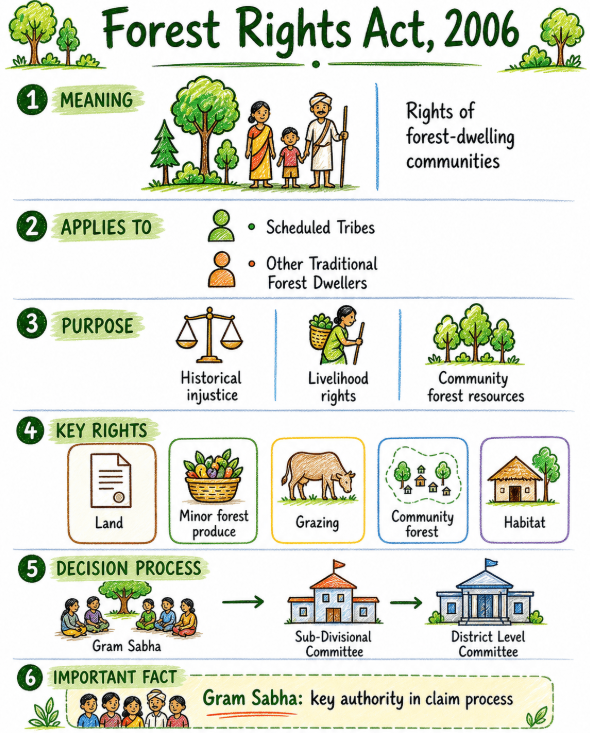
- The Forest Rights Act, 2006, officially known as the Scheduled Tribes and Other Traditional Forest Dwellers Act, was enacted to correct historical injustices against forest-dwelling communities.
- It recognizes legal rights of forest-dwelling Scheduled Tribes and Other Traditional Forest Dwellers over land and forest resources.
- It places Gram Sabhas at the centre of the decision-making process regarding recognition of forest rights.
- It prohibits eviction until the process of verification and recognition of rights is completed.
Key Judgements and Developments
Allahabad High Court
- The Allahabad High Court ruled that the DLC’s rejection of claims was legally incorrect.
- It emphasized that FRA, being a later law, overrides conflicting provisions of earlier laws or administrative decisions.
- It directed reconsideration of the claims of the Tharu tribal community.
- However, it did not impose penalties on authorities for violating FRA provisions.
Madras High Court
- The Madras High Court dismissed petitions challenging eviction notices.
- It held that entertaining FRA claims would delay administrative action.
- It allowed evictions under the Tamil Nadu Forest Act, 1882, even where FRA claims were pending.
- It upheld grazing bans despite FRA explicitly recognizing grazing rights.
Core Legal Principle Involved
- The doctrine of lex posterior derogat priori applies, meaning:
→ A later law overrides an earlier law in case of conflict. - Since FRA was enacted in 2006, it legally prevails over older forest laws such as the Tamil Nadu Forest Act, 1882.
- Courts are expected to interpret laws in a manner that upholds this principle.
Rights Recognised under FRA
The FRA provides a comprehensive framework of rights:
- Individual Forest Rights (IFR):
– Right to live and cultivate forest land for livelihood - Community Forest Rights (CFR):
– Grazing rights
– Collection of Minor Forest Produce
– Fishing and water access
– Forest management rights - Habitat Rights:
– For Particularly Vulnerable Tribal Groups (PVTGs) - Developmental Rights:
– Access to basic amenities like roads, schools, and health facilities
Issue of Grazing Rights
- FRA explicitly recognizes grazing rights across all forest categories, including:
– Reserved forests
– National parks
– Wildlife sanctuaries - These rights are essential for pastoral communities and traditional livelihoods.
- The Madras HC ruling contradicts this provision by upholding grazing bans under older laws.
Significance of Allahabad HC Ruling
- Reinforces FRA as a rights-based legislation with legal supremacy.
- Protects tribal communities from arbitrary eviction.
- Strengthens the role of Gram Sabha and due process in rights recognition.
- Provides judicial clarity on resolving conflicts between old and new laws.
Concerns Raised by Madras HC Approach
- Undermines the intent of FRA by prioritizing colonial-era forest laws.
- Weakens protection against eviction before claim verification.
- Ignores statutory recognition of grazing rights.
- Creates inconsistency in judicial interpretation across different High Courts.
Challenges in FRA Implementation
- Slow recognition of claims due to bureaucratic delays.
- Lack of awareness among tribal communities about their rights.
- Resistance from forest departments due to administrative control concerns.
- Overemphasis on individual rights while neglecting community rights.
- Conflicts between conservation goals and livelihood rights.
Way Forward
- Ensure uniform judicial interpretation across High Courts through Supreme Court guidance.
- Strengthen awareness campaigns among forest dwellers about FRA provisions.
- Improve administrative capacity for faster processing of claims.
- Promote community-based forest governance models.
- Balance conservation goals with livelihood rights using participatory approaches.
Conclusion
The recent rulings highlight a fundamental tension in India’s forest governance framework between colonial-era control and modern rights-based legislation. While the Allahabad High Court reinforces the primacy of the Forest Rights Act, the contrasting approach of the Madras High Court exposes gaps in uniform interpretation. Ensuring consistent enforcement of FRA is essential not only for tribal justice but also for sustainable and inclusive forest management.
CARE MCQ
Q.Which of the following rights are granted under the Forest Rights Act, 2006?
- Title rights to ownership of land cultivated by forest dwellers up to a maximum of 4 hectares.
- Rights to collect and use Minor Forest Produce (MFP), such as bamboo, honey, and medicinal plants.
- The right to clear forest land for cultivation beyond the existing limit of 4 hectares if approved by the Gram Sabha.
Select the correct answer using the code below:
a) 1 and 2 only
b) 2 and 3 only
c) 1 and 3 only
d)1, 2, and 3
Answer: (a)
Explanation:
Statement 1 is correct: The FRA provides title rights, allowing ownership of land actively cultivated by forest dwellers, subject to a maximum limit of 4 hectares.
Statement 2 is correct: The FRA grants use rights to collect Minor Forest Produce (MFP), which includes resources like bamboo, tendu leaves, honey, and medicinal plants. These are crucial for the livelihood of forest-dwelling communities.
Statement 3 is incorrect: The FRA does not allow forest dwellers to clear forest land for cultivation beyond the 4-hectare limit, even with Gram Sabha approval. The Act emphasizes conservation and sustainable use of forest resources.
Q.Which of the following statements is/are correct regarding the Gram Sabha?
- It consists of all the voters residing in the jurisdiction of a Gram Panchayat.
- It is the decision-making body for local self-governance at the village level.
Select the correct answer using the code given below:
a) 1 only
b) 2 only
c) Both 1 and 2
d) Neither 1 nor 2
Answer: (c)
Explanation: The Gram Sabha consists of all the registered voters residing in the jurisdiction of a Gram Panchayat and serves as the decision-making body for local self-governance at the village level.
Q.Consider the following statements about Gram Sabha:
- It is the primary body of the Panchayati Raj system and consists of all registered voters in the area of a Panchayat.
- The Gram Sabha must meet at least twice a year.
- The decisions of the Gram Sabha are not binding on the Gram Panchayat.
How many of the Statements given above are correct?
a) Only one
b) Only two
c) All three
d) None
Answer: (b)
Explanation:
Statement 1 is correct: As per Article 243(b) of the Constitution, the Gram Sabha is a body consisting of all persons registered in the electoral rolls relating to a village comprised within the area of a Panchayat at the village level. It is the foundation of the Panchayati Raj System.
Statement 2 is correct: While the Constitution does not specify the number of meetings, most State Panchayati Raj Acts mandate that the Gram Sabha must meet at least twice a year. The statement reflects this common statutory requirement.
Statement 3 is incorrect: The powers of the Gram Sabha, including whether its decisions are binding on the Gram Panchayat, are determined by the respective State Legislatures as per Article 243A. Many State Acts have provisions that make the recommendations or decisions of the Gram Sabha in specific matters (like approval of plans and selection of beneficiaries) binding on the Gram Panchayat. Therefore, the absolute statement that its decisions are ‘not binding’ is incorrect.
FAQs
Q1. What is the objective of the Forest Rights Act?
Ans: To correct historical injustices and recognize rights of forest-dwelling communities.
Q2. What did the Allahabad High Court rule?
Ans: It upheld FRA supremacy and ordered reconsideration of rejected tribal claims.
Q3. Why is the Madras High Court ruling controversial?
Ans: Because it ignores FRA provisions and allows evictions under older laws.
Q4. What are grazing rights under FRA?
Ans: They allow traditional pastoral communities to use forest land for livestock grazing.
Q5. Why is FRA important for UPSC?
Ans: It links governance, environment, tribal rights, and judiciary—important for GS II and GS III.