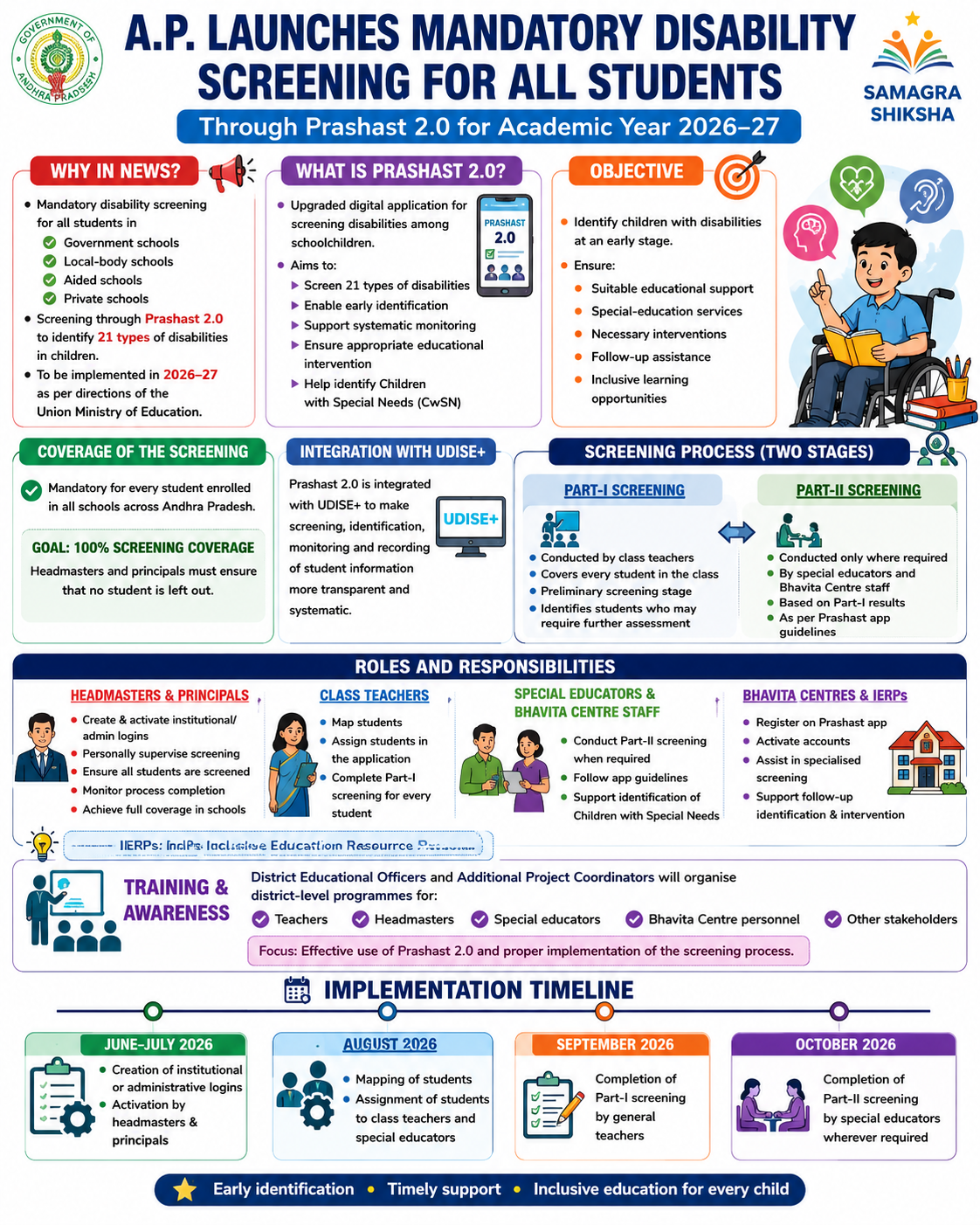
Why in News?
The Andhra Pradesh government announced mandatory disability screening for all students studying in:
- Government schools
- Local-body schools
- Aided schools
- Private schools
The screening will be conducted through Prashast 2.0, an upgraded application designed to identify 21 types of disabilities among children.
The initiative will be implemented during the 2026–27 academic year in accordance with directions from the Union Ministry of Education.
What is Prashast 2.0?
Prashast 2.0 is an upgraded digital application used for screening disabilities among schoolchildren.
It aims to:
- Screen students for 21 types of disabilities
- Facilitate early identification
- Support systematic monitoring
- Enable appropriate educational intervention
- Help identify Children with Special Needs
Objective of the Initiative
The main purpose is to identify children with disabilities at an early stage and ensure that they receive:
- Suitable educational support
- Special-education services
- Necessary interventions
- Follow-up assistance
- Inclusive learning opportunities
Early identification can help schools respond to the educational needs of students before learning difficulties become more serious.
Coverage of the Screening
The screening is mandatory for every student enrolled in schools across Andhra Pradesh.
The government aims to achieve:
100% Screening Coverage
Headmasters and principals have been instructed to ensure that no enrolled student is excluded from the process.
Integration with UDISE+
Prashast 2.0 has been integrated with UDISE+.
This integration is expected to make the process of:
- Screening
- Identification
- Monitoring
- Recording student information
more transparent and systematic.
Screening Process
The screening will take place in two stages.
Part-I Screening
- Conducted by class teachers
- Covers every student in the class
- Functions as the preliminary screening stage
- Identifies students who may require further assessment
Part-II Screening
- Conducted only where required
- Undertaken by special educators and Bhavita Centre staff
- Based on the results of Part-I
- Follows the guidelines available in the Prashast application
Role of School Authorities
Headmasters and Principals
They must:
- Create and activate institutional or administrative logins
- Personally supervise the screening
- Ensure all students are screened
- Monitor the completion of the process
- Achieve full coverage in their institutions
Class Teachers
They are responsible for:
- Mapping students
- Assigning students in the application
- Completing Part-I screening for every student
Special Educators and Bhavita Centre Staff
They will:
- Conduct Part-II screening when required
- Follow application guidelines
- Support the identification of Children with Special Needs
Role of Bhavita Centres and IERPs
Special Education School Assistants and Inclusive Education Resource Persons working in Bhavita Centres have been directed to:
- Register on the Prashast application
- Activate their accounts
- Assist in specialised screening
- Support follow-up identification and intervention
Training and Awareness
District Educational Officers and Additional Project Coordinators have been instructed to organise district-level programmes for:
- Teachers
- Headmasters
- Special educators
- Bhavita Centre personnel
- Other stakeholders
These programmes will focus on the effective use of Prashast 2.0 and the proper implementation of the screening process.
Implementation Timeline
June–July 2026
- Creation of institutional or administrative logins
- Activation by headmasters and principals
August 2026
- Mapping of students
- Assignment of students to class teachers and special educators
September 2026
- Completion of Part-I screening by general teachers
October 2026
- Completion of Part-II screening by special educators wherever required
Conclusion
The mandatory screening initiative through Prashast 2.0 marks an important step towards inclusive education in Andhra Pradesh.
Its success will depend not only on identifying disabilities but also on ensuring timely assessment, appropriate educational intervention and continuous support. Effective implementation can help Children with Special Needs participate fully and equally in the school system.
Why in News?
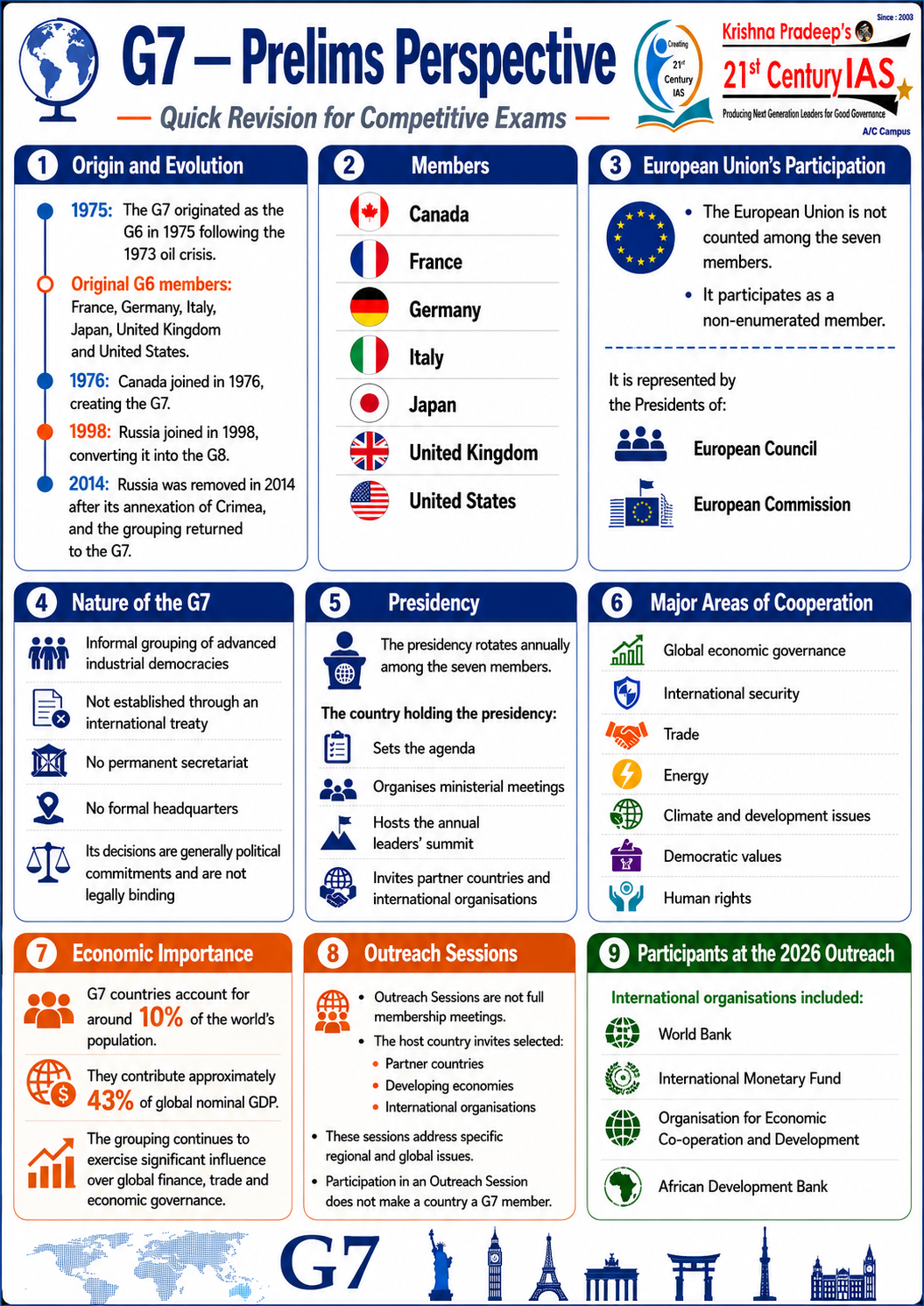
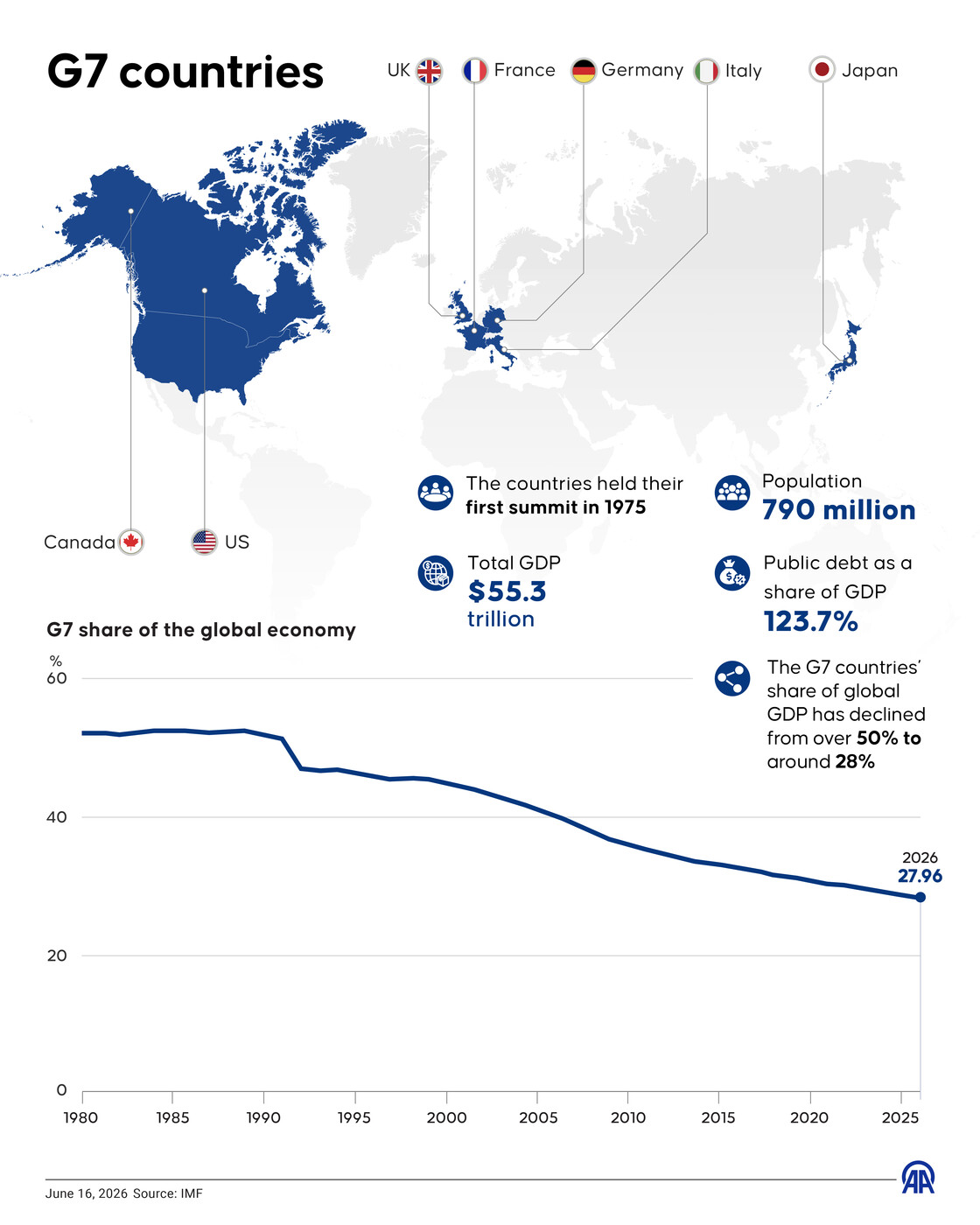
The Prime Minister of India attended the 52nd G7 Summit Outreach Session, 2026, held at Évian-les-Bains, France, under the theme:
“Forging New Partnerships and Rebuilding International Solidarity”
India used the summit to:
- Represent the concerns of the Global South
- Call for rebuilding trust in international relations
- Seek financial support for vulnerable developing countries
- Propose new connectivity and skilled-mobility partnerships
- Hold bilateral meetings with major global partners
India’s Core Message at the G7
Addressing the Global Trust Deficit
India described mutual trust as a critical strategic asset and argued that many global problems arise from a shortage of trust rather than resources.
Reforming the Development Model
India called for moving beyond the traditional donor–recipient approach towards partnerships based on:
- Equality
- Mutual respect
- Shared responsibility
- National ownership
Voice of the Global South
India stated that developing countries seek not merely assistance, but meaningful participation in global governance and development frameworks.
India–Africa Cooperation
India highlighted its partnership with Africa through targeted, high-impact initiatives based on South–South cooperation.
Global South and the West Asia Crisis
India warned that disruptions in fuel, fertiliser and food supply chains caused by the West Asia crisis would affect developing countries for a considerable period.
The disruption around the Strait of Hormuz affected supplies of:
- LPG
- LNG
- Diesel
- Petrol
- Fertilisers
India called upon international financial institutions to develop support mechanisms to help vulnerable countries:
- Absorb external shocks
- Maintain economic resilience
- Manage rising energy and food costs
- Avoid bearing the burden of wars alone
India stressed that economic growth must be examined through the questions:
- Growth for whom?
- Growth with whom?
- Growth in what direction?
India’s Inclusive Development Model
India presented its development experience as one based on:
“Sabka Saath, Sabka Vikas, Sabka Vishwas, Sabka Prayas”
It highlighted:
- Inclusive growth
- Development at scale
- Democratic empowerment
- Shared development
- Partnership with the Global South
India also referred to its G20 Presidency and the launch of the India–Middle East–Europe Economic Corridor as examples of cooperative development.
IMPACT Connectivity Proposal
India proposed an:
International Mobilisation Partnership for Accelerating Connectivity and Trade—IMPACT
The proposed partnership would combine:
- G7 capital
- India’s talent
- Ownership of Global South countries
It could support connectivity projects in:
- Africa
- Latin America
- Pacific Island countries
The proposal seeks to ensure that connectivity projects are based on partnership and local ownership.
Global Skills Partnership
India proposed a Global Skills Partnership to connect ageing developed economies with the young and skilled workforce of India and other Global South countries.
It would focus on:
- Skill mapping
- Trusted skilled mobility
- Legal migration channels
- Matching workers with labour-market needs
- Cooperation between ageing and youthful societies
The proposal builds on India’s mobility agreements with developed countries.
India–United States Meeting
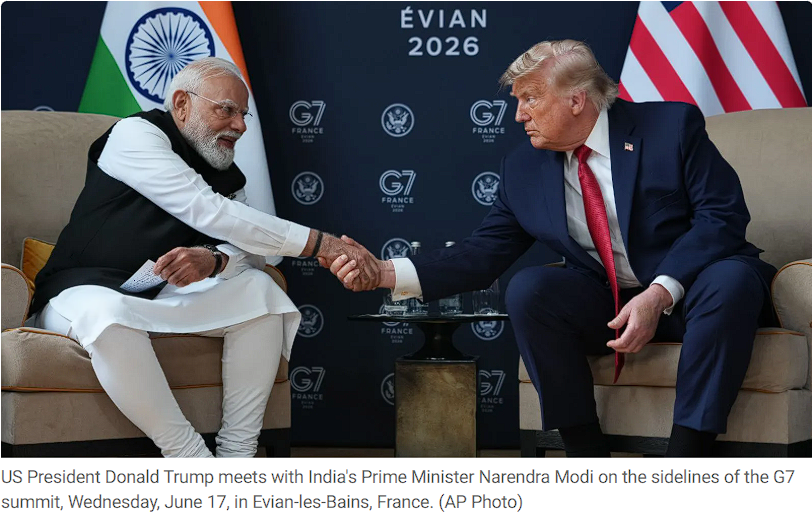
The Indian Prime Minister met US President Donald Trump on the sidelines of the summit.
Areas Reviewed
The two sides reviewed cooperation in:
- Trade
- Energy
- Defence
- Technology
- People-to-people relations
They also reviewed progress under the India–US COMPACT and reaffirmed their commitment to the Comprehensive Global Strategic Partnership.
Trade Relations
The US President stated that the two countries were close to concluding a trade deal and described the Indian Prime Minister as a tough negotiator.
Strait of Hormuz
India stressed that keeping the Strait of Hormuz open was vital for the global economy.
It also highlighted:
- Freedom of navigation
- Maritime trade
- Safety of civilians
- Protection of Indian seafarers
Skilled Professionals
The US President indicated continued opportunities for highly skilled Indian professionals.
India–Ukraine Meeting
The Indian Prime Minister met Ukrainian President Volodymyr Zelenskyy.
India reiterated that it would remain:
“On the side of peace, placing the values of humanity above everything else.”
The two leaders discussed:
- Restoration of trade to pre-war levels
- Industrial cooperation
- Joint projects
- Expansion of bilateral relations
- Mutually beneficial economic engagement
Both sides agreed that their teams would work on the details of proposed projects.
India–European Union Engagement
The Prime Minister met:
- European Council President António Costa
- European Commission President Ursula von der Leyen
India–EU Free Trade Agreement
The leaders welcomed the conclusion of negotiations for the India–EU Free Trade Agreement and stressed its early signing and implementation.
The agreement is expected to support:
- Trade
- Investment
- Supply-chain diversification
- Economic cooperation
The European Commission President stated that the agreement would be signed by the end of 2026.
Other Areas
India and the EU also agreed to:
- Accelerate work on an investment agreement
- Strengthen security and defence cooperation
- Advance the India–Middle East–Europe Economic Corridor
- Promote a resilient multipolar global order
India–Germany Engagement
German Chancellor Friedrich Merz invited the Indian Prime Minister to Germany for the 8th India–Germany Inter-Governmental Consultations later in 2026.
The leaders reviewed:
- Bilateral engagement
- Strategic partnership
- Recent progress in India–Germany relations
- India–EU economic cooperation
India–Canada Outcomes
Comprehensive Economic Partnership Agreement
- India and Canada agreed to expedite CEPA negotiations and aim to conclude them by the end of 2026.
- The objective is to double bilateral trade by 2030.
General Security of Information Agreement
- The two countries agreed to begin negotiations on a GSOIA to deepen defence and intelligence cooperation.
Raisina Americas
- The two sides announced Raisina Americas, a geopolitical platform intended to promote dialogue and Track 1.5 diplomatic exchanges.
IORA
- India expressed support for Canada becoming a Dialogue Partner of the Indian Ocean Rim Association.
Nuclear Energy Partnership
- The two sides advanced energy cooperation through a long-term uranium-supply agreement between Canada’s Cameco and India’s Department of Atomic Energy for the period 2027–2035.
India–United Kingdom Outcomes
The leaders reviewed bilateral relations under the India–UK Vision 2035 framework.
They reaffirmed their commitment to the early implementation of the Comprehensive Economic and Trade Agreement, with emphasis on:
- Technology
- Defence
- Education
- Trade cooperation
India–UAE Outcomes
Maritime Security
- India and the UAE expressed concern over disruptions in global trade and called for free and unimpeded navigation through the Strait of Hormuz.
BRICS Summit
- The Indian Prime Minister invited the UAE President to attend the 18th BRICS Summit, to be hosted by India later in 2026.
Significance for India
Voice of the Global South
- India used the summit to raise concerns relating to energy, food, fertilisers and financial resilience.
Connectivity Diplomacy
- The IMPACT proposal extends India’s emphasis on cooperative and locally owned connectivity.
Skilled Mobility
- The Global Skills Partnership can create legal pathways for Indian professionals.
Energy and Maritime Security
- India highlighted the strategic importance of the Strait of Hormuz and the safety of seafarers.
Trade Diplomacy
- Meetings with the US, EU, Canada and UK focused heavily on trade agreements and investment.
Strategic Autonomy
- India engaged with the US, Europe and Ukraine while continuing to advocate dialogue and peace.
Multipolar Global Order
- India supported a global system based on trust, shared values and the participation of developing countries.
Challenges
- Translating summit proposals into operational programmes
- Ensuring adequate financial support for vulnerable countries
- Restoring disrupted energy and food supply chains
- Protecting maritime trade routes
- Concluding and implementing multiple trade agreements
- Balancing relations among competing global powers
- Ensuring skilled mobility without encouraging brain drain
- Securing ownership of connectivity projects by Global South countries
- Maintaining peace amid continuing geopolitical conflicts
Way Forward
- Develop a clear institutional framework for IMPACT.
- Create financial-support mechanisms for crisis-affected developing countries.
- Strengthen international cooperation for freedom of navigation.
- Protect civilians and seafarers in conflict zones.
- Finalise trade and investment agreements within agreed timelines.
- Develop transparent and trusted skilled-mobility systems.
- Strengthen South–South cooperation.
- Ensure connectivity projects reflect local priorities.
- Continue diplomatic engagement in support of peace.
- Reform global institutions to provide greater representation to the Global South.
Conclusion
India’s participation in the G7 Summit 2026 demonstrated its expanding role as a representative of the Global South and a bridge between developed and developing countries.
India combined criticism of unequal global burden-sharing with constructive proposals such as IMPACT and the Global Skills Partnership. Its bilateral engagements also advanced trade, energy, defence, technology, connectivity and peace diplomacy.
The effectiveness of India’s outreach will depend on converting summit declarations into concrete financial, institutional and developmental outcomes.
Why in News?
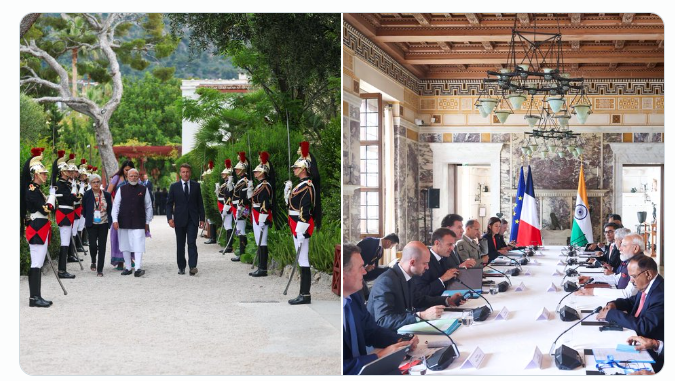
India and France adopted the Innovation Roadmap 2030 to deepen cooperation in AI, research, education, health, startups and space. It builds on the Horizon 2047 Roadmap and the India–France Year of Innovation 2026, following the elevation of ties to a Special Global Strategic Partnership on 17 February 2026.
Background
India’s Viksit Bharat 2047 vision and France’s France 2030 strategy provide the foundation for greater cooperation in innovation and emerging technologies.
The roadmap aims to:
- Promote co-development in critical and emerging technologies.
- Strengthen trusted technology ecosystems.
- Increase academic and research mobility.
- Support technological and industrial sovereignty.
- Develop solutions for people, the planet and shared prosperity.
 Major Pillars of the Roadmap
1. Partnership for Trusted Artificial Intelligence
India and France agreed to make trusted AI a central pillar of their innovation partnership.
The cooperation builds on:
- India–France Declaration on Artificial Intelligence, 2025
- AI Action Summit hosted by France in 2025
- AI Impact Summit hosted by India in 2026
Major Areas
- Development of safe, secure and trustworthy AI systems.
- Protection of democratic values and human rights.
- Prevention of discrimination and misinformation.
- Cooperation among regulators, standards bodies and technical experts.
- Risk-based governance of frontier and generative AI models.
- Promotion of innovation without affecting national development.
Child Safety Online
India and France will prioritise child safety in AI-enabled digital services.
The cooperation will include:
- Privacy-preserving age assurance.
- Safety-by-design architecture.
- Outcome-based safety standards.
- Protection of children from AI-related online risks.
Privacy-Preserving Data Sharing
India’s Data Empowerment and Protection Architecture—DEPA and France’s trusted data spaces and health-data platforms will support cooperation in:
- Research
- Healthcare
- Public services
- AI-based innovation
2. Academic Mobility and People-to-People Cooperation
India and France will strengthen cooperation in:
- STEM education
- Research partnerships
- Student mobility
- Talent mobility
- Institutional collaboration
- France aims to welcome 30,000 Indian students by 2030.
Mutual Recognition of Qualifications
France became the first country to conclude a Mutual Recognition of Qualifications agreement with India in 2018.
Both countries will work towards expanding the agreement to cover:
- More academic disciplines
- Regulated professions
- Emerging technology sectors
The expanded framework will support:
- Student mobility
- Dual-degree programmes
- Doctoral co-supervision
- Professional mobility
- Research collaboration
Indian and French institutions have also agreed to promote student exchanges and research partnerships.
3. Technological Sovereignty and Innovation-Led Growth
India and France will promote closer cooperation among:
- Governments
- Industries
- Startups
- Universities
- Research institutions
The aim is to build resilient and trusted supply chains in strategic sectors.
CEFIPRA
The Indo-French Centre for the Promotion of Advanced Research—CEFIPRA will continue to serve as a major platform for scientific cooperation.
Its role will be expanded towards:
- Innovation
- Co-development of technologies
- Scaling of strategically important technologies
India–France Innovation Network
- The India–France Innovation Network—IFIN will connect the innovation ecosystems of both countries.
- A joint Indo-French steering committee may be established to ensure its long-term governance.
Franco-Indian Campus in Life Sciences for Health
The Franco-Indian Campus in Life Sciences for Health—FIC-LSH will support cooperation in:
- Biomedical sciences
- Health research
- Academic collaboration
- Health innovation
Franco-Indian Campus for Aeronautics Training and Careers
- India and France will establish an aeronautical training campus in Kanpur.
- The campus will be developed in partnership with the Ministry of Skill Development and Entrepreneurship.
- It will promote training and skill development in the aeronautics sector.
India–France InnoXchange Bridge
- The proposed India–France InnoXchange Bridge will create a research and entrepreneurship corridor between the two countries.
It may provide startups and innovators with access to:
- Research laboratories
- Technology platforms
- Innovation clusters
- Investors
- Startup ecosystems
It will also support:
- Research residencies
- Innovation programmes
- Collaborative projects
- Soft-landing opportunities
Cooperation Among Small and Medium Enterprises
India and France will explore greater interaction between their small and medium enterprise ecosystems.
SMEs are recognised as important drivers of:
- Innovation
- Employment
- Inclusive economic growth
India–France Space Cooperation
India and France will strengthen cooperation between their public and private space ecosystems.
Two international space events will be held during the same week:
- Bengaluru Space Expo: 7–9 September, Bengaluru
- International Space Summit: 9–10 September, Paris
The countries will deepen cooperation in:
- Earth observation
- Human space exploration
- French Zero-G capabilities
- India’s proposed future space station in Low Earth Orbit
- Private-sector space collaboration
4. AI and Research-Based Health Solutions
India and France will develop consent-based systems for secure health-data sharing.
The cooperation builds upon the pilot project involving:
- India’s Indian Council of Medical Research—ICMR
- France’s Health Data Hub—HDH
The two countries will work with:
- Data intermediaries
- Technical standards bodies
- Regulators
- Research institutions
The aim is to create interoperable and rights-protecting data systems for:
- AI innovation
- Healthcare research
- Public-interest research
These models may later be expanded to other sectors and shared with interested countries, including those in the Global South.
Conclusion
The India–France Innovation Roadmap 2030 makes innovation a major pillar of the bilateral relationship. Guided by mutual trust, shared democratic values, strategic autonomy, open and inclusive innovation, and human-centric technological development, the Roadmap seeks to convert bilateral cooperation into practical outcomes in artificial intelligence, education, research, healthcare, startups, aeronautics and space.