Why in News?
The Prime Minister of India attended the 52nd G7 Summit Outreach Session, 2026, held at Évian-les-Bains, France, under the theme:
“Forging New Partnerships and Rebuilding International Solidarity”
India used the summit to:
- Represent the concerns of the Global South
- Call for rebuilding trust in international relations
- Seek financial support for vulnerable developing countries
- Propose new connectivity and skilled-mobility partnerships
- Hold bilateral meetings with major global partners
India’s Core Message at the G7
Addressing the Global Trust Deficit
India described mutual trust as a critical strategic asset and argued that many global problems arise from a shortage of trust rather than resources.
Reforming the Development Model
India called for moving beyond the traditional donor–recipient approach towards partnerships based on:
- Equality
- Mutual respect
- Shared responsibility
- National ownership
Voice of the Global South
India stated that developing countries seek not merely assistance, but meaningful participation in global governance and development frameworks.
India–Africa Cooperation
India highlighted its partnership with Africa through targeted, high-impact initiatives based on South–South cooperation.
Global South and the West Asia Crisis
India warned that disruptions in fuel, fertiliser and food supply chains caused by the West Asia crisis would affect developing countries for a considerable period.
The disruption around the Strait of Hormuz affected supplies of:
- LPG
- LNG
- Diesel
- Petrol
- Fertilisers
India called upon international financial institutions to develop support mechanisms to help vulnerable countries:
- Absorb external shocks
- Maintain economic resilience
- Manage rising energy and food costs
- Avoid bearing the burden of wars alone
India stressed that economic growth must be examined through the questions:
- Growth for whom?
- Growth with whom?
- Growth in what direction?
India’s Inclusive Development Model
India presented its development experience as one based on:
“Sabka Saath, Sabka Vikas, Sabka Vishwas, Sabka Prayas”
It highlighted:
- Inclusive growth
- Development at scale
- Democratic empowerment
- Shared development
- Partnership with the Global South
India also referred to its G20 Presidency and the launch of the India–Middle East–Europe Economic Corridor as examples of cooperative development.
IMPACT Connectivity Proposal
India proposed an:
International Mobilisation Partnership for Accelerating Connectivity and Trade—IMPACT
The proposed partnership would combine:
- G7 capital
- India’s talent
- Ownership of Global South countries
It could support connectivity projects in:
- Africa
- Latin America
- Pacific Island countries
The proposal seeks to ensure that connectivity projects are based on partnership and local ownership.
Global Skills Partnership
India proposed a Global Skills Partnership to connect ageing developed economies with the young and skilled workforce of India and other Global South countries.
It would focus on:
- Skill mapping
- Trusted skilled mobility
- Legal migration channels
- Matching workers with labour-market needs
- Cooperation between ageing and youthful societies
The proposal builds on India’s mobility agreements with developed countries.
India–United States Meeting
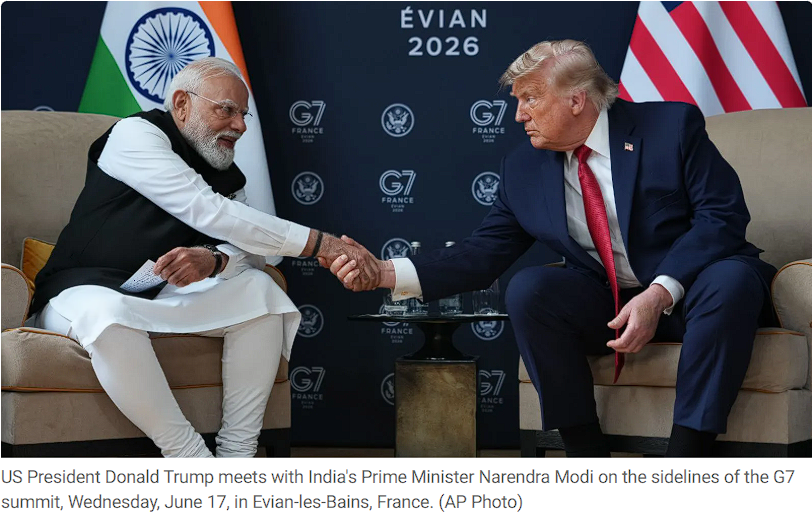
The Indian Prime Minister met US President Donald Trump on the sidelines of the summit.
Areas Reviewed
The two sides reviewed cooperation in:
- Trade
- Energy
- Defence
- Technology
- People-to-people relations
They also reviewed progress under the India–US COMPACT and reaffirmed their commitment to the Comprehensive Global Strategic Partnership.
Trade Relations
The US President stated that the two countries were close to concluding a trade deal and described the Indian Prime Minister as a tough negotiator.
Strait of Hormuz
India stressed that keeping the Strait of Hormuz open was vital for the global economy.
It also highlighted:
- Freedom of navigation
- Maritime trade
- Safety of civilians
- Protection of Indian seafarers
Skilled Professionals
The US President indicated continued opportunities for highly skilled Indian professionals.
India–Ukraine Meeting
The Indian Prime Minister met Ukrainian President Volodymyr Zelenskyy.
India reiterated that it would remain:
“On the side of peace, placing the values of humanity above everything else.”
The two leaders discussed:
- Restoration of trade to pre-war levels
- Industrial cooperation
- Joint projects
- Expansion of bilateral relations
- Mutually beneficial economic engagement
Both sides agreed that their teams would work on the details of proposed projects.
India–European Union Engagement
The Prime Minister met:
- European Council President António Costa
- European Commission President Ursula von der Leyen
India–EU Free Trade Agreement
The leaders welcomed the conclusion of negotiations for the India–EU Free Trade Agreement and stressed its early signing and implementation.
The agreement is expected to support:
- Trade
- Investment
- Supply-chain diversification
- Economic cooperation
The European Commission President stated that the agreement would be signed by the end of 2026.
Other Areas
India and the EU also agreed to:
- Accelerate work on an investment agreement
- Strengthen security and defence cooperation
- Advance the India–Middle East–Europe Economic Corridor
- Promote a resilient multipolar global order
India–Germany Engagement
German Chancellor Friedrich Merz invited the Indian Prime Minister to Germany for the 8th India–Germany Inter-Governmental Consultations later in 2026.
The leaders reviewed:
- Bilateral engagement
- Strategic partnership
- Recent progress in India–Germany relations
- India–EU economic cooperation
India–Canada Outcomes
Comprehensive Economic Partnership Agreement
- India and Canada agreed to expedite CEPA negotiations and aim to conclude them by the end of 2026.
- The objective is to double bilateral trade by 2030.
General Security of Information Agreement
- The two countries agreed to begin negotiations on a GSOIA to deepen defence and intelligence cooperation.
Raisina Americas
- The two sides announced Raisina Americas, a geopolitical platform intended to promote dialogue and Track 1.5 diplomatic exchanges.
IORA
- India expressed support for Canada becoming a Dialogue Partner of the Indian Ocean Rim Association.
Nuclear Energy Partnership
- The two sides advanced energy cooperation through a long-term uranium-supply agreement between Canada’s Cameco and India’s Department of Atomic Energy for the period 2027–2035.
India–United Kingdom Outcomes
The leaders reviewed bilateral relations under the India–UK Vision 2035 framework.
They reaffirmed their commitment to the early implementation of the Comprehensive Economic and Trade Agreement, with emphasis on:
- Technology
- Defence
- Education
- Trade cooperation
India–UAE Outcomes
Maritime Security
- India and the UAE expressed concern over disruptions in global trade and called for free and unimpeded navigation through the Strait of Hormuz.
BRICS Summit
- The Indian Prime Minister invited the UAE President to attend the 18th BRICS Summit, to be hosted by India later in 2026.
Significance for India
Voice of the Global South
- India used the summit to raise concerns relating to energy, food, fertilisers and financial resilience.
Connectivity Diplomacy
- The IMPACT proposal extends India’s emphasis on cooperative and locally owned connectivity.
Skilled Mobility
- The Global Skills Partnership can create legal pathways for Indian professionals.
Energy and Maritime Security
- India highlighted the strategic importance of the Strait of Hormuz and the safety of seafarers.
Trade Diplomacy
- Meetings with the US, EU, Canada and UK focused heavily on trade agreements and investment.
Strategic Autonomy
- India engaged with the US, Europe and Ukraine while continuing to advocate dialogue and peace.
Multipolar Global Order
- India supported a global system based on trust, shared values and the participation of developing countries.
Challenges
- Translating summit proposals into operational programmes
- Ensuring adequate financial support for vulnerable countries
- Restoring disrupted energy and food supply chains
- Protecting maritime trade routes
- Concluding and implementing multiple trade agreements
- Balancing relations among competing global powers
- Ensuring skilled mobility without encouraging brain drain
- Securing ownership of connectivity projects by Global South countries
- Maintaining peace amid continuing geopolitical conflicts
Way Forward
- Develop a clear institutional framework for IMPACT.
- Create financial-support mechanisms for crisis-affected developing countries.
- Strengthen international cooperation for freedom of navigation.
- Protect civilians and seafarers in conflict zones.
- Finalise trade and investment agreements within agreed timelines.
- Develop transparent and trusted skilled-mobility systems.
- Strengthen South–South cooperation.
- Ensure connectivity projects reflect local priorities.
- Continue diplomatic engagement in support of peace.
- Reform global institutions to provide greater representation to the Global South.
Conclusion
India’s participation in the G7 Summit 2026 demonstrated its expanding role as a representative of the Global South and a bridge between developed and developing countries.
India combined criticism of unequal global burden-sharing with constructive proposals such as IMPACT and the Global Skills Partnership. Its bilateral engagements also advanced trade, energy, defence, technology, connectivity and peace diplomacy.
The effectiveness of India’s outreach will depend on converting summit declarations into concrete financial, institutional and developmental outcomes.