Why Honey Bees Attack Humans — Risks, Triggers and Safety Measures
Table of Contents
Relevance: GS Paper III – Environment, Biodiversity, Disaster Management; GS Paper IV – Awareness & Behaviour
For Prelims:
- Apis dorsata (Giant Rock Bee), Swarm Behaviour, Defensive Mechanism in Bees, Pheromones, Anaphylaxis, Pollination, National Beekeeping and Honey Mission (NBHM), National Bee Board (NBB), Madhukranti Portal, Honey Production and Export, Waggle Dance
For Mains:
- Human-Wildlife Conflict, Behavioural Ecology of Pollinators, Apiculture Development in India, Role of Pollination in Agricultural Productivity, Rural Livelihood Diversification, Climate Change Impact on Pollinators, Disaster Management for Biological Hazards, Sustainable Agriculture and Integrated Farming Systems
Why in News?
Recent incidents of honeybee attacks across India have raised serious concerns, with fatalities reported in states like Uttar Pradesh, Gujarat, and Maharashtra. The Uttar Pradesh government is considering classifying bee attacks as a state-notified disaster, highlighting the growing public safety risk.
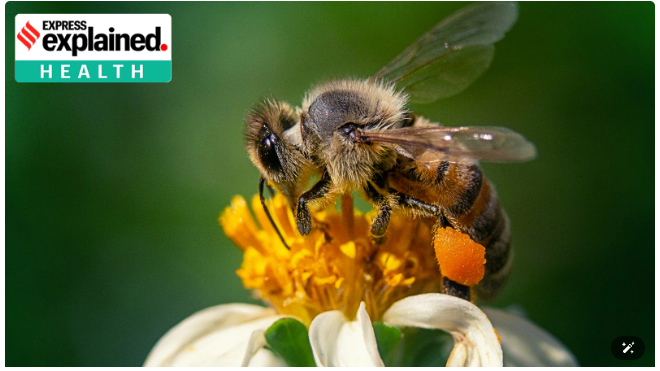
Understanding Honeybee Behaviour
Contrary to popular belief, honeybees do not attack humans unprovoked. They sting only when they perceive a threat to their colony.
- Bees act as defensive organisms, not aggressive predators
- A single sting leads to the death of the bee, making it a last-resort defence
- Colonies behave collectively, mobilising large numbers when threatened
National Beekeeping & Honey Mission (NBHM)
- NBHM is a Central Sector Scheme.
- It aims to promote scientific beekeeping for the holistic growth of the beekeeping sector.
- Its broader objective is to bring about the “Sweet Revolution”.
Implementation
- The mission has a total budget outlay of ₹500 crore.
- It is being implemented for the period FY 2020–21 to FY 2025–26.
- The National Bee Board (NBB) is implementing the mission.
Structure of the Mission
- NBHM is implemented through 3 Mini Missions.
- These focus on:
- Productivity improvement
- Post-harvest management
- Research and technology generation
Production and Export
- In 2024, India produced about 1.4 lakh metric tonnes (MT) of natural honey.
- India exported about 1.07 lakh metric tonnes (MT) of natural honey in FY 2023–24.
- The value of these exports was USD 177.55 million.
- India became the second-largest exporter of honey globally.
- Its global rank improved from 9th rank in 2020.
Important Portal
- Madhukranti portal has been launched.
- It is meant for:
- Online registration
- Traceability of the source of honey and other bee products
Species Responsible for Most Attacks
The majority of incidents are linked to the Apis dorsata (Giant Rock Bee).
Key Characteristics:
- Builds large open hives on cliffs, trees, forts
- A colony may contain up to 60,000 bees
- Highly defensive and capable of mass attacks
- Can chase targets over long distances at speeds of ~35 km/h
These bees are commonly found near hill forts, trekking routes, and forested areas.
What Triggers Bee Attacks?
Bee attacks are usually caused by human interference rather than natural aggression.
Common Triggers
- Throwing stones at hives
- Flying drones near colonies
- Loud noises or shouting
- Lighting fires or smoking near hives
- Strong smells (perfumes, oils, incense)
- Taking selfies close to hives
- Crowding narrow trails where nests are hidden
Seasonal Factor:
Bees are more aggressive during summer, when colonies are larger and honey storage is at its peak.
How Dangerous Are Bee Attacks?
The risk depends on the number of stings and individual health conditions.
Health Impacts
- Single sting: Pain, swelling (usually manageable)
- Multiple stings: Can cause toxic shock
- Allergic individuals: Risk of Anaphylaxis, a life-threatening reaction
High-Risk Groups
- Children
- Elderly persons
- People with allergies or comorbidities
In remote areas like forts or trekking routes, delay in medical help increases fatality risk.
Preventive Measures (Before an Attack)
To avoid provoking bees:
- Avoid perfumes, scented lotions, and oils
- Stay alert for buzzing sounds near cliffs or trees
- Maintain distance from visible hives
- Avoid loud noises and sudden movements
- Do not attempt photography or disturb colonies
- Avoid lighting fires near forested or rocky areas
What to Do During a Bee Attack
Immediate Actions
- Run quickly toward a closed space (room, vehicle)
- If escape is not possible, cover face and vital organs
- Do not swat bees (this releases pheromones attracting more bees)
First Aid After a Sting
- Remove stingers by scraping sideways (not pinching)
- Apply ice packs to reduce swelling
- Avoid scratching the area
Seek Immediate Medical Help If:
- Multiple stings are received
- Victim is a child or elderly
- Symptoms of anaphylaxis appear:
- Difficulty breathing
- Throat swelling
- Dizziness or vomiting
Benefits of Beekeeping
- Pollination Support: Bees contribute to pollinating nearly one-third of the food crops we consume, including fruits, vegetables, and nuts, thereby playing a vital role in ensuring food security.
- Higher Agricultural Productivity: Effective pollination by bees enhances both the quality and yield of crops such as apples, almonds, and berries.
- Source of Rural Livelihoods: Beekeeping provides a cost-effective and accessible income-generating opportunity for rural populations through the production and sale of honey, beeswax, and related products.
- Ecological Sustainability: It promotes biodiversity conservation and helps maintain ecological balance by supporting healthy ecosystems.
- Diverse Value-Added Products: Beyond honey, bees produce economically and medicinally important substances such as royal jelly, propolis, and bee venom.
Challenges in the Development of Apiculture in India
1. Inadequate Awareness and Training
A large number of prospective beekeepers lack proper knowledge of scientific beekeeping practices, including hive management, disease control, and efficient honey extraction methods.
2. Limited Access to Resources
Availability of essential apiculture inputs such as bee colonies, modern hives, and protective equipment remains restricted in several regions, particularly in rural areas, thereby constraining expansion.
3. Climate Variability
Unpredictable climatic conditions, including irregular rainfall and extended droughts, adversely affect the foraging behaviour of honeybees, disturb flowering cycles, and reduce honey yield.
4. Pest and Disease Incidence
Bee colonies are vulnerable to various pests and diseases such as Varroa mites, Nosema infection, and foulbrood, leading to colony losses and reduced productivity.
5. Excessive Use of Agro-Chemicals
Indiscriminate use of pesticides and chemicals in agriculture contaminates nectar sources and weakens bee immunity, posing a serious threat to bee populations.
6. Market-Related Constraints
Fluctuating prices, competition from imported honey, and inadequate market infrastructure negatively impact the profitability and sustainability of beekeeping activities
Conclusion
Honeybee attacks are largely preventable incidents arising from human disturbance. Understanding bee behaviour, avoiding triggers, and following safety protocols can significantly reduce risks.
As human interaction with natural ecosystems increases, promoting awareness, responsible tourism, and ecological sensitivity becomes essential to ensure both human safety and conservation of pollinators.
UPSC PYQ
Q. The “Triple Test” to determine the status of an ‘Industry’ was established in which of the following landmark cases?
Which of the following organisms perform waggle dance for others of their kin to indicate the direction and the distance to a source of their food?
(IAS Prelims 2023)
A. Butterflies
B. Dragonflies
C. Honeybees
D. Wasps
Answer: C
Explanation
The waggle dance is a unique and sophisticated communication method used by honeybees (Apis mellifera) to inform other members of the hive about the location of food sources.
Key Features of Waggle Dance
- Direction Indication
- The angle of the waggle run (relative to the vertical hive surface) shows the direction of food with respect to the Sun.
- Distance Indication
- The duration of the waggle phase represents the distance:
- Longer waggle → farther food source
- Shorter waggle → nearer source
- The duration of the waggle phase represents the distance:
- Pattern
- The bee moves in a figure-eight pattern, repeating waggle runs.
Scientific Importance
- This behavior was decoded by Karl von Frisch, who received the Nobel Prize for this discovery.
CARE MCQ
Q. Consider the following statements regarding the National Beekeeping and Honey Mission (NBHM):
I. NBHM is a Central Sector Scheme.
II. The scheme is implemented by the National Bee Board (NBB) under the Ministry of Agriculture.
III. NBHM was launched as part of the Green Revolution to increase food grain production.
How many of the above statements are correct?
A. Only one
B. Only two
C. All the three
D. None
Answer: B
Explanation:
- Statement I – Correct: NBHM is a Central Sector Scheme launched to promote scientific beekeeping and increase the production of quality honey and bee products.
- Statement II – Correct: The scheme is implemented through the National Bee Board (NBB), which works under the Ministry of Agriculture and Farmers’ Welfare.
- Statement III – Incorrect: NBHM is part of the “Sweet Revolution”, not the Green Revolution. It focuses on apiculture and honey production, not food grains.
Hence, option (b) is correct.
Additional Information:
- NBHM was launched under the umbrella of Atmanirbhar Bharat Abhiyan.
- It promotes integrated farming systems, where beekeeping supports agriculture through pollination, increasing crop yields.
- It also enhances farmers’ income by providing additional products like beeswax, bee pollen, propolis and royal jelly.