Table of Contents
Relevance: APPSC: Andhra Pradesh geography and irrigation projects
Veligonda Project, Krishna River, Srisailam Reservoir, Nallamala Sagar, Gravity Flow, Ayacut, Fluoride Contamination, Groundwater Recharge
Why in News?
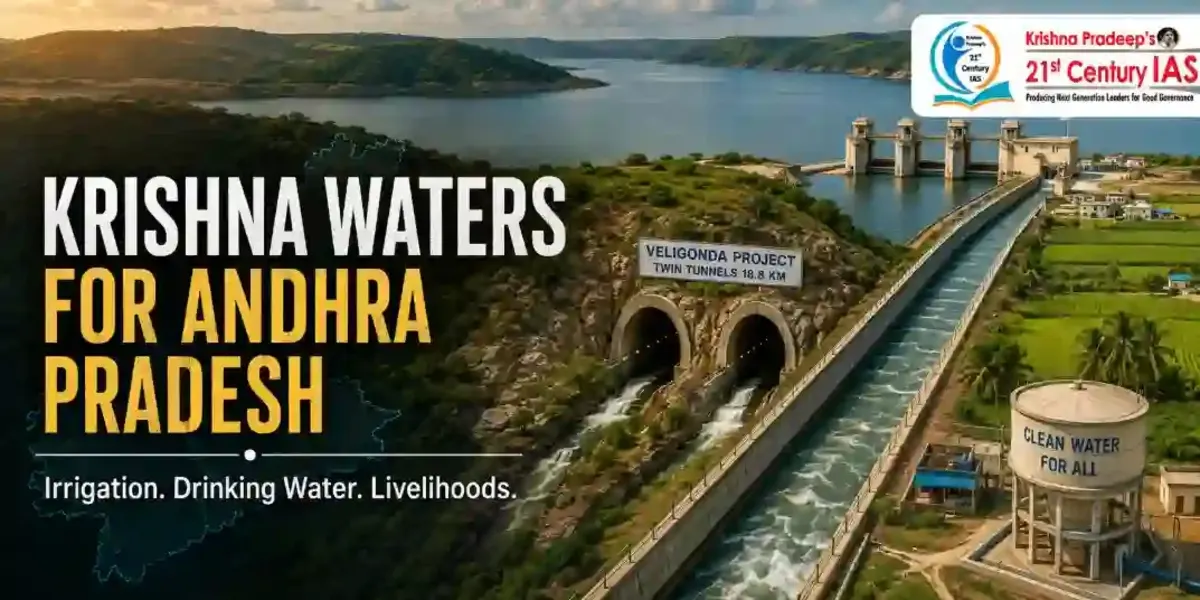
Phase I of the Veligonda Project is scheduled to be inaugurated at Markapuram on August 31, 2026. The ₹10,200-crore project seeks to supply Krishna water to the drought-affected areas of Prakasam, Nellore and Kadapa districts for irrigation and drinking purposes.
Background
The foundation stone for the Veligonda Project was laid on March 5, 1996. Nearly three decades later, its first phase is set to become operational.
The project was conceived to address the major problems faced by western Prakasam and neighbouring regions, including:
- recurring crop failures;
- uncertain rainfall;
- fluoride-contaminated groundwater;
- drinking-water shortages;
- dependence on borewells; and
- migration caused by limited livelihood opportunities.
About the Veligonda Project
| Particular | Details |
| Estimated cost | ₹10,200 crore |
| Source of water | Krishna River |
| Intake location | Foreshore of Srisailam Reservoir |
| Destination reservoir | Nallamala Sagar |
| Water allocation | 10.70 TMC |
| Method of transfer | Gravity flow through twin tunnels |
| Total ayacut | 4.47 lakh acres |
| Coverage | 30 mandals |
| Beneficiary districts | Prakasam, Nellore and Kadapa |
| Overall drinking-water target | Nearly 23 lakh people in fluoride-affected areas, in phases |
What Is an Ayacut?
An ayacut is the agricultural area that receives irrigation from a canal, reservoir or irrigation project.
Project Infrastructure
Twin Tunnels
The project will convey Krishna water by gravity from the foreshore of the Srisailam Reservoir to Nallamala Sagar.
- It contains two tunnels.
- Their combined length is 18.8 km.
- Gravity-based conveyance allows water to move without depending entirely on mechanical lifting.
Canal Network
The distribution system includes:
- 21.8 km of feeder canals;
- Teegaleru Main Canal;
- Gottipadiya Main Canal; and
- Eastern Main Canal.
These canals will carry stored water from Nallamala Sagar to the intended agricultural and drinking-water areas.
District-Wise Irrigation Coverage
| Region | Proposed ayacut |
| Erstwhile Prakasam district | 3.36 lakh acres |
| Nellore district | 84,000 acres |
| Kadapa district | 27,200 acres |
| Total | Approximately 4.47 lakh acres |
The largest share of the irrigation benefit is intended for the drought-prone areas of the erstwhile Prakasam district.
Regional Development Strategy
Horticulture Hub
- The government plans to develop Rayalaseema and the erstwhile Prakasam district as a horticulture hub, supported by proposed investments of ₹1 lakh crore.
- Irrigation from the Veligonda Project is expected to provide the water base required for this development.
Transport and Logistics
The following infrastructure projects are expected to improve connectivity:
- national highways;
- Bengaluru–Amaravati Highway; and
- Ramayapatnam Port.
Improved connectivity can help transport agricultural and processed products to wider markets and create opportunities for industrial and commercial growth.
Conclusion
The Veligonda Project seeks to address the interconnected problems of drought, unsafe drinking water, agricultural instability and migration. By carrying Krishna water from the Srisailam Reservoir to Nallamala Sagar, it can strengthen water security and create new opportunities for agriculture, horticulture, processing and employment in Prakasam, Nellore and Kadapa districts.
CARE MCQ
Q1. Consider the following statements regarding the Veligonda Project:
- It draws Krishna water from the Srisailam Reservoir.
- It transfers water to Nallamala Sagar through twin tunnels.
- It is primarily designed as a lift-irrigation project.
Which of the statements given above are correct?
(a) 1 only
(b) 1 and 2 only
(c) 2 and 3 only
(d) 1, 2 and 3
Answer: (b) 1 and 2 only
Explanation:
- Statement 1 is correct: Krishna water is drawn from the foreshore of the Srisailam Reservoir.
- Statement 2 is correct: The water is carried through twin tunnels to Nallamala Sagar.
- Statement 3 is incorrect: Water is conveyed by gravity rather than primarily through lift irrigation.
FAQs
1. From where will the Veligonda Project receive water?
It will receive Krishna water from the foreshore of the Srisailam Reservoir.
2. How will the water reach Nallamala Sagar?
Water will be conveyed by gravity through two tunnels with a combined length of 18.8 km.
3. How much land will receive irrigation?
The entire project envisages irrigating approximately 4.47 lakh acres across 30 mandals.
4. What are the benefits under Phase I?
Phase I will provide irrigation to 1.19 lakh acres and drinking water to four lakh people.
5. Which districts will benefit?
The project will benefit areas in Prakasam, Nellore and Kadapa districts.
6. How will it address fluoride contamination?
It will supply safe drinking water to fluoride-affected areas, with household tap connections planned.