Why in News?
Western and Central Europe are experiencing a severe heatwave caused by a persistent high-pressure system known as an Omega Block.
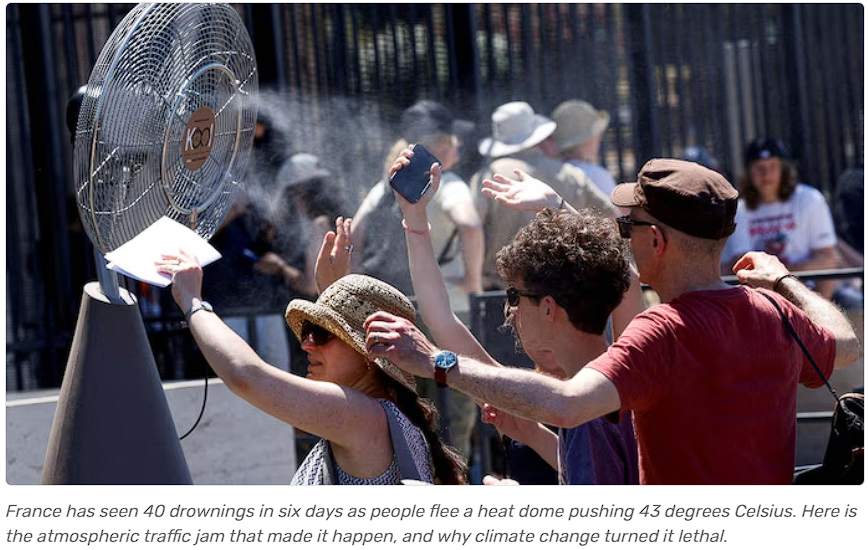
France has reported at least 18 direct heat-related deaths and 40 drownings, as people entered rivers, lakes and unsupervised coastal areas to escape extreme temperatures.
Several European countries, including France, the United Kingdom, Spain and Italy, have issued heat alerts, while schools, transport services and power systems have faced disruptions.
What is an Omega Block?
An Omega Block is a persistent atmospheric pattern in which a high-pressure system becomes positioned between two low-pressure systems.
On a weather map, the airflow resembles the Greek letter Omega (Ω).
Role of the Jet Stream
The jet stream is a narrow band of strong winds flowing from west to east in the upper atmosphere. It normally moves weather systems across Europe.
During an Omega Block:
- The jet stream becomes highly curved.
- A high-pressure ridge becomes stationary.
- Low-pressure systems remain on either side.
- Normal movement of weather systems is interrupted.
The result is an atmospheric “traffic jam” in which the same weather conditions remain over a region for several days.
How Does a Heat Dome Develop?
The central high-pressure system draws warm and dry air from North Africa towards Europe.
Under this high pressure:
- Air sinks towards the surface.
- Sinking air is compressed and becomes warmer.
- Cloud formation is suppressed.
- Prolonged sunshine further heats the land.
- Warm surface air cannot rise and disperse.
The trapped mass of hot air acts like a lid over the atmosphere. This condition is commonly described as a heat dome.
Thus, the Omega Block refers to the broader atmospheric pattern, while the heat dome describes the trapping and intensification of hot air beneath the high-pressure ridge.

Why is Europe Experiencing Extreme Heat?
Saharan Air Intrusion
The stationary high-pressure system is pulling hot, dry air northward from the Sahara and trapping it over Europe.
Prolonged Sunshine
Clear skies allow continuous solar heating during the day.
Weak Atmospheric Circulation
The disrupted jet stream prevents cooler weather systems and Atlantic air from reaching affected regions.
Warm Nights
Night-time temperatures have remained unusually high. When buildings and the human body cannot cool after sunset, heat stress accumulates over successive days.
Urban Heat Island Effect
Concrete, asphalt and dense construction absorb heat during the day and release it at night, making cities hotter than surrounding rural areas.
Why Has the Heatwave Become Deadly?
Infrastructure Designed for Cold Weather
Much of Europe’s housing, transport and public infrastructure was developed for historically temperate or cold conditions.
Homes often use:
- Thick stone
- Brick
- Concrete
- Heavy insulation
These materials retain indoor warmth during winter but can trap heat during summer.
Limited Air Conditioning
Household air conditioning remains uncommon in several European countries because prolonged extreme heat was historically rare.
Long Summer Daylight
Western Europe experiences long daylight hours during summer, allowing buildings and urban surfaces to absorb heat for extended periods.
Vulnerable Population
Older persons, children and people with existing health conditions face higher risks from dehydration, heat exhaustion and heatstroke.
Unsafe Search for Relief
The high number of drownings in France reflects people entering unsupervised water bodies without adequate knowledge of currents, depth or swimming safety.
The event therefore demonstrates that heat-related mortality includes not only direct heatstroke deaths but also indirect behavioural and infrastructural consequences.
How is Climate Change Intensifying the Event?
Omega Blocks and European heatwaves occurred before modern climate change. However, human-induced warming has increased the temperature upon which such natural weather patterns operate.
Europe has been warming at more than twice the global average rate, making it the world’s fastest-warming continent.
The current heatwave is estimated to be several degrees hotter than it would have been without human-caused climate change.
Amplification Effect
Climate change does not necessarily create every blocking pattern. Instead, it intensifies its consequences:
- Higher baseline temperatures
- More severe heat peaks
- Longer-lasting heatwaves
- Warmer nights
- Greater wildfire risk
- Increased pressure on health and infrastructure
A weather system that once produced an uncomfortable week can now produce a lethal emergency.
What Role Does the Albedo Effect Play?
Albedo refers to the ability of a surface to reflect sunlight.
Bright ice reflects a large share of solar energy. However, as Arctic ice melts, darker ocean water is exposed.
Dark water absorbs more heat than ice, contributing to further warming. Since the Arctic is warming faster than any other region, these changes can influence neighbouring Europe and reinforce regional warming.
What is Climate Whiplash?
Climate whiplash refers to rapid shifts between contrasting extreme weather conditions, such as:
- Hot and cold
- Wet and dry
- Drought and intense rainfall
Europe experienced below-normal temperatures shortly before unusually intense heat developed.
Such abrupt fluctuations are becoming increasingly common as climate change disrupts established atmospheric and seasonal patterns.
What are the Wider Impacts of the Heatwave?
Public Health
Extreme heat increases the risk of:
- Heat exhaustion
- Heatstroke
- Dehydration
- Cardiovascular stress
- Respiratory problems
Education
Schools have been closed or forced to modify schedules because buildings cannot maintain safe indoor temperatures.
Transport
Rail services may slow down because heat can affect tracks, power systems and other infrastructure.
Electricity
High electricity demand and power failures can worsen indoor heat exposure, especially where cooling systems are already limited.
Agriculture
Farmers have shifted harvesting to night-time hours to protect workers and crops from extreme daytime heat.
Wildfires
Hot, dry and windy conditions increase wildfire risk across Spain, Italy and other affected regions.
Urban Services
Libraries, museums, cinemas and community buildings have been used as temporary cooling shelters for vulnerable people.
When is Relief Expected?
Forecasts suggested that conditions would begin easing gradually as the Omega Block weakened and the jet stream resumed its normal west-to-east movement.
However, heat stored in buildings, soil and urban surfaces does not disappear immediately. Even after atmospheric conditions change, temperatures may remain uncomfortable for several days.
Authorities have therefore continued:
- Heat alerts
- Cooling-centre operations
- Public-health advisories
- Warnings against swimming in unsupervised waters
What Does the Emerging El Niño Mean for India?
An El Niño phase is developing in the equatorial Pacific Ocean.
El Niño refers to the unusual warming of surface waters in the central and eastern equatorial Pacific. It can influence weather patterns across the world.
Possible Implications for India
- Increased probability of below-normal monsoon rainfall
- Higher likelihood of prolonged heatwaves
- Greater stress on agriculture and water resources
- Possible weakening of rainfall during the later monsoon months
Historical records show that many El Niño years have been associated with below-normal Indian monsoons.
However, the relationship is probabilistic rather than deterministic. El Niño increases the likelihood of certain outcomes but does not guarantee them.
What Lessons Does the Heatwave Offer?
Adaptation Must Match Changing Climate Risks
- Past weather patterns can no longer be treated as a reliable basis for designing infrastructure.
Heat is a Multi-Sectoral Disaster
- Extreme heat affects health, housing, transport, electricity, education, agriculture and water safety simultaneously.
Night-Time Heat Matters
- Heat action plans should monitor minimum temperatures because hot nights prevent physical and urban recovery.
Local Preparedness Determines Impact
- The same temperature can produce different outcomes depending on housing design, cooling access, public awareness and emergency systems.
Indirect Deaths Must Be Recognised
- Drownings, workplace accidents and power failures may be linked to extreme heat even when heatstroke is not the immediate cause.
Way Forward
Climate-Resilient Buildings
- European cities need ventilation, shading, reflective materials and passive-cooling systems suited to hotter summers.
Urban Cooling
Cities should expand:
- Tree cover
- Green spaces
- Cool roofs
- Shaded public areas
- Water-sensitive urban planning
Stronger Heat Action Plans
- Warnings should be linked with local emergency response, outreach to vulnerable groups and real-time health monitoring.
Public Cooling Infrastructure
- Libraries, schools, museums and community halls can serve as accessible cooling centres.
Water-Safety Measures
- Supervised swimming facilities, trained lifeguards and clear warnings are essential during heat emergencies.
Infrastructure Upgradation
- Power grids, railways, schools and healthcare facilities must be redesigned for recurring extreme-heat conditions.
Climate Mitigation
- Long-term resilience requires reducing greenhouse-gas emissions alongside immediate adaptation.
Conclusion
Europe’s 2026 heatwave illustrates how a natural atmospheric blocking pattern can become far more dangerous in a warming climate. The Omega Block trapped Saharan air over a continent whose buildings, public services and lifestyles were designed for cooler conditions.
The crisis is therefore not only a weather event but also an adaptation failure. As heatwaves become more frequent and intense, countries must redesign infrastructure, strengthen public-health systems and treat extreme heat as a major disaster-management challenge.
Why in News?
The Union Ministry of Home Affairs has issued two notifications tightening the regulation of foreign contributions received by NGOs and associations under the Foreign Contribution Regulation Act.
The changes:
- Link FCRA registration to specified purposes.
- Restrict activities to approved States or Union Territories.
- Explicitly exclude proselytisation from permitted religious activities.
- Expand reporting and disclosure requirements.
- Tighten conditions for renewal and utilisation of funds.
- Revise penalties for misuse and diversion of foreign contributions.
Separately, the FCRA Amendment Bill, 2026 proposes a designated authority to manage foreign-funded assets when an organisation’s registration is cancelled, surrendered or ceases to remain valid.
What is the FCRA?
The Foreign Contribution Regulation Act regulates the acceptance and utilisation of foreign donations and foreign hospitality by individuals, associations and organisations in India.
Historical Evolution
- FCRA, 1976: Enacted amid concerns that foreign powers could influence Indian affairs through financial support to independent organisations.
- FCRA, 2010: Replaced the earlier law and consolidated provisions regulating foreign contributions.
- Subsequent amendments: The law was amended in 2016, 2018 and 2020.
- 2020 amendment: Strengthened government control and scrutiny over the receipt and use of foreign funds.
The central objective is to ensure that foreign contributions are not used in a manner detrimental to:
- National interest
- Sovereignty
- Public order
- Security
- The values of a sovereign democratic republic
How Does the Existing FCRA System Operate?
An NGO or association seeking foreign contribution must obtain either:
- FCRA registration, or
- Prior permission for a specific donor, amount and project.
Major Conditions
An organisation receiving foreign contribution must:
- Receive the funds through the designated State Bank of India account in New Delhi.
- Use the contribution only for the approved purpose.
- File annual returns.
- Maintain prescribed financial records.
- Follow the statutory limit on administrative expenses.
- Not transfer the contribution to another NGO.
Who Cannot Receive Foreign Contributions?
The law prohibits foreign contributions to categories including:
- Election candidates
- Political parties and their office-bearers
- Members of legislatures
- Judges
- Government servants
- Journalists
- Newspaper and broadcast-media companies
- Organisations of a political nature
New FCRA Notifications
What Does the First Notification Provide?
- The first notification amends the Foreign Contribution (Regulation) Rules, 2011.
Purpose-Specific Registration
- Organisations must select their activities from a government-prescribed Schedule containing 105 permissible purposes.
- Foreign funds can be used only for the activities included in the organisation’s registration.
Geography-Linked Approval
- FCRA registration must now specify the States or Union Territories where the organisation is authorised to operate.
- An organisation cannot freely extend foreign-funded activities to another State or Union Territory without approval.
Transition for Existing Organisations
Existing FCRA-registered associations have been given one year to identify:
- The purposes they wish to retain.
- The geographical areas in which they intend to continue operating.
Any later expansion will require fresh government approval.
How Has the Definition of “Key Functionary” Changed?
The rules now define “key functionary” more broadly.
The expression includes:
- Directors of companies
- Partners in firms
- Trustees
- Karta of a Hindu Undivided Family
- Office-bearers
- Members of governing bodies
- Any person controlling or managing the affairs of an association
This enables wider scrutiny of those who exercise actual influence over an organisation, even when they do not hold the title of chief functionary.
What Other Compliance Requirements Have Been Introduced?
Foreign Nationals in Management
- Organisations having foreign nationals in important management positions will ordinarily face restrictions in obtaining registration or prior permission.
Minimum Utilisation Requirement
The government has introduced a minimum utilisation threshold that may be considered while deciding:
- Renewal of registration
- Cancellation
- Continued eligibility to receive foreign funds
Release of Subsequent Instalments
- Conditions have been tightened for releasing further instalments of foreign contributions, particularly in cases involving prior permission.
Enhanced Annual Disclosures
Organisations must provide more extensive information, including:
- Detailed activity reports
- Social-media account details
- Information about ultimate donors
- Details of donor-advised funds
- Information regarding intermediary funding arrangements
These requirements seek to expose the complete flow of money rather than only the immediate donor.
How Do the New Rules Differ from the 2011 Framework?
Earlier Framework
Under the 2011 Rules, organisations broadly identified themselves as carrying out:
- Cultural
- Economic
- Educational
- Religious
- Social activities
Registration was largely connected with broad programmes.
New Framework
The revised system is more prescriptive because:
- Organisations must choose from an approved list of activities.
- Registration is tied to each permitted purpose.
- Geographical areas become part of the licence.
- Expansion in purpose or area requires approval.
- Management structures and donor chains face deeper scrutiny.
The framework therefore shifts from broad, programme-based permission to purpose-specific and geography-specific regulation.
Religious Conversion and FCRA
Why Has Proselytisation Been Specifically Excluded?
The revised Schedule repeatedly uses the phrase “excluding proselytisation” while listing permissible religious activities.
Foreign contributions may continue to support activities such as:
- Religious education
- Theological study
- Preservation of religious traditions
- Religious gatherings
- Faith-based social activities
However, foreign funds cannot be used for conversion-oriented or proselytising activities.
The government is therefore drawing a distinction between:
- Supporting religious practice and education, and
- Financing efforts aimed at converting individuals to another religion.
What is the Constitutional Position?
Article 25
Article 25 of the Constitution guarantees freedom of conscience and the right to:
- Profess religion
- Practise religion
- Propagate religion
However, this freedom is subject to:
- Public order
- Morality
- Health
- Other Fundamental Rights
Rev. Stainislaus Case, 1977
In Rev. Stainislaus v. State of Madhya Pradesh, the Supreme Court held that the right to propagate religion does not include a Fundamental Right to convert another person.
The judgment distinguished between:
- Communicating or explaining one’s faith, and
- Converting another person through force, fraud or inducement.
By excluding proselytisation, the government seeks to prevent foreign contributions from financing conversion-oriented activities.
Why is the Conversion Issue Politically Sensitive?
Foreign-funded religious organisations have long faced allegations of involvement in conversion activities.
Several Christian and faith-based institutions have previously faced FCRA-related action, including:
- Missionaries of Charity
- Compassion International
- World Vision India
- Evangelical Fellowship of India
- Organisations connected with the Church of North India
The government has maintained that regulatory action was based on specific violations of FCRA provisions.
Critics, however, have alleged that some actions disproportionately affect Christian institutions and organisations serving minority communities.
The issue therefore lies at the intersection of:
- Religious freedom
- Foreign influence
- National interest
- Minority rights
- Regulatory accountability
Revised Penalties
What Does the Second Notification Provide?
- The second notification revises compounding penalties under Section 41(1) of the FCRA.
- Compounding allows an organisation to settle specified violations by paying a prescribed penalty instead of immediately facing full criminal prosecution.
Excess Administrative Expenditure
Foreign contribution spent beyond the statutory 20% administrative-expense limit will attract:
- ₹1 lakh, or
- 5% of the excess expenditure,
whichever is higher.
Speculative Investment
Using foreign contributions for speculative activities, including stock-market investments, will attract:
- ₹1 lakh, or
- 30% of the amount invested,
whichever is higher.
Returns earned from such investments may also be recovered.
Diversion of Funds
Using foreign contribution for purposes other than those for which it was received will attract:
- ₹1 lakh, or
- 30% of the amount involved,
whichever is higher.
Unapproved Purpose or Geography
Receiving or using foreign funds for:
- An activity not included in registration, or
- A State or Union Territory not authorised by the registration,
will invite similar penalties.
Significance
The revised system:
- Raises the financial cost of non-compliance.
- Encourages strict adherence to approved purposes.
- Provides a structured settlement mechanism.
- Reduces the need for criminal prosecution in compoundable cases.
Why Does the Government Consider the Changes Necessary?
Closing Compliance Gaps
- Officials argue that the previous system could not adequately establish whether funds were used strictly for approved programmes.
Tracking Geographic Use
- Making geography part of the licence allows the government to monitor where foreign-funded activities are being conducted.
Following the Ultimate Donor
- Disclosures relating to intermediary entities and donor-advised funds can help uncover the real source of foreign contributions.
Monitoring Influence Networks
- Social-media disclosures and detailed activity reports may allow authorities to assess both financial flows and organisational outreach.
Preventing Diversion
- Higher penalties and purpose-specific approvals seek to prevent the use of funds for unauthorised activities.
Managing Foreign-Funded Assets
The government has cited legal uncertainty over assets acquired through foreign funds when an organisation’s registration:
- Expires
- Is cancelled
- Is surrendered
- Ceases for another reason

FCRA Amendment Bill, 2026
What Does the Bill Propose?
The proposed amendment creates a designated authority appointed by the Central government.
This authority would control, supervise and manage foreign contributions and assets when an FCRA certificate:
- Is cancelled
- Is surrendered
- Expires
- Otherwise ceases to remain valid
The proposal seeks to replace the existing Section 15 framework.
When Would a Registration Be Deemed to Have Ceased?
The certificate may be treated as having ceased when:
- No renewal application is submitted.
- The renewal application is rejected.
- Renewal is not obtained before the certificate expires.
The designated authority would then take control of the unutilised foreign contribution and related assets.
Can the Assets Be Returned?
The authority may return the funds and assets when the organisation:
- Secures renewal
- Obtains fresh registration
- Has its legal status restored
However, permanent control may follow when:
- The organisation does not obtain registration within the prescribed period.
- It ceases to exist.
- It becomes defunct or inoperative.
In such cases, the authority may:
- Transfer assets to a Central, State or local government body.
- Transfer them to another public authority or agency.
- Dispose of the assets through sale or another prescribed process.
What Happens to Places of Worship?
The Bill provides that where an asset is a place of worship, the designated authority may entrust its management to another person.
It must, however, ensure that the religious character of the place of worship is preserved.
Why Has the Bill Generated Controversy?
Concerns of Minority Institutions
Religious and civil-society organisations fear that loss or delay of FCRA registration could lead to government control over:
- Schools
- Hospitals
- Charitable institutions
- Community facilities
- Places of worship
- Other foreign-funded assets
Renewal Delays
Critics argue that an organisation could lose control over assets even when renewal remains pending or is not processed before expiry.
Centralisation of Power
- The Bill gives the Union government authority to appoint the body controlling foreign-funded assets.
- Opposition parties argue that this may provide excessive administrative discretion.
Impact on Social Services
Many foreign-funded institutions operate in:
- Education
- Healthcare
- Poverty alleviation
- Community welfare
- Disaster relief
Restrictions or interruptions in funding could affect service delivery.
Government’s Position
The government states that the Bill addresses:
- Administrative uncertainty
- Lack of clear asset-management procedures
- Inconsistent penalties
- Multiple investigations
- Lack of timelines for utilisation
- Ambiguity during suspension or cessation
The government has also linked the proposal to preventing foreign-funded forcible religious conversion.
Registration, Renewal and Cancellation
How is FCRA Registration Granted?
Applications are submitted online with the prescribed documents.
The Ministry of Home Affairs may conduct inquiries, including through intelligence agencies, into the organisation and its functionaries.
An applicant should not:
- Be fictitious or benami.
- Have been convicted for forcible or induced conversion.
- Have promoted communal tension.
- Have diverted or misused funds.
- Have engaged in sedition or activities against national interest.
The Ministry is expected to approve or reject an application within the prescribed period.
How Long is Registration Valid?
FCRA registration is generally valid for five years.
Organisations are expected to apply for renewal within six months before expiry.
Failure to renew means that the organisation cannot:
- Receive new foreign contributions.
- Use existing foreign funds without government permission.
On What Grounds Can Registration Be Cancelled?
Registration may be cancelled when:
- False information was provided in the application.
- Conditions of registration were violated.
- Funds were diverted or misused.
- The organisation remained inactive for two consecutive years.
- The organisation became defunct.
- Cancellation is considered necessary in the public interest.
Before cancellation, the organisation must generally be given a reasonable opportunity to be heard.
Once cancelled, it ordinarily becomes ineligible for re-registration for three years.
What is Suspension?
The Ministry may suspend an organisation’s registration pending inquiry.
During suspension:
- Receipt of foreign funds may be stopped.
- Existing funds may be frozen or restricted.
- Utilisation may require prior government approval.
Government orders can be challenged before the High Court.
Broader Implications
Greater Traceability
Purpose, geography and donor-chain disclosures can make the movement and utilisation of foreign contributions more transparent.
Stronger Regulatory Control
The government gains greater control over:
- Activities
- Areas of operation
- Management structures
- Instalment releases
- Asset utilisation
Reduced Organisational Flexibility
NGOs may find it harder to respond quickly to new emergencies or expand projects into new regions without approval.
Compliance Burden
Detailed reporting, social-media disclosures and donor identification may increase the administrative cost for smaller organisations.
Religious-Freedom Debate
The exclusion of proselytisation may help prevent foreign-funded inducement or coercion, but critics fear that legitimate religious outreach may face broad interpretation and scrutiny.
Continuity of Welfare Activities
Asset-control provisions may protect foreign-funded assets from misuse after an organisation closes, but they may also interrupt charitable services if registration disputes remain unresolved.
Key Concerns
- Possibility of excessive executive discretion
- Absence of clarity in defining proselytisation
- Risk of delays in approvals and renewals
- Increased compliance burden on smaller NGOs
- Potential impact on minority-run institutions
- Reduced operational flexibility during emergencies
- Concerns about privacy in social-media disclosures
- Possibility of selective or unequal enforcement
- Lack of independent control over the designated authority
- Need to distinguish procedural violations from deliberate misuse
Way Forward
Clearly Define Proselytization
- Rules should distinguish peaceful religious communication from conversion through force, fraud or inducement.
Time-Bound Decisions
- Applications for registration, prior permission and renewal should be decided within clear timelines.
Independent Review Mechanism
- Decisions involving cancellation, asset takeover and major penalties should be subject to effective administrative or judicial review.
Proportionate Regulation
Penalties should reflect:
- Nature of the violation
- Amount involved
- Intent
- Repetition
- Harm caused
Protect Essential Services
- Schools, hospitals, rehabilitation centres and welfare institutions should not face sudden disruption during regulatory disputes.
Digital Compliance Support
- Smaller NGOs should receive guidance and digital assistance to comply with complex reporting requirements.
Transparency in Enforcement
- The government should publish accessible information on registrations, cancellations, penalties and reasons for regulatory action.
Balance Security and Civil-Society Space
- Foreign-funding regulation must protect national interest without weakening legitimate charitable, educational and humanitarian work.
Conclusion
The new FCRA framework marks a shift from broad programme-based regulation to a closely monitored system in which foreign funding is tied to specific purposes, geographical areas and detailed disclosures.
The focus on proselytization reflects the government’s concern that foreign contributions should not finance conversion-oriented activities. The penalty notification and proposed asset-management authority further strengthen enforcement.
However, effective regulation must combine transparency and national-security safeguards with procedural fairness, religious freedom and the operational autonomy of legitimate civil-society organisations. The long-term credibility of the framework will depend on clear definitions, time-bound decisions, proportionate penalties and non-discriminatory enforcement.