
Why in News?
Stanford University and the Arc Institute used AI to design complete bacteriophage genomes. Of 285 designs tested in laboratories, 16 produced functional phages, some of which overcame bacterial resistance. The experiment marks AI’s shift from analysing genomes to proposing biological designs, creating medical opportunities and biosecurity concerns.
Stanford–Arc Experiment
Researchers used Evo 1 and Evo 2, which are genome language models, to generate complete genomes of bacteriophages—viruses that infect bacteria.
Computational Stage
The AI models:
- studied thousands of phage genomes related to ΦX174;
- identified patterns within their genetic sequences;
- generated previously unseen ΦX174-like genomes; and
- proposed combinations of changes across entire genomes.
Laboratory Stage
Scientists:
- selected 285 AI-generated sequences;
- physically manufactured the corresponding DNA;
- introduced it into E. coli bacteria;
- observed whether bacterial machinery produced phage particles; and
- tested the functioning of the resulting phages.
Sixteen designs produced functioning phages. Some succeeded against bacterial strains that resisted the original ΦX174.
Therefore, the computer did not physically create a virus. AI proposed the genetic blueprint, while human researchers selected, synthesised and tested it.
About Bacteriophages
Bacteriophages, meaning “bacteria eaters,” are viruses that infect bacteria.
They:
- are among the most abundant biological entities in nature;
- generally, target particular bacteria or bacterial strains;
- use bacterial machinery to reproduce; and
- may destroy the infected bacterial cell.
Their ability to target bacteria gives them potential value against infections that no longer respond to antibiotics.
Limitations of Phage Therapy
- A phage effective against one bacterial strain may fail against another.
- Bacteria can develop resistance to phages.
- Identifying a suitable natural phage may require extensive screening.
Generative biology may allow scientists to design customised phages rather than depend exclusively on those discovered in nature.
Why Is ΦX174 Important?
- ΦX174 is a small bacteriophage. In 1977, it became the first complete DNA genome to be sequenced.
- By the early 2000s, scientists had demonstrated that known viral sequences could be chemically synthesised and used to recover functioning viruses.
Before the Stanford–Arc experiment, researchers already knew:
- the natural ΦX174 genome;
- how to synthesise its DNA;
- how to introduce that DNA into bacteria; and
- how to recover functioning phages.
The new development was the use of AI to decide what genome should be synthesised.
Evolution of Genomic Science
| Stage | Period | Scientific development |
| Reading | 1970s | Sequencing natural genomes |
| Writing | 2000s | Chemically synthesising known DNA |
| Modifying | 2010s | Targeted editing and gain-of-function research |
| Designing | Present | AI proposing coherent genetic blueprints |
- Influenza gain-of-function experiments conducted in 2011–12 showed that genetic changes could alter properties such as transmission in experimental animals.
- Such research presents a continuing dilemma: the same scientific capability may improve pandemic preparedness while creating biosafety and biosecurity risks. Generative biology adds speed and scale to this challenge.
What Is Generative Biology?
Generative biology combines artificial intelligence with synthetic biology.
Biological foundation models learn the grammar, structure and functional patterns of:
- DNA;
- RNA; and
- proteins.
They then generate new sequences or biological blueprints intended to perform specified functions. The broader field aims to design functional biological entities de novo, meaning from the beginning.
How Do Genome Language Models Work?
A conventional language model learns relationships among words. A genome language model studies patterns in biological sequences.
It learns from the DNA alphabet:
- A: adenine;
- C: cytosine;
- G: guanine; and
- T: thymine.
From large genomic datasets, the model learns:
- which genetic sequences commonly occur together;
- how different genomic regions are organised;
- which changes may remain compatible; and
- how a complete genome may preserve functional coherence.
The model can then generate new sequences based on these patterns. However, statistical pattern recognition does not amount to complete biological understanding.
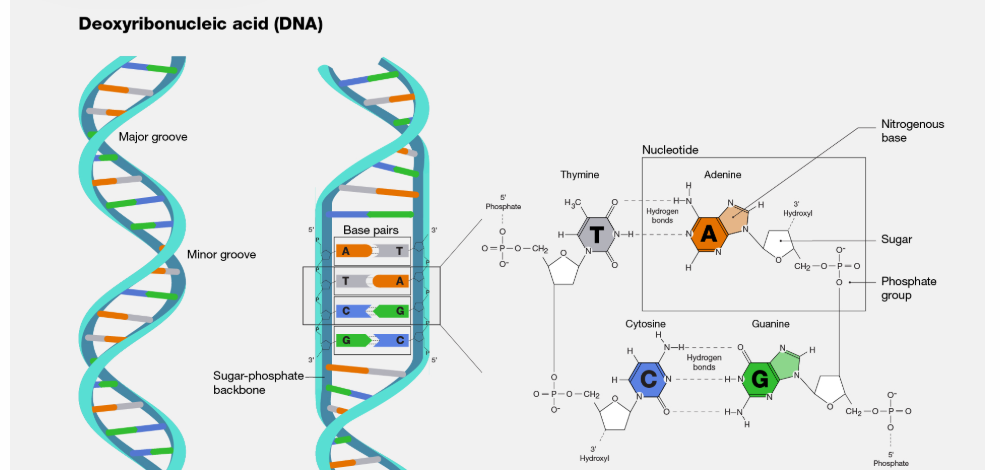
DNA: Deoxyribonucleic Acid
Basic Structure
Backbone of DNA Each DNA strand has a backbone made of:
These sugar and phosphate units are arranged alternately. Nitrogenous Bases DNA contains four bases:
Base Pairing The two DNA strands are connected by chemical bonds between bases.
Function
|
Scientific Significance
Whole-genome Design
The models generated complete genomes rather than suggesting only individual mutations.
Coordinated Genetic Changes
Biological functions often depend on several genetic changes working together. An AI-designed phage combined a viral protein with other modifications in a way that conventional engineering had struggled to achieve.
Wider Genetic Search
AI can examine far more possible genetic combinations than researchers can manually test.
Designing Biological Function
The significant shift is from predicting or analysing biological systems towards designing them for particular functions, such as overcoming bacterial resistance.
Medical and Scientific Opportunities
1. Combating Antimicrobial Resistance
Antimicrobial resistance is reducing the effectiveness of conventional antibiotics. AI-designed phages may support:
- treatment of multidrug-resistant bacteria;
- customised therapies for specific bacterial strains;
- new designs when bacteria develop phage resistance; and
- combinations that reduce bacterial escape.
Medicine may increasingly ask not only whether a suitable phage can be found, but whether the required phage can be designed.
2. Targeted Gene Delivery
AI may improve engineered viral vectors, including Adeno-Associated Viruses, that carry gene-editing tools such as CRISPR.
Better-designed vectors could:
- target selected organs or tissues;
- improve delivery efficiency; and
- reduce unwanted immune reactions.
3. Vaccine and Drug Discovery
Generative models can accelerate the design of:
- vaccine antigens;
- monoclonal antibodies;
- therapeutic proteins; and
- treatments against against emerging pathogens.
4. Precision Oncology
AI may help design oncolytic viruses that selectively infect and destroy cancer cells while limiting harm to healthy tissues.
5. Pandemic Preparedness
AI may shorten genomic analysis, modelling and experimental-design cycles. However, the same acceleration could also assist harmful biological engineering.
What the Experiment Does Not Prove
The study does not demonstrate that:
- AI independently manufactured viruses;
- researchers created a dangerous human pathogen;
- an ordinary chatbot can casually design a pandemic virus;
- AI fully understands complex viral behaviour; or
- human scientists and laboratory infrastructure are no longer required.
Complexity of Human Viruses
Dangerous human viruses must coordinate several biological properties:
- receptor binding;
- host range;
- tissue tropism;
- replication;
- immune escape; and
- transmission.
ΦX174 is far simpler. Nevertheless, complexity should not create false reassurance because researchers already understand many links between genetic changes and viral behaviour.
Principal Risk: Capability Amplification
The immediate concern is not that an untrained person can use a public chatbot to manufacture a dangerous virus. It is that advanced AI may make a knowledgeable and well-equipped laboratory substantially more capable.
AI could shorten:
- literature review;
- biological modelling;
- hypothesis generation;
- genome design; and
- experimental planning.
When combined with automated laboratories and accessible DNA synthesis, this acceleration could become profound.
Biosafety and Biosecurity Risks
Dual-use Potential
The same model may support useful medicines or harmful biological designs.
Unpredictable Outcomes
A sequence that appears coherent digitally may behave differently when introduced into living cells.
Lower Entry Barriers
More capable models, automated laboratories and DNA-synthesis services may gradually make complex biological engineering accessible to more users.
Model Limitations
AI may generate unintended properties because it identifies statistical patterns without fully understanding biological causation.
Novel Harmful Sequences
- Traditional DNA screening generally checks whether an ordered sequence resembles a known pathogen or toxin. AI may generate a novel sequence that looks different but performs a similar harmful function.
- Screening must therefore assess not only what a sequence resembles, but also what it may do.
Safety Without Obstructing Science
Too little restriction can create security risks, while excessive restrictions can obstruct legitimate medical research.
A practical approach is graduated and auditable access, under which model capability is provided according to:
- the user’s qualifications;
- institutional affiliation;
- research purpose;
- risk level;
- security verification; and
- audit requirements.
Verified researchers may receive stronger capabilities under appropriate institutional controls, while highly sensitive functions remain restricted.
Governance Across the Biological-Design Chain
Biosecurity cannot depend only on whether an AI system refuses to answer a question. Safeguards are required at every stage.
1. AI Model Governance
- Evaluate biological capabilities before deployment.
- Restrict functions capable of enabling high-risk design.
- Maintain logs for sensitive use.
- Provide advanced access only to verified users.
2. DNA-Synthesis Screening
- Compare orders with databases of pathogens and toxins.
- Verify customer identity and institutional purpose.
- Develop functional screening for novel sequences.
- Flag suspicious or unusually complex orders.
3. Laboratory Biosafety
- Conduct risk assessment before physical synthesis.
- Use appropriate containment.
- Monitor experiments involving enhanced functions.
- Maintain incident-reporting and emergency procedures.
4. Institutional Oversight
- Strengthen biosafety committees.
- Conduct dual-use research reviews.
- Require ethical and security clearance for high-risk work.
- Establish researcher and institutional accountability.
5. Data Security
- Protect sensitive pathogen datasets.
- Control access to high-risk biological information.
- Use secure computing systems.
6. International Cooperation
Common standards are required for:
- DNA-synthesis screening;
- reporting of high-risk research;
- responsible use of biological AI;
- biosecurity capacity-building; and
- prevention of regulatory arbitrage.
Implications for India
Generative biology can strengthen India’s capabilities in:
- drug discovery;
- genomics;
- vaccines;
- protein engineering;
- antimicrobial-resistance research;
- precision medicine; and
- experimental design.
Risk of Scientific Dependence
- Smaller specialised models may be sufficient for many scientific tasks. However, Indian researchers should not be limited to weaker models merely because foreign organisations control frontier systems.
- If researchers elsewhere receive trusted access to advanced biomedical AI while Indian scientists rely on restricted public versions, India may face a growing disadvantage in medicines, vaccines, AMR research and genomics.
India’s Required Capabilities
Biomedical AI
India should develop biological and medical foundation models suited to its research requirements.
Secure Computing
Sensitive biological models and datasets require protected computing infrastructure.
High-quality Datasets
Indigenous models need diverse, reliable and properly governed biological data.
Trusted Researcher Access
Verified scientists should receive access to advanced models under auditable institutional safeguards.
Biosecurity Capacity
India must strengthen:
- DNA-synthesis screening;
- laboratory containment;
- institutional review;
- secure biological data governance; and
- dual-use risk assessment.
Role of the IndiaAI Mission
The IndiaAI Mission and indigenous foundation-model programmes should support:
- scientific and biomedical AI;
- secure computing capacity;
- high-quality biological datasets;
- trusted-access systems; and
- responsible research safeguards.
AI sovereignty without biosecurity could be reckless, while biosecurity without AI sovereignty could create scientific dependence.
Conclusion
The Stanford–Arc experiment marks a transition from reading, writing and modifying genomes to AI-assisted biological design. AI did not independently manufacture a dangerous virus; it proposed complete phage genomes that scientists physically synthesised and tested.
This capability may transform phage therapy, vaccines, gene delivery, drug discovery and cancer treatment. It may also accelerate harmful biological engineering. India must therefore build scientific capability and biosecurity together while helping shape international safeguards.
Why in News?
The Unified Payments Interface (UPI) completed ten years on August 25, 2026. Its annual transactions increased from 1.78 crore in 2016–17 to over 24,162 crore in 2025–26, while transaction value rose from ₹0.07 lakh crore to nearly ₹314 lakh crore.
What Is UPI?
UPI is an interoperable, real-time payment system developed by the National Payments Corporation of India (NPCI).
It allows users to:
- access multiple bank accounts through one mobile application;
- transfer money directly between bank accounts;
- make peer-to-peer and merchant payments;
- use different participating banks and payment applications; and
- complete transactions throughout the day.
UPI brings fund transfers, merchant payments and several banking services onto a common platform.
How UPI Works
A user links a bank account to a UPI-enabled application. Transactions can then be initiated through:
- a UPI identification number;
- mobile number;
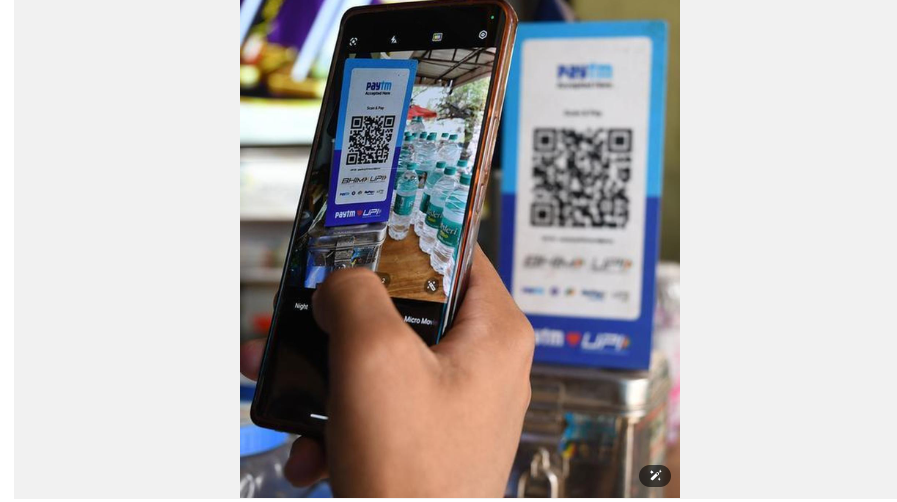
- QR code;
- bank-account details; or
- other supported payment instructions.
UPI uses two-factor authentication and end-to-end encryption to strengthen transaction security.
Why Is UPI Interoperable?
- Interoperability allows a customer of one bank or application to transact with a user or merchant connected to another participating bank or application.
- Thus, users are not restricted to making payments only within the same bank or payment platform.
Evolution of UPI
2016: Launch and Public Rollout
- UPI was launched on a pilot basis in April 2016 with 21 member banks.
- It was rolled out publicly in August 2016 through UPI-enabled banking applications.
- The BHIM application was launched in December 2016 to facilitate direct bank-to-bank payments through mobile devices.
2017: Dynamic QR
Dynamic QR codes were introduced for retail merchants.
Unlike a basic QR code, a dynamic QR can include:
- merchant details;
- transaction amount; and
- payment-specific information.
This reduces manual entry and payment errors.
2018: UPI 2.0
UPI 2.0 introduced several features:
- Invoice in the Inbox: Allows users to check an invoice before payment.
- Signed Intent and QR: Improves payment authorisation and security.
- UPI Mandates: Enables pre-authorised recurring payments.
- Overdraft Linking: Permits transactions through linked overdraft accounts.
2019: IPO Payments and Mass Adoption
The Securities and Exchange Board of India allowed retail investors to use UPI while applying for initial public offerings through designated intermediaries.
In October 2019, UPI crossed one billion monthly transactions for the first time.
2020–2022: Expansion of Access and Use Cases
UPI AutoPay
UPI AutoPay introduced recurring electronic mandates for:
- subscriptions;
- utility bills;
- insurance premiums;
- systematic investment plans; and
- loan instalments.
UPI 123PAY
UPI 123PAY brought feature-phone users into the digital-payment system through:
- interactive voice response;
- application-based payments;
- missed-call-based transactions; and
- proximity sound-based payments.
UPI Lite
UPI Lite enabled faster, low-value and PIN-less transactions.
Linking eligible credit cards with UPI expanded Credit-card Integration
the available sources of payment.
Growth Milestones
During 2021–22, UPI:
- processed transactions worth more than $1 trillion; and
- crossed five billion monthly transactions in March 2022.
Bhutan became UPI’s first international deployment.
2023: Credit and Market Dominance
- Credit Line on UPI enabled users to link pre-sanctioned bank credit lines as a funding source.
- UPI accounted for approximately 70% of India’s digital-payment transactions in 2023–24.
Recent Innovations
UPI Circle
UPI Circle allows a primary user to authorise a secondary user to transact from the primary user’s bank account within predefined limits.
Revised Transaction Limits
- The limit for tax payments was raised from ₹1 lakh to ₹5 lakh per transaction.
- Higher limits apply to selected areas such as capital markets, IPO subscriptions, loan collections, insurance, healthcare and education.
- The limit for UPI 123PAY was increased to ₹10,000 per transaction.
- The UPI Lite wallet limit was raised to ₹5,000, with a ₹1,000 per-transaction limit.
On-device Authentication
Users can authenticate UPI transactions through smartphone fingerprints or facial recognition.
Aadhaar-based Face Authentication
Aadhaar-based face authentication simplifies UPI PIN onboarding, particularly for:
- first-time users;
- senior citizens; and
- users without easy access to payment cards.
Growth of UPI
Annual Growth
| Indicator | 2016–17 | 2025–26 |
| Transaction volume | 1.78 crore | More than 24,162 crore |
| Transaction value | ₹0.07 lakh crore | Approximately ₹314 lakh crore |
Over the decade:
- transaction volume increased almost 13,000-fold; and
- transaction value increased more than 4,000-fold.
UPI in July 2026
The ecosystem comprised:
- 741 live banks;
- 2,365.8 crore transactions during the month; and
- transaction value of ₹29.87 lakh crore.
The growth reflects widespread adoption by individuals, merchants, banks and financial institutions.
UPI as Digital Public Infrastructure
- UPI is a major component of India’s Digital Public Infrastructure because it provides common digital payment rails on which banks, payment applications and businesses can offer services.
Its principal features are:
- open and interoperable architecture;
- real-time settlement;
- round-the-clock availability;
- low-cost acceptance infrastructure;
- ability to operate at a large scale; and
- support for continuous private-sector innovation.
The IMF has recognised UPI as the world’s largest real-time payment system by transaction volume.
UPI’s Global Footprint
- In 2024, UPI accounted for approximately 49% of global real-time payment transaction volume.
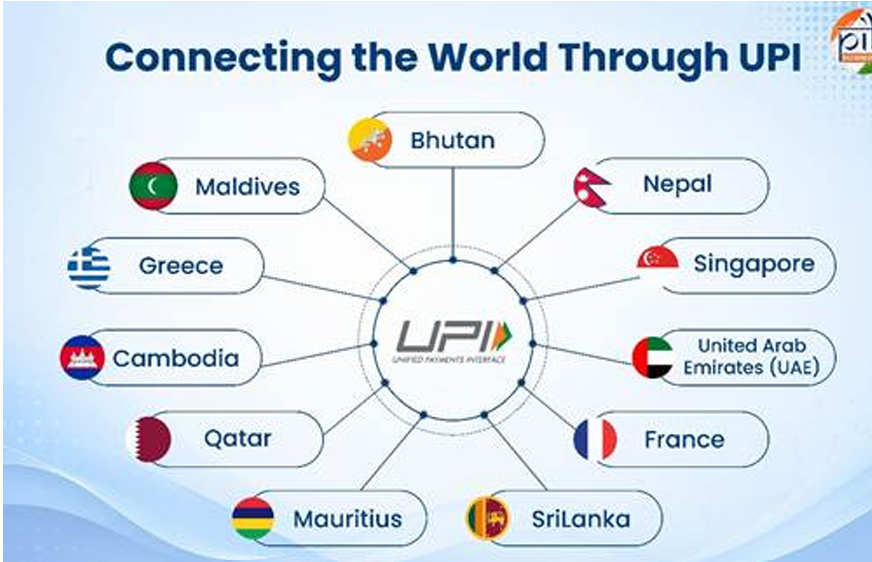
- As of August 2026, UPI was live in 11 foreign countries for merchant acceptance, cross-border remittances or both.
These include:
- Bhutan;
- Nepal;
- Singapore;
- United Arab Emirates;
- France;
- Sri Lanka;
- Mauritius;
- Qatar;
- Cambodia;
- Greece; and
- Maldives.
Recent International Developments
Cambodia
In June 2026, NPCI International Payments Limited partnered with ACLEDA Bank to introduce UPI acceptance in Cambodia.
Greece
UPI-based cross-border remittances between Greece and India became operational in June 2026 through Eurobank.
Maldives
- On July 30, 2026, cross-border remittances between the Maldives’ Favara instant-payment system and India’s UPI became operational.
- International expansion strengthens India’s cross-border payment connectivity and demonstrates the exportability of its digital public infrastructure.
Significance of UPI
1. Financial Inclusion
UPI has expanded access to digital financial services, including among rural and underserved communities. Products such as UPI 123PAY reduce dependence on smartphones.
2. Convenience for Users
It provides instant bank-to-bank transactions without requiring users to enter lengthy banking details for every payment.
3. Support for Small Businesses
Street vendors and small merchants can accept digital payments through QR codes without purchasing expensive card-processing equipment.
4. Ease of Doing Business
Real-time settlement simplifies payments among customers, merchants and enterprises.
5. Formalisation of Transactions
Digital payment records improve transaction traceability and support wider participation in the formal economy.
6. Fintech Innovation
UPI’s common infrastructure allows banks and payment companies to build diverse applications and services, increasing competition.
7. Government Payments
The platform can support transparent and efficient payments involving government institutions and citizens.
8. Global Digital Leadership
UPI demonstrates India’s ability to build population-scale, interoperable and inclusive digital infrastructure.
Major Challenges
Cybersecurity and Fraud
Growing transaction volumes attract:
- phishing;
- impersonation;
- fraudulent payment requests;
- social engineering; and
- account-related attacks.
Technical security alone cannot prevent fraud when users are deceived into authorising transactions.
Scalability and Reliability
The payment infrastructure must handle rapidly growing volumes without delays, outages or failed transactions.
Connectivity Divide
Core UPI services generally require stable telecommunications and Internet access. Connectivity limitations can restrict use in rural and remote regions.
Digital Literacy
Users unfamiliar with digital payments may struggle to identify fraudulent links, misleading QR codes or unauthorised requests.
Grievance Redressal
Failed or disputed transactions require timely, simple and coordinated resolution among banks, payment applications and NPCI.
International Merchant Acceptance
Operational availability in a country does not automatically produce widespread merchant adoption. Local payment systems, regulations and consumer habits may limit expansion.
Sustainability of the Ecosystem
Banks, payment companies and service providers need a sustainable operating model while maintaining affordability and broad access.
Data Protection
The scale of payment data requires strong safeguards against unauthorised access, profiling and misuse.
Way Forward
- Strengthen real-time fraud detection and inter-bank threat intelligence.
- Conduct continuous user-awareness campaigns in regional languages.
- Expand UPI 123PAY and low-connectivity payment options.
- Build redundancy to prevent outages at high transaction volumes.
- Improve time-bound grievance redressal and customer compensation.
- Use device-based and Aadhaar-enabled authentication responsibly.
- Strengthen data protection, privacy and cybersecurity audits.
- Ensure accessibility for senior citizens and persons with disabilities.
- Promote cross-border interoperability through bilateral partnerships.
- Encourage international merchant adoption and transparent currency conversion.
- Maintain competition and prevent excessive platform concentration.
- Balance consumer affordability with the financial sustainability of service providers.
Conclusion
In ten years, UPI has evolved from a pilot involving 21 banks into the backbone of India’s digital-payment ecosystem. Its interoperability, real-time operation and continuous innovation have promoted financial inclusion, merchant digitisation and fintech development. The next phase must prioritise cybersecurity, reliability, accessibility, consumer protection and sustainable global expansion.