UNION BUDGET Summary (2026–2027)
Table of Contents
Relevance:
GS Paper III: Indian Economy and Planning, Budget, Growth, Development and Employment, Infrastructure, Manufacturing, MSMEs, Energy Security, Logistics, Investment
Important Keywords
For Prelims:
- Union Budget 2026–27, Yuva Shakti, Kartavya Bhawan, Biopharma Shakti, National Fibre Scheme, City Economic Regions, Dedicated Freight Corridor, National Waterway Number Five, Khelo India Mission, Bharat Vistaar.
For Mains:
- Youth-led growth strategy, Manufacturing-led economic transformation, Infrastructure as growth multiplier, Energy security and resilience, Inclusive development and regional balance, Fiscal consolidation with growth.
Why in News?
The Union Budget for the year 2026–2027 is a Yuva Shakti-driven Budget. Presented by the Union Minister for Finance and Corporate Affairs, Smt. Nirmala Sitharaman.
Overall Theme and Context
- The Union Budget for the year 2026–2027 is a Yuva Shakti-driven Budget.
- It emphasizes the Government’s Sankalp, meaning firm resolve, to focus on:
- The poor
- The underprivileged
- The disadvantaged sections of society
- This is the first Union Budget prepared in Kartavya Bhawan.
- The Budget is inspired by three Kartavya, meaning duties.
The Three Kartavya of the Budget
First Kartavya
- To accelerate and sustain economic growth.
- This will be achieved by:
- Enhancing productivity
- Enhancing competitiveness
- Building resilience against volatile global economic dynamics
Second Kartavya
- To fulfil the aspirations of the people.
- To build the capacity of citizens, making them strong partners in India’s journey towards prosperity.
Third Kartavya
- Aligned with the vision of Sabka Sath, Sabka Vikas.
- To ensure that:
- Every family
- Every community
- Every region
- Every sector has access to resources, amenities and opportunities for meaningful participation in national development.
Broader Economic Backdrop
- India will continue to take confident steps towards Viksit Bharat, balancing ambition with inclusion.
- As a growing economy with expanding trade and capital requirements, India must:
- Remain deeply integrated with global markets
- Export more goods and services
- Attract stable and long-term investment
- The country is facing:
- Disruptions in global trade and multilateralism
- Disruptions in access to resources and supply chains
- Rapid technological transformation of production systems
- Increasing pressure on water, energy and critical minerals
Government Reforms Since 2025
- Following the Prime Minister’s announcement on Independence Day in 2025:
- More than three hundred and fifty reforms have been rolled out.
- These include:
- Simplification of the Goods and Services Tax
- Notification of Labour Codes
- Rationalisation of mandatory Quality Control Orders
- High-level committees have been formed.
- The Central Government is working with State Governments to:
- Deregulate sectors
- Reduce compliance requirements

First Kartavya: Accelerating And Sustaining Economic Growth
Six Key Intervention Areas
- Scaling up manufacturing in seven strategic and frontier sectors
- Rejuvenating legacy industrial sectors
- Creating Champion Micro, Small and Medium Enterprises
- Delivering a strong push to infrastructure
- Ensuring long-term energy security and stability
- Developing City Economic Regions
BIOPHARMA SECTOR
- Biopharma Shakti will be established with an outlay of ten thousand crore rupees.
- Objective:
- To build an ecosystem for domestic production of biologics and biosimilars over the next five years.
- Key components:
- Establishment of a biopharma-focused network
- Setting up three new National Institutes of Pharmaceutical Education and Research
- Upgrading seven existing National Institutes of Pharmaceutical Education and Research
- Creation of a network of more than one thousand accredited clinical trial sites
- Strengthening of the Central Drugs Standard Control Organisation
- Dedicated scientific review cadre
- Specialists to meet global approval standards and timelines
Textile Sector: Integrated Programme
Five Sub-Parts
- National Fibre Scheme
- Self-reliance in:
- Silk
- Wool
- Jute
- Man-made fibres
- New-age fibres
- Self-reliance in:
- Textile Expansion and Employment Scheme
- Modernisation of traditional textile clusters
- Capital support for:
- Machinery
- Technology upgradation
- Common testing and certification centres
- National Handloom and Handicraft Programme
- Integration and strengthening of existing schemes
- Targeted support for weavers and artisans
- Textile Ecology Initiative
- Promotion of globally competitive and sustainable textiles and apparel
- Samarth Version Two
- Modernisation of textile skilling ecosystem
- Collaboration with industry and academic institutions
MICRO, SMALL AND MEDIUM ENTERPRISES
- Recognised as a vital engine of economic growth.
- A dedicated ten thousand crore rupees Small and Medium Enterprise Growth Fund proposed.
- Objective:
- To create future champion enterprises
- Incentives based on select performance criteria
Public Capital Expenditure
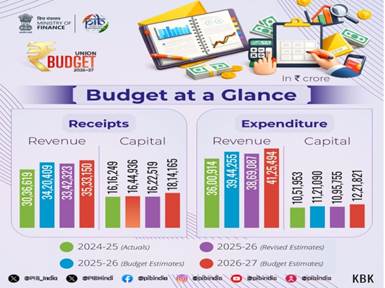
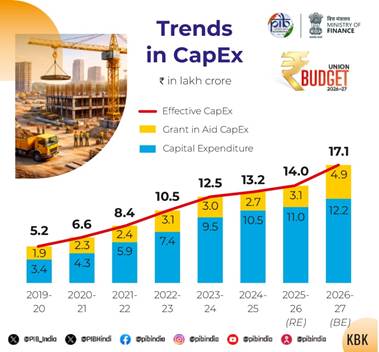
- Public capital expenditure increased from:
- Two lakh crore rupees in the year two thousand fourteen to two thousand fifteen
- To eleven lakh twenty thousand crore rupees in the Budget Estimate of two thousand twenty-five to twenty-six
- Proposed increase to twelve lakh twenty thousand crore rupees in the year two thousand twenty-six to twenty-seven.
LOGISTICS AND TRANSPORT INFRASTRUCTURE
Freight and Waterways
- Dedicated Freight Corridor connecting:
- Dankuni in the eastern region
- Surat in the western region
- Operationalisation of twenty new National Waterways over five years
- Starting with National Waterway Number Five in Odisha
- Connecting Talcher and Angul mineral regions
- Linking Kalinga Nagar industrial centres
- Connecting to Paradeep and Dhamra ports
- Training institutes to be established as Regional Centres of Excellence for manpower development
CITY ECONOMIC REGIONS
- Mapping of city economic regions based on growth drivers.
- Allocation of five thousand crore rupees per City Economic Region over five years.
- Implementation through:
- Challenge mode
- Reform-cum-results-based financing mechanism
HIGH-SPEED RAIL CORRIDORS
Seven high-speed rail corridors to promote environmentally sustainable passenger systems:
- Mumbai to Pune
- Pune to Hyderabad
- Hyderabad to Bengaluru
- Hyderabad to Chennai
- Chennai to Bengaluru
- Delhi to Varanasi
- Varanasi to Siliguri
SECOND KARTAVYA: FULFILLING ASPIRATIONS AND BUILDING CAPACITY
- Nearly twenty-five crore individuals have exited multidimensional poverty due to sustained government efforts.
MEDICAL TOURISM AND HEALTHCARE
- Scheme to establish five Regional Medical Hubs in partnership with the private sector.
- Each hub will include:
- Medical facilities
- Educational institutions
- Research facilities
- Ayurveda, Yoga, Unani, Siddha and Homeopathy centres
- Medical Value Tourism Facilitation Centres
- Diagnostics, post-care and rehabilitation infrastructure
- Employment generation for doctors and allied health professionals
VETERINARY SECTOR
- Loan-linked capital subsidy scheme proposed.
- Objective:
- To scale up availability of veterinary professionals by more than twenty thousand.
- Support for:
- Veterinary colleges
- Para-veterinary colleges
- Veterinary hospitals
- Diagnostic laboratories
- Breeding facilities in the private sector
CREATIVE ECONOMY
- Support to Indian Institute of Creative Technologies, Mumbai.
- Establishment of Animation, Visual Effects, Gaming and Comics Content Creator Laboratories in:
- Fifteen thousand secondary schools
- Five hundred colleges
GIRLS’ EDUCATION
- One girls’ hostel to be established in every district.
- Focus on Higher Education Science, Technology, Engineering and Mathematics institutions.
- Support through viability gap funding and capital assistance.
TOURISM AND HOSPITALITY SKILLS
- National Institute of Hospitality to be established by upgrading the National Council for Hotel Management and Catering Technology.
- Pilot scheme to upskill ten thousand tourist guides.
- Coverage:
- Twenty tourist sites
- Twelve-week standardised training
- Hybrid mode
- Collaboration with an Indian Institute of Management
SPORTS SECTOR
- Launch of Khelo India Mission.
- Objective:
- Transform the sports sector over the next decade.
- Focus areas:
- Integrated talent development pathway
- Coach and support staff development
- Sports science and technology integration
- Competitions and leagues
- Sports infrastructure development
THIRD KARTAVYA: SABKA SATH, SABKA VIKAS
Agriculture
- Bharat Vistaar, a multilingual digital tool.
- Integration of:
- Agricultural data portals
- Indian Council of Agricultural Research practices
- Objective:
- Increase productivity
- Improve decision-making
- Reduce risk through customised advisories
Women and Self-Help Groups
- Self-Help Entrepreneur Marts
- Community-owned retail outlets at cluster level federations
- Enhanced and innovative financing
Mental Health
- Establishment of second National Institute of Mental Health and Neurosciences
- Upgradation of mental health institutes at Ranchi and Tezpur as regional apex institutions
Purvodaya and North-East
- Integrated East Coast Industrial Corridor with node at Durgapur
- Five tourism destinations in Purvodaya States
- Provision of four thousand electric buses
- Scheme for development of Buddhist circuits in:
- Arunachal Pradesh
- Sikkim
- Assam
- Manipur
- Mizoram
- Tripura
FISCAL CONSOLIDATION
- Debt to Gross Domestic Product ratio:
- Fifty-six-point one percent in Revised Estimates two thousand twenty-five to twenty-six
- Fifty-five-point six percent in Budget Estimates two thousand twenty-six to twenty-seven
- Fiscal deficit:
- Four-point four percent of Gross Domestic Product in Revised Estimates two thousand twenty-five to twenty-six
- Four-point three percent of Gross Domestic Product in Budget Estimates two thousand twenty-six to twenty-seven
DIRECT TAXATION
- New Income Tax Act, two thousand twenty-five effective from April two thousand twenty-six.
- Simplified income tax rules and redesigned forms to be notified.
- Reduction in Tax Collected at Source:
- Overseas tour packages reduced to two percent
- Education and medical remittances under Liberalised Remittance Scheme reduced to two percent
- One-time six-month foreign asset disclosure scheme for specified categories
- Integration of assessment and penalty proceedings
- Decriminalisation of minor tax offences
COOPERATIVES
- Deduction extended to cattle feed and cotton seed.
- Inter-cooperative dividend income deduction.
- Three-year exemption for notified national cooperative federations.
SUPPORT TO INFORMATION TECHNOLOGY SERVICES
- Single category of Information Technology Services.
- Common safe harbour margin of fifteen-point five percent.
- Threshold raised to two thousand crore rupees.
- Automated approval and five-year continuity.
ATTRACTING GLOBAL INVESTMENT
- Tax holiday till year two thousand forty-seven for foreign cloud service providers using Indian data centres.
- Exemption from Minimum Alternate Tax for non-residents on presumptive taxation.
- Five-year income tax exemption for global experts under notified schemes.
INDIRECT TAXATION AND CUSTOMS
- Duty exemptions for:
- Lithium-ion battery manufacturing capital goods
- Critical mineral processing equipment
- Seventeen medicines
- Tariff on personal imports reduced from twenty percent to ten percent.
- Warehouse operator-centric customs framework.
- Single digital window for cargo clearance.
- Removal of value cap on courier exports.
- Duty exemptions for:
Conclusion
The Union Budget 2026–27 represents a strategic shift from welfare-led expenditure to youth-driven, capacity-building growth, anchored in fiscal prudence and inclusive development. By aligning economic acceleration with Sabka Sath, Sabka Vikas, the Budget lays a comprehensive foundation for India’s journey towards Viksit Bharat in an uncertain global environment.
UPSC PYQ
1. Along with the Budget, the Finance Minister also places other documents before the Parliament which include ‘The Macro Economic Framework Statement’. The aforesaid document is presented because this is mandated by (2020)
(a) Long standing parliamentary convention
(b) Article 112 and Article 110(1) of the Constitution of India
(c) Article 113 of the Constitution of India
(d) Provisions of the Fiscal Responsibility and Budget Management Act, 2003
(a) Long standing parliamentary convention
(b) Article 112 and Article 110(1) of the Constitution of India
(c) Article 113 of the Constitution of India
(d) Provisions of the Fiscal Responsibility and Budget Management Act, 2003
Ans: (d)
2. What is the difference between “vote-on-account” and “Interim Budget”? (2011)
- The provision of a “vote-on-account” is used by a regular Government while an “interim budget” is a provision used by a caretaker Government.
- A “vote-on-account” only deals with the expenditure in Government’s budget, while an “interim budget” includes both expenditures and receipts.
Which of the statements given above is/are correct?
(a) 1 only
(b) 2 only
(c) Both 1 and 2
(d) Neither 1 nor 2
Ans: (b)
CARE MCQ
Q. Consider the following statements regarding Biopharma Shakti announced in the Union Budget 2026–27:
- It aims to promote domestic production of biologics and biosimilars.
- It includes the establishment of new and upgradation of existing NIPERs.
- It focuses exclusively on vaccine manufacturing.
Which of the statements given above is/are correct?
- 1 and 2 only
- 2 and 3 only
- 1 only
- 1, 2 and 3
Answer: A
Explanation:
- Statement 1 – Correct, it aims to promote domestic production of biologics and biosimilars.
- Statement 2 – Correct, it includes the establishment of new and upgradation of existing NIPERs.
- Statement 3 – Incorrect (scope includes biologics, biosimilars, clinical trials, CDSCO strengthening)