Why in News?
Telangana Chief Minister A. Revanth Reddy invited South African industrialists and entrepreneurs to participate in the Telangana Rising Global Summit 2026, scheduled to be held in December at Bharat Future City.The invitation was extended during a meeting with a high-level South African delegation led by Deputy President Paul Mashatile. The discussions focused on cooperation in education, skill development, medical tourism, investments, technology, startups and life sciences.

Background
Telangana is trying to position itself as a major investment and innovation hub in India. Hyderabad already has a strong base in information technology, pharmaceuticals, defence, aerospace, life sciences and Global Capability Centres.
The State government is also promoting Bharat Future City, a proposed large-scale urban and industrial development project near Hyderabad’s international airport. The project is expected to attract global companies and support Telangana’s long-term growth vision.
Key Highlights of the South Africa Meeting
- Chief Minister Revanth Reddy invited South African businesses to the Telangana Rising Global Summit 2026.
- The summit is expected to be held at Bharat Future City in December.
- The Chief Minister highlighted Hyderabad’s strong education and skill training ecosystem.
- He said Hyderabad has become a preferred destination for Global Capability Centres of Fortune 500 companies.
- Telangana also projected Hyderabad as a growing medical tourism hub due to cost-effective healthcare facilities.
- South African Deputy President Paul Mashatile said India and South Africa share strong historical and cultural ties.
- He noted that South Africa can offer Indian companies access to African markets through the African Continental Free Trade Area.
Why Hyderabad is Important
Hyderabad has emerged as a major knowledge and innovation centre.
Its key strengths include:
- Strong higher education ecosystem , Skilled engineering talent , Information technology base , Pharmaceutical and life sciences industry, Defence and aerospace ecosystem, Medical infrastructure , Startup ecosystem , Global Capability Centres Cost-effective healthcare services
These strengths make Hyderabad suitable for attracting investments in technology, research, healthcare, manufacturing and services.
Bharat Future City
Bharat Future City is proposed as a major future-ready development project near Hyderabad’s international airport.
The Chief Minister invited global investors to explore opportunities in the proposed 30,000-acre Bharat Future City.
It is expected to support:
- Technology industries
- Global Capability Centres
- Startups
- Life sciences
- Education and skill development
- Healthcare and medical tourism
- Defence and aerospace
- Future industries
Bharat Future City is being projected as a new growth engine for Telangana.
Areas of Cooperation with South Africa
1. Education
Telangana and South Africa can cooperate in student exchange, higher education partnerships and joint academic programmes.
2. Skill Development
Skill training can be aligned with global workforce requirements in sectors such as IT, healthcare, engineering, manufacturing and services.
3. Medical Tourism
Hyderabad’s affordable and advanced healthcare facilities can attract patients from South Africa and other African countries.
4. Pharmaceuticals
South Africa expressed interest in greater collaboration in pharmaceuticals. Telangana’s strong pharma ecosystem can support medicine supply, research and investment.
5. Startups and Technology
Both sides can cooperate in innovation, digital technology, startups and entrepreneurship.
6. Life Sciences
Hyderabad’s life sciences ecosystem can support research, manufacturing and healthcare innovation.
7. Market Access
South Africa can act as a gateway for Indian firms to African markets through the African Continental Free Trade Area.
Challenges
- Global investors need clear policy stability and fast approvals.
- Bharat Future City requires strong infrastructure, land planning and connectivity.
- Skill programmes must match actual industry demand.
- Medical tourism requires quality, trust, language support and patient care systems.
- Competition from other Indian States for global investments is high.
- International collaborations need proper follow-up after MoUs.
- Workforce mobility requires language training, certification and global-standard skills.
Way Forward
- Create a dedicated investment facilitation system for South African and German firms.
- Fast-track infrastructure development in Bharat Future City.
- Build sector-specific clusters for pharma, life sciences, defence, aerospace and semiconductors.
- Strengthen Young India Skills University with international curricula.
- Expand German, Japanese and Korean language training for workforce mobility.
- Promote Hyderabad as a medical tourism destination in African markets.
- Support startups through incubation, funding and global mentorship.
- Ensure MoUs are converted into practical projects with timelines.
- Develop a single-window system for global investors.
Conclusion
Telangana’s outreach to South Africa and Germany reflects the State’s ambition to become a global hub for investment, skills, technology and medical tourism. Hyderabad’s strong education, healthcare, IT, pharma and innovation ecosystem gives the State a major advantage.The success of these partnerships will depend on converting discussions and MoUs into real investments, jobs, skill programmes and infrastructure. If implemented effectively, Telangana Rising Global Summit 2026 and Bharat Future City can strengthen Telangana’s role in India’s economic and technological growth.
Why in News?
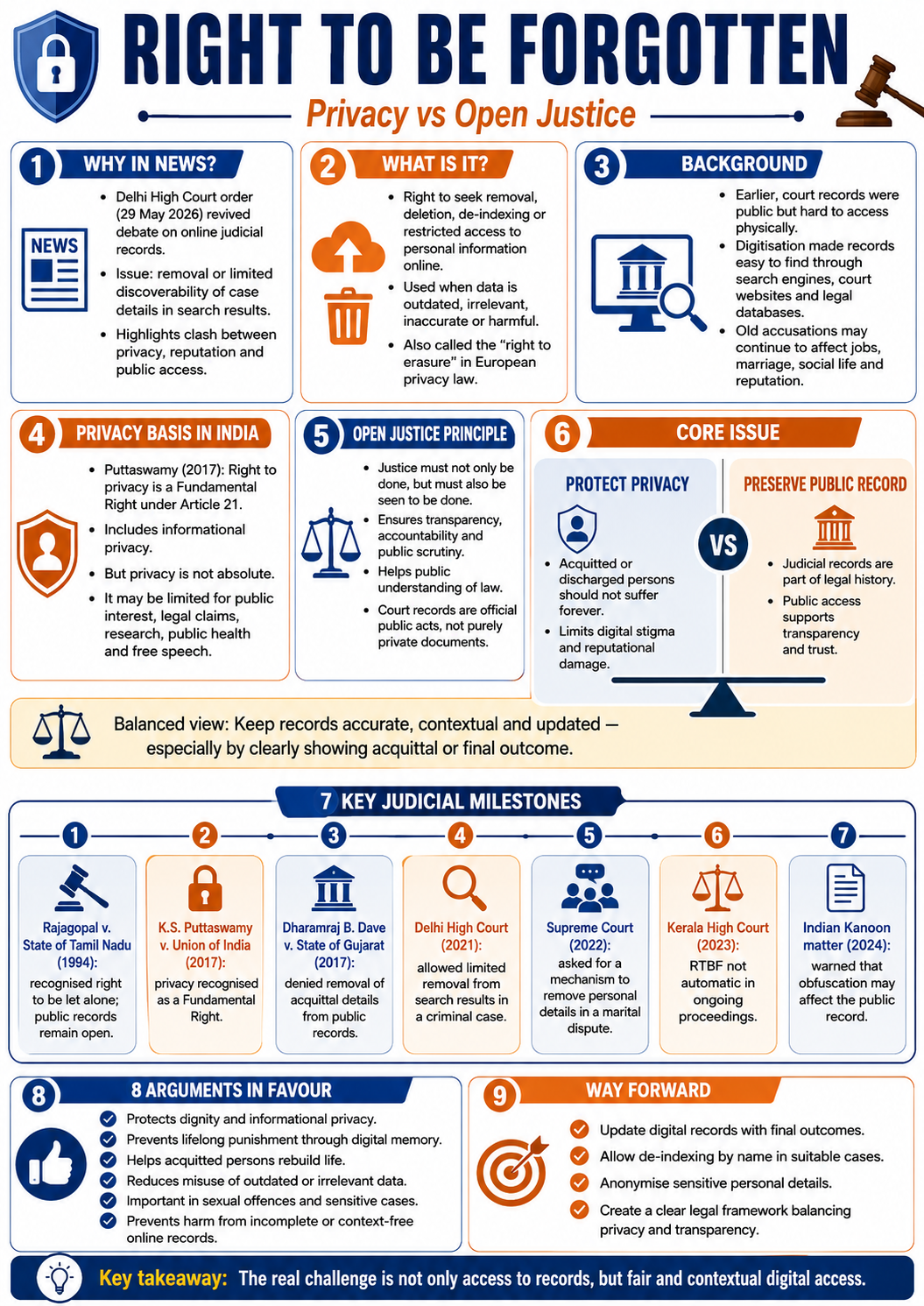
The debate on the right to be forgotten has again come into focus after a Delhi High Court order on May 29, 2026 concerning the removal or limited discoverability of certain judicial records from online searches.
The issue highlights a conflict between two important principles:
- Right to informational privacy, recognised by the Supreme Court in Justice K.S. Puttaswamy v. Union of India, 2017
- Open justice, which requires court proceedings and judicial records to remain accessible for public scrutiny
The case shows how digital access to court records can affect privacy, reputation and public memory.
What is the Right to Be Forgotten?
The right to be forgotten means the right of an individual to request removal, deletion, de-indexing or restricted access to personal information available online when such information is outdated, irrelevant, inaccurate or harmful to privacy.
It is also known as the right to erasure in European privacy law.
In simple terms, it allows a person to say: “My past personal information should not remain easily searchable forever if it no longer serves any legitimate public purpose.”
Background
In earlier times, court records were technically public, but access was limited. A person had to physically visit courts or legal archives to find records.
Digitisation changed this situation. Now, judgments and legal records can be easily found through:
- Search engines
- Online legal databases
- Automated archivers
- Court websites
- Digital repositories
This has improved transparency, but it has also created new privacy concerns. Even an old accusation, if searchable by name, can affect a person’s employment, marriage, social life and reputation, even after acquittal or discharge.
Right to Privacy in India
In Justice K.S. Puttaswamy v. Union of India, 2017, the Supreme Court recognised the right to privacy as a fundamental right under Article 21.
The judgment also recognised informational privacy, which means individuals should have some control over personal information about themselves.
However, the Court also made it clear that privacy is not an absolute right. It can be restricted for:
- Public interest
- Public order
- Legal claims
- Research
- Archiving
- Public health
- Freedom of expression
Thus, the right to be forgotten must be balanced with other constitutional values.
Open Justice Principle
The principle of open justice means that justice should not only be done but should also be seen to be done.
It allows:
- Public scrutiny of courts
- Transparency in judicial functioning
- Public understanding of law
- Accountability of the justice system
- Creation of historical legal records
- Access to court judgments and legal reasoning
Court records are not only personal documents. They are also official acts of the State and form part of the public record.
Delhi High Court Order
The Delhi High Court considered the privacy concerns of a person whose name was linked with court records available online.
The Court observed that simply updating records may not be enough because search engines may show small parts of a case without proper context. The Court also noted that open justice does not necessarily require every detail of a case to be searchable through the name of the accused person.
However, this approach raises an important concern. If access to original records is restricted, the public record may become incomplete or difficult to verify.
Key Issue: Privacy vs Public Record
The central question is:
Should judicial records be hidden to protect privacy, or should they remain public with proper updates and context?
One view says that if a person is acquitted or discharged, old accusations should not continue to damage their life.
Another view says that court records are public documents and should not be erased or hidden because they are part of the history of justice administration.
A balanced view is that the problem is not always discoverability, but incompleteness. If a person is acquitted, the digital record should clearly show the acquittal or final outcome instead of preserving only the accusation.
Judicial Precedents
1. Rajagopal v. State of Tamil Nadu, 1994
The Supreme Court recognised the right to be let alone, but also held that public records, including court records, remain open to public comment.
2. Justice K.S. Puttaswamy v. Union of India, 2017
The Supreme Court recognised privacy as a fundamental right and acknowledged informational privacy.
3. Dharamraj Bhanushankar Dave v. State of Gujarat, 2017
The Gujarat High Court denied removal of acquittal details from public records and emphasised the accessibility of court orders.
4. Orissa High Court, 2020
In a case involving online sexual abuse, the Court noted the need for a serious debate on the right to be forgotten.
5. Delhi High Court, 2021
The Court allowed limited removal from search results in a criminal case to protect the petitioner’s social life and career.
6. Supreme Court Order, 2022
The Court directed its registry to create a mechanism for removing personal details of a couple involved in a marital dispute from search engines.
7. Kerala High Court, 2023
The Court held that the right to be forgotten cannot be applied automatically to ongoing court proceedings because of open justice and public interest.
8. Indian Kanoon Matter, 2024
The Court warned that obfuscation of court records may have serious implications for the public record.
Arguments in Favour of the Right to Be Forgotten
- Protects individual privacy and dignity.
- Prevents lifelong punishment through digital memory.
- Helps acquitted persons rebuild their lives.
- Reduces misuse of outdated or irrelevant information.
- Protects victims of sexual crimes and sensitive cases.
- Supports control over personal data.
- Prevents reputational harm from incomplete online records.
Concerns and Challenges
1. Conflict with Open Justice
Court records must remain accessible for transparency and public scrutiny.
2. Impact on Public Records
Deleting or hiding judicial records may weaken the historical record of the justice system.
3. Lack of Uniformity
Different High Courts have taken different approaches, creating legal uncertainty.
4. Freedom of Speech and Press
Excessive removal may affect journalism, legal reporting and public debate.
5. Technical Difficulty
Information copied across websites may not be fully removed from the internet.
6. Risk of Misuse
Powerful persons may try to erase information of genuine public importance.
7. Lack of Statutory Clarity
India does not yet have a clear law specifically dealing with the right to be forgotten in relation to court records.
Way Forward
- India needs a clear legal framework for the right to be forgotten.
- Courts should balance privacy with public interest on a case-by-case basis.
- Judicial records should not be erased casually.
- Instead of removing records, courts may prefer updating, contextualising and redacting sensitive personal details.
- Search results should show the final outcome of a case, such as acquittal, discharge or closure.
- Legal databases and search platforms should regularly refresh their records.
- Sensitive cases involving sexual offences, minors and private family disputes need special protection.
- Public interest must be considered in cases involving public officials, corruption, serious crimes and matters affecting society.
- The Digital Personal Data Protection Act, 2023 should be harmonised with open justice and court record rules.
- An independent mechanism may be created to decide requests for erasure, de-indexing or redaction.
Conclusion
The right to be forgotten is an important part of privacy in the digital age, but it cannot be absolute. Court records serve a public purpose because they preserve the history of justice and allow public scrutiny of the judiciary.
The better solution is not to erase judicial records, but to ensure digital accuracy, proper context and timely updates. If a person is acquitted or discharged, online records must clearly reflect that outcome. This approach protects both privacy and open justice.
India must develop a balanced framework where personal dignity is protected without weakening transparency, public interest and the integrity of judicial records.
Why in News?
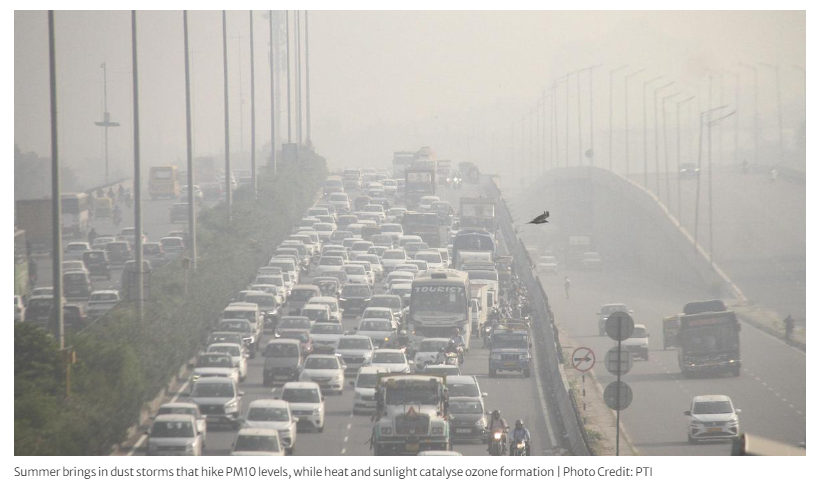
Although summer is usually seen as a cleaner season compared to winter, several Indian cities recorded serious air pollution episodes in 2026. In Delhi, the Commission for Air Quality Management (CAQM) reimposed Stage-I restrictions under the Graded Response Action Plan (GRAP) in May 2026. This highlighted the emerging concern of summer air pollution in urban India.
What is Summer Air Pollution?
Summer air pollution refers to air quality deterioration during hot months due to pollutants such as PM10 and ground-level ozone.
Unlike winter smog, which is mainly linked with trapped fine particles, summer pollution is driven by:
- Dust storms, Road dust, Construction activity, Vehicular emissions, Industrial emissions, Strong sunlight, High temperature, Ozone formation
Summer Pollution vs Winter Pollution
| Feature | Summer Pollution | Winter Pollution |
| Main Pollutants | Mainly caused by coarse particulate matter (PM10), dust, and ground-level ozone. | Mainly caused by fine particulate matter (PM2.5), dense smog, and smoke particles. |
| Weather Conditions | Heatwaves, strong sunlight, dust storms, dry weather, and fast-moving winds increase pollution. | Cold air, fog, low wind speed, and temperature inversion trap pollutants near the ground. |
| Major Sources | Road dust, construction dust, wind-blown dust, vehicle emissions, and pollutants reacting under sunlight. | Stubble burning, biomass burning for heating, industrial emissions, and trapped vehicular smoke. |
| How Pollution Forms | Dust gets suspended in the air, while strong sunlight helps form ozone through chemical reactions. | Pollutants accumulate because cold and stable air prevents their proper dispersion. |
| Peak Pollution Time | Pollution is usually more severe during midday and hot afternoons, when ozone formation is high. | Pollution is usually more severe during early mornings and late nights, when inversion is stronger. |
| Main Seasonal Factor | High temperature and sunlight-driven atmospheric reactions. | Cold weather, fog, and stagnant air conditions. |
Why Does Ozone Rise in Summer?
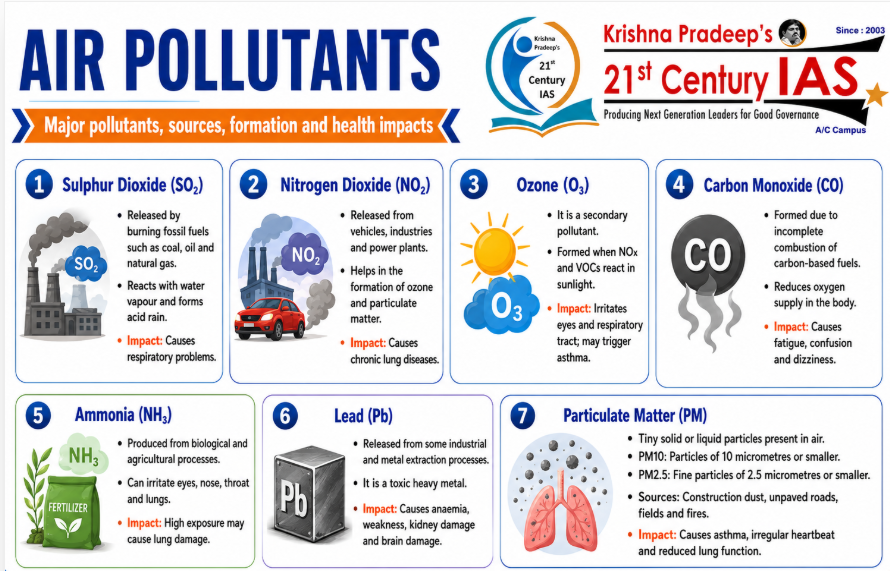
Ground-level ozone is not directly emitted from vehicles or factories. It is formed through chemical reactions in the atmosphere.
Ozone forms when:
- Nitrogen oxides (NOx) from vehicles and industries
- Volatile Organic Compounds (VOCs) from vehicle exhaust, paints, solvents and industries
react under strong sunlight and high temperature.
Hot and sunny days create favourable conditions for ozone formation. Ground-level ozone is harmful because it can irritate the lungs and worsen respiratory illnesses.
What Causes PM10 Spikes?
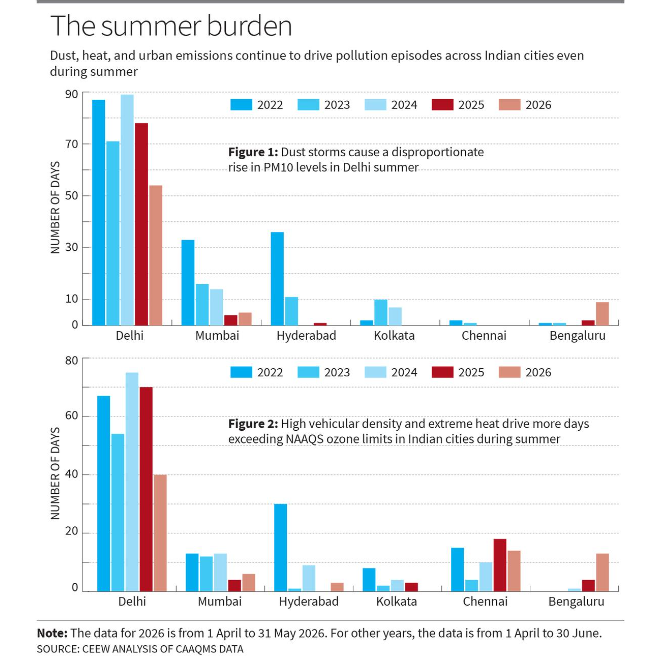
PM10 refers to particulate matter with a diameter of 10 micrometres or less. These are coarser than PM2.5 particles and often come from dust.
Major reasons for PM10 rise in summer include:
- Dust storms
- Dry soil and loose dust
- Construction and demolition activity
- Broken roads
- Vehicle movement on dusty roads
- Industrial emissions
- Local thunderstorms
PM10 levels can remain high for several days during large dust episodes.
Role of Dust Storms
During summer, hot conditions over the Indian subcontinent create a low-pressure zone. This interacts with surrounding high-pressure areas and produces hot, windy conditions.
These winds may carry dust from:
- West Asia
- Thar Desert
- Dry regions of North India
Such winds can raise PM10 levels across large areas.
Two common types of dust-related events are:
1. Loo-type Dust Storms
- Common in North India.
- Hot winds carry dust over long distances.
- They can affect air quality for several days.
2. Andhi
- Short, localised dust storms.
- Often linked with thunderstorms.
- Strong downward air hits the ground and lifts loose dust.
- Usually lasts for a shorter period.
Cities such as Mumbai and Hyderabad may experience dusty episodes due to local thunderstorms.
Role of Human Activities
Natural dust cannot be fully controlled, but human activities worsen the situation.
Important human-made contributors include:
- Construction and demolition work
- Poor dust control at construction sites
- Broken roads
- Road dust resuspension by vehicles
- Traffic emissions
- Industrial emissions
- Waste burning
- Use of paints and solvents
- Idling of vehicles at traffic signals
When winter restrictions are lifted, construction work often resumes. Without proper dust management, it increases PM10 pollution.
Impact on Public Health
Summer pollution can harm public health in several ways.
- PM10 can irritate the nose, throat and lungs.
- Ozone can worsen asthma and other respiratory diseases.
- Children, elderly people and persons with lung diseases are more vulnerable.
- Heatwaves combined with air pollution increase health risks.
- High pollution can reduce outdoor working capacity and quality of life.
Thus, summer pollution is not only an environmental issue but also a public health concern.
Government and Institutional Measures
CAQM and GRAP
The Commission for Air Quality Management uses the Graded Response Action Plan to impose pollution control measures in Delhi-NCR.
Air Quality Early Warning System
Delhi’s Air Quality Early Warning System (AQEWS) was created after severe dust storms and smog episodes. It now provides forecasts for multiple pollutants.
It gives:
- Weather information
- Air quality forecasts
- Pollution alerts
- Three-day AQI forecasts for many Indian cities
The system has also been extended to cities such as Jaipur and Mumbai.
IMD Forecasts
The India Meteorological Department issues weather forecasts several times a day. These can be used to warn citizens about dust storms, heatwaves and poor air quality.
Mumbai AQDSS
The Brihanmumbai Municipal Corporation’s Air Quality Decision Support System, developed with CEEW, helps monitor construction sites. It has helped authorities take measures against more than 1,000 construction sites since October 2025.
Challenges
- Summer pollution receives less attention than winter smog.
- Construction dust control is weak in many cities.
- Road dust management remains poor.
- Vehicle emissions continue to increase ozone-forming gases.
- Industrial compliance is uneven.
- Cities lack summer-specific clean air action plans.
- Public awareness about ozone pollution is low.
- Dust storms are natural, but preparedness is limited.
- Monitoring of VOCs is still weak in many cities.
Way Forward
- Prepare summer-specific clean air action plans for all major cities.
- Use early warning systems to issue dust storm and ozone alerts.
- Enforce dust control at construction and demolition sites.
- Repair broken roads and improve road sweeping.
- Reduce heavy vehicle movement near construction zones.
- Control NOx and VOC emissions from vehicles and industries.
- Promote cleaner public transport and electric mobility.
- Encourage behaviour such as switching off vehicles at red lights.
- Strengthen monitoring of ozone, PM10, NOx and VOCs.
- Link air pollution alerts with public health advisories.
- Treat summer and winter pollution with equal seriousness.
Conclusion
Indian cities are no longer facing air pollution only in winter. Summer brings a different pollution pattern driven by PM10, dust storms, heat and ozone formation.
While natural dust events cannot be fully prevented, their impact can be reduced through forecasting, public alerts and strong control of human-made sources. Cities need year-round clean air strategies that address both winter smog and summer pollution. Effective control of construction dust, road dust, vehicular emissions and industrial pollutants is essential for protecting public health.