
Why in News?
The Government of India has highlighted the growing role of Geographical Indication (GI) tags in protecting India’s cultural heritage and converting traditional products into global brands. GI tags are being promoted as tools of rural development, export promotion, tourism integration, intellectual property protection and Aatmanirbhar Bharat.
What is a GI Tag?
- A Geographical Indication tag is a form of intellectual property right given to products that originate from a specific geographical region and have qualities, reputation or characteristics linked to that place.
- For example, a Banarasi saree is not merely a textile product. It represents the weaving tradition, zari work and inherited craftsmanship of Banaras. A GI tag certifies that the saree is genuinely made in Banaras using traditional methods, thereby protecting both the product and the weaver’s skill.

Why GI Tags Matter for India?
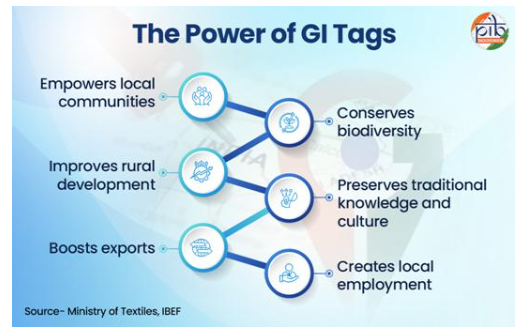
1. Protection of Traditional Knowledge
GI tags protect regional products from imitation, misuse and unauthorised commercialisation. This is important for crafts and agricultural products that depend on inherited local knowledge.
2. Better Income for Producers
By certifying origin and authenticity, GI tags improve the market value of products. As per the Ministry of Textiles, GI recognition can raise rural artisans’ incomes by 20–30%.
3. Consumer Trust
GI tags act as a seal of authenticity. They help consumers distinguish genuine products from fake or mass-produced imitations.
4. Premium Market Access
GI products can access high-value domestic and international markets because consumers increasingly value authenticity, tradition and craftsmanship.
5. Cultural Preservation
GI recognition helps preserve local traditions, indigenous craftsmanship and regional identity for future generations.
6. Rural Development
GI tags support artisans, farmers, weavers and producer groups by improving visibility, bargaining power and access to premium markets.
Legal and Institutional Framework
International Framework
Geographical Indications are recognised internationally under:
- Paris Convention for the Protection of Industrial Property
- WTO Agreement on Trade-Related Aspects of Intellectual Property Rights — TRIPS
Indian Framework
India protects GI products through the Geographical Indications of Goods (Registration and Protection) Act, 1999.
GI Rules and Timeline
- GI Rules were notified in 2002.
- The legal framework became operational in 2003.
- GI registrations started in 2004–05.
- The GI Rules were amended in 2025.
GI Registry
The registration and protection of GI products are overseen by the Geographical Indications Registry, Chennai, which has all-India jurisdiction.
2025 Amendment
The 2025 amendment reduced the fee for GI applications and related processes by 80%. The renewal fee was reduced from ₹3,000 to ₹500.
Registration, Validity and Revocation
Who Can Apply?
The following can apply for GI registration:
- Association of producers
- Organisation
- Authority established by law
The applicant must be a legal entity and must represent the interests of the producers of the concerned product.
What Cannot Be Registered as GI?
A GI cannot be registered if it:
- is a generic product name no longer protected in its country of origin;
- misleads consumers about geographical origin;
- offends religious sentiments;
- contains scandalous, offensive or obscene matter;
- violates any law in force;
- is not eligible for legal protection.
Validity and Renewal
- A GI registration is valid for 10 years.
- It can be renewed from time to time.
Can a GI Tag be Revoked?
Under Section 27 of the GI Act, a GI registration may be revoked, cancelled or varied.
Grounds for Revocation
A GI may be cancelled if:
- it was obtained through fraud or misrepresentation;
- it is no longer protected in its country of origin;
- it has fallen into disuse;
- its use is likely to deceive consumers;
- it violates any law;
- it contains scandalous or obscene matter.
India’s GI Ecosystem
India’s GI ecosystem has expanded significantly.
Important Facts for Prelims
| Fact | Details |
| Total GI products | India has over 800 registered GI products |
| GI since 2014 | 607 GIs granted since 2014 |
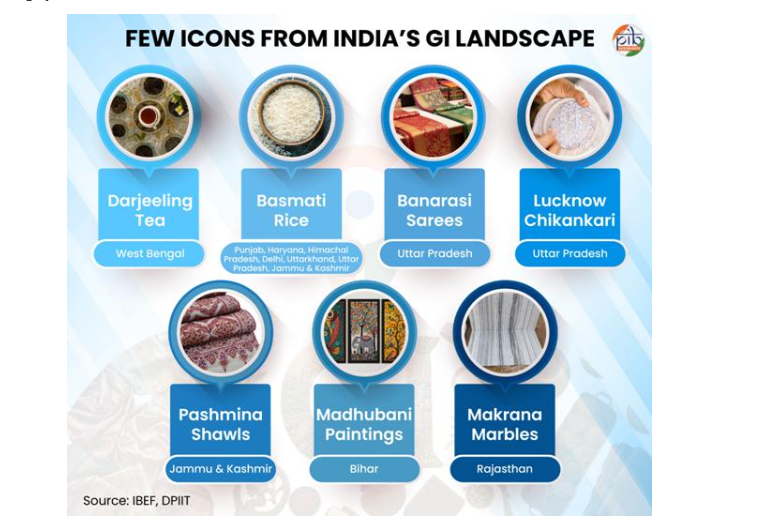
| First GI product | Darjeeling Tea from West Bengal |
| Early GI examples | Aranmula Kannadi from Kerala, Pochampalli Ikat from Telangana |
| Authorised users | Increased from 365 to 29,000 in the last 10 years |
| Export destinations | UK, Italy, UAE, Bahrain, Qatar, USA, South Korea |
Key Sectors and Leading States
India has GI-tagged products across handicrafts, agriculture, manufactured goods, food products and natural products.
| Sector | Status / Examples |
| Handicrafts | 445 handicraft products and 27 product logos registered; examples: Pashmina, Baluchari Saree, Banaras Gulabi Meenakari |
| Agriculture | 251 products covering cereals, fruits, vegetables, spices and non-basmati rice |
| Manufactured Goods | 64 products such as Nashik Valley Wine and Kannauj Perfume |
| Food Products | 66 products such as Bardhaman Mihidana, Sitabhog, Kendrapara Rasabali and Tirupati Laddu |
| Natural Products | 5 products including Makrana Marble, Chunar Balua Patthar, Lac of Purulia, Panna Diamond and Ambaji White Marble |
Leading States
As of December 2025:
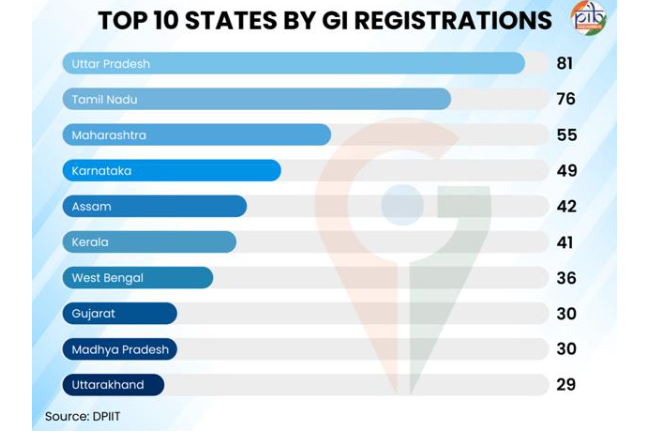
- Uttar Pradesh: 81 GI-tagged products
- Tamil Nadu: 76 GI-tagged products
- Maharashtra: 55 GI-tagged products
This shows that GI tags are becoming tools of State-level cultural branding and regional economic development.
GI Tags as Rural Economic Assets
1. Banarasi Saree
GI certification helps genuine Banarasi sarees gain recognition, prevents imitation and improves returns for weavers.
2. Channapatna Toys
Channapatna toys received GI recognition in 2006. The tag applies only to wooden toys made in Karnataka’s Channapatna region using traditional lacquerware art.
3. Muzaffarnagar Jaggery
The GI tag strengthened the identity of Muzaffarnagar Jaggery as a premium product. In 2025, Brijnandan Agro Farmer Producer Company exported 30 metric tonnes of jaggery to Bangladesh. This improved export opportunities and income prospects for its 545 members.
Government Initiatives Promoting GI Products
The Government is promoting GI products through financial assistance, market access, export promotion, legal protection, tourism integration and dedicated retail platforms.
1. PM Ekta Mall / Unity Mall
- Promotes One District One Product, GI-tagged products and handicrafts.
- An allocation of ₹5,000 crore was made for establishing these malls across States in FY 2023–24.
2. One Station One Product
- Railway stations provide dedicated stalls for regional products.
- It gives direct market access to artisans, weavers, farmers and producer groups.
3. GI Trails and Tourism Integration
GI clusters are being integrated into tourism circuits. This promotes experiential tourism and direct rural retail.
Examples include:
- Pochampally Ikat weaving village tour
- Darjeeling tea estate trail
- Muga Silk Trail in Assam
In June 2026, the Muga Silk Trail was announced in Assam along with a Silk Tourism Park and Muga Utsav festivals.
4. MSME Innovative Scheme
Under the IPR component of the MSME Innovative Scheme, eligible applicants can get reimbursement for GI registration.
- Up to 100% reimbursement
- Maximum limit of ₹2 lakh per registered GI
5. Financial Assistance for GI Protection
The Office of the Development Commissioner (Handicrafts) provides support for GI protection.
- Up to ₹1.5 lakh for enforcing GI rights
- Support for legal expenses
- Assistance under National Handloom Development Programme and National Handicrafts Development Programme
As of June 2026, 104 GI-registered handloom products and 53 registrations were supported under Handloom Marketing Assistance.
GI Tags, Exports and FTAs
APEDA’s Export Promotion
The Agricultural and Processed Food Products Export Development Authority supports GI agricultural products through:
- quality improvement
- capacity building
- infrastructure support
- market promotion
- opening new export markets
Recent Export Examples
| Market | GI Product | Key Impact |
| Maldives | Karnataka GI fruits | 40–50% higher returns for farmers |
| Canada | Salem Sago | Expanded demand and better incomes |
| UK and Italy | Joha Rice | New export markets and better price realisation |
| Dubai | Tezpur Litchi | Around 10% higher prices for growers |
FTA Linkage
Free Trade Agreements increase the value of GI products by reducing trade barriers and securing formal protection.
- After the India–Oman CEPA, 3 metric tonnes of Indi Lime from Karnataka were exported to Oman in December 2025.
- New Zealand has committed to enabling registration of Indian GI products such as Darjeeling Tea, Basmati Rice and region-specific handicrafts.
- India and the European Union continue negotiations on a dedicated GI agreement.

Promotional Events and Global Visibility
GI products are being promoted through exhibitions, fairs, awareness programmes and international events.
Domestic Promotion
GI products have been showcased through:
- craft fairs
- Dilli Haat events
- GI promotion programmes
- GI & Beyond: Virasat se Vikas Tak
- World Food India 2025
- Tribal Business Conclave 2025
- India AI Impact Summit 2026
They are also displayed at Varanasi, Delhi and Mumbai airports, and in Delhi Metro.
International Promotion
Indian GI products have been promoted overseas through events such as:
- Autumn Fair International 2024, Birmingham
- Bazaar Berlin 2024, Germany
Challenges in Scaling GI Products
1. Low Awareness Among Producers
Many artisans and farmers are unaware of GI registration, authorised user status and legal benefits.
2. Imitation and Misuse
Fake GI-like products reduce consumer trust and hurt genuine producers.
3. Weak Branding and Packaging
Many GI products lack modern packaging, digital marketing and brand identity.
4. Limited Authorised Users
Even genuine producers may not be formally registered as authorised users, reducing direct benefits.
5. Quality Standardisation
Export markets require consistent quality, traceability and certification.
6. Market Access Gaps
GI recognition alone cannot increase income unless linked with retail platforms, e-commerce, tourism and exports.
Way Forward
1. Expand GI Registration
India should identify more traditional, tribal, agricultural and craft-based products for GI registration.
2. Increase Authorised Users
More genuine producers must be registered as authorised users so that benefits reach local communities.
3. Strengthen Enforcement
Strict action is needed against fake branding, imitation and unauthorised commercial use.
4. Improve Branding and Packaging
GI products need better design, packaging, storytelling, quality certification and digital promotion.
5. Link GI with Exports
APEDA, MSME Ministry and State agencies should connect GI products with global buyers.
6. Promote GI Tourism
GI Trails can convert craft clusters and agricultural regions into tourism and rural retail hubs.
7. Use FTAs Strategically
India should secure GI protection in trade agreements, especially with the EU, New Zealand and other premium markets.
Conclusion
GI tags are not merely legal certificates; they are instruments of heritage protection, rural development, cultural branding and export-led growth. By protecting regional identity and empowering artisans, farmers and producer groups, GI tags can transform traditional products into global brands. With a target of 10,000 GI registrations by 2030, India has an opportunity to build a strong heritage economy that connects tradition with markets, culture with livelihoods and local products with global value chains.
Why in News?
The Environmental Performance Index 2026 was recently released. India ranked 176th out of 177 countries, while Estonia topped the index. The report has again brought attention to India’s environmental performance, climate governance, sustainability indicators and the debate over global environmental rankings.
What is the Environmental Performance Index?
The Environmental Performance Index is a biennial global index that ranks countries based on their environmental performance.
It acts as a data-driven scorecard to assess how well countries are performing in areas such as:
- air quality
- water quality
- biodiversity
- sustainable forestry
- greenhouse gas reduction
- climate change action
- ecosystem vitality
- environmental public health
The index helps policymakers track sustainability progress, identify ecological vulnerabilities and improve environmental policy.
Institutions Behind EPI
The EPI is developed by:
- Yale Center for Environmental Law & Policy
- Columbia University’s Center for International Earth Science Information Network
- Yale Center for Geospatial Solutions
- Supported by the McCall MacBain Foundation
Methodology of EPI 2026
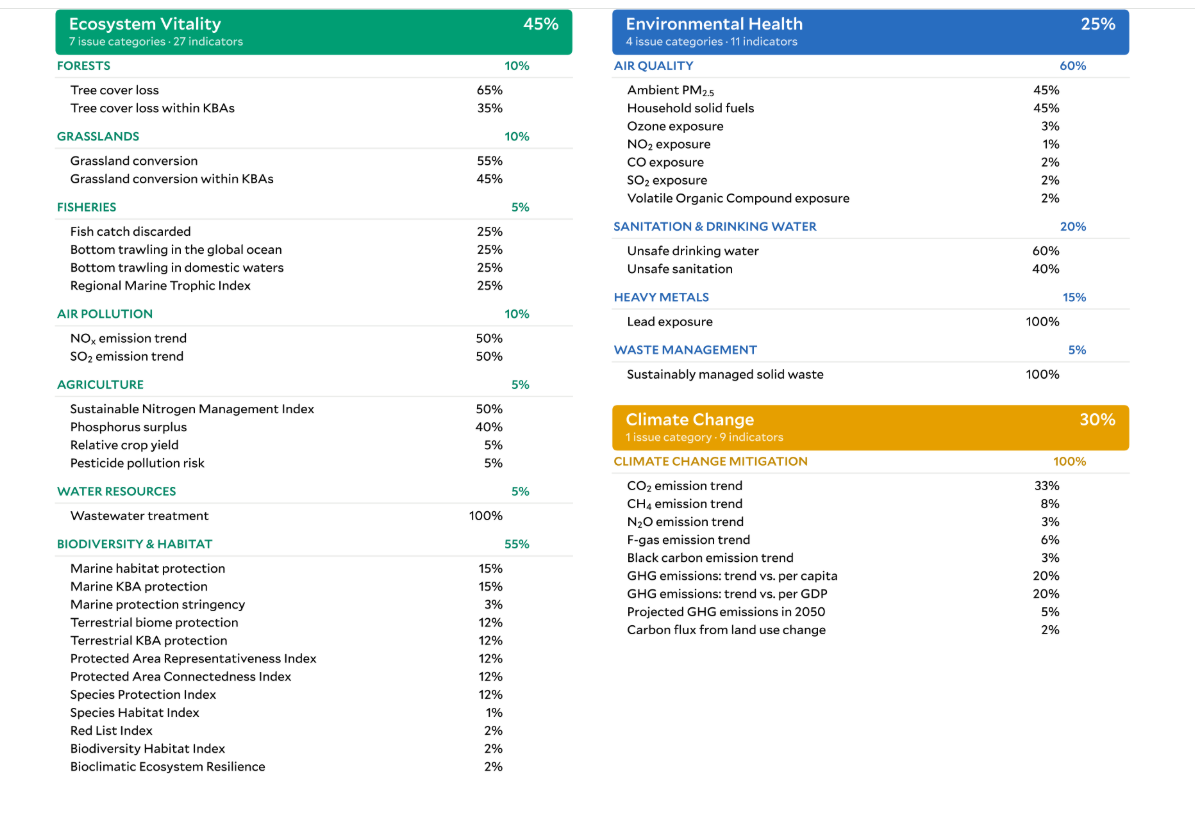
The EPI 2026 assessed:
- 177 countries
- 47 specific metrics
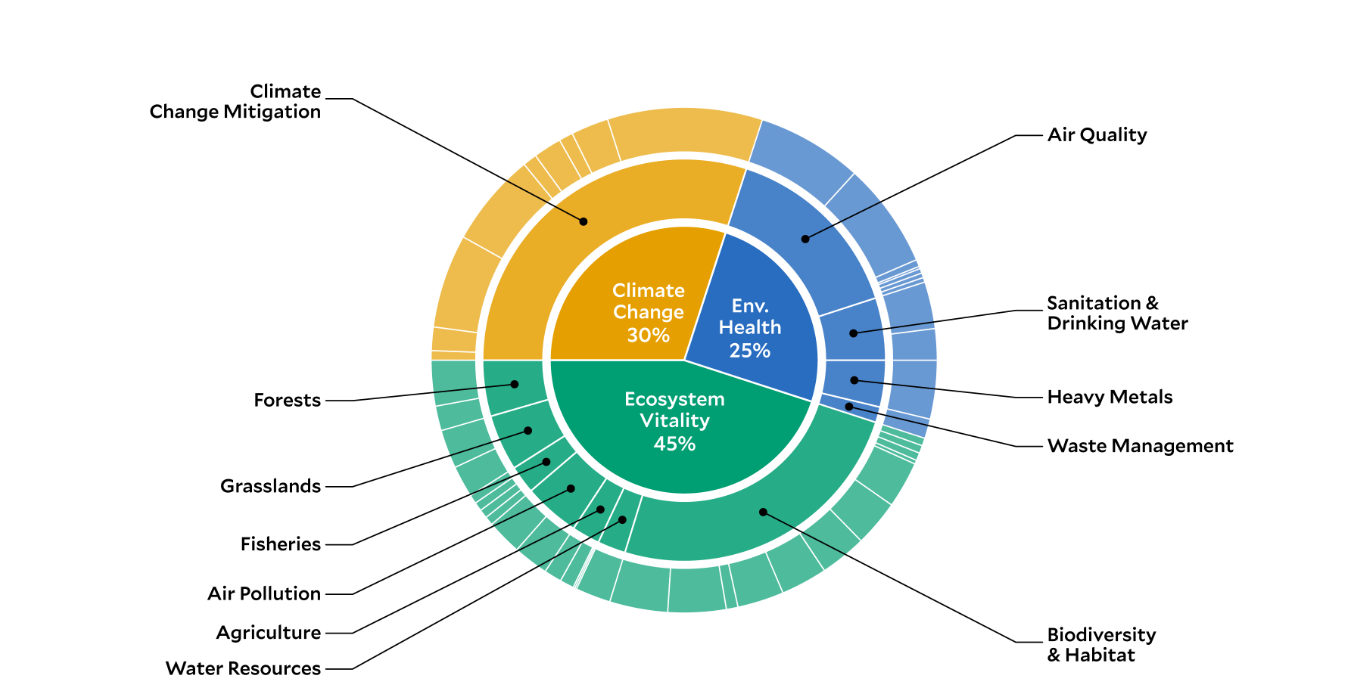
- 12 issue categories
- 3 broad policy objectives
Three Policy Objectives
| Policy Objective | Focus Area |
| Environmental Health | Air quality, water, sanitation and public health |
| Ecosystem Vitality | Biodiversity, forests, fisheries and natural resources |
| Climate Change | Greenhouse gas reduction and decarbonisation |
The index is also linked to broader global goals such as the UN Sustainable Development Goals and the Paris Climate Agreement.
Global Rankings in EPI 2026
European countries dominated the top ranks.
Top 10 Countries in EPI 2026
| Rank | Country |
| 1 | Estonia |
| 2 | Luxembourg |
| 3 | United Kingdom |
| 4 | Finland |
| 5 | Netherlands |
| 6 | Germany |
| 7 | France |
| 8 | Norway |
| 9 | Sweden |
| 10 | Austria |
Key Global Facts
- Estonia ranked 1st with a score of 74.79.
- Laos ranked lowest with a score of 21.78.
- Five European countries occupied the top five positions.
- EPI 2026 scores showed a strong correlation with national wealth, with a correlation value of r = 0.69.
This means richer countries generally perform better, though some countries outperform or underperform within their income group.
India’s Performance in EPI 2026
India ranked 176th out of 177 countries, second from the bottom.
India’s Key Scores
| Indicator | India’s Performance |
| Rank | 176th / 177 |
| Overall EPI Score | 22.46 |
| Regional Average | 31.81 |
| Tree Cover Loss in Key Biodiversity Areas | -3.92 |
India’s low rank reflects concerns related to air pollution, biodiversity pressure, climate vulnerability and sustainability challenges.
India’s Objection to EPI Methodology
- India has previously questioned the methodology of the EPI.
- In 2022, when India ranked 180th out of 180 countries, the Ministry of Environment, Forest and Climate Change rejected the ranking. It argued that the index used indicators based on unfounded assumptions, extrapolations and unscientific methods.
Other Important Climate-Related Indices
EPI should be studied along with other climate-related indices such as:
- Climate Change Performance Index
- Climate Risk Index
These indices measure different aspects of climate and environmental performance.
Climate Change Performance Index 2026
The Climate Change Performance Index is an independent monitoring tool that tracks the climate mitigation performance of 63 countries and the European Union.
It is published by:
- Germanwatch
- New Climate Institute
- Climate Action Network International
CCPI Assessment Categories
| Category | Weightage |
| GHG Emissions | 40% |
| Renewable Energy | 20% |
| Energy Use | 20% |
| Climate Policy | 20% |
CCPI 2026 Top Rankings
The top three positions remained vacant because no country achieved a “very high” rating.
| Rank | Country | Score |
| 1 | Vacant | — |
| 2 | Vacant | — |
| 3 | Vacant | — |
| 4 | Denmark | 80.52 |
| 5 | United Kingdom | 70.80 |
| 6 | Morocco | 70.75 |
| 7 | Chile | 70.63 |
| 8 | Luxembourg | 70.45 |
| 9 | Lithuania | 70.30 |
| 10 | Netherlands | 67.27 |
India in CCPI 2026
- India ranked 23rd.
- India’s score was 61.31.
- India fell 13 places from its earlier rank of 10th.
- Saudi Arabia ranked last at 67th position with a score of 11.9.
Climate Risk Index 2026
The Climate Risk Index is released by Germanwatch.
It measures the impact of climate-related extreme weather events on countries.
What Does CRI Measure?
The index ranks countries based on:
- fatalities
- people affected
- economic losses
- long-term exposure to climate disasters
The country most affected by climate-related disasters is ranked highest.
India in Climate Risk Index 2026
India ranked 9th among countries most affected by climate-related disasters over the last 30 years.
India’s Climate Vulnerability: 1995–2024
| Indicator | India’s Status |
| Rank | 9th most affected globally |
| Extreme weather events | 430 |
| Economic losses | $170 billion |
| Fatalities | 80,000 |
| Share of global deaths | 9.6% |
Top 10 Most Affected Countries
| Rank | Country |
| 1 | Dominica |
| 2 | Myanmar |
| 3 | Honduras |
| 4 | Libya |
| 5 | Haiti |
| 6 | Grenada |
| 7 | Philippines |
| 8 | Nicaragua |
| 9 | India |
| 10 | The Bahamas |
Significance for India
1. Environmental Governance Alert
India’s low EPI rank highlights the need to strengthen environmental regulation, pollution control and ecological conservation.
2. Climate Vulnerability Concern
India’s CRI ranking shows that the country remains highly vulnerable to floods, cyclones, heatwaves and extreme rainfall events.
3. Development-Environment Balance
India must pursue growth while reducing pollution, protecting forests and improving resource efficiency.
4. Global Climate Negotiations
These indices influence global perceptions of India’s environmental performance and climate commitments.
5. Policy Course Correction
They help identify areas needing improvement, such as air quality, biodiversity protection, waste management and emissions reduction.
Concerns and Limitations
1. Methodological Disputes
India has questioned EPI methodology, especially the use of assumptions and extrapolated indicators.
2. Wealth Bias
EPI scores are strongly correlated with country wealth, which may disadvantage developing countries with large populations and developmental needs.
3. Different Indices, Different Outcomes
India ranks poorly in EPI but performs relatively better in CCPI. This shows that indices measure different aspects of sustainability.
4. Data Quality Issues
Environmental data collection and reporting vary across countries, affecting comparability.
5. Limited Reflection of Equity
Indices may not fully capture principles such as Common but Differentiated Responsibilities and historical emissions.
Way Forward
1. Improve Air and Water Quality
India must strengthen pollution control, urban planning, clean fuel transition and river conservation.
2. Protect Biodiversity and Forests
Tree cover loss in key biodiversity areas must be reduced through stronger conservation and monitoring.
3. Accelerate Clean Energy Transition
Renewable energy, green hydrogen, electric mobility and energy efficiency should be scaled up.
4. Improve Climate Adaptation
India needs better disaster preparedness, climate-resilient infrastructure and early warning systems.
5. Strengthen Environmental Data Systems
Transparent, scientific and real-time environmental data can improve both policy and global reporting.
6. Engage with Global Index Makers
India should constructively engage with global ranking institutions to ensure fair methodology and accurate data.
7. Promote Sustainable Development
Environmental policy must integrate livelihood security, energy access and ecological protection.
Conclusion
The Environmental Performance Index 2026 places India near the bottom, raising concerns about environmental quality and sustainability. However, India’s performance must be understood with methodological debates, development challenges and climate equity concerns. The larger lesson is clear: India needs stronger environmental governance, credible data systems, faster clean energy transition and climate-resilient development. Global rankings should not be treated as final judgments, but as tools for policy reflection and improvement.