Table of Contents
Relevance: TGPSC Public Health, Tribal Health, Health Infrastructure, Medical Research
For Prelims:
- GANSID Congress 2026 | Sickle Cell Disease | Thalassemia | Haemoglobin Disorder | CRISPR Gene Therapy
For Mains:
- Inherited blood disorders | Tribal health vulnerability | Health equity | Science-to-access gap | Public health implementation
Why in News?
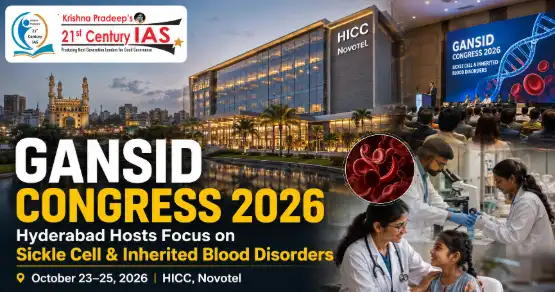
Hyderabad will host the GANSID Congress 2026 from October 23 to 25, 2026, at HICC, Novotel. The event will be organised in collaboration with GANSID, USA, and hosted by the Thalassemia and Sickle Cell Society, Hyderabad, as the local partner. The Congress will focus on scientific advances, patient care, access to treatment and implementation challenges in sickle cell disease and other inherited blood disorders.
About GANSID Congress 2026
- GANSID stands for the Global Action Network for Sickle Cell and Other Inherited Blood Disorders.
- The GANSID Congress 2026 will bring together experts working in the field of inherited blood disorders.
Key Details
| Aspect | Details |
| Event | GANSID Congress 2026 |
| Venue | HICC, Novotel, Hyderabad |
| Dates | October 23–25, 2026 |
| Collaborating Body | GANSID, USA |
| Host / Local Partner | Thalassemia and Sickle Cell Society, Hyderabad |
| Focus Area | Sickle cell disease and other inherited blood disorders |
Theme of the Congress
The theme of the Congress is:
“From Innovation to Implementation: Bridging Science and Access in Inherited Blood Disorders.”
What are Inherited Blood Disorders?
Inherited blood disorders are genetic conditions passed from parents to children. They affect the structure, production or functioning of blood cells or haemoglobin.
Important Examples
- Sickle Cell Disease
- Thalassemia
- Other inherited haemoglobin disorders
These conditions require early diagnosis, lifelong care, genetic counselling, regular monitoring and access to specialised treatment.
About Sickle Cell Disease
- Sickle Cell Disease is an inherited haemoglobin disorder.
- It is caused by a genetic mutation that affects red blood cells.
- Normal red blood cells are round and flexible.
- In sickle cell disease, red blood cells become sickle-shaped or crescent-shaped.
- These sickle-shaped cells become rigid and do not flow smoothly through blood vessels.
- This can block blood flow and cause pain, anaemia and organ damage.
- As per the Ministry of Health and Family Welfare, marginalised tribal populations are among the most vulnerable groups affected by sickle cell disease.
Symptoms of Sickle Cell Disease
Common symptoms include:
- Chronic anaemia, leading to fatigue, weakness and paleness
- Painful episodes, also known as sickle cell crises
- Sudden pain in bones, chest, back, arms and legs
- Delayed growth in children
- Delayed puberty
- Repeated infections
- Organ-related complications in severe cases
Treatment Options
1. Blood Transfusions
Blood transfusions help relieve anaemia and reduce the risk of severe complications.
2. Hydroxyurea
Hydroxyurea can reduce the frequency of painful episodes and help prevent some long-term complications.
3. Bone Marrow or Stem Cell Transplantation
Stem cell transplantation can offer curative potential in selected cases, though access, cost and donor availability remain major challenges.
4. Gene Therapy and CRISPR-Based Approaches
Newer technologies such as gene therapy and CRISPR are emerging as promising treatment options. However, the major challenge is ensuring affordability and access for vulnerable communities.
Conclusion
The GANSID Congress 2026 in Hyderabad is significant because it brings global attention to sickle cell disease and inherited blood disorders. These diseases are not merely medical conditions; they are linked with tribal health, equity, access and public health governance. Scientific innovation must be matched with affordable diagnosis, treatment, counselling and community outreach. The Congress can help bridge the gap between research, policy and patient care, making inherited blood disorder management more inclusive and effective.
CARE MCQ
Q. Consider the following statements regarding sickle cell disease:
- It is an inherited haemoglobin disorder.
- It causes red blood cells to become sickle or crescent shaped.
- It can lead to anaemia, painful episodes and organ damage.
- It is caused by bacterial infection and spreads through contaminated water.
Which of the statements given above are correct?
(a) 1, 2 and 3 only
(b) 1 and 4 only
(c) 2, 3 and 4 only
(d) 1, 2, 3 and 4
Answer: (a) 1, 2 and 3 only
Explanation
Statements 1, 2 and 3 are correct. Sickle cell disease is an inherited haemoglobin disorder in which red blood cells become sickle-shaped, causing anaemia, pain crises and organ-related complications.
Statement 4 is incorrect because sickle cell disease is genetic, not a bacterial or water-borne disease.
FAQs
1. What is GANSID?
GANSID stands for Global Action Network for Sickle Cell and Other Inherited Blood Disorders.
2. Where will GANSID Congress 2026 be held?
It will be held at HICC, Novotel, Hyderabad.
3. When will GANSID Congress 2026 take place?
From October 23 to 25, 2026.
4. Who is hosting the Congress locally?
The Thalassemia and Sickle Cell Society, Hyderabad.
5. What is the theme of GANSID Congress 2026?
“From Innovation to Implementation: Bridging Science and Access in Inherited Blood Disorders.”
6. What is sickle cell disease?
It is an inherited haemoglobin disorder in which red blood cells become sickle-shaped.