Why in News?
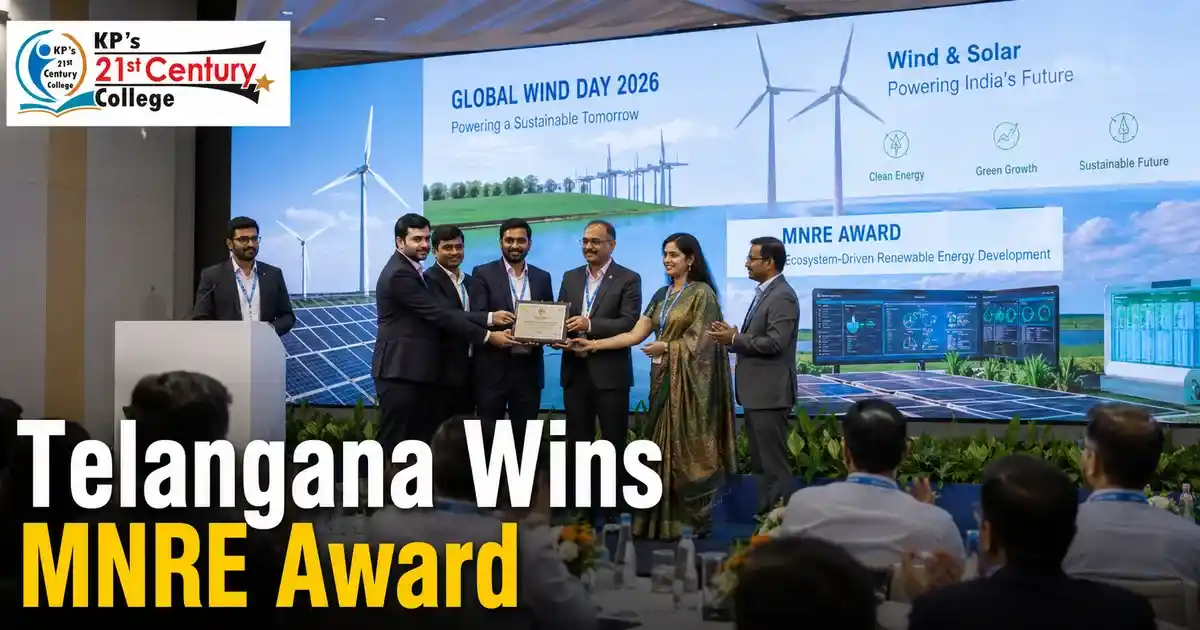
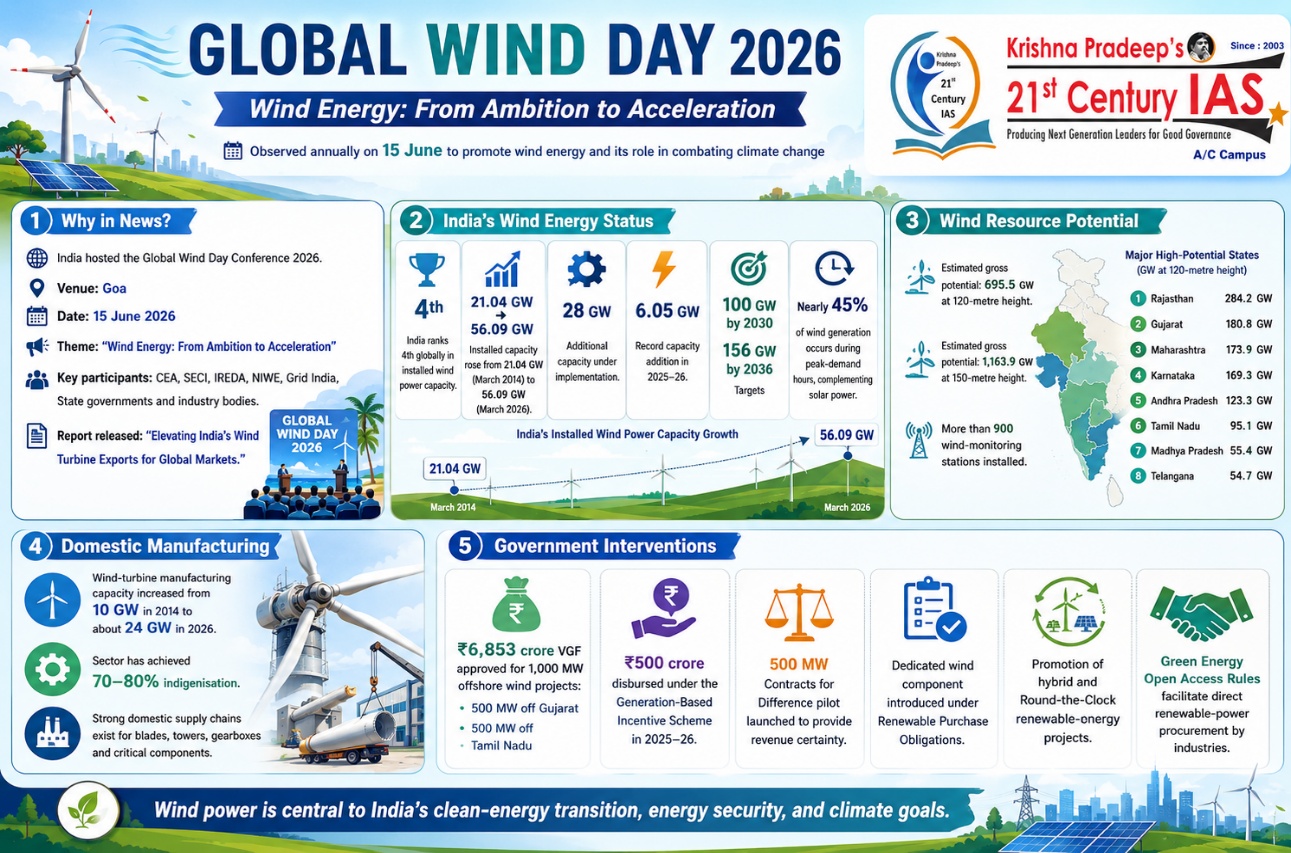
Telangana participated in the Global Wind Day 2026 National Conference, organised by the Ministry of New and Renewable Energy in Goa under the theme “Wind Energy: From Ambition to Acceleration.”
The State was also conferred with the Inclusive Enterprise and Ecosystem Development Award for its ecosystem-driven approach to renewable-energy development.
Global Wind Day Conference
Telangana was represented by:
- Navin Mittal, Special Chief Secretary, Energy
- V. Anila, Vice-Chairman and Managing Director, TGREDCO
The conference was attended by Union Minister for New and Renewable Energy Pralhad Joshi and other dignitaries.
The event provided Telangana with a national platform to showcase its wind-resource potential and renewable-energy planning.
Telangana’s Wind-Energy Potential
Assessments by the National Institute of Wind Energy indicate that Telangana possesses substantial untapped wind potential.
| Hub Height | Assessed Wind Potential |
| 100 metres | 4,240 MW |
| 120 metres | 24,835 MW |
| 150 metres | 54,717 MW |
The sharp increase in potential at higher hub heights indicates that taller and more advanced wind turbines can access stronger and more consistent winds.
What is Hub Height?
Hub height is the distance from the ground to the central part of a wind turbine where the blades and rotor are attached.
Higher hub heights may offer:
- Stronger wind speeds
- More stable wind flow
- Higher electricity generation
- Better project viability
High Wind-Density Zones
High wind-density zones have been identified across the erstwhile districts of:
- Nalgonda
- Mahabubnagar
- Rangareddy
- Medak
- Hyderabad
- Nizamabad
These areas can be considered for detailed technical studies and future wind-project development.
Wind-Resource Monitoring
TGREDCO, with support from NIWE, installed 139 wind-monitoring masts across the identified districts.
Private developers installed an additional 25 masts.
Total Monitoring Network
- TGREDCO and NIWE: 139 masts
- Private developers: 25 masts
- Total: 164 masts
This network has created a strong wind-resource database for future project planning.
Role of Wind-Monitoring Masts
Wind-monitoring masts collect information on:
- Wind speed
- Wind direction
- Wind density
- Seasonal variation
- Site suitability
- Expected power-generation potential
Reliable data helps reduce investment risk and identify commercially viable locations.
Present Wind Capacity
Despite its large assessed potential, Telangana has commissioned only 128.8 MW of wind-power capacity.
This reveals a major gap between:
- Resource potential, and
- Actual installed capacity
It also indicates significant scope for accelerated investment and project development.
Significance
Renewable-Energy Diversification
Wind power can complement other renewable-energy sources and diversify Telangana’s energy mix.
Energy Security
Locally generated wind energy can strengthen the State’s electricity supply.
Investment Potential
The large gap between assessed potential and installed capacity creates opportunities for new investment.
Data-Driven Governance
The wind-monitoring network supports evidence-based planning and project selection.
Green Development
Wind power can contribute to cleaner energy generation and sustainable economic growth.
Employment Creation
Wind projects can generate jobs in construction, installation, operation and maintenance.
Challenges
- Converting assessed potential into operational projects
- Availability of suitable and pre-cleared land
- Construction of evacuation infrastructure
- Financial viability of tariffs
- Timely clearances
- Integration of variable wind power into the grid
- Attracting long-term private investment
Conclusion
Telangana possesses substantial wind-energy potential, estimated at up to 54,717 MW at a hub height of 150 metres. However, only 128.8 MW has been commissioned so far.
The State’s extensive monitoring network and national recognition provide a strong foundation. The next step is to convert wind-resource data into projects through transparent bidding, pre-cleared land, assured grid evacuation and effective institutional coordination.