Why in News?
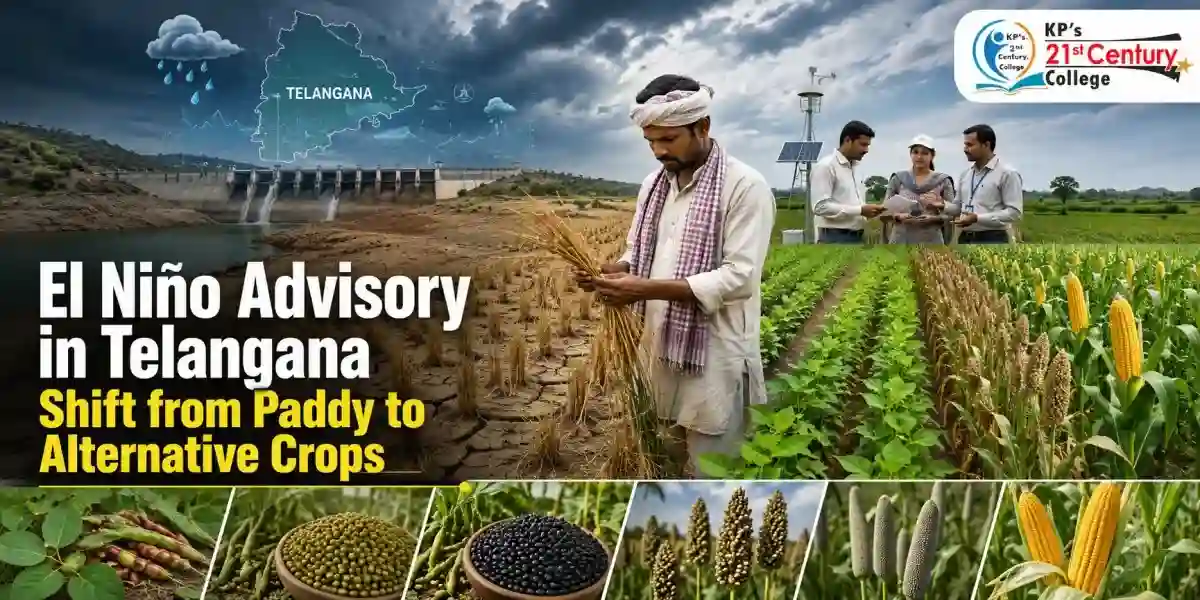
The Telangana Agriculture Department has launched a campaign asking farmers to avoid water-intensive paddy cultivation and choose short-duration alternative crops during the Kharif season due to the possibility of poor rainfall linked to El Niño.
The department has warned that below-normal rainfall in the Krishna and Godavari river catchments may reduce reservoir inflows, affecting irrigation supply and timely paddy sowing.

What is El Niño?
- El Niño is a climatic phenomenon caused by the abnormal warming of surface waters in the central and eastern equatorial Pacific Ocean.
- Under normal conditions, trade winds blow from east to west across the Pacific Ocean. This pushes warm water towards Indonesia and allows cold water to rise near the Peru coast. This rising of cold water is called upwelling.
- During El Niño, trade winds weaken or reverse. Warm water moves eastwards and suppresses cold water upwelling in the eastern Pacific Ocean. This increases sea surface temperatures and disturbs atmospheric circulation, especially the Walker Circulation.
- El Niño generally occurs once in 2 to 7 years and usually lasts for about 9 to 12 months, though it may continue longer in some cases.
El Niño and Indian Monsoon
El Niño often weakens the Indian southwest monsoon. It can reduce rainfall and increase the chances of drought-like conditions.
Its major impacts include:
- Reduced monsoon rainfall in India.
- Lower water availability in reservoirs.
- Delayed sowing of Kharif crops.
- Stress on irrigation-dependent crops.
- Higher risk for paddy cultivation.
- Impact on agriculture, drinking water and livestock.
Globally, El Niño may cause heavy rainfall and flooding in parts of western South America, while causing drought-like conditions in India, Australia and Indonesia.
Why Paddy is a Concern?
- Paddy is a water-intensive crop. It needs assured water supply during different stages of growth.
- In Telangana, paddy has become a dominant crop in recent years. However, if rainfall is poor and reservoir inflows are delayed, paddy cultivation may face serious risks.
The Agriculture Department has warned that poor rainfall in:
- Karnataka’s Krishna basin catchments may reduce inflows into Srisailam, Jurala and Nagarjunasagar reservoirs.
- Godavari river catchments may reduce water availability for irrigation.
This can directly affect timely paddy sowing and crop survival.
Agriculture Department’s Campaign
The department has started a farmer awareness campaign to promote climate-resilient crop choices.
Major features include:
- Social media campaign through YouTube.
- Awareness video explaining El Niño and alternative crops.
- Messages shared through a WhatsApp channel with around 57,000 farmers.
- Weather messaging service to reach nearly 15 lakh farmers.
- Direct outreach through district-level officials.
- Farmer advisories based on updated weather conditions.
Agriculture Commissioner Dr. B. Gopi said that the department will continue updating farmers as weather conditions change.
Contingency Agriculture Plan
The department has prepared district-wise contingency agriculture plans for three rainfall situations:
- No rain till July 15
- No rain till July 30
- No rain till August 15
These plans will guide farmers on what crops to grow depending on rainfall delay.
District Collectors will act as nodal officers for implementing the plan according to local weather conditions.
Suggested Crop Strategy
- If Monsoon is Delayed
Farmers are advised to avoid long-duration paddy varieties and instead choose crops that need less water and mature quickly.
- If Farmers Still Choose Paddy
They should select short-duration paddy varieties with a crop period of 125 days or less.
Recommended Alternative Crops
The Agriculture Department has suggested major contingency crops such as:
- Red gram , Green gram , Black gram , Jowar, Bajra, Maize
These crops are more suitable under poor rainfall conditions because they need comparatively less water and have shorter crop duration.
Challenges
- Farmers may hesitate to shift from paddy due to market and procurement concerns.
- Availability of quality seeds for alternative crops must be ensured.
- Farmers need assured prices and market linkages for pulses and millets.
- Delayed rainfall may still affect even short-duration crops.
- Small farmers may lack access to irrigation-saving technologies.
- Crop diversification requires continuous extension support.
Way Forward
- Strengthen village-level crop advisory systems.
- Provide assured seed supply for pulses, millets and maize.
- Promote procurement support for alternative crops.
- Encourage micro-irrigation and water-saving methods.
- Link crop planning with reservoir water availability.
- Use weather-based advisories in local languages.
- Promote millets and pulses as climate-resilient crops.
- Coordinate agriculture, irrigation and disaster management departments.
- Provide crop insurance support for farmers facing climate risks.
Conclusion
The Telangana Agriculture Department’s El Niño advisory is an important step towards climate-resilient agriculture. As paddy requires high water availability, farmers need to adjust crop choices according to rainfall and reservoir conditions.
Short-duration crops such as pulses, millets and maize can reduce risk during poor monsoon years. The success of the campaign will depend on timely weather advisories, seed availability, farmer awareness, market support and strong coordination among government departments.