Special Intensive Revision (SIR) of Electoral Rolls
Table of Contents
Source: The Hindu, The Indian Express, PIB, Rangarajan (Explainer)
Relevance: Facts for Prelims, GS Paper II – Government Policies & Interventions
Key Concepts for Prelims and Mains:
For Prelims:
- Special Intensive Revision (SIR) of electoral rolls
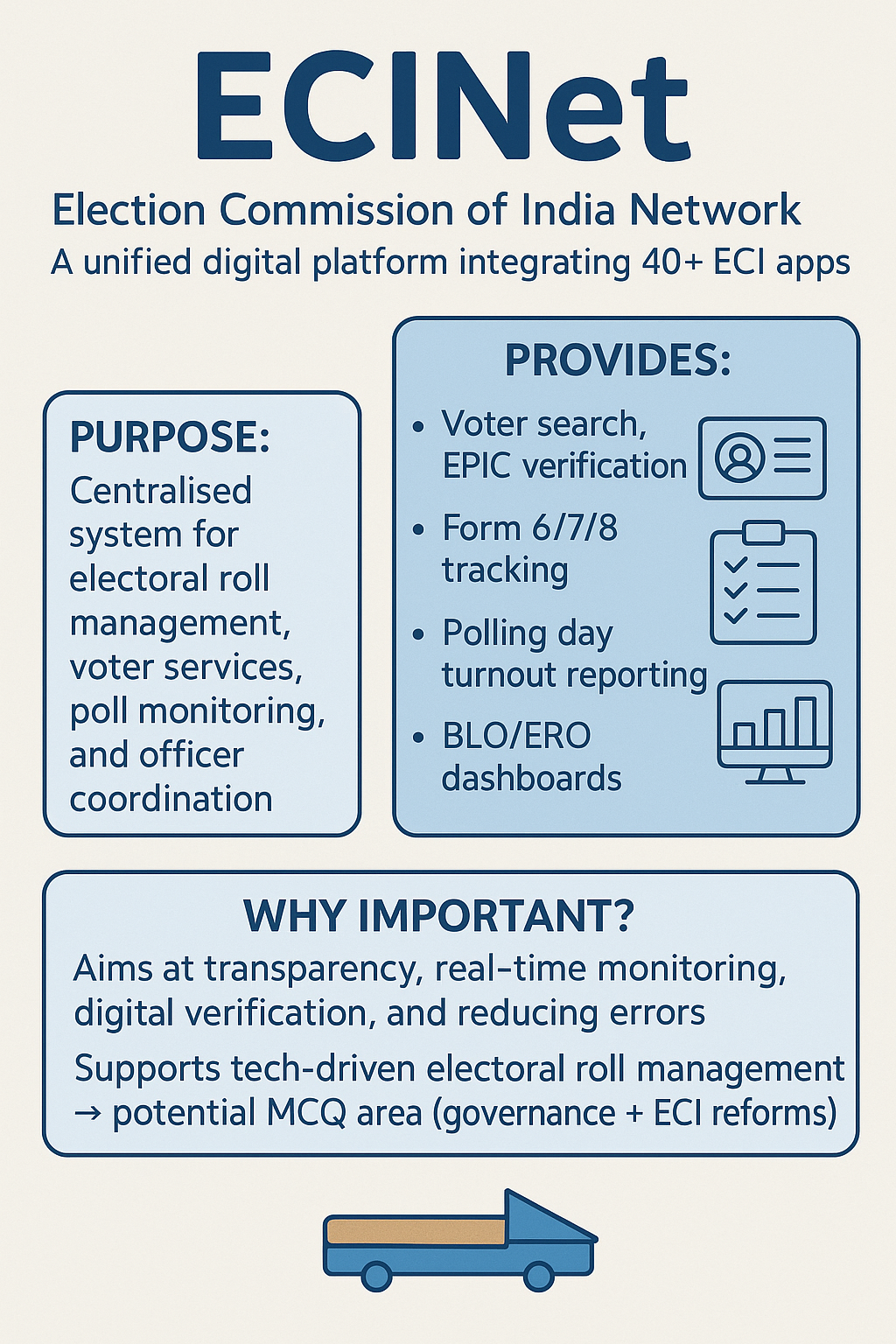
- Election Commission of India (ECI), ECINET (digital platform)
- Representation of the People Act, 1950 — Sections 16, 19, 20, 21(3), 23, 24
- Article 324, 326 of the Constitution
- Aadhaar / UIDAI, CAG Audit Report (2021), Standing Committee on Finance (2010/2011)
For Mains:
- Electoral integrity vs. inclusion (one person one vote)
- Significance of SIR
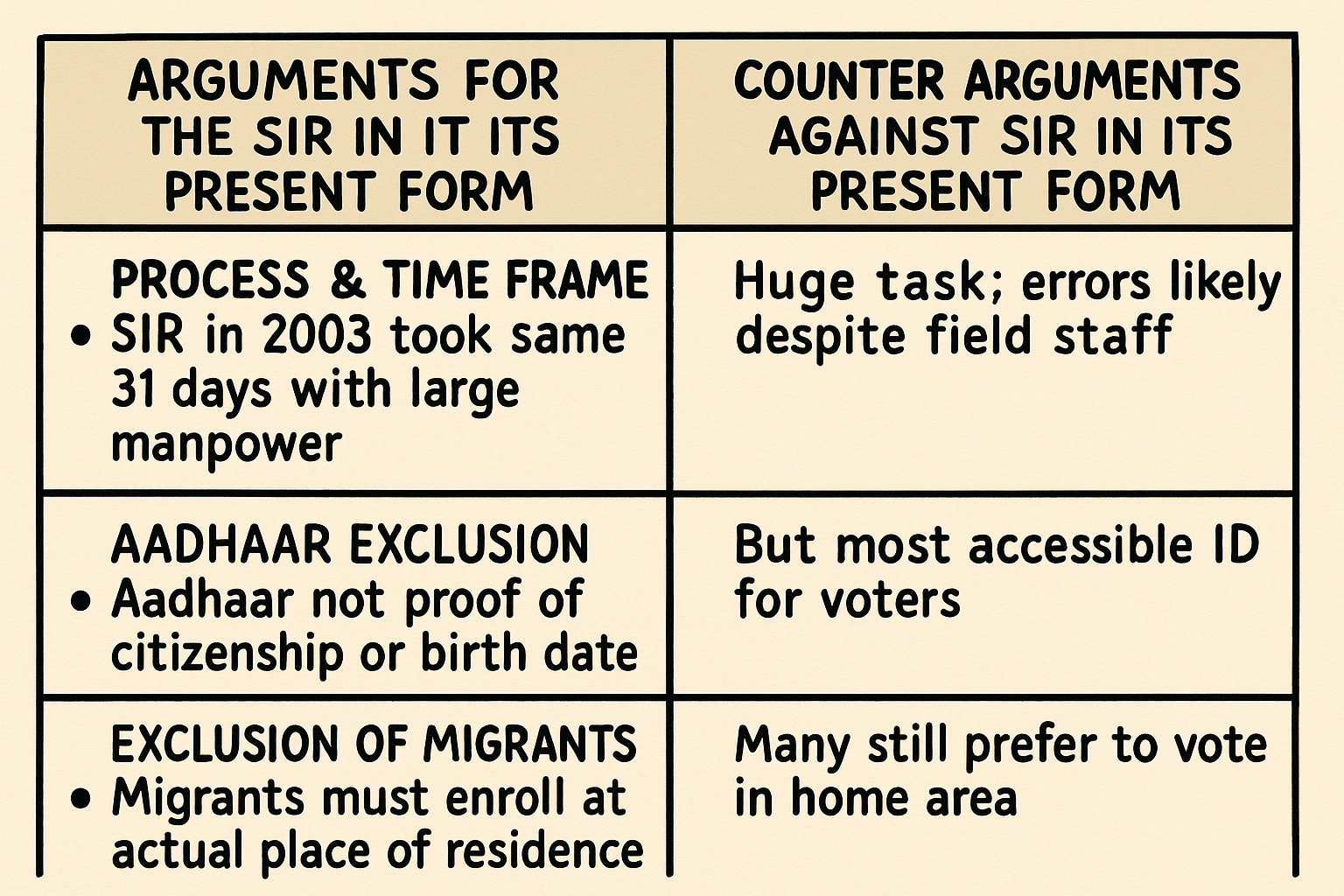
- Challenges of SIR and Measures to Improve SIR
- What is Electoral Roll, legal basis and Types of Electoral Roll
Why in News?
- The Election Commission of India (ECI) has launched a Special Intensive Revision (SIR) beginning with Bihar, covering 8 crore electors, with final rolls expected by 30 September 2025.
- Under SIR 2.0, distribution and submission of enumeration forms (including online forms) continues till 4 December, and draft rolls will be published on 9 December.
- Exercise initiated after allegations that illegal immigrants in some states were enrolled through Aadhaar, prompting a national roll-purification drive.
- Kerala has approached the High Court challenging SIR’s implementation.

Booth level officer (BLOs) distributing enumeration forms to voters as part of Special Intensive Revision (SIR) exercise in West Bengal (The Hindu)
What is SIR (Special Intensive Revision)?
- Special Intensive Revision (SIR) is a full-scale, house-to-house re-verification of electoral rolls conducted when large inaccuracies, illegal entries, duplicates or ghost voters are suspected.
- It goes beyond routine Summary Revision and requires fresh enumeration forms from every elector.
- SIR is used selectively under Section 21(3) of the RPA 1950, which allows the ECI to conduct a special revision “in such manner as it thinks fit.”
- SIR is meant to rebuild clean, verified, citizenship-based electoral rolls before major elections.
Why is SIR Happening in Bihar?
- Earlier Aadhaar enrolment had weak verification, especially before 2016.
- Fears that ineligible persons/illegal immigrants may have been added to voter rolls using Aadhaar.
- Bihar has high migration, leading to large additions and deletions in rolls.
- The last full SIR in Bihar was in 2003, making current rolls outdated.
- Large number of duplicate/ghost entries suspected.
- Needed before the 2025 Assembly elections to ensure accurate and citizenship-based rolls.
Objectives of the Special Intensive Revision (SIR)
- Re-verify and purify electoral rolls where errors are high.
- Remove non-citizens, illegal immigrants, duplicate entries, ghost voters, and deceased persons.
- Add newly eligible voters (18+).
- Ensure roll accuracy in terms of ordinary residence (Section 20, RPA 1950).
- Upload verification documents to ECINET for transparent record-keeping.
- Strengthen public trust before significant elections like Bihar Assembly 2025.
States Currently Covered Under SIR (2025 Phase)
- Andaman & Nicobar, Chhattisgarh, Goa, Gujarat, Lakshadweep, Madhya Pradesh, Puducherry, Rajasthan, Uttar Pradesh.
- Poll-bound West Bengal, Tamil Nadu, Kerala (2026 elections).
Significance of the Exercise SIR
- Ensures clean and credible electoral rolls.
- Addresses security concerns related to Aadhaar verification gaps.
- Improves turnout accuracy, booth planning, and constituency management.
- Facilitates future reforms like remote voting, digital voter services, and civil registry synchronisation.
Key Challenges of SIR
1. Documentation Barriers
- Marginalised groups may be unable to produce birth or residence documents, risking disenfranchisement.
2. Aadhaar Verification Gaps
- CAG 2021 exposed weak documentary verification in early Aadhaar enrolment.
3. Large-Scale Operational Burden
- Manpower shortages, internet gaps, and seasonal floods hinder smooth implementation.
4. Perception of Political Manipulation
- Fear that inclusion or exclusion could favour political parties; ECI uses BLAs and observers to ensure neutrality.
5. Citizenship Verification Limits
- ECI cannot legally determine citizenship; Home Ministry holds this authority.
6. Migrant Complexity
- India’s large migrant population (~15 crore) complicates proof of ordinary residence.
What are Electoral Rolls?
Electoral Rolls
- Official list of all eligible voters in a constituency (RPA 1950).
- Prepared for each Assembly and Parliamentary constituency.
- Contains name, age, address, EPIC details.
- Only those whose names appear in the roll can vote.
Electoral Roll Revision
- Process of updating the voter list for accuracy and completeness.
- Done by the Electoral Registration Officer (ERO) under ECI supervision.
- Includes additions, deletions, and corrections.
- Conducted annually and before major elections.
Types of Electoral Roll Revision
1. Intensive Revision
- Fresh house-to-house enumeration.
- Used when rolls are outdated or after delimitation.
- Conducted in 1952–56, 1957, 1961, 1965, 1983–84, 1995, 2002–04; recent: Bihar SIR 2025.
- Removes duplicate entries, ghost voters, and ensures full coverage.
2. Summary Revision
- Routine annual update of existing rolls.
- Draft rolls published → claims/objections → verification → final rolls.
- Most common revision method.
- Purpose: new additions, deletions of deceased, corrections.
3. Special Revision
- For exceptional/localised situations under Section 21(3), RPA 1950.
- May follow summary, intensive, or mixed methods.
- Used when areas are missed, major errors detected, or after disasters/migration.
- Special Intensive Revision (SIR) = door-to-door verification in selected areas.
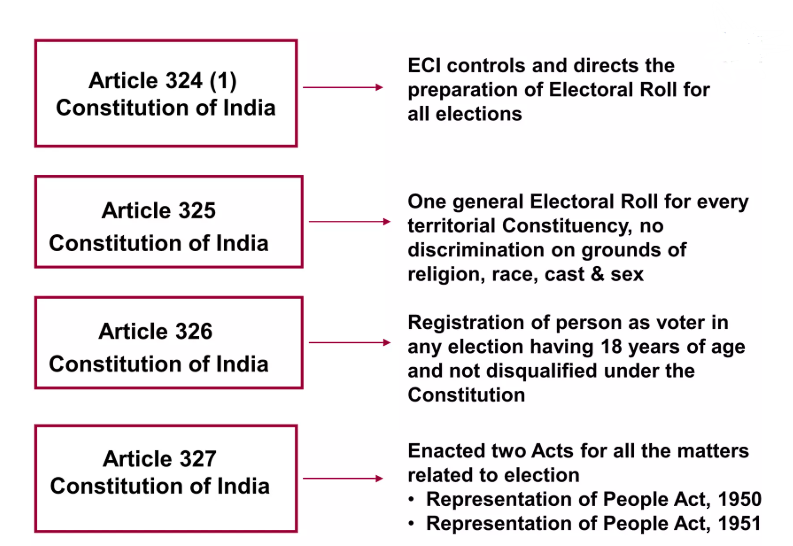
Constitutional and Legal Provisions of Electoral Roll
Conclusion
SIR is a crucial, constitutionally empowered exercise to purge electoral rolls of duplicates, ghost voters and suspected illegal entries while including eligible voters. Given Aadhaar’s early verification gaps and India’s high internal mobility, SIR must combine flexibility in acceptable proofs, robust tech-assisted verification, strong field capacity, legal clarity on citizenship checks, and extensive civic outreach. Only a balanced, phased, transparent SIR can strengthen democracy without disenfranchising the vulnerable.
UPSC PYQ
Q. Consider the following statements: (2021)
- In India, there is no law restricting the candidates from contesting in one Lok Sabha election from three constituencies.
- In the 1991 Lok Sabha Election, Shri Devi Lal contested from three Lok Sabha constituencies.
- As per the existing rules, if a candidate contests in one Lok Sabha election from many constituencies, his/her party should bear the cost of bye-elections to the constituencies vacated by him/her winning in all the constituencies.
Which of the statements given above is/are correct?
(a) 1 only
(b) 2 only
(c) 1 and 3
(d) 2 and 3
Ans: (b)
CARE MCQ
Q. Consider the following statements about Special Intensive Revision (SIR):
- SIR can be conducted in any state only after the Governor recommends it.
- SIR allows deletion of duplicate and bogus voters through house-to-house verification.
- SIR is legally backed by Section 21(3) of the RPA, 1950.
Which of the above statements is/are correct?
(a) 1 and 2 only
(b) 2 and 3 only
(c) 3 only
(d) 1, 2 and 3
Answer: (b) 2 and 3 only
Explanation:
Statement 1: “SIR can be conducted in any state only after the Governor recommends it.”: Incorrect
- The Governor has no role in recommending or approving a Special Intensive Revision (SIR).
- Under Section 21(3) of the Representation of the People Act, 1950, the Election Commission of India (ECI) alone has the power to order an SIR.
- The ECI exercises this power independently under Article 324 of the Constitution.
Statement 2: “SIR allows deletion of duplicate and bogus voters through house-to-house verification.”: Correct
- SIR involves intensive, door-to-door verification by Booth Level Officers (BLOs).
- This process identifies:
- Duplicate entries
- Bogus voters
- Deceased persons
- Illegal immigrants
- Voters who shifted constituency
- Hence, SIR is an essential tool for purifying electoral rolls.
Statement 3: “SIR is legally backed by Section 21(3) of the RPA, 1950.” Correct
- Section 21(3) empowers ECI to conduct a fresh, summary, or special revision “in such manner as it thinks fit.”
- This is the legal foundation for SIR.