New Solid Waste Management Rules Notified; To Come into Force from April 1, 2026
Table of Contents
Relevance:
GS Paper II (Governance): GS Paper III (Environment)
Important Keywords
For Prelims:
- Solid Waste Management Rules, 2026
- Four-Stream Waste Segregation
- Bulk Waste Generators (BWGs)
- Polluter Pays Principle
- Refuse-Derived Fuel (RDF)
For Mains:
- Circular Economy–Based Waste Governance
- Extended Bulk Waste Generator Responsibility (EBWGR)
- Decentralised Urban Environmental Governance
- Digital Monitoring & Regulatory Accountability
- Landfill Minimisation & Legacy Waste Remediation
Why in News?
The Union Ministry of Environment, Forest and Climate Change has notified the Solid Waste Management (SWM) Rules, 2026, which will come into force from 1 April 2026, replacing the SWM Rules, 2016. The new framework introduces four-stream waste segregation, extended responsibility for bulk waste generators, deterrence-based enforcement, digital monitoring, restrictions on landfilling, and mandatory energy recovery from high-calorific waste, signalling a decisive policy shift towards a circular economy–based waste governance model.
Rationale Behind the New Rules: India’s Waste Crisis
India faces a severe solid waste management challenge:
- Annual waste generation: over 620 lakh tonnes
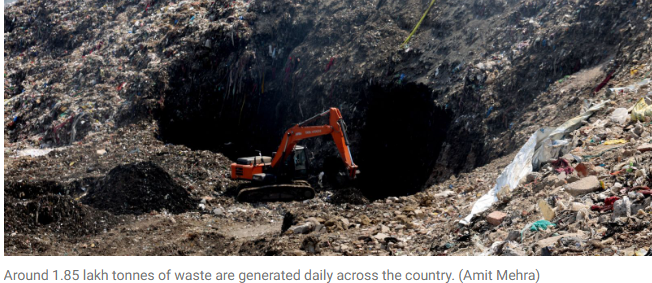
- Daily generation: ~1.85 lakh tonnes
- Daily processing: only 1.14 lakh tonnes
- Daily landfilling: nearly 40,000 tonnes
Despite the SWM Rules, 2016, poor segregation, weak accountability of bulk generators, and landfill dependence have resulted in garbage mountains, methane emissions, groundwater contamination, and public health risks. The 2026 Rules aim to correct these structural deficiencies by reducing landfill dependence, strengthening accountability, and treating waste as a resource.
Key Policy Shifts under SWM Rules, 2026
1. Waste Hierarchy and Four-Way Segregation
The 2026 Rules formally introduce a waste hierarchy prioritising:
Prevention → Reduction → Reuse → Recycling → Recovery → Disposal (last resort).
To operationalise this hierarchy, four-way segregation at source has been made mandatory:
- Wet waste: biodegradable household waste
- Dry waste: recyclable materials (plastic, paper, metal, glass)
- Sanitary waste: sanitary napkins, tampons, condoms
- Special-care waste: medicines, paint cans, bulbs, tube lights
Urban local bodies must provide enabling infrastructure such as green, blue and red bins, especially in public spaces, addressing a major implementation gap of the 2016 Rules.
2. Enhanced Responsibility of Bulk Waste Generators
A central governance reform is the introduction of Extended Bulk Waste Generator Responsibility (EBWGR).
Bulk waste generators—defined as entities with:
- Built-up area ≥ 20,000 sq m, or
- Water consumption ≥ 40,000 litres/day, or
- Waste generation ≥ 100 kg/day
These include residential societies, gated communities, malls, hotels, institutions, government establishments, and large townships.
New obligations include:
- Mandatory four-way segregation
- On-site wet waste processing (preferred)
- Registration on a centralised portal
- Certification-based compliance replacing self-declaration
- Annual waste accounting and reporting
Given that bulk generators account for nearly 30% of total solid waste, this reform reduces pressure on ULBs and promotes decentralised waste management.
3. Polluter Pays Principle and Deterrence-Based Regulation
Unlike the advisory nature of earlier rules, the 2026 framework operationalises the Polluter Pays Principle through:
- Environmental compensation for non-registration, false reporting, forged documents
- Higher landfill fees for unsegregated waste
- Financial disincentives for landfill use
The CPCB will frame guidelines, while SPCBs and local bodies will enforce penalties—marking a shift from voluntary compliance to regulatory deterrence.
4. Digitalisation and Centralised Monitoring
A centralised online portal will track the entire waste lifecycle:
- Generation
- Collection
- Transportation
- Processing
- Disposal
- Biomining and bioremediation of legacy dumpsites
Mandatory registration applies to ULBs, bulk generators, waste processors, transporters, waste pickers, railways, airports and SEZs. Online reporting and mandatory audits address data opacity and weak oversight under the 2016 regime.
Landfills: From Default Option to Last Resort
The 2026 Rules aim to end landfill dependency:
- Landfills restricted strictly to non-recyclable, non-energy-recoverable and inert waste
- Higher fees for unsegregated waste discourage dumping
Legacy Waste Remediation
- Mapping of all legacy dumpsites by 31 October 2026
- Time-bound biomining and bioremediation
- Quarterly progress reporting via the online portal
This directly targets India’s long-standing landfill mountains and land contamination issues.
Energy Recovery and Industrial Responsibility
Waste with calorific value ≥ 1,500 kcal/kg must be diverted for energy recovery through:
- Refuse-Derived Fuel (RDF)
- Co-processing in cement and thermal power plants
Industries are mandated to progressively replace fossil fuels with RDF:
- 6% initially
- 15% within six years
This links waste management with energy transition, climate mitigation, and circular economy goals.
Governance Significance and Federal Dimensions
The Rules redefine roles across governance levels:
- ULBs: frontline implementation and by-law framing
- SPCBs/CPCB: regulation, monitoring and enforcement
- District Collectors: landfill oversight
- Bulk generators: decentralised responsibility
Special provisions for hilly areas and islands, including tourist user fees and decentralised processing, reflect ecological sensitivity and environmental justice.
Implementation Challenges
- Capacity constraints of ULBs and SPCBs
- Behavioural resistance to segregation at source
- Financial stress in urban governance
- Integration of informal waste pickers into formal systems
Way Forward
- Strengthen ULB capacity and fiscal support
- Institutionalise Behaviour Change Communication (BCC)
- Formal inclusion of waste pickers
- Monetise waste through RDF markets and carbon credits
- Promote cooperative federalism in waste governance
Conclusion
The Solid Waste Management Rules, 2026 represent a paradigm shift from landfill-centric sanitation to accountability-driven environmental governance. By embedding circular economy principles, extended responsibility, digital oversight and economic deterrence, the rules aim to address India’s waste crisis at its roots. Their success, however, will ultimately depend on institutional capacity, citizen participation and effective inter-governmental coordination, making implementation—not intent—the true test of reform.
UPSC PYQ
Q. As per the Solid Waste Management Rules, 2016 in India, which one of the following statements is correct? IAS 2019
- Waste generator has to segregate waste into five categories.
- The Rules are applicable to notified urban local bodies, notified towns and all industrial townships only
- The Rules provide for exact and elaborate criteria for the identification of sites for landfills and waste processing facilities
- It is mandatory on the part of waste generator that the waste generated in one district cannot be moved to another district.
- Option (c) – Correct The Solid Waste Management Rules, 2016 lay down detailed and elaborate criteria for identification and notification of sites for solid waste processing, treatment and sanitary landfills. Authorities are required to ensure scientific site selection to minimise environmental and public health impacts.
- Option (a) – Incorrect The Rules mandate segregation of waste into three categories — wet, dry and domestic hazardous waste, not five categories.
- Option (b) – Incorrect
The Rules have wide applicability, covering:
- Municipal areas
- Census towns
- Notified industrial townships
- Areas under Railways, airports, ports, defence establishments
- SEZs, pilgrimage places, religious and historical sites Hence, they are not limited only to notified urban local bodies and industrial townships.
- Option (d) – Incorrect The Rules do not prohibit inter-district movement of waste. There is no mandatory restriction preventing waste generated in one district from being transported to another district for processing or disposal.
CARE MCQ
Q. With reference to the Solid Waste Management Rules, 2026, consider the following statements:
- The Rules mandate segregation of solid waste at source into wet, dry, sanitary and special care waste.
- Dry waste is required to be transported to Material Recovery Facilities (MRFs) for sorting and recycling.
Which of the statements given above is/are correct?
- 1 only
- 2 only
- Both 1 and 2
- Neither 1 nor 2
Answer: C
Explanation
- Statement 1 – Correct
The Solid Waste Management Rules, 2026 make four-stream segregation at source mandatory—wet, dry, sanitary and special care waste. - Statement 2 – Correct
Dry waste such as plastic, paper, metal and glass is to be transported to Material Recovery Facilities (MRFs) for sorting and recycling.