Why in News?
- Advances in Quantum Error Correction by companies such as Google, especially through the Willow processor, have renewed global attention on quantum computing.
- India’s National Quantum Mission, sanctioned in April 2023 with an allocation of over ₹6,000 crore, aims to make India a leading nation in quantum technologies by 2031.
- These developments may accelerate the shift from today’s error-prone Noisy Intermediate-Scale Quantum systems to fault-tolerant quantum computers.
- Quantum computing has potential applications in cryptography, climate modelling, materials science, logistics and molecular simulation.
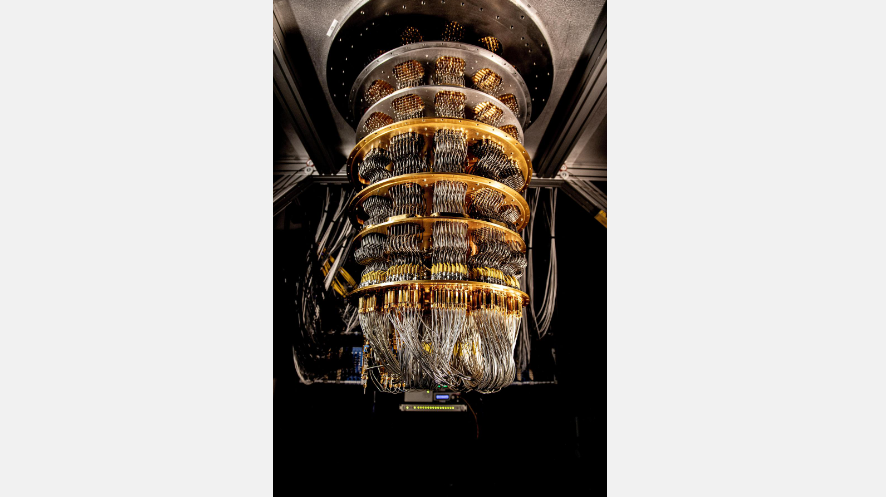
What is Quantum Computing?
- Quantum computing is an emerging field that uses the principles of quantum mechanics to solve certain complex problems beyond the capability of classical computers.
- Quantum mechanics deals with matter and light at atomic and subatomic scales, where particles do not behave according to normal classical rules.
- For selected problems, quantum computers may perform calculations in minutes or hours that could take conventional supercomputers thousands of years.
Classical Bit vs Qubit
| Feature | Classical Computer | Quantum Computer |
| Basic unit | Bit | Qubit |
| State | Either 0 or 1 | Can be 0, 1 and intermediate states |
| Working principle | Transistors switch ON/OFF | Quantum states are manipulated |
| Processing style | Mostly sequential | Can evaluate many possibilities simultaneously |
| Strength | Reliable, general-purpose computing | Powerful for selected complex problems |
- Classical computers use transistors to represent data as bits. A bit is either 0 or 1. Quantum computers use qubits, which can exist in multiple states at the same time due to superposition.
Core Principles of Quantum Computing
1. Superposition
A qubit can exist in a blend of multiple states at the same time. It is often compared to a spinning coin, which appears as both heads and tails until it is measured.
2. Entanglement
Qubits can become linked in such a way that the state of one qubit affects another, even when they are separated by distance.
3. Interference
Quantum computers manipulate quantum states so that wrong answers cancel out, while correct answers are amplified.
4. Massive Parallelism
Superposition and entanglement allow quantum computers to work like massively parallel machines. This helps in tasks such as sorting algorithms, search algorithms, optimisation and simulation.
Different Types of Qubits
| Type of Qubit | Description |
| Superconducting Qubits | Made using Josephson junctions, where two superconductors are separated by a thin barrier and cooled near absolute zero. Example: Google’s Willow processor |
| Quantum Dot Qubits | Fabricated using tiny semiconductor particles such as silicon, gallium arsenide or germanium |
| Trapped Ion Qubits | Created by trapping and manipulating individual charged atoms using electromagnetic fields |
| Photonic Qubits | Use particles of light, or photons, to carry quantum information |
| NMR Qubits | Use angular momentum of nuclei within molecules; used in the first quantum computer demonstration in 1998 |
- The 2025 Nobel Prize in Physics was awarded to John Clarke, Michel H. Devoret and John M. Martinis for the discovery of macroscopic quantum mechanical tunnelling and energy quantisation in an electric circuit, a breakthrough linked to superconducting circuits used in quantum technologies.
Noise Problem in Quantum Computing
- The biggest challenge in quantum computing is not merely building more qubits, but building stable and reliable qubits.
- Present quantum computers are called Noisy Intermediate-Scale Quantum systems because they are fragile and error-prone.
Decoherence
- Qubits are extremely sensitive. Any interaction with the environment, such as heat, light or electromagnetic interference, can make them lose their quantum state. This is called decoherence.
High Error Rates
- To prevent decoherence, quantum processors are cooled to temperatures near absolute zero, around -273°C.
| System | Error Rate |
| Current quantum processors | Around 1% to 0.1%, or one error in every 100 to 1,000 operations |
| Classical computers | Around one error in every quintillion operations |
Imperfect Control Systems
- Lasers and microwave pulses used to control qubits are not perfect. This adds further noise and produces calculation errors.
- Thus, the quantum computing age will become practical only when scientists can control noise, decoherence and errors.
Quantum Error Correction
- Quantum Error Correction is a method used to reduce errors in quantum computers.
- It forces several noisy physical qubits to work together as one more reliable logical qubit.
- However, simply adding more qubits is not enough. If all qubits are noisy, adding more of them can worsen the system. Scientists must first push individual qubit error rates below a certain threshold. After that, adding more qubits can reduce the overall error rate exponentially.
Google Willow Breakthrough
In 2024, Google’s Willow processor demonstrated that scaling up physical qubits could suppress the encoded error rate.
- The system moved from 3×3 to 5×5 to 7×7 lattices of physical qubits.
- Each increase reduced the encoded error rate by a factor of two.
- This marked an important step towards a fault-tolerant quantum computer.
Google expects useful quantum computing applications within the next few years, while IBM aims to develop a fault-tolerant quantum computer by 2029.
Quantum Key Distribution
Quantum Key Distribution is a highly secure method of sharing encryption keys using quantum particles such as photons.
It is important because:
- It helps two users share secret encryption keys securely.
- If a hacker tries to intercept the key, the quantum particles get disturbed.
- This disturbance alerts users to possible intrusion.
- It is based on principles such as the observer effect and no-cloning rule.
QKD can become important for future cybersecurity, defence communication, banking networks and strategic communication systems.
India’s National Quantum Mission
- National Quantum Mission is India’s flagship mission to develop quantum technologies in computing, communication, sensing and materials.
Objectives
- Develop intermediate-scale quantum computers.
- Build secure quantum communication systems.
- Promote Quantum Key Distribution (QKD).
- Develop advanced quantum sensors and atomic clocks.
- Create next-generation quantum materials and devices.
- Strengthen India’s capability in quantum-safe cybersecurity.
Major Targets
- Develop quantum computers with:
- 20–50 physical qubits in 3 years
- 50–100 physical qubits in 5 years
- 50–1000 physical qubits in 8 years
- Establish satellite-based quantum-secured communication over 2,000 km within India.
- Develop inter-city QKD network over 2,000 km.
- Build multi-node quantum networks using quantum memories, entanglement swapping and quantum repeaters.
Thematic Hubs
Four Thematic Hubs (T-Hubs) have been established in leading institutions:
- IISc Bengaluru
- IIT Madras with C-DOT, New Delhi
- IIT Bombay
- IIT Delhi
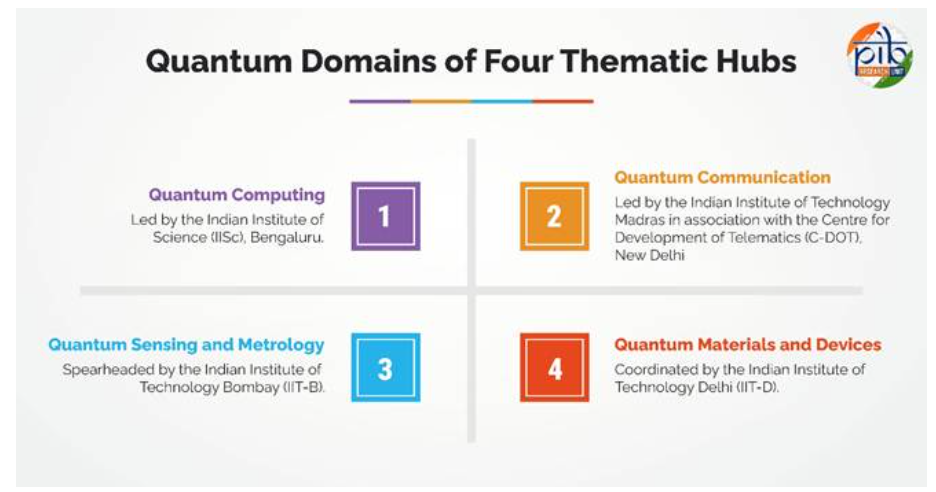
These hubs focus on:
- Quantum Computing
- Quantum Communication
- Quantum Sensing and Metrology
- Quantum Materials and Devices
Implementation Model
- NQM follows the Hub-Spoke-Spike model.
- Hubs: Central institutions for coordination.
- Spokes: Research projects.
- Spikes: Individual research groups.
- It involves 14 Technical Groups across 17 States and 2 Union Territories.
Key Initiatives
- Quantum-safe ecosystem framework for securing digital infrastructure.
- DRDO projects on quantum-resilient security schemes.
- SETS work on Post-Quantum Cryptography for FIDO authentication and IoT security.
- C-DOT development of QKD, PQC and quantum-secure video IP phones.
Top of Form
Bottom of Form
Applications of Quantum Computing
1. Cryptography and Cybersecurity
Quantum computers can challenge existing encryption systems, while quantum technologies like QKD can support secure communication.
2. Climate Modelling
Quantum computers may help model complex natural systems that overwhelm classical supercomputers.
3. Materials Science
They can help discover new materials, alloys, superconductors and energy-efficient technologies.
4. Molecular Simulation
Quantum computers can simulate molecules and chemical reactions, supporting drug discovery and advanced chemistry.
5. Logistics and Optimisation
They can improve supply chains, transport networks, scheduling and other optimisation-heavy systems.
Challenges
- High noise and error rates in quantum processors.
- Decoherence due to environmental interaction.
- Requirement of near absolute zero cooling.
- Complex and expensive hardware.
- Shortage of skilled quantum scientists and engineers.
- Commercially useful quantum advantage still remains limited.
- Future risks to existing cryptographic systems.
Way Forward
- Invest in Quantum Error Correction and logical qubits.
- Strengthen the National Quantum Mission through academia-industry collaboration.
- Build indigenous quantum hardware, software and materials ecosystems.
- Expand QKD networks for secure strategic communication.
- Promote quantum-safe cryptography.
- Support deep-tech startups through patient capital and innovation financing.
- Avoid hype and focus on practical, measurable progress.
Conclusion
Quantum computing is one of the most important frontiers of modern science. Its power comes from superposition, entanglement, interference and massive parallelism, but its practical use is limited by noise, decoherence and errors. Advances in Quantum Error Correction are bringing the world closer to fault-tolerant quantum computers. For India, the National Quantum Mission offers a strategic opportunity to build deep-tech self-reliance, strengthen cybersecurity, support advanced research and contribute to Viksit Bharat 2047.