Table of Contents
Relevance: UPSC GS Paper II: International relations, regional groupings, India and Indo-Pacific
For Prelims:
- Quad, Quadrilateral Security Dialogue, Indo-Pacific, Malabar Exercise, Maritime Domain Awareness, Quad Ports of the Future Partnership, Critical Minerals Framework, Pax Silica, Rare Earth Elements
For Mains:
- Free and open Indo-Pacific, maritime security, supply chain resilience, China factor, critical minerals security, minilateral diplomacy, strategic autonomy, rules-based order
Why in News?
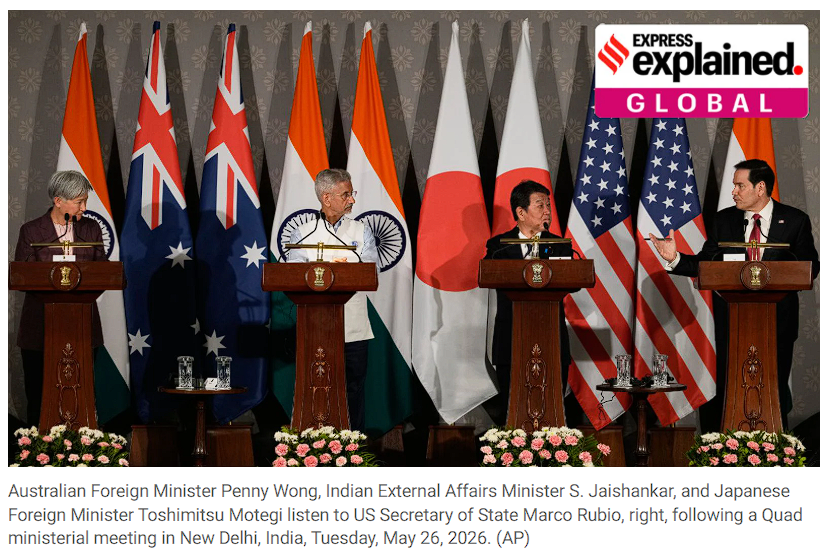
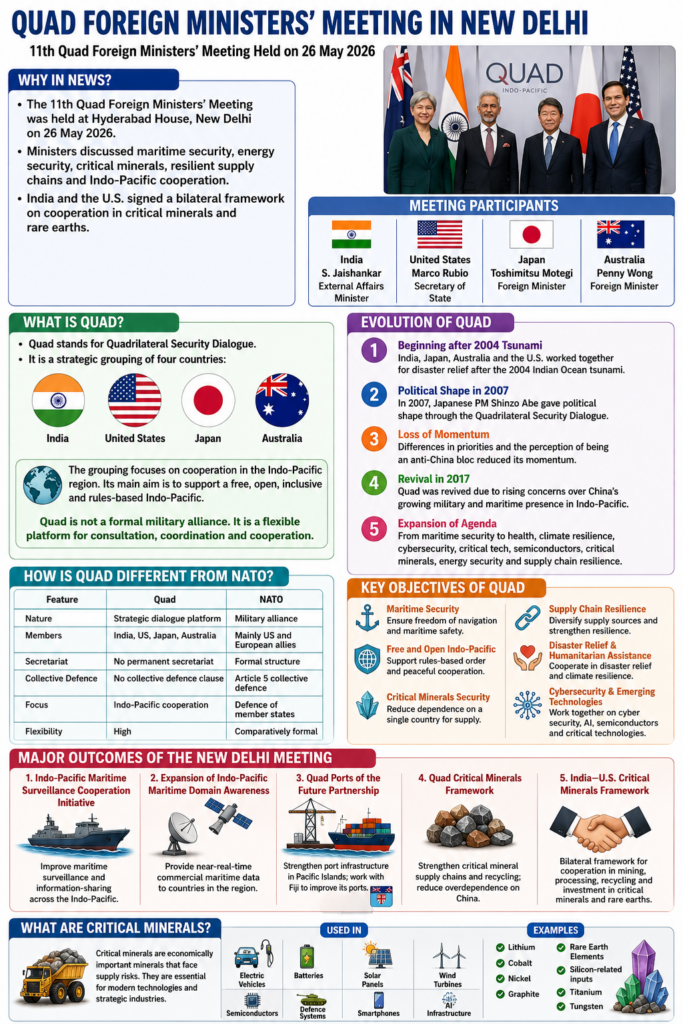
The 11th Quad Foreign Ministers’ Meeting was held at Hyderabad House, New Delhi on 26 May 2026.
The meeting was hosted by India’s External Affairs Minister S. Jaishankar. It was attended by:
- India: S. Jaishankar
- United States: Marco Rubio
- Japan: Toshimitsu Motegi
- Australia: Penny Wong
The ministers discussed maritime security, energy security, critical minerals, resilient supply chains and Indo-Pacific cooperation.
On the sidelines of the meeting, India and the United States signed a bilateral framework on cooperation in critical minerals and rare earths.
What is Quad?
Quad stands for Quadrilateral Security Dialogue.
It is a strategic grouping of four countries:
- India
- United States
- Japan
- Australia
The grouping focuses on cooperation in the Indo-Pacific region. Its main aim is to support a free, open, inclusive and rules-based Indo-Pacific.
Quad is not a formal military alliance. It is a flexible platform for consultation, coordination and cooperation.
Evolution of Quad
1. Beginning after 2004 Tsunami
- After the Indian Ocean tsunami of December 2004, India, Japan, Australia and the United States worked together to coordinate disaster relief operations.
- This created the foundation for future cooperation among the four countries.
2. Political Shape in 2007
- In 2007, Japanese Prime Minister Shinzo Abe gave political shape to the grouping through the Quadrilateral Security Dialogue.
3. Loss of Momentum
- The grouping later lost momentum due to differences in strategic priorities and concerns that it was being seen as an anti-China bloc.
4. Revival in 2017
- In 2017, Quad was revived due to rising concerns over China’s growing military and maritime presence in the Indo-Pacific.
5. Expansion of Agenda
Initially, Quad focused mainly on maritime security. Later, its agenda expanded to areas such as:
- Health security
- Climate resilience
- Cybersecurity
- Critical technologies
- Semiconductors
- Critical minerals
- Energy security
- Supply chain resilience
How Quad is Different from NATO
Quad is different from traditional military alliances like NATO.
| Feature | Quad | NATO |
| Nature | Strategic dialogue platform | Military alliance |
| Members | India, US, Japan, Australia | Mainly US and European allies |
| Secretariat | No permanent secretariat | Formal structure |
| Collective Defence | No collective defence clause | Article 5 collective defence |
| Focus | Indo-Pacific cooperation | Defence of member states |
| Flexibility | High | Comparatively formal |
Quad works through dialogue, coordination, joint exercises and issue-based cooperation, not through binding military commitments.
Key Objectives of Quad
1. Maritime Security
Quad aims to ensure freedom of navigation and maritime safety in the Indo-Pacific. This is important because the region has major sea routes for trade and energy supplies.
2. Free and Open Indo-Pacific
The grouping supports a rules-based order where countries can trade, move and cooperate freely without coercion.
3. Critical Minerals Security
Critical minerals are essential for electric vehicles, semiconductors, batteries, defence equipment and clean energy technologies.
Quad aims to reduce dependence on a single country for critical mineral supply chains.
4. Supply Chain Resilience
The Covid-19 pandemic and geopolitical tensions exposed the risks of overdependence on limited supply chains. Quad countries are working to diversify supply sources.
5. Disaster Relief and Humanitarian Assistance
Quad members have experience in disaster relief cooperation. This remains important for the Indo-Pacific, which is vulnerable to cyclones, tsunamis and climate-related disasters.
6. Cybersecurity and Emerging Technologies
Quad also promotes cooperation in cybersecurity, artificial intelligence, semiconductors and critical technologies.
Major Outcomes of the New Delhi Meeting
1. Indo-Pacific Maritime Surveillance Cooperation Initiative
- This initiative aims to improve maritime surveillance and information-sharing across the Indo-Pacific.
- It will help countries monitor illegal fishing, maritime threats, suspicious vessel movement and security risks.
2. Expansion of Indo-Pacific Maritime Domain Awareness
- The Indo-Pacific Maritime Domain Awareness initiative will be expanded to provide near-real-time commercial maritime data to countries in the region.
- This can help smaller countries improve maritime security without having advanced surveillance systems of their own.
3. Quad Ports of the Future Partnership
- The Quad announced the Ports of the Future Partnership to strengthen port infrastructure in the Pacific Islands.
- Under this initiative, the Quad will work with Fiji to improve its port infrastructure.
- This is strategically important because Pacific Island countries are becoming important in Indo-Pacific geopolitics.
4. Quad Critical Minerals Framework
- The Quad countries announced a Critical Minerals Framework to strengthen critical mineral supply chains and recycling.
- The framework aims to reduce supply chain risks caused by overdependence on China, which dominates the global processing capacity of many critical minerals.
5. India-US Critical Minerals Framework
- India and the United States signed a bilateral framework for cooperation in the mining, processing, recycling and investment related to critical minerals and rare earths.
- This agreement is important because critical minerals are essential for clean energy, defence, electronics and advanced technologies.
What are Critical Minerals?
Critical minerals are minerals that are economically important but face supply risks.
They are needed for:
- Electric vehicles
- Batteries
- Solar panels
- Wind turbines
- Semiconductors
- Defence systems
- Smartphones
- Artificial intelligence infrastructure
Examples include:
- Lithium
- Cobalt
- Nickel
- Graphite
- Rare Earth Elements
- Silicon-related inputs
- Titanium
- Tungsten
Significance for India
1. Strengthens India’s Indo-Pacific Role
- The meeting shows India’s growing role as a key power in the Indo-Pacific region.
2. Supports Maritime Security
- India has major interests in the Indian Ocean Region. Quad cooperation can help improve maritime surveillance, shipping security and freedom of navigation.
3. Reduces Critical Mineral Dependence
- India needs critical minerals for electric mobility, renewable energy, electronics and defence manufacturing. Quad cooperation can help diversify supply chains.
4. Supports India’s Manufacturing Goals
- Stable mineral supply chains are important for Make in India, semiconductor manufacturing, battery production and clean energy transition.
5. Balances China’s Influence
- Although Quad does not officially call itself an anti-China grouping, its focus on maritime security, critical minerals and Pacific infrastructure is linked to concerns over China’s growing influence.
6. Strengthens Strategic Partnerships
- The meeting deepens India’s cooperation with the US, Japan and Australia without joining a formal military alliance.
- This supports India’s policy of strategic autonomy with issue-based alignment.
Challenges
1. Different National Priorities
- All four Quad members have different strategic and economic interests. This can slow decision-making.
2. Economic Ties with China
- Quad members continue to have economic relations with China. This creates a balancing challenge.
3. No Formal Institutional Structure
- Quad does not have a permanent secretariat or binding mechanism. This gives flexibility but may reduce implementation capacity.
4. Perception of Anti-China Bloc
- China views Quad with suspicion and argues that cooperation between countries should not target any third party.
5. Implementation Gap
- Announcements on infrastructure, supply chains and technology must be converted into actual projects.
6. Resource Mobilisation
- Critical minerals and port infrastructure projects require large investments, technology and long-term coordination.
Way Forward
- Quad should continue to focus on practical cooperation rather than becoming a formal military alliance.
- It should strengthen maritime domain awareness, disaster relief, cyber security and resilient supply chains.
- India should use Quad cooperation to secure critical minerals, improve maritime capacity and support domestic manufacturing.
- Quad must also work with ASEAN, Pacific Island countries and Indian Ocean countries to avoid the perception of exclusion.
- A balanced approach is needed where Quad supports a rules-based Indo-Pacific while respecting India’s strategic autonomy.
Conclusion
The 11th Quad Foreign Ministers’ Meeting in New Delhi reflects the growing importance of the Indo-Pacific in global politics. The focus on maritime security, critical minerals, port infrastructure and supply chain resilience shows that Quad is moving beyond security dialogue towards practical strategic cooperation.
For India, Quad provides an important platform to strengthen its maritime role, secure critical resources and deepen partnerships with major democracies while maintaining strategic autonomy.
UPSC PYQ
Q. Which of the following statements about Quad is/are correct? (CAPF 2023)
- It is a group of four countries, namely, India, Australia, USA and France.
- Maritime cooperation is an important binding force among members of the Quad.
- The Quad members formed a working group on COVID-19 vaccines.
Options
A. 1 only
B. 1 and 2 only
C. 2 and 3 only
D. 1, 2 and 3
Answer: C
Explanation
Statement 1 is incorrect:
- The Quad, or Quadrilateral Security Dialogue, consists of India, Australia, Japan and the United States. France is not a member of Quad.
Statement 2 is correct:
- Maritime cooperation is one of the most important areas of Quad cooperation. The Quad focuses on a free, open and rules-based Indo-Pacific, maritime security, freedom of navigation and maritime domain awareness.
Statement 3 is correct:
- The Quad members formed a working group on COVID-19 vaccines. This was part of the Quad Vaccine Partnership, which aimed to improve vaccine production and distribution, especially in the Indo-Pacific region.
CARE MCQ
Q. With reference to the Quad, consider the following statements:
- Quad consists of India, the United States, Japan and Australia.
- Quad was first shaped politically by Japanese Prime Minister Shinzo Abe in 2007.
- Quad has a collective defence clause similar to NATO.
Which of the statements given above are correct?
A. 1 and 2 only
B. 2 and 3 only
C. 1 and 3 only
D. 1, 2 and 3
Answer: A
Explanation:
- Statement 1 is correct: Quad includes India, the US, Japan and Australia.
- Statement 2 is correct: Shinzo Abe gave political shape to the Quad in 2007.
- Statement 3 is incorrect: Quad does not have a collective defence clause like NATO.
Additional Information:
Quad is a flexible strategic grouping. It has no permanent secretariat or binding military commitment.
Q. Consider the following initiatives announced or discussed in the context of the Quad Foreign Ministers’ Meeting:
- Quad Ports of the Future Partnership
- Quad Critical Minerals Framework
- Indo-Pacific Maritime Domain Awareness Initiative
- Article 5 Collective Defence Mechanism
Which of the above are associated with Quad cooperation?
A. 1, 2 and 3 only
B. 1 and 4 only
C. 2, 3 and 4 only
D. 1, 2, 3 and 4
Answer: A
Explanation:
- Items 1, 2 and 3 are correct: These are linked with Quad cooperation in port infrastructure, critical minerals and maritime domain awareness.
- Item 4 is incorrect: Article 5 collective defence is associated with NATO, not Quad.
Additional Information:
Quad is not a military alliance. It focuses on coordination in areas such as maritime security, technology, critical minerals and supply chains.
FAQs
1. What is Quad?
Quad is a strategic grouping of India, the United States, Japan and Australia.
2. Is Quad a military alliance?
No. Quad is not a military alliance like NATO. It has no collective defence clause.
3. Why is Quad important?
It is important for maritime security, Indo-Pacific cooperation, critical minerals, supply chain resilience and strategic coordination.
4. What was discussed in the New Delhi meeting?
The meeting discussed maritime security, energy security, critical minerals, port infrastructure and Indo-Pacific cooperation.
5. What is the Quad Critical Minerals Framework?
It is a framework to strengthen critical mineral supply chains, recycling and cooperation among Quad countries.