Proposal to Increase Lok Sabha Strength by 50%: Concerns Over Regional Imbalance
Table of Contents
Relevance: GS Paper II – Polity (Parliament, Representation, Delimitation, Federalism, Electoral Reforms)
For Prelims:
- Lok Sabha, Delimitation, Census, Article 81, Delimitation Commission, Freeze on Delimitation, 42nd Amendment, 84th Amendment, 87th Amendment, Nari Shakti Vandan Act
For Mains:
- Federalism, Regional Imbalance, Political Representation, Population vs Representation Debate, Electoral Reforms, Centre-State Relations
Why in News?
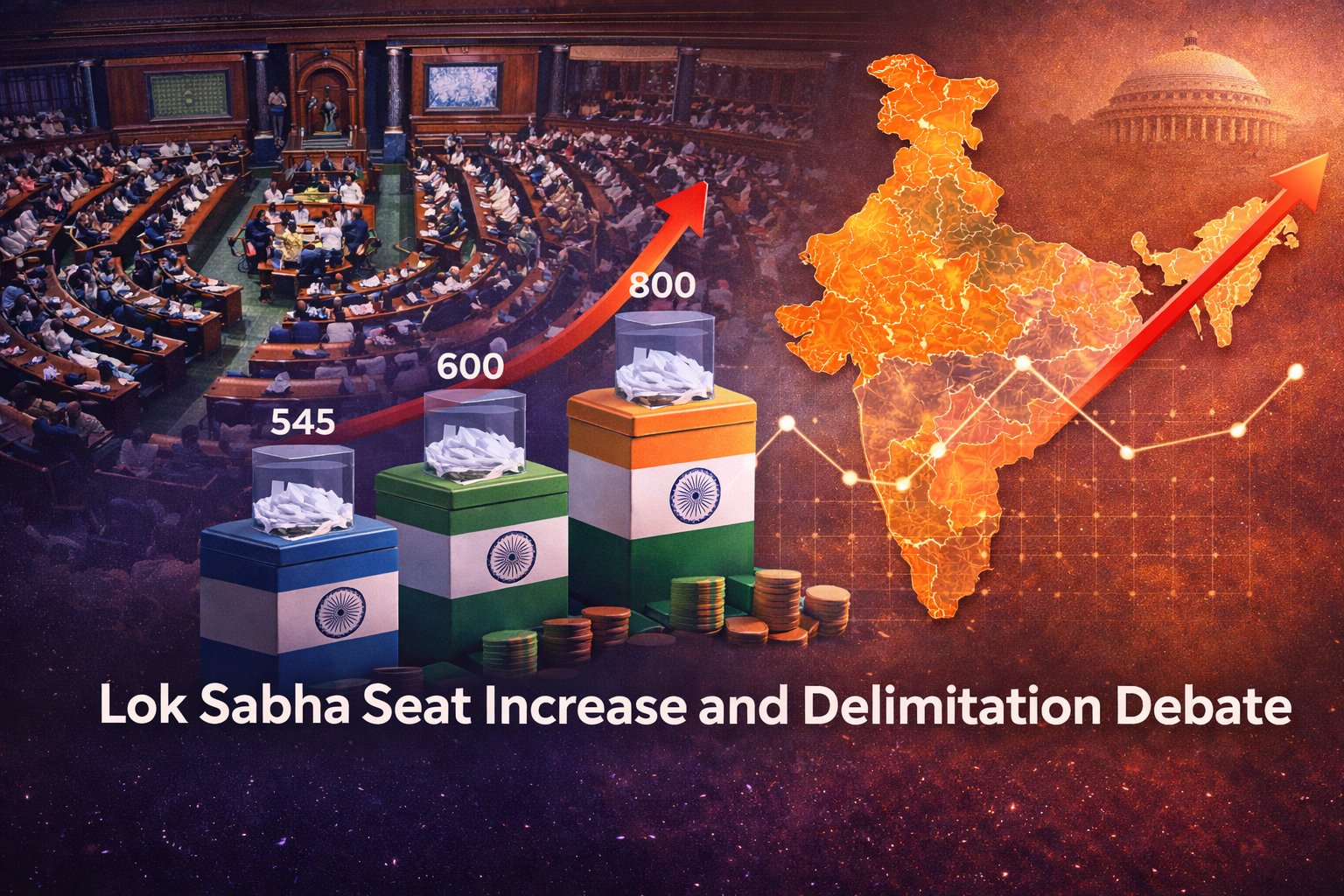
Concerns have been raised by leaders including A. Revanth Reddy over a reported proposal to increase the strength of the Lok Sabha by 50%, which may impact regional representation.
Background and Constitutional Context
- The composition of Lok Sabha is governed by Article 81, which provides for representation of states based on population.
- Delimitation ensures periodic adjustment of constituencies based on census data.
- However, to promote population control, delimitation has been frozen until after the first Census post-2026, creating a major constitutional and political debate.
Key Highlights of the Proposal
- Proposal to increase Lok Sabha seats by 50%
- Proportionate increase in seats across states
- Larger states likely to gain more seats in absolute terms
- No official confirmation yet (based on political claims)
- Linked indirectly with future delimitation exercise

Delimitation & Census
| Aspect | Details |
| Delimitation Meaning | Process of redrawing boundaries of constituencies and allocation of seats based on population |
| Constitutional Basis | Articles 81, 82 (Lok Sabha), Article 170 (State Assemblies) |
| Authority | Delimitation Commission of India |
| Nature of Commission | Independent, quasi-judicial body; orders have force of law and cannot be challenged in court |
| Composition | Retired Supreme Court judge (Chairperson), Chief Election Commissioner, State Election Commissioners |
| Frequency | After every Census (ideally every 10 years) |
| Past Delimitation Exercises | 1952, 1963, 1973, 2002 (based on 2001 Census) |
| Current Status | Frozen until after Census post-2026 |
| Freeze Reason | To avoid penalising states that controlled population growth |
| 42nd Amendment (1976) | Froze delimitation until 2001 |
| 84th Amendment (2001) | Extended freeze till 2026 |
| 87th Amendment (2003) | Allowed readjustment using 2001 Census without altering seat numbers |
| Next Delimitation | Expected after Census conducted post-2026 |
| Census Meaning | Official population count conducted every 10 years |
| Census Authority | Conducted under Census Act, 1948 |
| Last Census | 2011 (2021 Census delayed) |
| Link with Representation | Determines seat allocation in Lok Sabha and State Assemblies |
| Key Debate | Population-based representation vs federal fairness |
| Impact on South vs North | Northern states gain more seats due to higher population growth |
| Relation with Women Reservation | Constitution (106th Amendment) Act, 2023 linked to delimitation |
| Major Concern | Penalising states that achieved population control |
Concerns Raised by States
- Regional imbalance: Northern states may gain significantly more seats
- Reduced influence of southern states
- Population control paradox: Better-performing states may lose political weight
- Federal tensions: Perception of unequal representation
Significance
- Enhances representative democracy
- Addresses need for increased parliamentary capacity
- Reflects changing population dynamics
- Opens debate on equity vs equality in representation
Issues and Challenges
- Risk of political imbalance
- Between other states and regions
- Delay in census data availability
- Complex delimitation exercise post-2026
- Potential politicisation of representation reforms
Way Forward
- Conduct timely Census and delimitation
- Ensure consultative approach with states
- Maintain balance between population principle and federal fairness
- Explore institutional safeguards to prevent regional dominance
Conclusion
The debate over increasing Lok Sabha seats highlights deeper structural questions about representation, federalism, and demographic change. The upcoming delimitation exercise will be crucial in shaping India’s political future.
CARE MCQ
Q. With reference to delimitation in India, consider the following statements:
- Delimitation Commission orders cannot be challenged in any court.
- Delimitation has been frozen until after the Census post-2026.
- Delimitation is carried out by the Election Commission of India.
Which of the above statements are correct?
A. 1 and 2 only
B. 2 and 3 only
C. 1 and 3 only
D. 1, 2 and 3
Answer: A
Explanation
Statement 1 is correct: Orders of Delimitation Commission have legal force and are not subject to judicial review.
Statement 2 is correct: Freeze continues till after Census post-2026.
Statement 3 is incorrect: Delimitation is conducted by a separate Delimitation Commission, not the Election Commission.
Q. Consider the following statements regarding the functions of the Election Commission of India:
- It determines the territorial extent of electoral constituencies in accordance with the Delimitation Commission Act.
- It prepares and periodically updates electoral rolls to ensure inclusion of all eligible voters.
- It has the power to disqualify Members of Parliament on grounds of defection under the Tenth Schedule of the Constitution.
How many of the statements given above are correct?
(a) Only one
(b) Only two
(c) All three
(d) None
Answer: (a)
Explanation:
Statement 1 is incorrect: The delimitation of constituencies, including determination of their territorial boundaries, is carried out by the Delimitation Commission, which is an independent statutory body constituted under the Delimitation Commission Act. The Election Commission of India (ECI) does not perform this function; it only implements elections based on the constituencies so delimited.
Statement 2 is correct: One of the core constitutional functions of the Election Commission of India under Article 324 is the preparation, revision, and maintenance of electoral rolls. This ensures universal adult suffrage by including all eligible citizens and removing ineligible entries.
Statement 3 is incorrect: The power to decide on disqualification of Members of Parliament or State Legislatures on grounds of defection under the Tenth Schedule lies with the Speaker of the Lok Sabha or the Chairman of the Rajya Sabha (or State Legislatures, as applicable). The Election Commission has no direct role in such decisions, although it may advise the President or Governor in certain disqualification matters under Articles 102 and 191 (not related to defection).
MAINS QUESTION :
Q. Examine the implications of the upcoming delimitation exercise on India’s federal structure and political representation.
Word Limit: 250 words