PMO Declares Questions on PM CARES and Other Funds Not Admissible in Lok Sabha
Table of Contents
Relevance:
GS Paper II – Polity & Governance (Parliamentary Procedures, Accountability, Transparency)
Important Keywords
For Prelims:
- PM CARES Fund, Prime Minister’s National Relief Fund (PMNRF), National Defence Fund (NDF), Rule 41 of Lok Sabha, Consolidated Fund of India, Public Charitable Trust, Article 12 (Definition of State), RTI Act.
For Mains:
- Transparency vs executive discretion, Parliamentary oversight and accountability, Status of public charitable trusts linked to government, Ethical governance and public fund management.
Why in News?
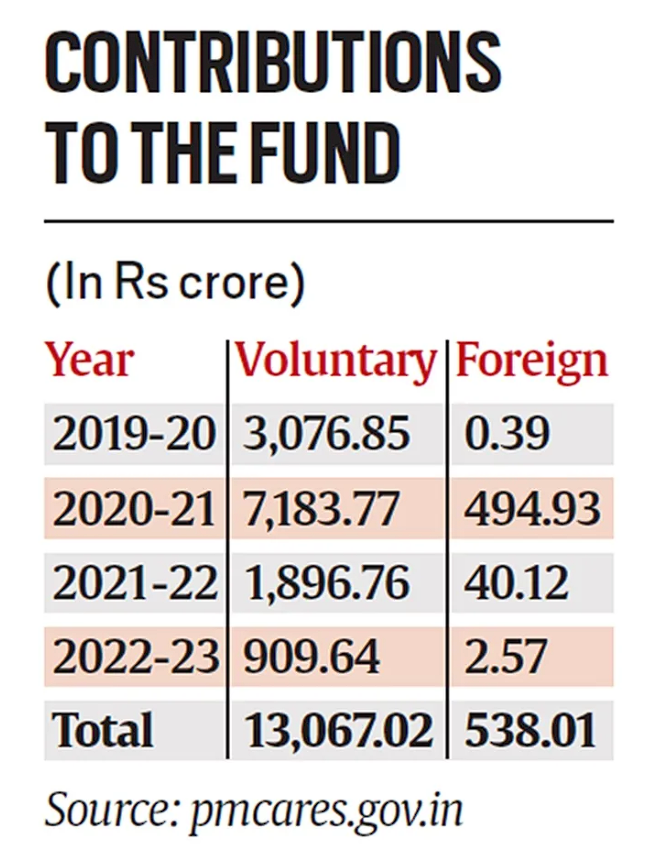
The Prime Minister’s Office (PMO) informed the Lok Sabha Secretariat that questions regarding PM CARES Fund, PMNRF, and the National Defence Fund are not admissible under parliamentary rules, as these funds are based on voluntary contributions and are not financed through the Consolidated Fund of India.
About the Three Funds
PM CARES Fund
- Established: March 27, 2020, during the COVID-19 pandemic.
- Nature: Public charitable trust.
- Objective: Provide relief during emergencies and distress situations.
- Balance (2022–23): Approximately ₹6,283.7 crore.
Prime Minister’s National Relief Fund (PMNRF)
- Established: 1948 to assist displaced persons after Partition.
- Current Use: Relief for victims of natural disasters, accidents, and riots.
National Defence Fund (NDF)
- Purpose: Welfare of armed forces personnel and dependents.
- Administered by an executive committee chaired by the Prime Minister.
Rules Cited by PMO
The PMO invoked Rule 41(2) of the Rules of Procedure and Conduct of Business in Lok Sabha:
- Rule 41(2)(viii): Questions cannot relate to matters not primarily the concern of the Government of India.
- Rule 41(2)(xvii): Questions cannot address bodies not primarily accountable to the Government.
Since these funds rely entirely on voluntary donations and are not funded by government revenue, they fall outside routine parliamentary scrutiny.
Government’s Legal Position
- PM CARES is not constituted under the Constitution or any statute.
- It is neither owned nor controlled by the government.
- Therefore, it is not a “public authority” under the RTI Act.
Supreme Court’s View (2020)
- Refused to transfer PM CARES funds to the National Disaster Response Fund (NDRF).
- Held that both funds serve distinct purposes.
- Noted that CAG audit applies to NDRF, while PM CARES, being a charitable trust, does not require such audit.
Key Constitutional and Governance Issues
- Raises debate on parliamentary accountability.
- Tests the boundary between public institutions and private trusts linked to public office.
- Connects to Article 12 discussions on whether such entities qualify as “State.”
Significance
- Clarifies procedural limits of parliamentary questioning.
- Reinforces the legal distinction between government funds and charitable trusts.
- Highlights evolving governance mechanisms during emergencies.
Concerns
- Reduced legislative scrutiny may affect perceptions of transparency.
- Public donations create expectations of accountability.
- Ambiguity over institutional status can trigger legal debates.
Way Forward
- Consider voluntary disclosure standards for high-profile public trusts.
- Strengthen audit transparency without compromising legal structure.
- Clarify regulatory frameworks for quasi-public funds.
- Enhance communication to maintain public trust.
CARE MCQ
Q. Consider the following statements regarding the NDMA’s Disaster Victim Identification (DVI) Guidelines:
- PM CARES Fund is financed through the Consolidated Fund of India.
- Rule 41 of Lok Sabha restricts questions on matters not primarily the concern of the Government of India.
- The Supreme Court mandated CAG audit of PM CARES Fund.
Which of the statements given above is/are correct?
A. 2 only
B. 1 and 3 only
C. 2 and 3 only
D. 1, 2 and 3
Answer: A
Explanation:
- Statement 1 – Incorrect: PM CARES relies on voluntary contributions.
- Statement 2 – Correct: Rule 41 limits admissibility of such questions.
- Statement 3 – Incorrect: CAG audit applies to NDRF, not PM CARES.